
Saperavi is an ancient Georgian grape variety used to produce premium dry, semi-dry, and sparkling wines. Professional winemakers prize this grape for its balanced combination of sweetness and acidity.
Origin
Saperavi originated in southwestern Georgia—Zemo Kartli, or Meskheti. From there, this unique grape spread to Kartli and then to Kakheti, which became its second home. The Saperavi variety was added to the State Register in 1959.
The exact origin of the Saperavi grape is unknown. This variety exhibits mutations typical of ancient varieties, which affect the crop's appearance, fruiting, and agronomic characteristics.
The existence of numerous Saperavi clones is proof that this variety has been used in winemaking for a very long time. The most famous Saperavi clones are Saperavi Pachkha and Budeshuri Seburi. Breeders often use Saperavi to develop new wine varieties. The most famous of these are Saperavi Severny, Rubinovy Magaracha, and Tigrani.
Description of Saperavi grapes
Saperavi is a wine grape with all the morphological characteristics and biological properties typical of the Black Sea Basin group of varieties. Other names for the Saperavi variety include Krasilshchik, Kleinbeeriger, and Didi Saperavi.
- ✓ Saperavi leaves have dense, cobwebby pubescence, which is rare in other varieties.
- ✓ Autumn leaf coloration includes yellow tones with wine-red mottling, which is a unique characteristic.
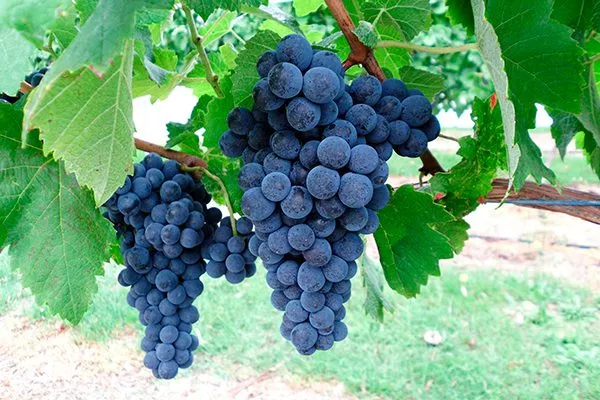
Brief botanical description:
- Bushes - medium-sized, spreading.
- Roots - powerful, branched.
- Leaves — light green, slightly dissected. 3 or 5 lobed. They have raised edges and dense, web-like pubescence. The shape is round or ovoid. In autumn, the color turns yellow with wine-red spots.
- Flowers - bisexual, collected in panicle inflorescences.
- Clusters — loose, broadly conical in shape. Average weight: 93–99 g. Length: 13–17 cm. Width: 12–15 cm. Stem length: 4.5 cm.
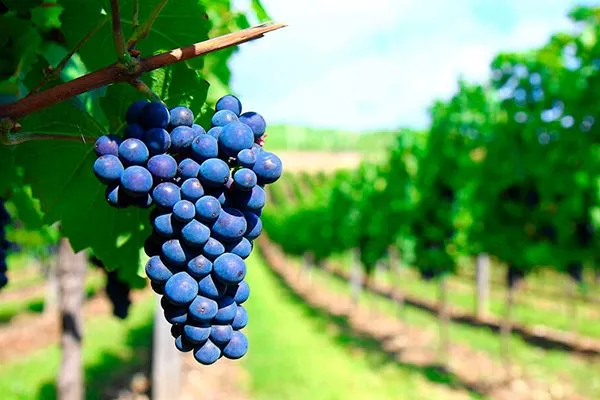
- Berries — dark blue, with a thick waxy coating. The fruit is oval. The average weight of one berry is 1.2-1.5 g. Dimensions are 13-18 x 12-17 mm. The pulp contains 2-3 seeds. The pulp is juicy and slimy. The skin is thin and strong, easily peeled.
The variety is quite hardy and unpretentious; it can withstand periods of drought and winter frosts down to -20 °C.
Taste and yield
The ripe grapes have a very pleasant, refreshing taste. The variety's main characteristic is the pigment in the berries. This gives the juice pressed from Saperavi grapes a light pink color.
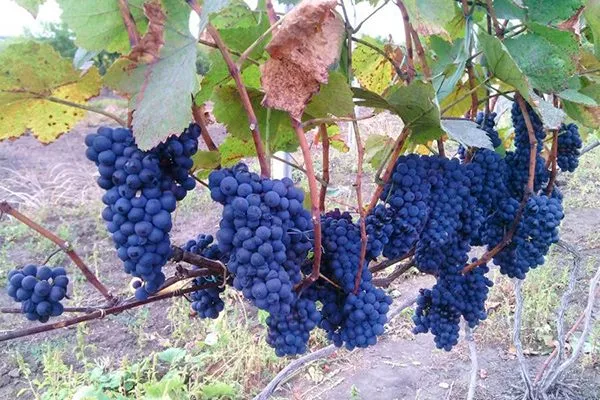
Fruiting begins in the fourth year after planting. Saperavi grapes can grow and bear fruit in the same location for up to a quarter of a century. The average yield is 90-110 centners per hectare. The percentage of fruit-bearing shoots is 66%.
Technical characteristics of fruits:
- sugar accumulation - 18-25%;
- acids - 8-12 g/l;
- excellent juice yield - 85%;
- Energy value: 62 kcal.
Ripening time
This variety is late-ripening, with ripening lasting 150-160 days. The sum of active temperatures should be at least 3000°C. Harvesting takes place no earlier than the third ten days of September or early October.
Geographic distribution
Saperavi is native to the Black Sea basin. It is also grown in the Lower Volga and North Caucasus regions. In Georgia, this variety is grown primarily in Kakheti.
In Russia, the Saperavi variety is cultivated:
- in Kuban and Stavropol Krai;
- in Dagestan.
Saperavi grapes are also grown in Moldova, Bulgaria, Armenia, and Ukraine.
Pros and cons
The long history of the Saperavi grape confirms the uniqueness of this remarkable variety. It is so good for winemaking that producers forgive its existing shortcomings.
Benefits and harms
Saperavi grapes are rich in antioxidants and sugars, contain iron, and promote blood oxygenation. They are also rich in vitamin E and potassium, which has a beneficial effect on the cardiovascular system.
Saperavi grapes contain a lot of tannins, which, according to scientists, slow down oxidative processes in the human body, that is, slow down its aging.
Consumption of Saperavi berries is recommended for the following pathologies:
- high blood pressure;
- infectious diseases;
- dyspnea;
- heart muscle diseases;
- gastritis;
- rheumatism;
- lung diseases;
- anemia;
- loss of strength;
- insomnia.
Grapes should be consumed with caution by those with obesity, diabetes, gastrointestinal disorders, or high stomach acidity. People with dental caries, stomatitis, or other oral conditions should consult a dentist before eating grapes.
Landing features
The success of growing Saperavi grapes, the quantity and quality of its harvest, largely depends on how correctly the planting is carried out.
- ✓ Avoid soils with a pH above 7.5, as Saperavi does not tolerate alkaline conditions well.
- ✓ Check the soil drainage capacity before planting: water should drain to a depth of at least 1 meter within 24 hours.
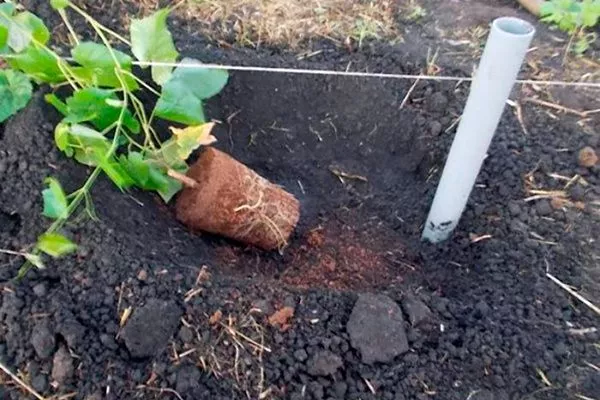
Features of planting the Saperavi variety:
- Plot. It is recommended to plant grapes on a south-facing site. The site should be protected from the wind, and an artificial or natural barrier is required on the north side. Good air circulation is essential, but drafts should be avoided.
Saperavi requires maximum light, as it ripens late. Avoid areas with high groundwater levels, rocky outcrops, or stagnant water. - Priming. Saperavi isn't particularly picky about soil quality. It grows in virtually any location. It doesn't tolerate chalky, saline, or very waterlogged soils. This variety also doesn't thrive in quickly drying sandy, heavy clay, acidic, or excessively water-intensive soils. It produces well in loose, well-drained soils, preferring loams, chernozems, or sandy loams.
- Preparing the site. The planting hole should be about 1 meter in diameter, as Saperavi has highly branched roots. If the soil is clayey, add drainage to the bottom; if the soil is loose, simply add coarse sand. Fill the hole with a mixture of 20-30 liters of organic matter mixed with superphosphate (300 g), potassium salt (100 g), and ammonium nitrate (30-40 g).
The prepared holes are watered and left to soak. For fall planting, they are prepared a month before planting, and for spring planting, in the fall, 3-4 months before planting. - Planting dates. In the south, planting takes place in October. The optimal period occurs when nighttime temperatures do not drop below 5°C. In areas with colder winters, planting takes place in the spring. Here, planting begins in the second ten days of April.
- Preparing seedlings. Their optimal age is two years. Before planting, bare-root seedlings are soaked in water for several days.
- The landing process. A hole is dug 50% of its size. The remaining soil is collected into a mound, and the seedling is placed on it. The root collar should be 8-10 cm below the edge of the hole. The roots are covered with soil, compacted, and then watered thoroughly.
In areas of conditionally sheltered viticulture, it is recommended to plant Saperavi grapes with the formation of a crop on a high trunk.
Care
Saperavi grapes require standard care, but it's important that it be done regularly and on time. Watering and fertilizing should be done according to the plant's needs; overwatering is just as harmful as underwatering or underfeeding.
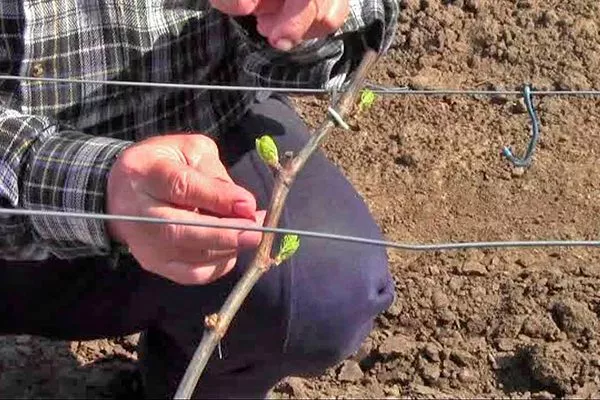
Care features:
- Trimming. No more than two clusters are left on a single shoot. When pruning, 10-12 buds are left on the vine (in Georgia), but in some regions, only 6-8 buds are left (in Crimea). A total of 50-60 buds should remain on a single bush.
Good harvests are obtained on old vines, so when pruning, be sure to leave the darkened (old) vines. The best fruiting is obtained on shoots at least 15 years old, with fan-pruning. - Watering. Saperavi roots reach a depth of 3-4 meters, allowing them to reach groundwater. The variety doesn't require frequent or abundant watering, but additional moisture is needed during bud break, after flowering, and when the fruit is ripening. Excessive watering can cause flower drop—it's best not to water the grapes at all during flowering.
The recommended watering rate is 20 liters per plant. When watering, the water should soak through to a depth of 0.5 meters. Otherwise, the plant will switch to surface rooting. It is recommended to mulch the tree trunks with straw to retain moisture and slow weed growth. - Top dressing. The Saperavi variety requires an average of two fertilizer applications per season. The first application occurs when young shoots reach 15 cm in length. During this period, a mixture of nitrophoska (15 g per 10 liters of water) is prepared. This solution stimulates foliar growth.
A second feeding is carried out in early August. A solution of superphosphate and potassium sulfate is added—20 g and 12 g per 10 liters of water, respectively. Fertilizers are applied after watering. - Wintering. During severe frosts, uncovered grapes lose some of their buds. If winter temperatures in the region drop below -20°C, the vines are covered using the standard technique: covered with soil, straw, or fallen leaves, and then covered with a waterproof material such as polyethylene film or roofing felt.
Diseases and pests
The variety has average resistance to fungal diseases, but under unfavorable climatic conditions and poor agricultural practices, it can become susceptible to oidium (powdery mildew), downy mildew (downy mildew), and gray mold.
Diseases develop primarily in high humidity. Standard preventative measures can help prevent their development.
To prevent the development of fungal diseases, it is necessary:
- plow fallen leaves;
- ensure good ventilation of the bushes by creating wide spaces between rows and removing excess leaves;
- spray the bushes with fungicides and copper-containing preparations (Bordeaux mixture, copper sulfate, etc.).
Among insects, aphids—root and leaf aphids—can cause the most damage to Saperavi grapes. It is recommended to remove affected leaves and treat the plants with systemic insecticides. Grape leaf rollers rarely damage the Saperavi variety.
Use of the Saperavi variety
Saperavi grapes are used to make a wide variety of wines—dry, semi-dry, semi-sweet, dessert (fortified), and sparkling. Winemakers are also experimenting with using frozen Saperavi grapes. The wines are made using various techniques—European or Kakhetian, with or without oak aging.
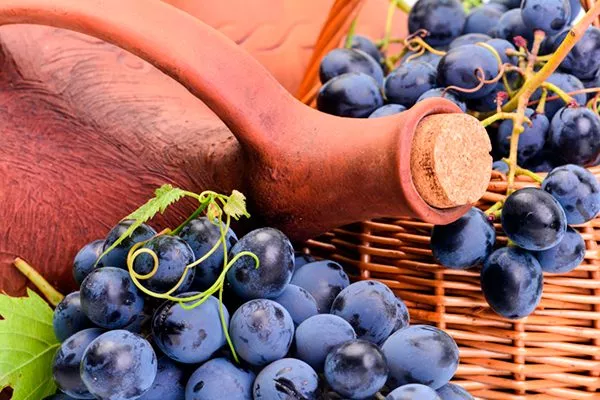
About forty varieties of wine are made from Saperavi, including:
- Saperavi red table wine. It has been produced in Kakheti since 1937.
- Saperavi Levokumskoe, a red dessert wine, has been produced in the Stavropol region since 1949.
- Dessert wine "Kagor Yuzhnoberezhny" - it has been produced at the Massandra factory (Crimea) since 1933.
Saperavi produces wines with a tart, astringent taste, as the fruit contains a lot of tannins.
The most famous premium wines from Saperavi:
- dry - Mukuzani and Napareuli;
- semi-dry - Kindzmarauli and Akhasheni.
Saperavi is considered one of the finest and most interesting Georgian grape varieties. It possesses excellent agronomic characteristics and is a wonderful raw material for creating wines and complex blends.