
Each crop is adapted to specific soil conditions, so to successfully grow vegetables, farmers and gardeners need to know how to test soil pH and then adjust its acidity (increase or decrease it). There are many methods for this, both laboratory and home remedies.
Methods for determining soil acidity
For many vegetable crops, a neutral pH range is between 5 and 7. However, some vegetables cannot tolerate even this, so accurately determining acidity is an important part of agricultural practice. This is done in a variety of ways.
| Name | Characteristic 1 | Characteristic 2 | Characteristic 3 |
|---|---|---|---|
| Litmus paper | Measures pH | Use with distilled water | The color changes depending on the acidity |
| Alyamovsky's device | Analyzes water and salt extracts | Obsolete method | Large dimensions of the device |
| Soil meter | High degree of accuracy | Multifunctionality | Digital monitor |
- ✓ Soil temperature should be between 10-25°C for most measurement methods.
- ✓ Soil moisture affects the accuracy of measurements; ideally, the soil should be slightly damp, but not wet.
Litmus paper
Litmus strips have been around since Soviet times—they were widely taught in schools and used in labs. Sold in pharmacies and specialty stores, they consist of a set of strips and accompanying instructions.
How to use:
- Take some soil from your garden plot.
- Fill it with water in a ratio of 1:5.
- Mix thoroughly and let stand for 2-3 minutes.
- Dip a litmus strip in the liquid for 5 minutes or drop a drop of water with a soil sample onto paper.
- Look at the color against the scale to understand the acidity level.
If there is no transcript, remember the reaction:
- reddening of paper – acid is too high;
- greening - alkaline;
- yellowing – acidity is slightly increased;
- The color became light green - a neutral indicator.
Use only distilled water (rainwater can be substituted), as tap and well water already contain acidity.
Craftsmen have come up with a way to make litmus paper themselves, but it doesn't provide 100% accurate results.
How to do:
- Buy red cabbage and shred it.
- Throw into water and cook for 30-35 minutes.
- When the water has cooled, strain through a fine sieve.
- Separately prepare unwaxed paper (A4 sheets are ideal). Cut into strips up to 1.5 cm wide.
- Place the paper in the water where the cabbage was boiled and keep it there until it is completely soaked.
- Take it out and dry it naturally.
Alyamovsky's device
The device consists of a device and a set of reagents used to analyze water and salt extracts. The operating principle is similar to that of litmus paper, but this method is considered obsolete and is rarely used due to the large size of the Alyamovsky device.

Soil meter
Modern agronomists, gardeners, and vegetable growers prefer to use highly sensitive, new-generation instruments to measure soil acidity. These are relatively expensive, but offer a host of advantages:
- high degree of accuracy;
- multifunctionality – it measures not only acidity, but also humidity, illumination, temperature (depending on the model);
- durability;
- digital monitor;
- there is no need to dig a hole and take a soil sample;
- speed of obtaining results.
The devices most commonly used in Russia:
- Megeon 35280. Relatively inexpensive. Measures pH, acidity, humidity, and light levels. It's solar-powered, so there's no need to recharge from a power outlet or replace conventional batteries.

- Megeon 35300An advanced model that also analyzes soil temperature. Features include automatic shutdown when not in use and a low-battery alert (battery-powered, requiring recharging). Features a large LCD display.
- PU AMT-300. Measures soil acidity, light intensity, humidity, and temperature. Features include a long electrode (200 mm) and an LCD display.
- Model ZD-06. It is designed to study the level of moisture and acidity of the soil and operates on solar batteries.
Chemical laboratory
Laboratory soil testing is considered the most reliable. Simply bring a soil sample to the lab. This reveals several indicators:
- acidity is actual - extracted from an aqueous solution;
- pH exchange – appears during prolonged application of humus to the garden;
- potential acidity – values are taken from the solid parts of the soil;
- Hydrolytic pH – indicates the level of saturation of the soil with bases.
The analysis is carried out in stages:
- Sampling – depth of not less than 60 cm and not more than 120 cm (experts recommend that this be done by laboratory staff to ensure representativeness).
- The study is conducted under special conditions.
- Recommendations – issued by a specialist (advises on what and how to change the indicators for specific crops).
Vinegar or hydrochloric acid
Folk craftsmen also offer their own methods for determining soil acidity. The simplest is using vinegar or hydrochloric acid. What you need:
- soil taken from a depth of 20-40 cm for vegetables and 90-100 cm for fruit trees;
- vinegar or acid (5%);
- container for mixing components.
The procedure is carried out as follows:
- Place the soil in the container.
- Fill with liquid solution.
- Look at the reaction.
If hissing occurs, the soil is neutral or alkaline; if there are no changes, it is acidic.
Currant, cherry or bird cherry leaves
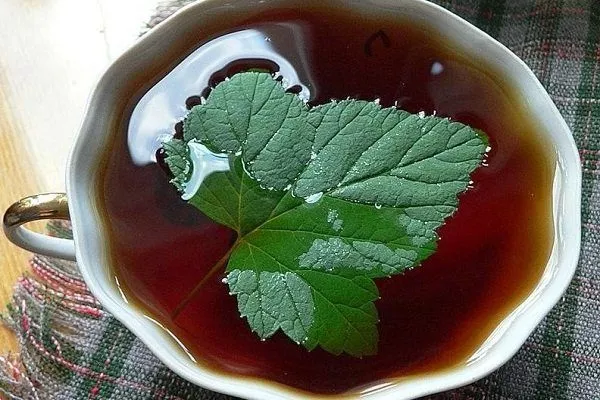
Gardeners often use the leaves of plants that contain their own acid, such as currants, bird cherry, and cherry. The results of the study show a change in the color of the decoction.
What you need to do:
- Dig a hole in the garden and take some soil.
- Prepare an infusion of the green mass and water in a glass container in advance - 5-6 leaves per 200 ml of boiling water (do not use metal containers, as they oxidize).
- Cover with a lid to infuse.
- Cool the liquid to room temperature.
- Throw the soil into the solution.
The reaction occurs in water – it turns a certain color:
- with increased acidity - becomes scarlet;
- at neutral indicators – light green;
- in alkaline soil - blue.
Grape juice
This is an ancient method used by our ancestors. However, there's an important requirement: the grape juice must be homemade, as preservatives, flavorings, and other synthetic additives can lead to improper results.
What you will need:
- glass container of at least 200 ml;
- soil;
- grape juice – 50-70 ml.
The procedure involves dropping the soil into the sap and carefully monitoring the reaction, similar to vinegar. If the liquid begins to fizz and changes color, the soil is neutral or alkaline; if not, it's acidic.

Chalk
The chalk test was devised by agronomist Klychnikov, which is why many refer to the method after him. What's needed for the analysis:
- soil sample;
- glass bottle;
- chalk;
- plain writing paper;
- rubber finger cot.
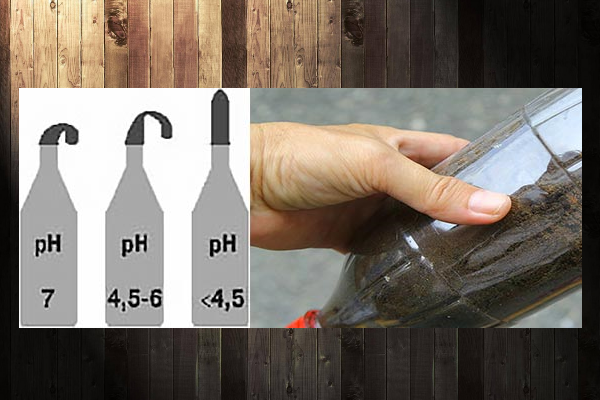
The research procedure includes the following steps:
- Remove soil from the garden bed.
- Dry it naturally (not in an oven, etc., as the results will be inaccurate).
- Place the soil in the bottle, filling it halfway.
- Grind the chalk into a powder.
- Place it on a small piece of paper and wrap it, but not too tightly.
- Transfer the chalk into a container.
- Place a finger cot over the neck, but make sure there is no air in it.
- Shake the bottle to mix the ingredients.
- Place the dishes on the table for 12-15 minutes and watch the reaction.
The pH level depends on how full the fingertip is - if it is half filled with carbon dioxide, then the soil is slightly acidic; if it is completely filled, then the acidity level is too high.
Weeds and crops on the site
Crop rotation is essential for growing crops, meaning that plants aren't planted in the same spot every year. But even this isn't enough; it's important to know which vegetable to plant after which crop, as some vegetables absorb nutrients from the topsoil, others from the subsoil, and so on.
Failure to follow these rules will severely deplete the soil, allowing pests to accumulate. This directly impacts acidity levels, as pH increases with a deficiency of certain minerals, most notably calcium.
Vegetation indicating high pH:
- sorrel and sedge;
- pansy and plantain;
- Ivan da Marya and buttercup;
- cinquefoil and chamomile;
- blue cornflower and chamomile;
- green moss and protruding white mustache;
- crowberry and lycopodium;
- blueberries and heather;
- cotton grass and meadow marsh grass;
- lingonberry and bearberry;
- mint and sorrel-leaved knotweed;
- Marsh wild rosemary and marsh goldenrod.
- ✓ The presence of mosses and lichens indicates high soil acidity.
- ✓ A predominance of clover and dandelions indicates a neutral or slightly alkaline pH.
Grass growing in alkaline soil:
- thistle and thistle;
- self-seeding poppy and spring adonis;
- larkspur and yellow alfalfa;
- field thistle and adonis;
- wild mustard and yarrow;
- bark and lily of the valley.
If the following plants grow quickly in the beds, the soil is considered neutral:
- delphinium and hairy sedge;
- sickle-leaved alfalfa and meadow arzhanets;
- goose feet and sowing mustard;
- vetch and white campion.
What to do to change acidity?
Acidification occurs due to the decomposition of organic matter and when certain crops draw magnesium, potassium, and calcium from the soil. Therefore, normalizing acidity requires a long period of time. To avoid waiting several years, gardeners have developed several basic methods for adjusting pH on their own.
Ways to lower pH
In Russia and the CIS, highly acidic soils are most common. While large industrial farms correct this with specialized preparations, homeowners resort to traditional methods, which lack synthetic or chemical components.
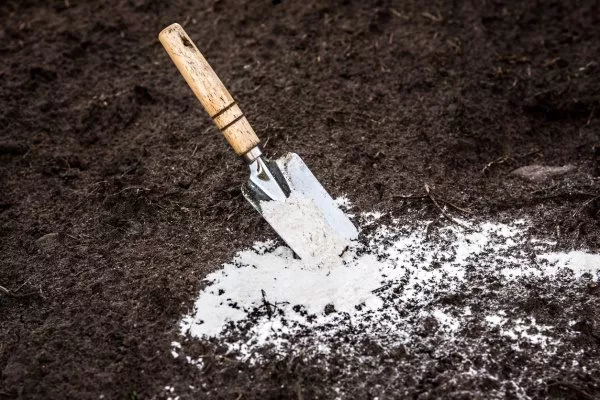
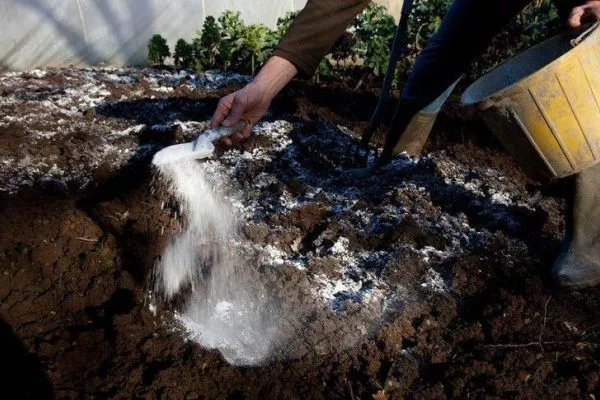
The most common method is liming. Lime must be slaked. The consumption rates for raw materials, depending on the soil's acidity, are as follows per 100 square meters:
- highly acidified – 50-60 kg;
- average acidity – 40-45 kg;
- slightly increased indicators – 20-30 kg.
How liming is carried out:
- Prepare lime and spread it evenly over the garden (taking into account the norms).
- Dig the beds to the depth of a spade blade along with lime material.
Recommendations:
- use the finest raw materials – the effect will occur 2 times faster;
- perform global deoxidation once every 4-6 years;
- partially lime the area once every 2-3 years;
- Do not apply manure or nitrogen-containing fertilizers along with the liming procedure;
- The optimal time of year for the procedure is spring.
If for some reason you cannot use lime, use other means:
- Dolomite flour. Its special feature is that it additionally enriches the soil with nutrients. 350-600 g of material is required per square meter.
- Chalk. The norm for application is 100-300 g per 1 sq. m.
- Wood ash. For 1 sq. m you will need from 200 to 600 g.
- Peat ash. Dosage: 400-1500 g per 1 sq. m.
- Aluminum sulfate. It's used to instantly reduce soil acidity. To reduce pH by 1 unit, apply 500-550 g of the substance per square meter.
- Sublimated sulfur. The main advantages over the previous product are its low cost and small dosages, but it reduces acidity more slowly. To reduce acidity by 1 unit, 90-100 g per square meter is required.
- Sowing green manure crops. This process is as natural as possible. The main advantage is that the plants' powerful root systems loosen the soil in the deep layers, bringing nutrients to the surface. What to plant in the fall: rye, oats, alfalfa, beans, mustard, phacelia.
Options for increasing pH
Acidity decreases with an excess of magnesium, potassium, and calcium. Crops also grow poorly and rot in alkaline beds.
To increase pH levels, experienced gardeners do the following:
- Acids. The substances are diluted in 10 liters of water, which is enough for 1 square meter of soil. The dosage is: acetic or citric acid (9%) – 100 ml each, citric acid – 2 tablespoons, oxalic acid – 5 g.
- Sulfur. The acidity increases after a year. The application rate per square meter is 70-100 g.
- Organic. For 1 square meter, use 9-12 kg of compost, 3-5 kg of humus, or 4-7 kg of manure. Wood shavings, peat, and sphagnum moss can be scattered over the beds in any amount (but the layer should not exceed 5 cm).
- Iron sulfate. Optimal for use on clay soils – 1 kg of the substance is enough for 15 square meters. Results are visible in 5-8 weeks.
- Electrolyte. It's available ready-made and is based on sulfuric acid, so be sure to wear thick rubber gloves and a protective mask like a respirator when working with it. Use 8-10 liters of solution per square meter. To prepare it, mix 10 liters of water with 10 ml of Electrolyte.
Knowing how to properly and accurately test soil pH and what to do to adjust it will help you consistently grow healthy and delicious vegetables and reap a bountiful harvest. A wide range of methods for determining, lowering, and increasing acidity allows you to choose the optimal option.
What is Ivan-da-Marya? Is it coltsfoot? I don't get it!
Actually, such a plant does not exist!