
The Turkish Turban is an ornamental pumpkin variety developed by an American breeder. Initially, the fruit, reminiscent of an oriental headdress, was not known for its good flavor, but through breeding, it was significantly improved. Today, both ornamental and edible varieties are sold commercially under the name "Turkish Turban."
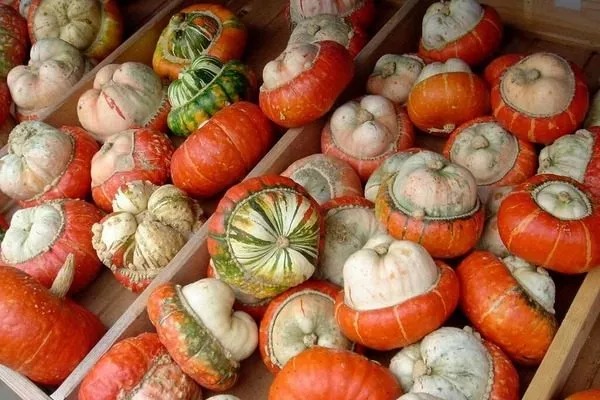
Description of the Turkish Turban pumpkin
The Turkish Turban pumpkin is a long-vine or bush plant, depending on the specific variety. In the former case, the vines can reach 6 meters in length. They easily climb any supports they encounter. The leaves are five-lobed and light green.
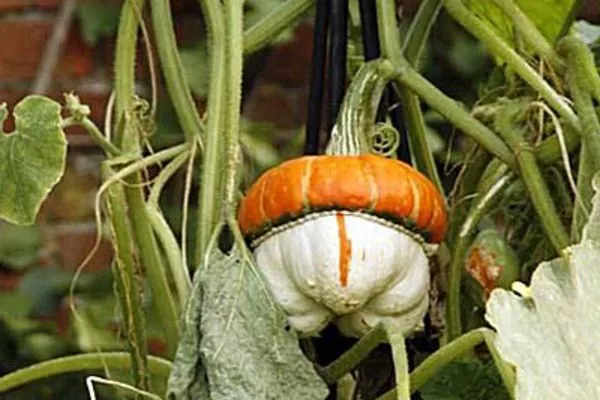
The fruit is the main difference between all turban pumpkins and regular varieties. They have a "cap" or "turban," the diameter of which is larger than the rest of the pumpkin. This portion makes up approximately two-thirds of the fruit.
The color varies depending on the stage of ripening:
- freshly picked fruits have a yellow “cap”;
- By winter, the yellow color changes to orange-red, and the striped part from green becomes white or dark yellow.
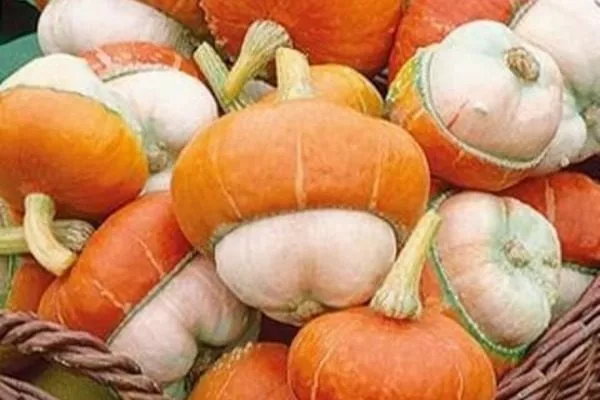
The Turkish turban belongs to the large-fruited group. Fruits weigh 1-2 kg, with individual fruits reaching 3-5 kg. The pulp is about 5 cm thick, and the seed chamber is small. A single plant can produce up to 30 fruits.
Who brought it out and when?
The 19th-century American breeder Luther Burbank is credited with creating the Turkish Turban pumpkin. He developed a whole line of turban-shaped varieties using seeds from the wild Chilean pumpkin.
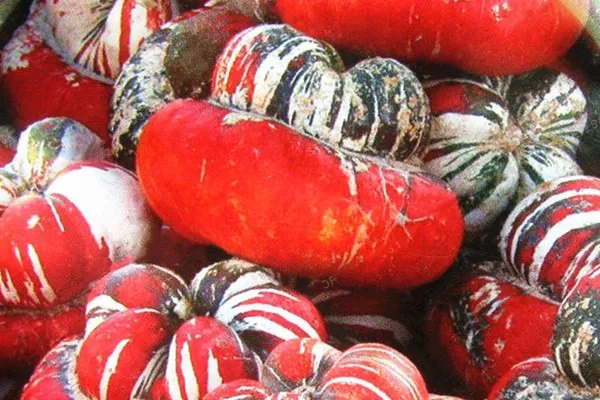
Turban pumpkins come in various sizes on the market. The smaller ones are the "Gribok" variety, which is completely unsuitable for cooking due to its bitter taste. However, larger pumpkins, weighing around 4-5 kg, are quite tasty. Producers offer them under various names: "Little Red Riding Hood," "Turkish Turban," or simply "Turban."
You can find out about the best pumpkin varieties, according to domestic gardeners Here.
Characteristics
When growing Turkish Turban pumpkin, it's important to consider its growing characteristics. It's a good idea to familiarize yourself with them before planting; this variety may not be suitable for your intended purposes.
Main characteristics:
- The variety is early maturing. It takes about 90 days from germination to fruit ripening.
- The yield of commercial fruits is 2 kg/sq. m.
- The shelf life is excellent. The fruits retain their marketable qualities for 90 days after harvest.
- Cold tolerance is good. Plants can tolerate light and short-term frosts. However, significant temperature drops are detrimental to shoots and fruits.
- Drought tolerance is average. The plant does not die if the soil dries out, but its growth stops.
Taste and application
The flavor of the Turkish Turban pumpkin flesh is distinctive and can vary depending on the variety. It can be neutral, more like raw potato, or slightly sweet.
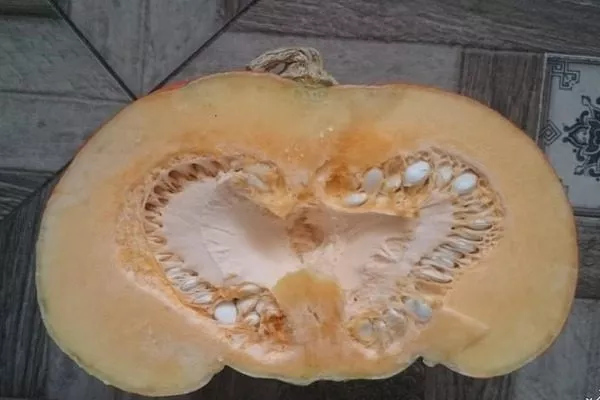
Recently, thanks to selective breeding, pumpkins with a more pleasant flavor have emerged—their flesh is sweet, with a nutty flavor. These fruits vaguely resemble Muscat varieties in their flavor. Their flesh is fiberless.
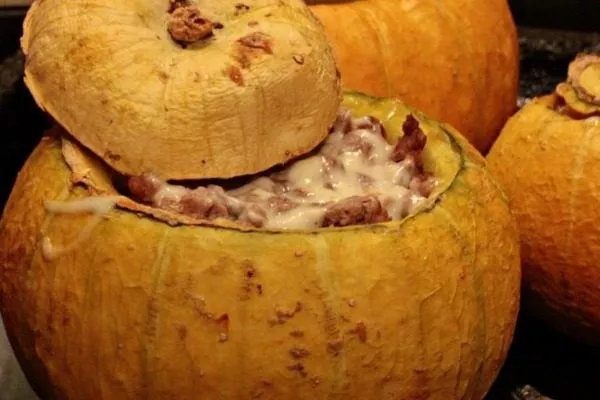
The Turkish Turban variety is used in cooking. The pulp is added to salads or simply eaten raw. Turban pumpkins are also used for baking and stuffing. Only the milky stage of ripeness is eaten; fully ripe pumpkins are not suitable for consumption.
Use in landscape design
The ability of this long-vineed ornamental melon to twine around supports makes it suitable not only for its distinctive fruit but also for vertical landscaping. It's suitable, for example, for decorating gazebos, trellises, pergolas, and so on.
Pros and cons
The Turkish Turban pumpkin is definitely for the amateur. Its color, shape, flavor, and uses are significantly different from those of other varieties. Before planting this pumpkin in your garden, it's recommended to familiarize yourself with all its advantages and disadvantages.
Landing
Turkish Turban pumpkin can be grown in two ways: direct sowing or from seedlings. The first option is simpler and less labor-intensive, while the second method allows for a faster harvest. You'll find detailed information on cultivating this vegetable crop outdoors here. Here.
Preparing seeds for planting
If pumpkin seeds were purchased from a grocery store rather than collected locally, they likely don't require disinfection—the grower typically performs this procedure themselves. Information about this can be found on the packaging. However, it's advisable to select (sort), disinfect, harden, and germinate the seeds before sowing them in the ground or for seedlings.
Features of processing Turkish Turban pumpkin seeds:
- Sorting. The seeds are sorted and checked for germination. Low-quality seeds—those with dark stripes and/or spots—are immediately discarded. The remaining seeds are immersed in water; the non-germinating seeds will float fairly quickly, while the good ones will sink to the bottom.
- Warming upPumpkin seeds are wrapped in cloth and placed in a warm place, such as a radiator, for approximately 24 hours.
- HardeningThe seeds are wrapped in damp gauze and placed in the refrigerator for 10 hours, on the bottom shelf.
- GerminationThe seeds are kept in damp gauze or swollen sawdust for several days. The water for soaking should be warm (approximately 25…30 °C).
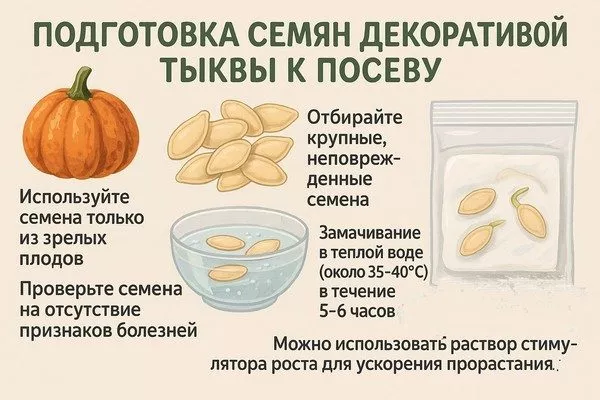
You can also soak the seeds in a solution of wood ash (1 tablespoon per 1 liter of warm water) - this will enrich them with microelements, or in a growth stimulator (Epin-Extra, Zircon, succinic acid).
Site selection and preparation
The Turkish Turban pumpkin thrives in full sun; shade negatively impacts flavor and fruit yield. This variety thrives in loose, fertile soils with a pH close to neutral (6.0-7.5). Suitable soils include loose, dark sandy loams, light loams, and chernozems.
If the groundwater level is too high in the area, raised beds are created for pumpkins. Since ornamental pumpkin vines grow very quickly, it's important to provide support for them in advance. It's best to plant pumpkins in a location that already has support—against a wall, in a gazebo, near a fence, etc.

The best predecessors for pumpkin:
- legumes;
- cabbage;
- beet.
The pumpkin planting area is prepared in the fall. It is dug over, adding organic fertilizers and other components necessary to improve the soil's quality. In the spring, the area is dug over again or deeply loosened, incorporating mineral fertilizers into the soil.
Features of site preparation:
- When digging in autumn or spring, add compost, humus or rotted manure - 10 kg per 1 sq. m.
- In spring, mineral fertilizers are added to the soil, for example, ammonium nitrate - 15-20 g per 1 sq. m.
- For overly acidic soils, add 300 g of wood ash or dolomite flour per 1 sq. m.
- If the soil is dense and clayey, it is loosened by adding 10 kg of river sand per 1 square meter.
Sowing in the ground
In southern Russia, Turkish Turban pumpkin can be sown directly into open ground, without growing seedlings. Sowing occurs approximately from April 20th to May 10th.
Features of sowing the Turkish Turban variety:
- Dig holes for sowing at intervals of 70-80 cm. If planting in a vegetable garden, keep intervals of 1-1.5 m between rows. No more than 2-3 plants should fit per square meter.
- Place 2-3 seeds in each hole to increase germination. Once the seedlings emerge, leave only one, the strongest, sprout.
- The seeding depth is 3-4 cm. It depends on the density of the soil; the looser it is, the deeper the planting is.
Sowing pumpkin seedlings
In regions with long springs and short summers, pumpkins can be grown using seedlings. This allows for an earlier harvest, with all the fruits ripening before the onset of cold weather.
Features of growing Turkish Turban pumpkin seedlings:
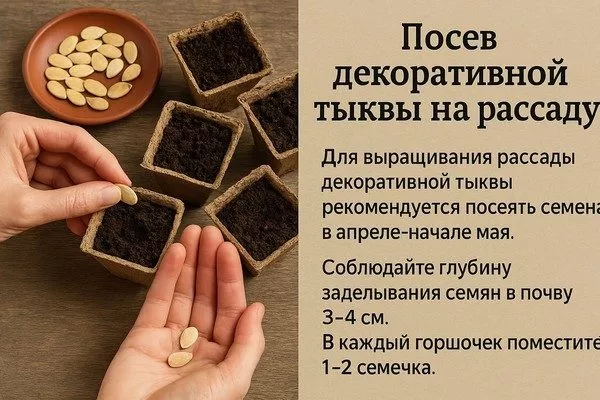
- Seedlings are sown 20-25 days before the expected planting date—the exact timing depends on the region's climate. In temperate climates, pumpkins are sown from late April to mid-May.
- For growing seedlings, use individual containers—plastic cups or peat-humus pots. They should be large enough, with a minimum capacity of 300-350 ml and a diameter of 7-9 cm. It is not recommended to transplant pumpkin seedlings into larger pots, as they do not tolerate such manipulations well.
- Planting containers must have drainage holes. Containers should be washed with hot water and disinfected. This is especially important if using used containers. Fill the container with soil, leaving about 1.5-2 cm from the top—leaving room for watering and adding soil.
- To grow pumpkin seedlings, you can use a ready-made substrate from an agricultural store or a soil mixture prepared independently, for example, from peat, leaf soil and mature compost (1:2:1).
- Prepared soils can be used immediately, but those prepared at home must first be disinfected, for example, with a weak solution of potassium permanganate - this will prevent the development of fungal diseases.
- Plant 2-3 seeds in each cup, burying them 3 cm deep. Spray the soil with warm, settled water and cover with transparent film to create a greenhouse effect, which stimulates plant growth.
- After the seedlings emerge, the film is removed, and the containers with the seedlings are moved closer to the light. This variety is heat-loving; the seeds germinate at temperatures of 20–22°C; lower temperatures increase the risk of seed rot.
During the first few days, there is an increased risk of plants becoming elongated, so as soon as the cover is removed, the room temperature is immediately lowered from 18..+22°C to 15..+16°C. After 4-5 days, the temperature is raised again.
Caring for seedlings
To obtain strong and healthy seedlings by the right time, it's necessary to carefully monitor growing conditions—temperature, humidity, and lighting. They also require careful care—watering, monitoring their condition, and taking appropriate measures promptly.
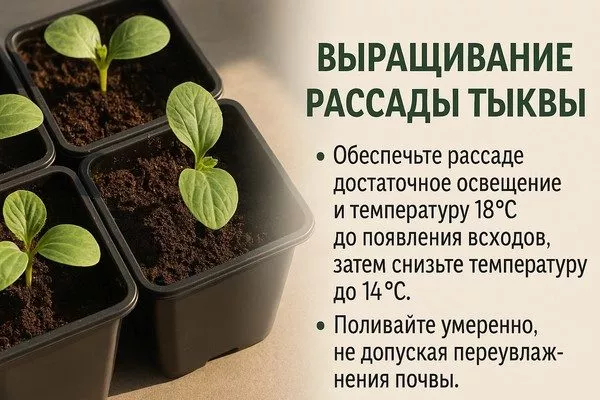
Features of caring for Turkish Turban pumpkin seedlings:
- Immediately after the seedlings appear, they are moved closer to the light and, if necessary, provided with additional illumination by turning on phytolamps.
- Two weeks before transplanting the seedlings into the soil, they begin hardening them off by taking them out into the fresh air for 15–20 minutes, gradually increasing the time.
- Watering should be moderate; pumpkin seedlings do not tolerate overwatering well, as this can lead to blackleg. The average watering frequency is once every 7-10 days. Use warm, settled water. Water when the top layer of soil has dried out; otherwise, there is a risk of root rot and fungal infections.
- Pumpkin seedlings generally don't require fertilizing. They grow for only 20-25 days, during which time the nutrients provided in the planting containers are sufficient. Fertilizing is only done if the plants show obvious signs of nutritional deficiency.
- If fertilizing is done, it should be done only after 1-2 true leaves appear and 5 days before planting. Complex mineral fertilizers are usually used for this purpose.
Planting seedlings in the ground
Planting of seedlings occurs in late May or early June, when the risk of recurrent frosts is eliminated or at least minimal. By the time of planting, pumpkin seedlings should have at least two true leaves.
Features of planting Turkish Turban pumpkin seedlings in the ground:
- Dig wide, deep holes for planting. The diameter should be 40-50 cm and the depth 20 cm. Add 5 liters of humus (or manure), a handful of wood ash, and 1 tablespoon of superphosphate. Mix everything thoroughly, and top with a small amount of regular soil.
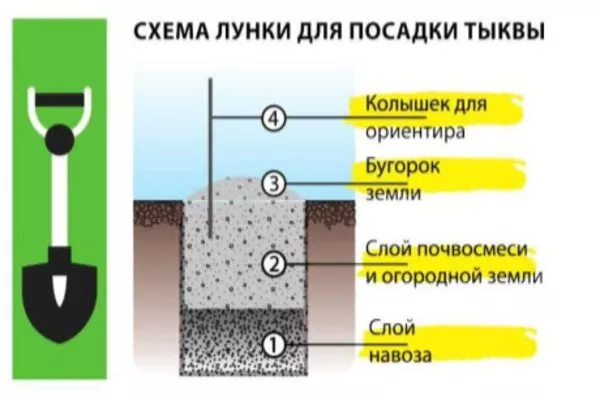
- Water the seedlings beforehand to soften the soil, which will allow them to be easily shaken out of their pots. This should be done with extreme care to avoid damaging the roots and disturbing the root ball.
- If the seedlings are grown in peat pots, simply place them in the holes along with the container—this option allows you to completely avoid stress.
- The planted seedlings are watered with warm, settled water. Once the water has soaked in, the soil is mulched with peat, humus, or simply dry soil.
- If planting is carried out at critically early times, it is recommended to initially cover the plantings with film at night.
Care
The Turkish Turban pumpkin requires regular care. Regular care affects the quality of the fruit, its size, appearance, taste, and quantity.
Watering
Turkish Turban pumpkin requires infrequent, but regular and generous watering. Use only warm water heated by the sun. The average watering frequency is once every 7-10 days. The frequency depends on weather conditions and soil conditions. In hot weather, watering should be doubled. Water should be applied directly to the roots.
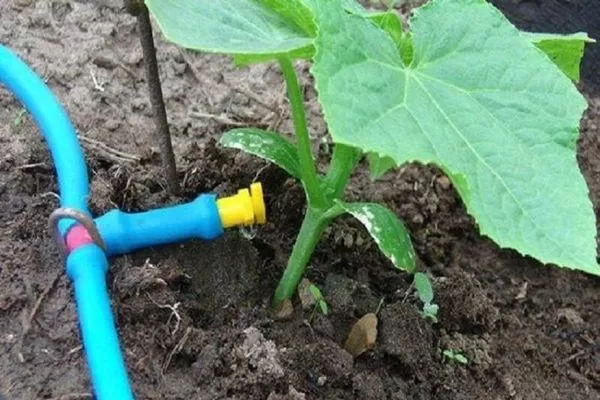
A month before harvesting, watering is stopped completely to prevent the fruit from becoming waterlogged. Furthermore, watering during harvesting negatively impacts the shelf life of the fruit, as it will rot during storage.
Loosening
The Turkish Turban pumpkin has a long main root and numerous small roots located close to the soil surface. To ensure the roots receive sufficient oxygen, the soil is loosened after watering and heavy rainfall.
Loosening prevents the formation of a hard crust and allows you to weed out growing weeds at the same time.
Fertilizing
The Turkish Turban pumpkin responds well to fertilization; it is recommended to fertilize it alternately with organic and mineral compounds.
Approximate feeding regime:
- Two weeks after planting, apply potassium and phosphate fertilizers (20 g per 10 liters of water) to the pumpkin to stimulate root development. Nitrogen is not used at this stage, as it encourages intensive growth of the tops, which the root system is not yet ready for.
- Two weeks after the first feeding, add an infusion of mullein, and then every two weeks water the beds with herbal infusion.
- Before flowering, re-apply fertilizer with potassium and phosphorus.
- When fruits appear, compounds containing boron, iron, magnesium, and manganese are added.
Read more about fertilizing this popular vegetable crop to ensure its high yield. Here.
Fighting diseases
The Turkish Turban ornamental pumpkin has a fairly strong immune system, but under unfavorable conditions it can be susceptible to various diseases and pest attacks. It's important to detect damage early and take appropriate measures.
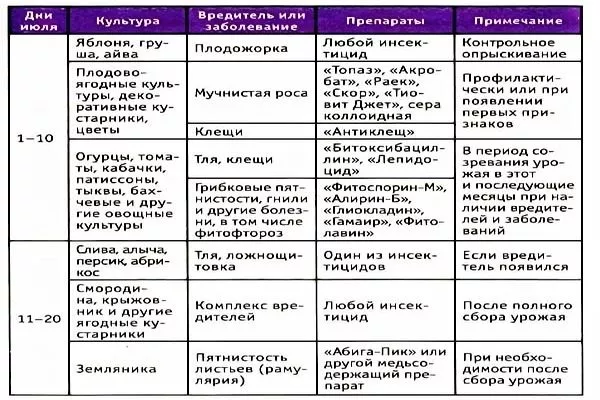
Turkish Turban pumpkins are susceptible to powdery mildew and bacterial wilt. To prevent these diseases, spray the pumpkin with Bordeaux mixture. If symptoms appear, treat with a mixture of copper sulfate and lime, followed by fungicides. If root rot occurs, spray with a solution of copper sulfate and zinc sulfate.
Pest control
If insect pests are widespread and no preventative measures are taken, Turkish Turban pumpkins can be attacked by melon aphids, spider mites, and slugs. Slugs not only eat the pumpkin leaves but also chew through the fruit.
There are different ways to combat pumpkin pests:
- If aphids appear on the plants, they are sprayed with onion infusion or a soap-ash solution (1 cup of wood ash and 1 tablespoon of liquid soap are diluted in 10 liters of hot water and then left for 24 hours).
- To repel slugs, sprinkle the soil around the plants with a mixture of wood ash and lime, mixed in equal parts.
Harvesting and storage
The first fruits of the Turkish Turban pumpkin are harvested in September. Subsequent harvesting can be done gradually throughout the fall, until frost sets in. If the threat of frost has increased, and the fruits have hardened but the leaves, stems, and flower stalks are still fresh, the harvest should still be collected—avoid freezing.
The best time to pick the pumpkins is a clear, sunny day. Wash the pumpkins thoroughly if they are dirty, or wipe them with dry cloths. The harvested pumpkins are stored in boxes or baskets. If the pumpkins are harvested early, they are left in a warm, dry place for a couple of weeks. Direct sunlight is ideal.
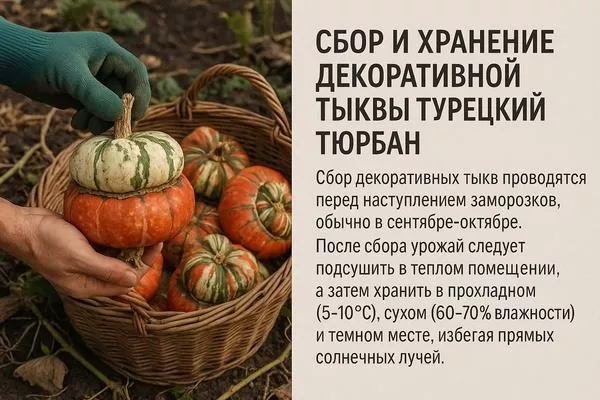
Dried pumpkins can be stored in a cellar or basement. However, they should not be placed on bare soil; they must be stored on boards or shelves. If the pumpkins are picked at full ripeness, they can be stored indoors for several months. Ripe pumpkins can be stored at room temperature for up to a year.
You will learn how to properly store pumpkin in winter so that it stays tasty and doesn't spoil for as long as possible. Here.
Reviews
The Turkish Turban pumpkin is an interesting and unusual variety that can be used for a wide variety of purposes. Modern "turbans" have an improved flavor, making them suitable not only for landscaping, decorating rustic interiors, and crafting, but also for culinary purposes.