
The name of this cultivar—the Hundred-Pound Pumpkin—speaks for itself, as the fruits are distinguished by their exceptional size. The variety is resistant to many diseases, boasts high yields, an attractive appearance, excellent shelf life, and delicious flesh. It is considered the most common plant in Russia.
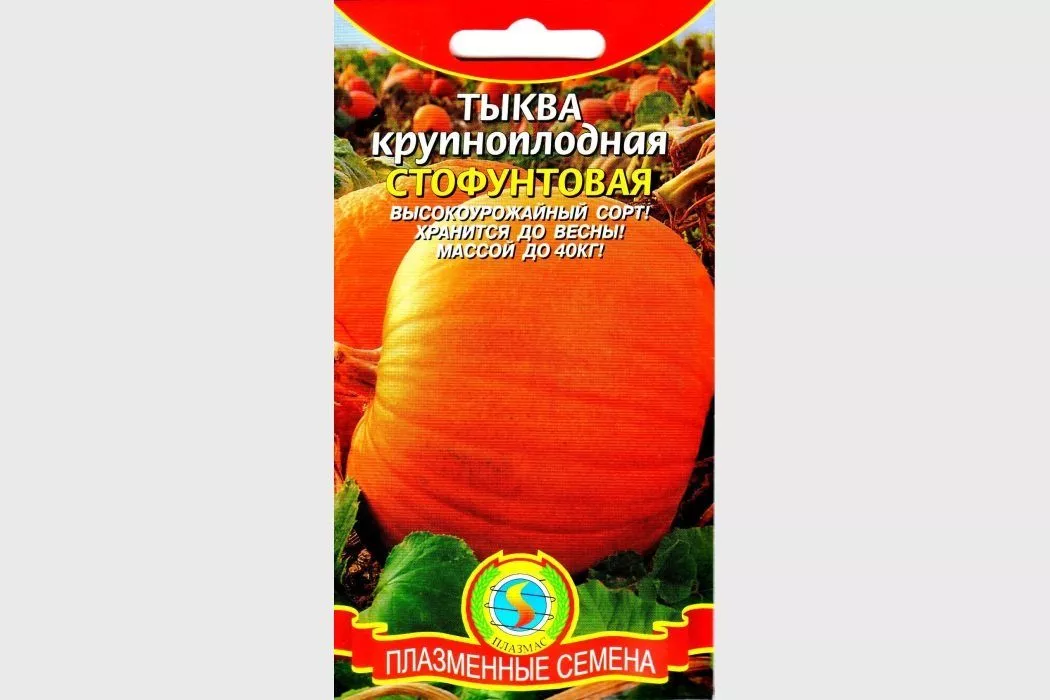
Hundred-pound pumpkin
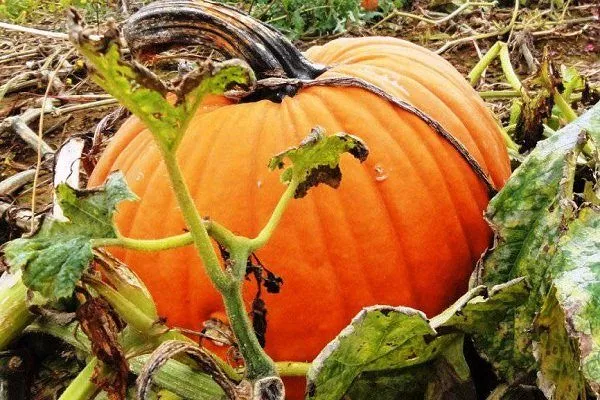
The hundred-pound pumpkin has juicy, crumbly flesh.
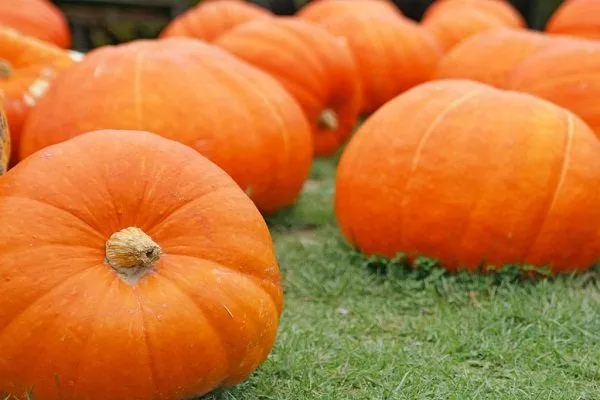
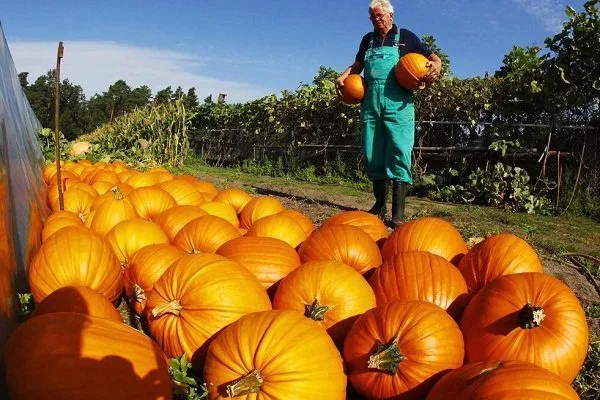
A hundred-pound pumpkin grows to 60 kg
Description of the variety
The Stofuntovaya pumpkin was added to the State Register back in 1947. It is intended for cultivation in the central regions of the Russian Federation. It is classified as a varietal pumpkin, which means that the seeds can be used as planting material (hybrid varieties cannot be planted from internal seeds).
This mid-season crop ripens 115-140 days after planting outdoors. The yield is high – up to three large pumpkins can be harvested from one square meter. Moderately warm weather conditions are best.
Bush characteristics:
- The leaves are wide and large. The color is green, with light green veins. The surface is uneven and rough.
- The stalk is quite hard, the size is medium.
- The seed nest is large, the main stem is 70 cm long.
- Lateral shoots are climbing and thin, more than one meter.
- The main rhizome penetrates into the deep layers of soil, additional roots are located near the soil surface.
Fruit characteristics:
- Size – quite large, weighing from 10 to 60 kg, respectively, with proper care and climate. Most commonly, they weigh 15-20 kg.
- Peel – Firm but thin. Color varies – light and bright orange, gray, yellow, green-yellow. The shade depends on the growing region, quality of care, weather conditions, and fruit size (large ones are the brightest).
- Form - spherical, oval, slightly flattened at the base.
- Ribbing - weakly expressed.
- Pulp – juicy and crumbly, up to 6 cm thick (on average). The color is deep orange and contains many seeds. The pulp is moderately sweet.
With proper care, the pumpkins grow large and sweet. This also influences yield—a single bush can contain up to three pumpkins.
Among advantages The following should be noted:
- resistance to many diseases;
- versatility of use;
- a variety tested by time and many years of experience;
- high yield;
- good shelf life;
- transportability;
- the possibility of ripening in a cool room or in the sun;
- storage duration;
- using seeds for planting.
Application areas:
- preparation of main courses – salads, casseroles, porridges, etc.;
- desserts;
- cream soups;
- animal feed;
- juices.
The seeds, which are distinguished by their excellent taste and size, are also used as food. The Hundred Pound Pumpkin is recommended by doctors for use in the treatment of helminths, as the seeds have an anthelmintic effect.
Furthermore, traditional medicine recommends using pumpkin (pulp and seeds) to treat visual acuity, metabolic disorders, and low immunity. Pumpkin's composition helps normalize liver function and eliminate toxins and other harmful substances from the body.
How to grow the variety?
To obtain a bountiful and delicious harvest, it's essential to follow basic agricultural practices. The cultivation technology is based on the following criteria:
- The 100-pound pumpkin doesn't like high humidity. Therefore, it's not planted in low-lying areas or where the groundwater table is close to the soil surface.
- Crop rotation. This variety is unpretentious, unlike its relatives. Pumpkins and corn are considered the best neighbors. It is recommended to plant it after tomatoes and any root vegetables. It is not recommended to plant it after watermelons, melons, cucumbers, and cabbage.
- The area should be well lit, thanks to which the fruits acquire a bright color.
- The best time to plant is spring, when the soil warms up to 15 degrees Celsius. Planting earlier is prohibited, as the variety is not cold-resistant. However, planting too late is also not recommended, as the flesh will not develop its juiciness and flavor.
- The Stofuntovaya pumpkin grows quickly and produces large fruits, so it requires plenty of space. Therefore, it's recommended to plant the seedlings in a 140x140 cm pattern.
- The soil should be rich and loose. If the soil is not fertile, fertilize it when you dig the garden in the fall. Organic matter, such as humus or slurry, is used for this purpose. 5-8 kg of fertilizer is needed per square meter. If the soil is highly acidic, add lime, peat, and wood ash. Sand is mixed in to lighten the soil.
- ✓ Soil pH should be between 6.0-6.8 for optimal growth.
- ✓ The depth of the fertile layer is at least 30 cm for the development of the root system.
Seed preparation
The hundred-pound pumpkin crop can be planted in two ways: with or without seedlings. Regardless of the method, special seed preparation is required to ensure rapid plant growth and a bountiful harvest.
Rules for preparing seed material:
- Initially, the seeds are manually inspected to select undamaged elements. Their surface should be smooth, free of blemishes and cracks. The structure should be dense.
- After this, you can (but it's not necessary) place the seeds in water for 15-20 minutes. The hollow seeds will rise to the top, while the full ones will settle at the bottom.
- Now you need to warm the seeds. To do this, take a piece of gauze, fold it in several layers, place the seeds inside, and place them in the sun (you can use a radiator). A faster method is to heat them in the oven. Follow this pattern: place the seeds at 20 degrees Celsius for one hour, 30 degrees Celsius for the second, 40 degrees Celsius for the third, 50 degrees Celsius for the fourth, and 60 degrees Celsius for the fifth.
- Disinfection is essential to prevent disease. Seeds are soaked in a weak solution of potassium permanganate for 15-20 minutes.
- To speed up the germination process, you can use growth stimulants purchased from a specialty store. You can also stimulate growth with folk remedies. To do this, take 200 ml of water and 1 tablespoon of wood ash, add the seeds, and leave for 12 hours. The solution temperature should not fall below 40 degrees Celsius.
- To help pumpkins adapt to outdoor conditions, you can harden them off. To do this, soak the seeds in a damp cloth and refrigerate them for two days.
Planting using seedlings
The seedling method for planting Stofuntovaya pumpkins is used in northern regions. Light, nutritious soil is selected for the seeds. Experienced gardeners recommend using universal store-bought soils. If this is not available, a mixture of sand, humus, and black soil in equal parts can be used. In this case, disinfection of the soil with a sodium permanganate solution is required, but the concentration should be higher than that used for seed disinfection.
Pumpkins don't tolerate transplanting because their root system is delicate. To prevent damage to the roots, place the seeds in individual cups or pots (peat pots are best).
Rules for planting seeds and seedlings:
- Place expanded clay stones on the bottom of the container for the drainage system, fill with prepared soil, and moisten with a spray bottle.
- Place 2 grains in each pot at a depth of 3 cm, then lightly water.
- Cover the glasses with film and place them on a sunny windowsill.
- When sprouts appear, remove the film.
- When 2 full leaves appear, one shoot is removed by pinching.
Basic requirements for growing seedlings:
- Water daily, but the soil should not be too wet;
- The Hundred Pound Pumpkin requires 15-16 hours of daylight, so lamps are necessary during the dark hours (preferably fluorescent ones);
- 7-8 days before planting, fertilize (water - 10 parts, chicken manure - 1 part);
- 15 days before picking, the seedlings must be taken out into the fresh air (open a window, place them outside/on a balcony).
Planting seeds in the ground
In warmer regions of the country, seeds are planted directly into the garden. The soil temperature should be 15 degrees Celsius (60 degrees Fahrenheit) (this can be measured with a thermometer inserted to the depth of a spade). This is most often the first few days of May.
Landing rules:
- Make holes at a distance of 140x140 cm from each other, add fertilizer and seeds, cover with soil, and water.
- The depth of the bookmark is from 6 to 10 cm.
- The width of the hole is 25 cm.
- The first shoots will appear in about 5-6 days. If two seeds sprout at the same time, the weaker one is removed by cutting.
- The second watering is carried out a week after planting the seed material.
Care instructions
The 100-pound pumpkin is easy to care for, but this depends on climate conditions and soil structure. If the soil is heavy, it will need to be loosened frequently. In infertile soil, top dressing.
Mandatory requirement – wateringIrrigate at least twice a week with 2-5 liters of warm water. Avoid watering the foliage and stems—only the root zone. Stop watering approximately 2-3 weeks before harvest. Otherwise, the fruits will be too watery.
Top dressing
Fertilizing always accelerates growth and increases yield, so don't neglect this procedure. The first application is made 30 days after planting. Subsequently, fertilize every 14-15 days. What to use:
- First time – nitrophoska. 10 grams is enough for one bush.
- Second time - Mullein. One liter of manure is needed per bucket of water. 800-1,000 ml is sufficient for one bush.
- Third time – store-bought fertilizers based on potassium and phosphorus (the proportions are prescribed in the instructions).
- After the formation of inflorescences A solution of wood ash and water is poured under the roots. One liter of water and 1 tablespoon of the natural component are needed per bush.
Pest and disease control
The Hundred Pound Pumpkin's immune system is considered average for melon diseases. The plant can be susceptible to:
- Bacteriosis Affects pumpkins and foliage, causing dark spots. Standard Bordeaux mixture is used for treatment.
- Powdery mildew Dries out and destroys the above-ground portion of the plant after whitish spots form. Treatment involves spraying with a solution of sodium dibasic phosphate mixed with water (50 grams per bucket).
- Spider mite Covers the entire plant with a web. It's helpful to spray with an infusion of onion peels (boil 1 kg of peels in 10 liters of water).
- Aphid. Signs include insects, curling, and drying leaves. Control methods include spraying with a malathion-based product or a soap solution.
A distinctive feature of the Hundred Pound Pumpkin is its increased resistance to rot-related diseases. Simply put, any rot (black, gray, root, or white) is not harmful to the variety, as long as the plant isn't intentionally overwatered.
What difficulties may arise?
Potential difficulties and useful tips from gardeners:
- If a plant's leaves are turning yellow, the cause should be a lack of soil nutrients. This problem can also arise from excessive fruit production (insufficient moisture and nutrients for the leaves).
- If the above-ground part of the plant turns yellow, it means there is not enough light.
- If the seeds do not germinate, then the planting material does not have enough heat (the water or soil is not at an adequate temperature).
- Thinning and wilting of stems occurs due to poor soil.
- Roots rot due to damage. This most often occurs after one of the seedlings is uprooted. The solution is to cut the weak shoot off at the soil surface.
- A low number of ovaries means no pollination due to an insufficient number of necessary insects. In this case, artificial pollination is used. This is done by cutting and opening the male flowers, and applying them stamen-side to the female stigmas.
- If seedlings don't germinate when planted outdoors, the seeds are freezing. The solution is to cover the holes with plastic wrap, plastic bottles, or compost.
How to harvest and store crops?
The harvest takes place throughout September, although the pumpkins most often ripen as early as August. This is because the longer this variety is exposed to the sun, the sweeter it becomes.
- ✓ The stalk becomes dry and woody.
- ✓ The peel acquires a matte shade and does not bend when pressed.
When harvesting, be sure to leave the stalks on. After picking, dry the fruit at room temperature or outdoors (in sunny conditions) for 8-10 days.
Pumpkin is stored more than six months in a cool and dry room at a temperature not exceeding +15 degrees and air humidity of 75-80%.
Reviews
The Stofuntovaya pumpkin variety is a well-known and most common vegetable in Russia. It has been cultivated for many years and is used in medicine and cooking. It is versatile, easy to grow, and has a moderate sweetness. If you follow simplified farming practices, you can get an excellent harvest of large fruits.