
Spaghetti squash is sure to please those who love new gardening options. Its slightly sweet fruits are not only exceptionally tasty but also healthy. Let's learn how to plant and grow this unique squash in your garden, and how it differs from other varieties.
Spaghetti Squash: Variety Description
It's no coincidence that this squash is called "Spaghetti" or "Macaroni"—as the fruit ripens, its flesh becomes fibrous. The thin yellow fibers look just like pasta. After cooking, the resemblance to spaghetti intensifies.
This unusual pumpkin has only recently appeared in Russia, but has already become popular among gardeners. In fact, "Spaghetti" isn't really a pumpkin; it's a hybrid created by crossing a pumpkin with a zucchini.
Another name for spaghetti squash is "squash." This word comes from a Native American language and translates as "eaten raw."
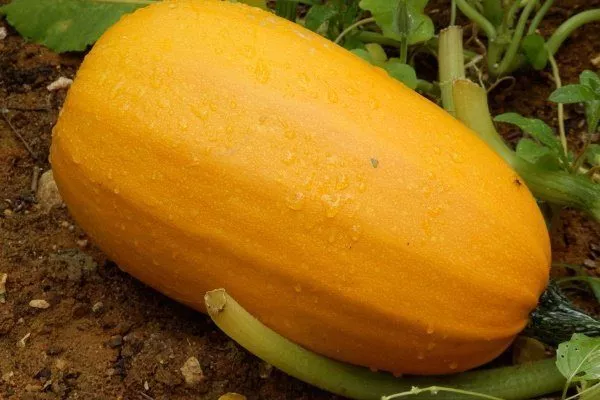
Spaghetti squash

Spaghetti pumpkin seeds
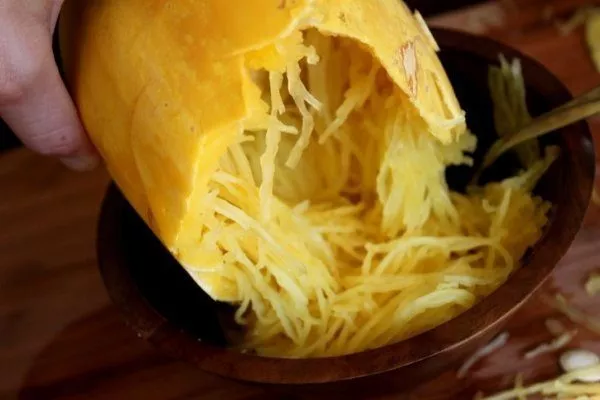
This is what the flesh of a ripe spaghetti squash looks like.
Productivity and other characteristics
Brief description of the Spaghetti variety:
- Plant. It has a powerful root system and requires a lot of space. The vines are long, growing up to 4.5 m. The stems are hollow, covered with stiff hairs.
- Leaves. Large, green, spreading. They look like ordinary pumpkin tops.
- Flowers. Large, bright yellow or orange.
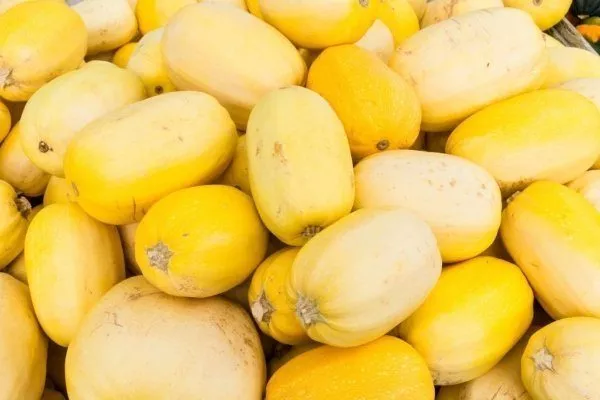
- Fruit. The shape is round or oval. The skin is light yellow or deep yellow. The flesh is fibrous, medium-dense, bright yellow or orange, with a vanilla and walnut aroma. The fruit length is up to 30 cm. Inside the fruit are elongated seeds.
Spaghetti pulp is low in calories, with only 25 kcal per 100 g.
Features of the variety:
- Bloom. It lasts from June to October. These are the dates for the central zone; in other regions, they are adjusted according to climate conditions.
- Early maturity. Approximately two months pass between germination and harvest. The growing season is 110-120 days.
- Productivity. A single bush produces up to ten pumpkins. The average fruit weight is 4 kg. One bush yields 20-30 kg.
- Storage. The pumpkins can be stored for up to two months. To extend their shelf life, dry them thoroughly in the sun before storing. The optimal storage temperature is between 3 and 10°C.
Advantages and disadvantages
Advantages of the Spaghetti variety:
- the harvest ripens early;
- long fruiting;
- excellent pulp taste;
- the fruits are stored well - if storage rules are followed;
- the fruits are beneficial for the body and do not cause allergies;
- good yield.
Cons:
- vulnerability to temperature changes - in the middle zone it is necessary to grow "Spaghetti" under film;
- requires fertile, well-moistened soils - it grows poorly on heavy and dry soils;
- affected by some diseases that reduce yields;
- does not tolerate cold well.
Growing Spaghetti Squash
Seeds are sown outdoors primarily in southern regions. In temperate climates, seedling cultivation is recommended, as it accelerates fruiting and prevents seedlings from freezing.
Selecting soil and planting container
The best option for growing seedlings is in peat pellets. This eliminates the need for transplanting. Pumpkin seedlings don't transplant well, so don't transplant them unnecessarily.
If you don't have peat pellets, you can use regular wooden boxes. Fill them with a mixture purchased at a local garden store—a universal substrate or a cucumber potting mix will do.
Seedlings can also be grown in individual cups or pots with a diameter of 6 cm.
- ✓ Soil pH should be between 6.0-6.8 for optimal growth.
- ✓ The soil must be well-drained to avoid waterlogging and root rot.
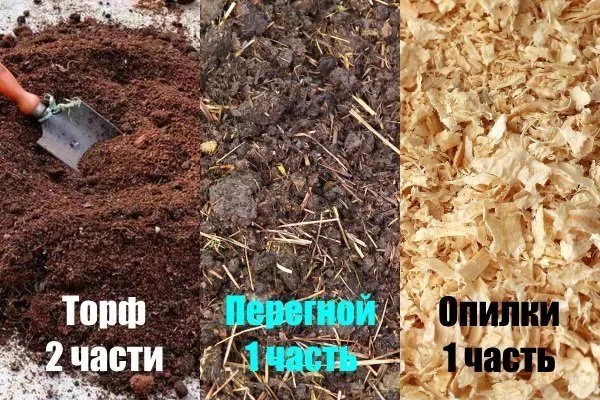
Seedling soil can be prepared by mixing peat, humus, and sawdust in a 2:1:1 ratio. Add a teaspoon of nitrophoska to each kilogram of the mixture. Before planting the soil needs to be disinfected.
Optimal timing of sowing seeds
Sowing seeds for seedlings usually begins in mid-April. Seedlings are planted outdoors in the second half of May. These recommendations apply to temperate climates. In other regions, climate adjustments should be made.
Seeds are sown in open ground at the end of May.
Preparing seeds for planting
Seeds are purchased at a local grocery store or collected from fruits in the fall. They are dried at room temperature. Drying in the oven is not recommended, as this will kill the seeds. Store the seeds in a dark, dry place, preferably in a linen bag, until spring sowing.
Before sowing, prepare the seeds:
- Sort the seeds. Only large ones are suitable; discard the small and empty ones.
- Soak the seeds in warm water and let them sit overnight.
- Remove the seeds from the water and wrap them in a damp cloth for 2-3 days. To speed up germination, moisten the cloth with water from time to time.
- Place the sprouted seeds in the refrigerator for three days to harden them.
- To disinfect the seeds, soak them in a 2% solution of potassium permanganate for half an hour.
The sprouted seeds are ready for planting – you can plant them in containers with soil or directly into open ground.
Sowing seeds for seedlings
Once the containers have been found and the seeds have been prepared, you can move on to sowing the seeds for seedlings:
- If you're using boxes to grow seedlings, add sawdust to the bottom. This will help the soil retain moisture longer.
- Fill the container with substrate and water generously.
- Make small holes in the soil, 4-5 cm deep. The intervals between holes are 2-3 cm.
- Plant the seeds and cover them with soil.
- Water the crops using a spray bottle.
- Cover with a transparent material - glass or film.
- Place the boxes with seeds in a room with a temperature of +25 °C.
Caring for seedlings
Features of seedling care:
- To prevent the seedlings from stretching, remove the film as soon as the shoots appear.
- Seedlings need light—place them in a well-lit spot. A south-facing window sill is ideal.
- Maintain an optimal temperature of 15 to 25°C. If it's too warm, the seedlings will grow too tall, and if it's too cold, they'll stunt and become diseased.
- Water the seedlings regularly; don't let the soil dry out. Use warm, settled or boiled water, and avoid getting it on the leaves.
- Fertilize the seedlings a week after germination. Prepare a solution: add 2 grams of nitrophoska to a liter of water. Pour the liquid fertilizer under the roots; avoid getting it on the leaves, as it will burn them. Alternatively, feed the seedlings with a mullein solution (10 parts water to 1 part mullein).
- 14 days before planting the seedlings in the ground, begin hardening them off. Take them outside every day. Start with 20 minutes and increase the duration to 2-3 hours.
Transplanting seedlings into open ground
Features of planting seedlings:
- Deadlines. Seedlings are planted approximately one month after sowing the seeds. However, don't rely solely on the number of days since sowing—the outside temperature must be consistently above zero. The seedlings should have at least two fully developed leaves.
- Plot. Choose a location based on the plant's size—Spaghetti squash needs plenty of space. It thrives in fertile, sunny areas; it won't produce fruit in shade.
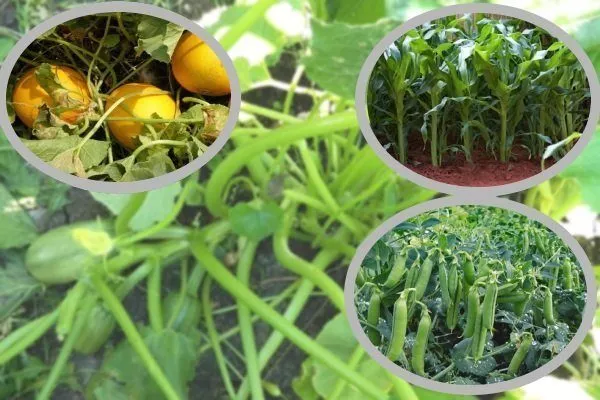
- Predecessors and neighbors. The crop grows well after tomatoes, potatoes, and legumes. Avoid planting Spaghetti squash after cucumbers, pattypan squash, and zucchini. However, it can be planted next to these crops, as well as melons, corn, and peas. When grown near these crops, the squash produces good yields and is disease-free.
The soil is prepared in the fall:
- The area is fertilized with manure - 4 kg is poured per 1 square meter.
- The beds are being dug up.
- If the soil is acidic, add 200 g of ash per 1 sq. m.
The order of planting seedlings:
- Half a month before planting, cover the area with black film to allow the soil to warm up better.
- Prepare holes 10-12 cm deep. The distance between them is 80 cm.
- Water the holes with hot water. After the water has soaked in, plant the seedlings. If the seedlings were grown in peat pellets, there's no need to shake the soil off the roots. If they were grown in containers, handle the seedlings so that a little soil remains on the roots.
- Cover the roots with soil and compact it with your hand.
It is best to plant seedlings in cloudy weather or in the evening.
Caring for and Growing Spaghetti Squash
In order for the Spaghetti squash to produce a full harvest, the plant requires, in addition to the usual agricultural practices, pinching.
Watering: volume and timing
Features of watering Spaghetti squash:
- Young seedlings, just planted in the ground, are watered as the soil dries out.
- Watering rate: 8 liters per plant.
- The recommended watering frequency is once every 3-4 days. In hot weather, double the watering frequency.
- The best time for watering is morning and evening.
- Water the pumpkin at the root – moisture should not get on the leaves and stems.
- The variety is drought-resistant and does not respond well to excess moisture. Overwatering leads to fungal diseases.
Fertilization
The crop responds well to fertilizer. Fertilize it as early as two weeks after planting. You can feed Spaghetti squash with:
- Use a ready-made store-bought mixture – dilute with water according to the instructions. These mixtures contain all the necessary elements for a young plant.
- Nitroammophoska. It is diluted at 15 g per 10 liters of water.
- Chicken manure solution. Dilute with water in a ratio of 1:4.
| Fertilizer type | Recommended dosage | Frequency of application |
|---|---|---|
| Nitroammophoska | 15 g per 10 liters of water | Every 2 weeks |
| Chicken manure solution | 1:4 with water | Every 2 weeks |
Fertilize the pumpkin every two weeks, alternating fertilizers. For example, superphosphate, urea, ash infusion, and chicken manure.
Topping
To ensure the plant produces many large fruits, its vines need to be pruned back in a timely manner. If this isn't done, the vines will grow to 6-8 meters in length, producing few fruits.
No more than four side shoots should be left on each stem; all others should be removed. Pinch off the top of each shoot, counting six leaves from the base of the vine.
Weeding and loosening
The soil is regularly loosened—after every rain and watering. This loosening allows oxygen to pass through well, which pumpkin roots need in large quantities. Loosened soil also allows water and fertilizer to pass through easily.
Weeds are removed during tillage. Once the pumpkin grows, there's no need to weed the area—this vigorous plant suppresses weed growth. However, it does require hilling, which is done every three weeks.
Harvesting, storage and use of crops
Fruit harvesting usually occurs in the second half of September or the first half of October. Generally, it takes about four months from sowing to fruit ripeness. The first sign that it's time to harvest is wilted green foliage.
If the summer is cool, the leaves do not wither, but it is still time to pick the fruits.
The collected pumpkins are dried in the sun and stored for 3-4 months in a cool, dark place, observing storage rules.
Spaghetti squash is delicious. It can be:
- bake in the oven - half an hour is enough to reach readiness;
- fry;
- boil for 20 minutes;
- to preserve;
- grill - in slices.
Diseases and pests
Spaghetti squash, like any garden plant, is not immune to diseases and pest attacks.
Spaghetti squash diseases and control measures:
| Diseases | Symptoms | How to fight? |
| Powdery mildew | The above-ground parts become covered with a white coating. The disease usually appears during rainy summers. | Preventative treatment with colloidal sulfur (70% solution). Spray with Karbofos. |
| Bacteriosis | Spots first appear on the leaves, which then dry out. The plant weakens and may die. | Spray with copper sulfate: 20 grams per bucket of water, add 40 grams of urea. Prepare the solution in cool water and then warm it to 40 degrees Celsius. Repeat the spraying after a week. |
The main pests of pumpkin:
- aphid;
- slugs;
- whitefly;
- spider mite.
Dusting with ash immediately after planting the seedlings helps against these insects. Spraying with onion and garlic infusion helps against mites. Actellic can be used, but no later than 20 days before harvesting.
Potential difficulties when growing
Spaghetti squash cultivation is the same as regular pumpkin cultivation. However, there are still some differences and growing challenges:
- The plant never stops blooming. The shoots grow constantly. The central and lateral stems bear numerous fruits. It's essential to pinch the shoots, shaping the plant and restricting its growth in certain directions.
- In rainy and cool weather, most fruits do not ripen, and those that do ripen rot during storage.
Spaghetti Squash Reviews
Growing spaghetti squash isn't easy, especially in regions with unstable summers—cool and rainy. But with dedication and strict adherence to proper cultivation techniques, it can produce excellent fruit.