
The "Volzhskaya Seraya" pumpkin captivates gardeners with its large, delicious fruits and excellent shelf life. Let's learn how to plant and grow this old, time-tested variety and how to achieve high yields.
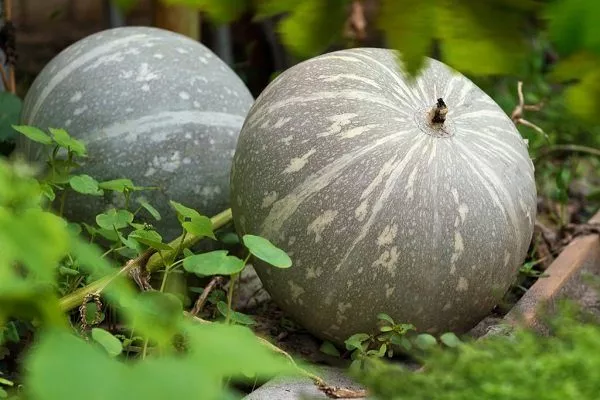
The Volga Gray pumpkin produces a high yield.
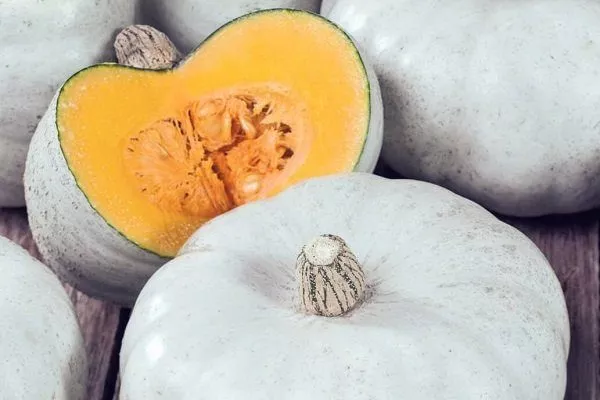
The Volga gray pumpkin stores well.

Volga Gray Pumpkin
Description and characteristics of the "Grey Volga Pumpkin"
"Volzhskaya Seraya 92" is a mid-season, large-fruited variety bred in 1940. Regions recommended for cultivation include the North Caucasus, the Lower Volga District, and some parts of the Urals.
The plant is medium-sized. It has a thick central shoot from which thinner side shoots branch. The foliage is moderate, but the leaves are prone to drying out. When well-watered, the foliage lifts and covers the pumpkins, protecting them from the scorching sun.
The flowers of this variety are medium-sized, pale yellow, and slightly pubescent on the outside.
Description of fruits
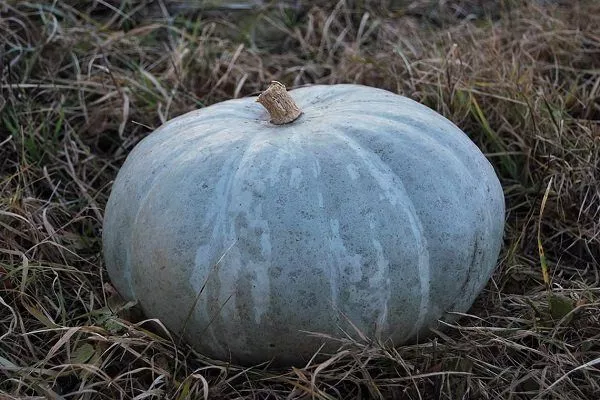
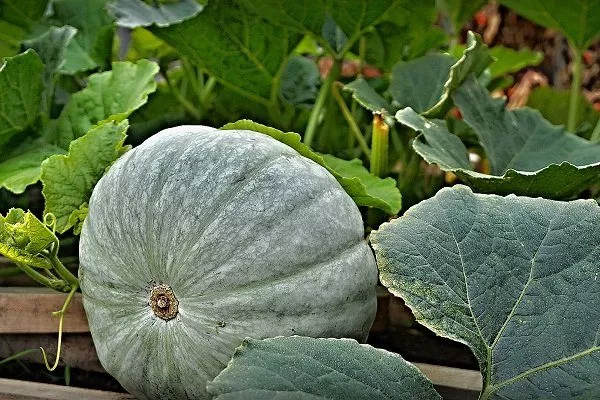
Volga Gray pumpkins are easily recognized by their gray rinds. Even when ripe, the rind doesn't yellow.
Description of fruits:
- Form. The fruits of the Volga Gray variety are round, slightly flattened at the top and bottom.
- Crust. Smooth, dense, segmented. No pattern.
- Color. The ripe fruit has a light gray rind, sometimes with a greenish tint.
- Pulp. The inside of the fruit is creamy or yellow, turning orange when fully ripe. Firmness and sweetness are medium. The pulp layer is 4-5 cm thick.
- Seeds. Semi-oval, with a distinct pumpkin-like flavor, they are eaten raw or roasted.
The average pumpkin weight is 10 kg. Some specimens reach 20 kg. A single bush produces 2-3 fruits.
Main characteristics
The "Volga Gray" pumpkin loves the sun, but its leaves are sensitive to sunburn. It can grow in shaded areas as long as it receives consistent, filtered sunlight.
Main characteristics of the Volga Gray pumpkin:
| Characteristics/parameters | Description/Meaning |
| Ripening time | 3.5-4 months (mid-season) |
| Cold resistance | Withstands temperatures down to +10 °C |
| Drought resistance | High |
| Pest resistance | Average |
| Productivity | 15 kg per 1 sq. m |
| Purpose | Universal |
| Transportability | Good |
| Shelf life | Excellent |
Advantages and disadvantages of the variety
Advantages of the "Volga Gray" pumpkin:
- It can withstand long periods of drought, provided that the ovaries have already formed.
- Consistently high yield.
- Large fruits.
- High taste qualities.
- The fruit pulp contains a lot of beta-carotene, potassium and iron.
- The dense rind ensures excellent shelf life. The fruits retain their color and flavor during storage, and they don't rot.
Flaws:
- Highly demanding fertilizing requirements. To produce large, abundant fruits, the crop requires regular feeding with mineral and organic fertilizers.
- Low cold tolerance. This variety is better suited for southern regions.
Features of planting and growing
This pumpkin variety is grown by direct sowing of seeds into the ground or from seedlings. The future harvest is influenced by many factors, including the quality of the seeds and seedlings, planting timing, soil, site conditions, and much more.
About the deadlines
The timing of pumpkin planting depends on two factors:
- The growing region, its climate and current weather conditions.
- Growing methods - planting times for seeds and seedlings are different.
In the southern regions, seeds are sown in open ground in mid-May, in cooler regions – at the beginning of summer.
When choosing planting dates, consider the weather. Pumpkins are planted when the soil warms to 14-17°C. If seeds or seedlings are planted in colder soil, they will rot.
The timing of sowing seeds for seedlings is calculated taking into account the rule: seedlings transplanted into the ground should be about 1 month old.
Choosing a landing site
Site requirements:
- A well-lit area. Some shade is possible.
- Deep groundwater. Don't plant pumpkins in low-lying areas—the fruits will be watery and not sweet.
- The soils are loamy and sandy, loose and well fertilized with organic matter.
- Neutral soil acidity level.
- There should not be tall plants growing nearby.
- The best soils are loam and sandy loam. Clay soils are not suitable for growing pumpkins, as the fruit develops thin and tough flesh.
- Optimal predecessors include onions, green manure, cabbage, legumes, and radishes. Pumpkins should not be planted after potatoes, sunflowers, zucchini, squash, cucumbers, melons, or watermelons.
- ✓ The soil pH level should be strictly within 6.0-6.8 for optimal nutrient absorption.
- ✓ The organic matter content of the soil should be at least 4% to ensure sufficient water-holding capacity.
The optimal temperature for the growth and development of the Volga Gray pumpkin is +25 °C.
Site preparation
Soil preparation begins in the fall:
- The area is dug over, adding compost or rotted manure. The recommended rate of manure is 1 bucket per square meter.
- Additionally, mineral fertilizers are added: 50 g of potassium salt and 80 g of phosphorus per 1 sq. m.
- In the spring, before planting, the area is dug up again.
Many gardeners plant pumpkins directly on compost heaps, which means no additional fertilizer is needed throughout the growing season.
Seed preparation
Pumpkin seeds are prepared for planting as follows:
- Soak the seeds in a weak solution of potassium permanganate for 60 minutes. This procedure disinfects the seeds.
- Wrap the seeds in a damp cloth to encourage germination. Spray the cloth with water from time to time, perhaps using a spray bottle. The sprouts will appear within a few days.
Gardeners have another method for preparing seeds:
- The seeds are kept in an oven at a temperature of +40 °C.
- Keep in gauze soaked in ash solution for 12 hours.
Sowing seeds
Planting pumpkin seeds in open ground:
- Prepare the holes in advance. The distance between adjacent holes should be 60-80 cm, and between rows, 1.5-2 m. Pumpkins need space, so don't reduce the distances.
- Pour 1-2 liters of warm water, heated to +50 °C, into the holes.
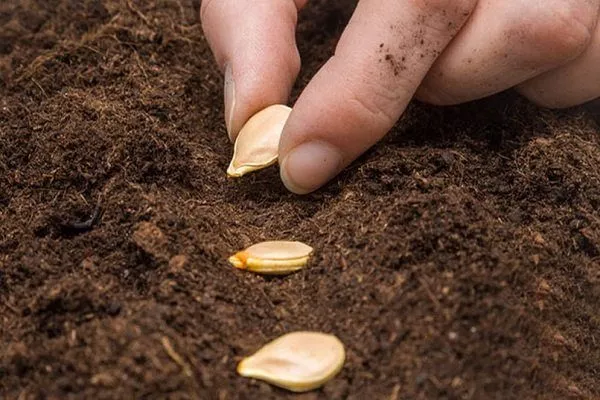
- Wait for the water to soak in, then plant the seeds deep, pointed ends down. Place 2-3 seeds per hole. When seedlings emerge, leave the strongest sprout and pinch out the others.
- Cover the seeds with soil to a depth of 6-7 cm. If the soil is heavy, 3-4 cm will be sufficient. Mulch the crops with peat or compost.
- Cover the crops with plastic film if there's a risk of frost. The greenhouse effect will help the seedlings emerge faster.
Caring for seedlings
It can take up to 10 days for seeds to germinate. It will take another 30 days to grow seedlings. Count 40 days from the intended planting date and soak the seeds on that day.
The procedure for growing pumpkin seedlings:
- Prepare the planting containers. Peat cups are the best option, as pumpkins don't like being transplanted. These "containers" can be buried in the soil along with the seedlings' roots.
- Sow the sprouted seeds in peat containers. If you don't have these, use cups filled with a mixture of turf, humus, peat, and cow manure (1:3:5:1). Plant them at a depth of 4-6 cm. Be sure to water the soil thoroughly before sowing.
- Cover the crops with plastic film. Ventilate the crops regularly. The optimal daytime temperature is 25°C, and the nighttime temperature is 15-18°C.
- When the seedlings emerge, remove the plastic wrap. To prevent the seedlings from stretching, place them in a well-lit area. Initially, reduce the daytime temperature to 15-18°C, then raise it again after 5 days.
- Water the seedlings as the soil dries out.
- A week after the emergence of seedlings, feed the seedlings with 15 g of nitrophoska per 10 liters of water, or mullein (1:10 solution).
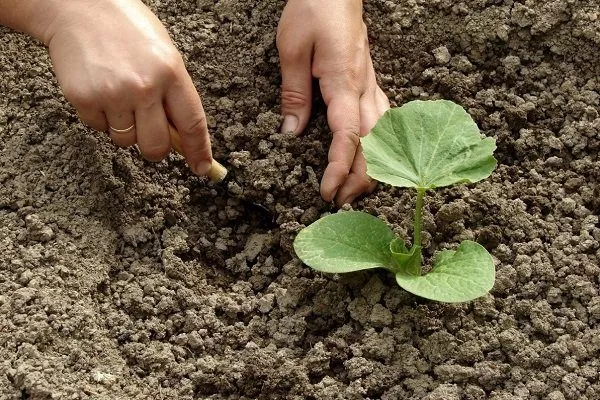
- When the seedlings reach 15-20 cm, you can plant them into open ground.
Transplanting seedlings
Once the pumpkin seedlings have reached maturity and favorable conditions have been created, they are transplanted into open ground:
The procedure for transplanting seedlings:
- In a pre-prepared area, dig holes using the same pattern as when planting seeds - 60-80 x 150-200 cm.
- If the seedlings were grown in peat pots, break up the dense outer walls. If the seedlings were grown in a substrate—in cups or containers—water them beforehand to make it easier to transfer them to the hole.
- Plant seedlings on a cloudy day or in the evening. Try to move them along with the soil to avoid damaging the roots.
- Water the seedlings generously and shade them for the first time.
- Mulch the soil and make a border around each seedling to prevent water from spilling out when watering.
Care instructions for the "Grey Volga Pumpkin"
Planting a pumpkin correctly isn't enough; you also need to provide it with proper care—the size, taste, and quantity of the fruit will depend on this.
Volumes and frequency of watering
From regularity and volume watering pumpkins The harvest depends on its quantity, as well as the size and taste of the pumpkins.
Watering rules:
- Pumpkin evaporates a lot of water through its large leaves, so it needs abundant and regular watering.
- Pumpkin is watered especially generously during flowering and fruit formation.
- For irrigation, use warm, settled water, no cooler than 22°C. The water can be heated directly in the sun in large containers.
- Don't water pumpkins with cold water. This is especially dangerous in hot weather, as it can kill the plants.
- At the beginning of the growing season, the watering rate is 2 liters per bush, subsequently the rate is increased to 10 liters.
- At the beginning of the growing season, water more frequently. Seedlings are watered every 3-4 days. Subsequently, water as the soil dries out.
- When pumpkins are blooming, first loosen the soil, remove weeds, and only then water them – during this period the plant requires more water.
Increased moisture consumption is observed during fruit formation.
Pumpkin fertilizing
"Volga gray" pumpkin is being fed three times:
- First feeding. When 3-5 leaves appear, apply mullein—dissolve 1/2 liter of liquid fertilizer in a bucket of water. Water at the roots. The recommended rate is 10 liters per 5 plants.
- Second feeding. During the growth period, mullein is used, but 1 tablespoon of nitrophoska is added to each bucket.
- Third feeding. Conducted during fruit formation. Add a glass of ash and 2 tablespoons of potassium sulfate to the mullein solution.
- Two weeks before planting, add a complex mineral fertilizer with an N:P:K ratio of 10:10:10 to the soil at a rate of 50 g per 1 sq.m.
- Three weeks after the emergence of seedlings, fertilize with a solution of mullein (1:10) with the addition of 20 g of superphosphate per 10 liters of water.
- During the flowering period, apply potassium fertilizers at a rate of 30 g per 1 sq.m to improve fruit set.
Loosening the soil and weeding
The purpose of loosening is to increase the soil's moisture and air permeability. Features of loosening:
- While loosening the soil, weeds are removed at the same time – they choke out the crops and take away moisture and nutrients from the pumpkin.
- Loosen the soil until the root collars are clearly visible. Once the pumpkin's leaves become large, they suppress weed growth, making weeding unnecessary.
- The soil must be loosened after watering and rain.
- The first time, the soil is loosened to a depth of 15 cm, then the loosening depth is gradually reduced. After a month, the soil is loosened to a depth of no more than 8-9 cm to avoid damaging the plant roots.
- To prevent moisture evaporation and weed growth, the soil is mulched with peat or humus.
Bush formation
To obtain large fruits, the ‘Volzhskaya Seraya’ bush needs to be shaped:
- At the beginning of growth, to increase bushiness, pinch the apical shoot when 2-3 pairs of leaves appear.
- The plant is trained with 1-2 stems, each bearing several flowers. To produce larger pumpkins, the plant is trained into a single stem.
- Excess inflorescences are removed, leaving a few flowers in the trunk area.
- On the main stem, on each side, after 4 leaves, one shoot is left, the rest are removed.
- The tops of the vines are positioned so that they are exposed to the sun, otherwise the fruits will be small.
Harvesting and storage
Collection rules and storing pumpkins:
- The fruits are harvested before the first frost.
- The ripeness of the fruit is determined by the stalk – it should darken and dry out.
- After harvesting, the fruits are dried in the sun or in a dry room.
- Pumpkins are stored in the basement, cellar, or on a glazed balcony.
- The fruits of this variety can be stored for a full year. To do this, they are placed in a well-ventilated room with a temperature of 6°C and humidity of 70%. The pumpkins are placed on shelves lined with dry straw.
- Fruits can be stored in an apartment for up to 5 months.
- Pumpkin can be frozen for storage. Peel it, cut it into portions, place it in an airtight container, and put it in the freezer.
Diseases and pests
This variety was bred a long time ago and is therefore susceptible to many diseases and pests. Fungal diseases pose the greatest threat.
The most common diseases and pests of the Volga Gray pumpkin variety:
| Diseases/pests | Signs of defeat | How to fight? |
| Bacteriosis | The leaves have brown spots that dry out over time. Holes appear where the spots once were. | Remove and destroy affected shoots. Spray with a 1% copper sulfate solution as a preventative measure. |
| White rot | The leaves and fruits have a white coating. They soften and rot. | Remove and burn the affected parts. Sprinkle the cut areas with charcoal. |
| Powdery mildew | The leaves develop a grainy white coating. The plant gradually dries out and dies. | Cut off affected leaves. Spray with colloidal sulfur – 20 g per 10 liters. |
| Aphid | Affects foliage and inflorescences. Can destroy the entire crop. | Spray with a 10% solution of malathion. |
| Spider mite | The leaves are covered with spots, and a whitish web covers the back of the leaves. | Weeds are removed promptly and crop rotation is observed. A 20% chloroethanol solution is used for spraying. Alternatively, an onion peel decoction can be prepared: 300 g per 10 liters. |
Potential difficulties when growing
The grey pumpkin is unpretentious, but the following problems may arise when growing the variety:
- This variety doesn't like damp and cool weather. Under such conditions, the plant is susceptible to fungal diseases.
- If pumpkins aren't fertilized on time, yields decline and fruit size decreases. It's important to ensure the vegetable's nutrition includes all three key nutrients—nitrogen, potassium, and phosphorus.
- The variety is capricious regarding growing conditions: if the area has poor lighting, close groundwater levels, or undesirable predecessors have grown, the crop's yield will sharply decrease.
Secrets to Successful Pumpkin Growing
Experienced gardeners advise beginners:
- When preparing seeds for planting, discard moldy and mechanically damaged specimens.
- Avoid planting pumpkins in waterlogged or acidic soils.
- Enrich the soil with humus and add peat or sand for looseness.
- Don't be lazy in removing weeds and plant debris - this will prevent many diseases.
Reviews of the "Grey Volga" pumpkin
Growing the "Volga Gray" pumpkin is easy; the key is to water and fertilize it at the right time, pinch the plants correctly, and remember to take disease prevention measures. This variety is so good that, despite its long history and numerous new competitors, it remains one of the most popular among gardeners.