
Red pumpkin belongs to the gourd family and is a variety of ornamental pumpkin. It is distinguished from other varieties by its vibrant, variegated skin. The flesh can be either red or orange, depending on the variety. There are many varieties of red pumpkin, but two are considered the most common in Russia: Parisian and Little Red Riding Hood.
| Name | Ripening period (days) | Disease resistance | Soil type |
|---|---|---|---|
| Little Red Riding Hood Turban Pumpkin | 100 | High | Neutral |
| Parisian red | 100-120 | Average | Sandy loam |
Little Red Riding Hood Turban Pumpkin
This variety is most often used for landscaping in gardens as a decorative element. It has the most unusual pumpkin shape—Little Red Riding Hood—unmistakable from any other variety.
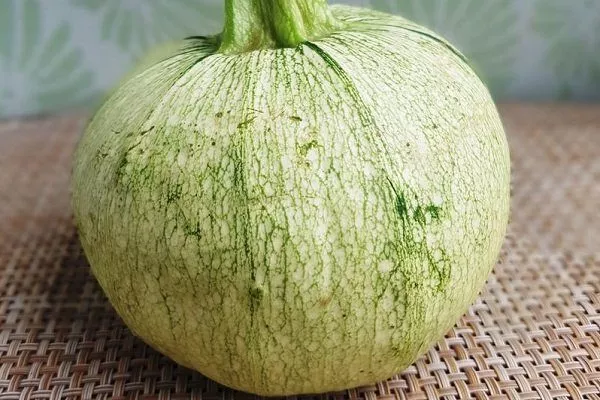
A distinctive feature is that numerous tendrils extend from the main trunk. These tendrils are used to hang the vines on a vertical trellis, saving space in the garden bed.
Description of the variety
This variety is considered high-yielding, yielding 40–60 kg of fruit per 10 square meters. If grown on a vertical support, the yield is even higher—one bush will produce 10 to 20 pumpkins.
The plant easily tolerates drought and high temperatures, without even requiring additional moisture. Like all large-fruited varieties, Red Riding Hood is susceptible to disease, but it is resistant to powdery mildew, slugs, aphids, and spider mites.
Characteristics and features
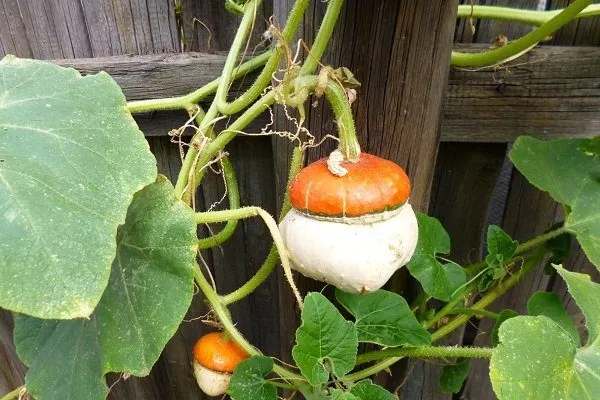
Little Red Riding Hood's most unusual characteristic is the pumpkin's shape and color—it resembles an acorn, a mushroom, and an oriental headdress (a turban). The color of the lower part and the top, shaped like a cap, differ.
Peculiarities:
- weight varies from 2 to 5 kg;
- peel color: top - orange-fiery, red; bottom - white or light green;
- the pulp is orange in color;
- the pulp is quite sweet, with a sugary, crumbly structure;
- the taste is pleasant, without bitterness and astringency;
- the aftertaste is melon-nutty (reminiscent of nutmeg);
- average diameter from 8 to 20 cm;
- pulp thickness 6–10 cm;
- ripening period is about 100 days;
- the surface is slightly segmented with or without clear edges;
- the juiciness is weak;
- nutritional value - contains the most carotene;
- small seed chamber;
- large seeds;
- the seed core shell is orange with a rim;
- the bush is very spreading;
- long whips with tendrils.
If you pinch the vines, the fruit will grow large, but there will be few of them per bush. If you don't pinch the stems, you can harvest about 20 pumpkins from a single bush.
Pros and cons of the variety
Little Red Riding Hood has far more advantages than disadvantages. The main advantages include the following:
- compactness due to long vines that are tied up;
- exotic appearance;
- versatility of use - can be used for decoration and eaten;
- optimal fruit weight (not too large and not too small);
- Possibility of weight adjustment by pinching;
- high level of productivity;
- resistance to drought and cold, major diseases;
- sweetness and pleasant aroma;
- storage duration;
- transportability;
- indoor ripening - if you pick pumpkins when they are unripe, they will quickly ripen indoors;
- suitability of planting material for 6–8 years;
- seed size.
Experienced gardeners note the following disadvantages:
- slight juiciness, but at the same time watery structure;
- the rind is too hard when fully ripe (and the longer the pumpkin is stored, the harder the rind becomes, to the point that it is impossible to cut).
It's forbidden to grow Red Riding Hood near other pumpkins. Cross-pollination occurs, and the true color of the surface won't be achieved.
Features of cultivation
Since Little Red Riding Hood easily adapts to both hot and cold conditions, it is grown in almost all regions of Russia. However, for seeding to occur, the air temperature must stabilize at between 8 and 10°C.
Planting methods depending on the region:
- Southern latitudes. Sow seeds into open soil. Deadline: late April.
- The middle zone and regions with identical climatic conditions. First, with seedlings, then transplanting the bushes into the garden. Time: March - April.
- Urals, Siberia. Only in greenhouses. Period: April.
If frost is expected, be sure to cover the seedbeds with plastic film after planting. Mulch the holes first (with straw, hay, or even better, peat or compost, which will provide additional heat).
What you need for planting:
- neutral soil - from 6.5 to 7.5 pH acidity;
- soil fertility (Little Red Riding Hood is demanding);
- sunny area - without any shading;
- planting pattern - the distance between rows is about 1 m, between seedlings in one row 0.8 m;
- When growing using the seedling method, it is strictly forbidden to transplant the pumpkin - Little Red Riding Hood does not tolerate frequent transplants due to the branching of its root system;
- Before sowing, 5 kg of cow dung per 1 sq. m is added to the soil.
- ✓ The soil temperature during planting should not be below +10°C to ensure optimal germination.
- ✓ The distance between plants should be at least 0.8 m to ensure sufficient space for root growth.
Further cultivation and care are identical to the standard rules for all pumpkin varieties. However, there are some nuances specific to this variety:
- Watering. Despite its good drought tolerance, to ensure a good harvest, monitor the soil moisture level. A dry crust should not form, and stagnant water should be strictly avoided. Water the soil once every 7-10 days, depending on the weather. Rules:
- If the soil is too dry, do not add large amounts of water at once, as this will cause the pumpkins to burst;
- young plants require 2 to 3 liters;
- during flowering - 4-5 liters of water per bush;
- during fruit formation and further - 11–12 l;
- 15–20 days before harvesting, stop watering completely.
- Garter. This procedure saves space in the garden beds and prevents fruit from rotting in rainy weather. To achieve this, create a support or trellis. If you plant the Red Riding Hood near a fence (but be sure to plant it on the sunny side), you can create a hedge.
- Topping. This procedure stimulates the growth of lateral shoots. Pinch the main vine at the 1-meter growth stage.
- Loosening. This is done to allow oxygen to penetrate the root system. It also breaks up the dry crust. Hilling should be done when 7-8 true leaves have formed.
- Mulching. It's best to use sawdust, sand, and hay. Turn the material periodically to prevent slugs from infesting it.
- Direction of the whips. Growth adjustments are required, otherwise large leaves will shade the fruits and they will not acquire the desired color.
Can you eat ornamental pumpkin?
Ornamental pumpkins are designed to decorate interiors and create a unique design element in the home's surroundings. These pumpkins are incredibly popular with designers, but unlike other red varieties, the Little Red Riding Hood pumpkin is also edible.
The variety is used for preparing a variety of dishes:
- porridge;
- casseroles;
- cream soups;
- sauces;
- side dish;
- jam and marmalade;
- juice, etc.
The vegetable can be not only cooked but also eaten raw in salads and appetizers. The key is to pick the fruit when it's not yet fully ripe, before the flesh acquires a slight bitterness.
Parisian red
This variety is considered a table pumpkin. It produces fruit successfully in almost all regions of Russia and is considered a mid-season variety. The Parisian red pumpkin was bred in France, but today it has spread throughout the world and become a favorite of many chefs and gourmets.
Description of the variety
This variety is considered large-fruited, and unlike the previous variety, this is indeed the case. Some gardeners grow pumpkins weighing up to 20–25 kg. Parisian Red is a high-yielding variety. A minimum of 4–10 kg can be harvested per square meter (assuming the fruits are small).
This variety easily tolerates long transportation, has a long shelf life, and requires no special care or growing conditions. Its high carotene content makes it ideal for making tasty and healthy dishes. Farmers often use pumpkins for livestock feed.
Characteristics and features
Parisian Red pumpkin plants grow very spreadingly. The vines are quite long, making them easy to grow—they can be suspended from supports, saving space in the garden beds.
Characteristic features:
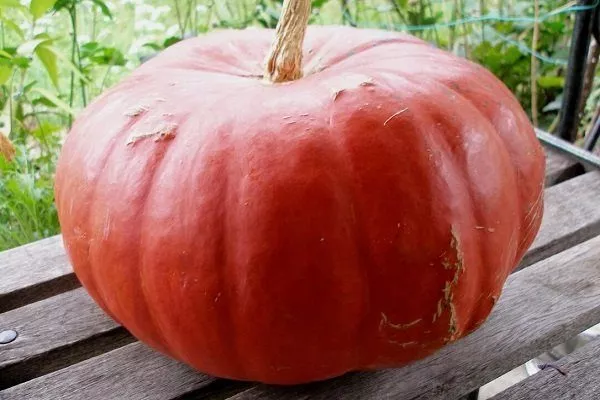
- the shape of the fruit is round and flattened;
- segmented ribbed surface;
- the color of the pulp is orange;
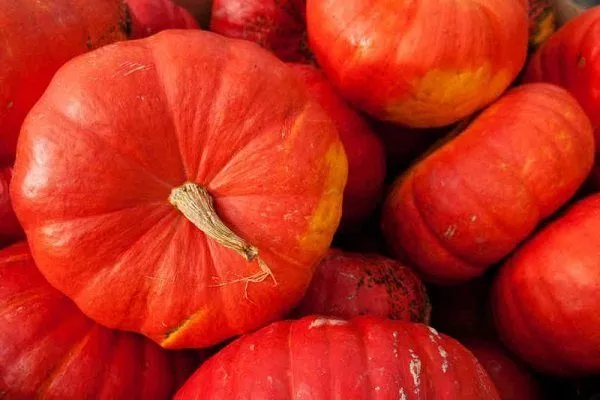
- the skin color is initially bright orange, then dark red;
- weight from 5 to 20 kg, but on average about 6–9 kg;
- density and juiciness are average;
- medium-sized seed nest with large whitish and elliptical seeds;
- pulp with crunch;
- maturation period from 100 to 120 days;
- the sweetness is excellent.
Pros and cons of the variety
The Parisian Red pumpkin's strength lies in its vigorous growth and bushy growth, which prevents breakage of the vines and main stem. But there are other advantages that are hard to ignore:
- high yield, transportability, and shelf life;
- unusual color for a pumpkin, commercial shape;
- sweetness of the pulp and pleasant aroma;
- fruit size;
- the possibility of creating a hedge, since the lateral shoots are very long;
- versatility of application;
- unpretentiousness.
Among the shortcomings, gardeners note the skin becoming woody during storage. Also, upon reaching technical maturity, a bitter taste develops, which is why the pumpkins have to be fed to livestock.
Growing conditions
Parisian red prefers sandy loam and light loamy soil with neutral pH. Planting is done in two ways: by seed in the ground or by seedlings.
| Planting method | Optimum soil temperature | Planting depth |
|---|---|---|
| Seeds in open soil | +10°C | 5-7 cm |
| Seedlings | +15°C | Pot depth |
Sowing features:
- soil temperature from + 10 to + 12°C;
- the depth of planting material is 5–7 cm;
- diagram - the distance between rows is 1.4 m, the distance between seedlings in one row is 0.9–1.0 m or 80 x 60 cm, if you need not very large fruits;
- when growing seedlings, a special soil mixture is required, consisting of 35% humus, 5% coconut mixture and 30% each of turf soil and peat;
- In the first stage of vegetation, fertilizing is carried out twice:
- the first one 9–11 days after the formation of sprouts (for 10 liters of water - 25 g of calcium nitrate);
- the second time after the same number of days (a complex mineral fertilizer is used).
- The soil for sowing seeds is prepared twice:
- in autumn, during digging, 25 kg of humus is added per 1 sq. m;
- in spring - 75-80 g of Fertika spring-summer or universal preparation per 1 sq. m.
Care and cultivation rules:
- Moisturizing. It's strictly forbidden to water this variety at the roots. To water, dig furrows around the perimeter and add water to them. Watering once a week, 12-15 liters per plant, is sufficient.
- Mulching. A necessary procedure for maintaining optimal soil moisture levels. Peat or straw/hay are recommended.
- Formation of a bush. To ensure good fruit production, remove all side shoots and suckers from the Parisian Red pumpkin, leaving one or two stems at most. After three fruit sets have formed, pinch out the shoots.
- Top dressing. This variety requires a lot of nutrients. Fertilization is the key aspect of growing Parisian red pumpkin. Here are the guidelines:
- the first time after the formation of 5 leaves;
- the second, when the whips are formed;
- then (until the fruits begin to grow rapidly) - every 10–15 days;
- use liquid manure, mullein (1 liter of mixture per 10 liters of water);
- in the middle of the growing season, add minerals - 2 tablespoons of ammonium sulfate per 10 liters of water;
- after another 14 days - 2 tablespoons of potassium sulfate per 10 liters of water;
- then after 10 days - 1 tablespoon of potassium monophosphate per 10 liters of water;
- after the same amount of time - Agricola, Turbo, etc.
Parisianka, as gardeners also call this variety, responds well to additional foliar feeding. To do this, add 1 teaspoon of urea per 10 liters of water and apply twice a month.
Methods of use and storage
Harvesting after frost is not permitted. Parisian Red pumpkins can be harvested when unripe. They will ripen well in a warm place within 1–2 months.
For harvesting, choose a dry and preferably sunny location. Then follow these guidelines:
- do not twist or tear off the fruits, but cut them off together with the stalk using scissors/pruning shears/knife;
- leave a stalk of about 5 cm;
- Immediately after harvesting, lay the pumpkins out on burlap or a wire rack to dry thoroughly;
- If it is cloudy outside, set aside a room for this purpose, where fresh air should be supplied;
- It can be stored both indoors and in a cellar, but the humidity level should not exceed 85%.
Choosing a red pumpkin variety shouldn't be based solely on the desire to impress your neighbors with an unusual vegetable. Each variety has its own characteristics, growing requirements, climate preferences, and preferred uses. However, among the wide variety of hybrids, it's entirely possible to find a variety that perfectly combines ornamental and culinary uses.