
Relatively recently, an exotic wonder appeared in our country: the white pumpkin, which is not only unusual in appearance but also contains a wealth of beneficial nutrients. The white color is usually only apparent on the outside. Many gardeners claim that this vegetable, like regular pumpkin, is easy to grow, but has its own unique characteristics.
The History of the White Pumpkin
Pumpkin crops appeared around 6000 BC (the exact date is unknown, but probably around the first century). Various varieties existed, and even light-colored specimens were found, but these were considered "mutants."
The white variety emerged thanks to the work of breeders in 2005. At the same time, research began into developing snow-white pumpkin varieties.
White pumpkins were first bred on the island of Java, and the seeds were then transported to China and Japan, from where they reached Russia.
Varieties of white pumpkin
White pumpkins, like green, red, orange, and other varieties, are divided into two classes: bush and climbing. The former have short vines (up to 2 m), while the latter have long vines (7-15 m), making them suitable for tying to trellises and other supports.
| Name | Ripening period (days) | Pulp color | Fruit shape | Average weight (kg) |
|---|---|---|---|---|
| White Forest | 110-120 | Orange | Flattened-round | 14-15 |
| New Zealand | 110 | Orange | Flattened-rounded | 4-5 |
| Benincasa | 110-120 | White with a greenish tint | Elongated | 5-10 |
| White acorn | 80-80 | Snow-white or light beige | Acorn-shaped | 0.5-1 |
| Fortune | 100-120 | Orange | Pear-shaped | 1-1.5 |
| Little Boo | 100 | Light | Round and flattened | 0.15-0.3 |
- ✓ For regions with short summers, early-ripening varieties such as White Acorn are preferable.
- ✓ All varieties can be grown in the southern regions, but Bely Bor and Fortuna perform particularly well.
- ✓ In conditions of high humidity, it is better to choose varieties with resistance to fungal diseases, for example, Benincasa.
White Forest
The variety was bred in Africa, is a table crop, and is characterized by large fruits.
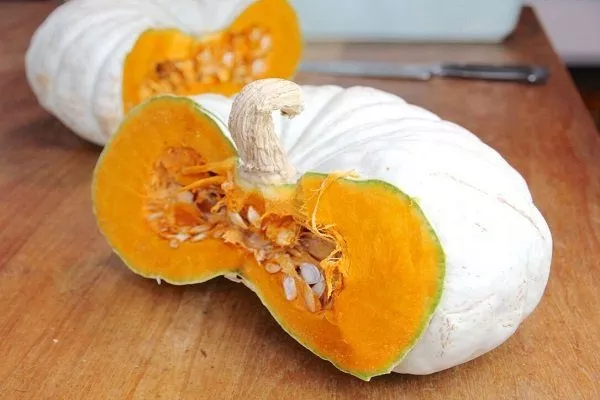
Other features:
- ripening period – average, varies from 110 to 120 days;
- pulp – has a classic orange hue, is quite dense, and tastes like an exotic fruit mix;
- form - flattened-round, and very much so;
- peel – ribbed type (large segments are divided by small grooves), compacted, absolutely white at the end of the growing season, green at the beginning;
- purpose – consumption in raw, boiled, stewed, baked form;
- average weight – 14-15 kg in our region, on the African continent almost 2 times more (due to the climate);
- seminal chamber - insignificant with large seeds, which are also covered with a white shell (experts also note the looseness of the placenta).
The variety has a massive root system that penetrates deep layers, so in the presence of nearby groundwater, the crop does not require frequent watering.
What is needed for a high yield and the sweetest and most delicious fruits:
- air temperature 29-35°C;
- low humidity;
- the optimal region for cultivation is Crimea, Krasnodar Krai, Lower Volga region;
- frequent loosening of the soil.
If you don't follow these conditions, the pulp will be bland. If you water it too often, the carotene and sugar will be washed out.
New Zealand
The variety also has another name, Kruan Vangapara, meaning long-lasting. It resembles Bely Bor in appearance, but produces much smaller pumpkins. It produces its best fruit in the Black Sea region. If grown in the central part of Russia, greenhouse conditions are required.
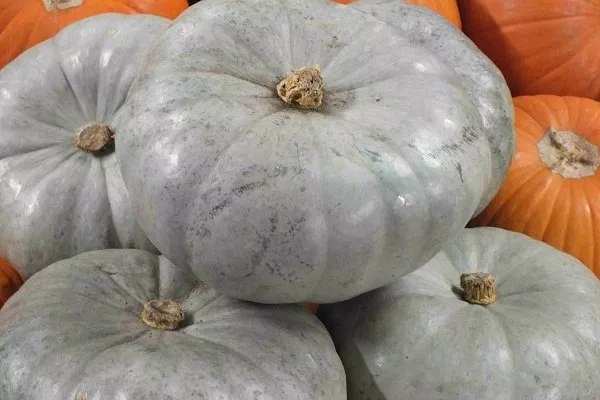
Other features:
- ripening period – about 110 days, which indicates the average ripeness of the variety;
- pulp – very thick, reaches up to 8-10 cm, separates from the peel with a light green ring, the edible part is orange, the taste is exotic;
- form - flattened-rounded;
- peel – segmented, white, but greenish at the beginning of the growing season;
- purpose – preparation of any food, decoration of the local area;
- average weight – 4-5 kg;
- seminal chamber – small, but with large white seeds.
A distinctive feature is the surface being covered with a whitish coating. The plant is very vining, requiring support. Other cultivation features:
- Frequent moisturizing is necessary;
- frosts are not allowed;
- it can be grown even in Siberia, but in a heated greenhouse;
- the soil is very fertile and loose;
- is susceptible to pest and disease attacks, so it is pre-treated with fungicides and insecticides.
Average air temperatures are 22-24°C. In this case, harvesting occurs before 110 days.
Benincasa
The peel is also known as waxy because the surface of the peel is covered with a thick waxy layer. Despite this, it reflects light under bright light, giving it a glossy appearance. This coating acts as a protective barrier against pests and fungal infections.
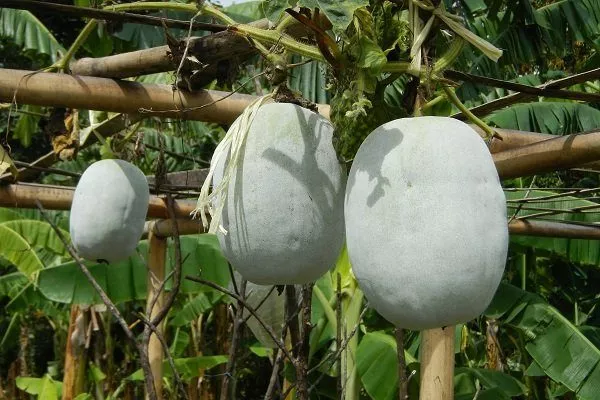
Gardeners sometimes call Benincasa winter squash or Indian squash. It resembles a giant zucchini. It was imported from Asia. The vines reach up to 4 meters, and the flesh contains a lot of pectin.
Other features:
- ripening period – from 110 to 120 days;
- pulp – white with a slightly greenish tint, medium thickness – about 6 cm, not too sweet, but very juicy;
- form - elongated;
- peel – slightly hairy in the middle of the growing season, smooth at the end, colour – very light green with a snow-white tint;
- purpose – preparation of sauces, gravies and side dishes for fish and meat dishes;
- average weight – from 5 to 10 kg;
- seminal chamber – voluminous, but the seeds are small and yellowish.
Growing features:
- needs a lot of sun;
- watering is moderate (if you water too often, the plant will rot and the fruits will become tasteless);
- It easily survives drought, so it is most often cultivated in the corresponding regions;
- optimal air temperature +23–+27°C.
White acorn
An early-ripening variety grown in virtually all regions of Russia. The plant is bushy, so the stems reach a maximum of 2 meters, and the ovaries form at the very base of the stems.
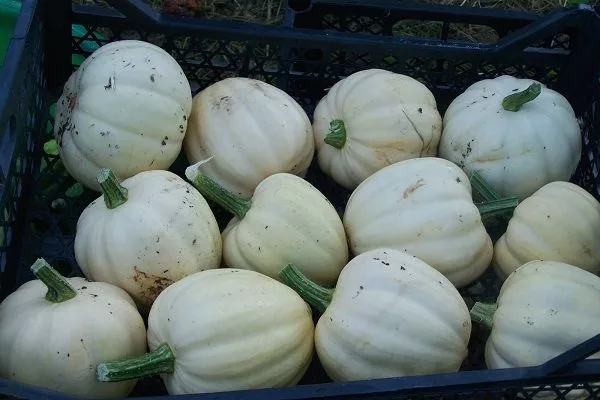
Other features:
- ripening period – 80-80 days;
- pulp – snow-white or light beige, not sweet (the variety does not contain polysaccharides and carotenoids), pumpkin-potato flavor, medium density;
- form - acorn-shaped with an expansion at the stalk and a narrowing on the other side;
- peel - ribbed, white or cream in color;
- purpose - as a side dish (chefs recommend preparing the same dishes as with potatoes);
- average weight – 0.5-1 kg (portion size);
- seminal chamber - small with large seeds, light in color.
White Acorn is undemanding in cultivation and care - all the measures are standard, like for any pumpkin.
Fortune
This mid-season crop is ideal for growing in Crimea, the Krasnodar Krai, and the Caucasus, as it is very heat-loving. When planting in the Central Belt and similar regions, seedlings and greenhouse cultivation are used.
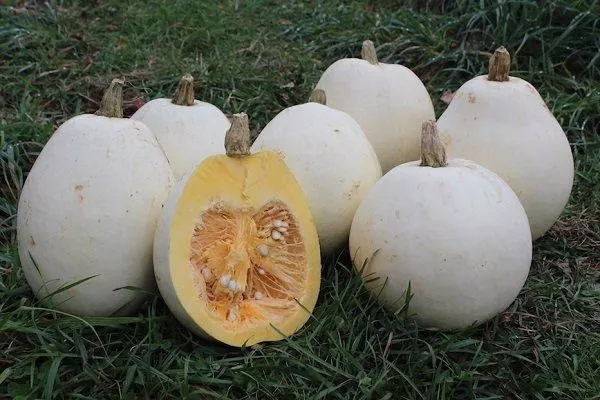
Other features:
- ripening period – 100-120 days;
- pulp – orange and not very dense, moderate sweetness, neutral taste;
- form - pear-shaped with a strong expansion at the bottom;
- peel – even, smooth and snow-white;
- purpose – universal – porridge, potato dishes, casseroles, etc.;
- average weight – from 1 to 1.5 kg;
- seminal chamber - large with medium-sized seeds.
The plant is vigorous and vining, so gardeners recommend staking the vines rather than pruning them. One problem with growing it is pollination. The problem is that most bushes contain female pistils, leaving insufficient male pistils.
Other cultivation features:
- requires very fertile soil, so it can even be grown on compost heaps;
- does not tolerate cold and frost;
- The soil must always be moist, for which the mulching method is used.
Little Boo
This is an ornamental pumpkin variety used for food. It is intended for cultivation in the southern regions, but can also be planted in the Moscow region, central Russia, and Siberia (under greenhouse conditions). The plant is considered a climbing plant and was developed by American breeders.
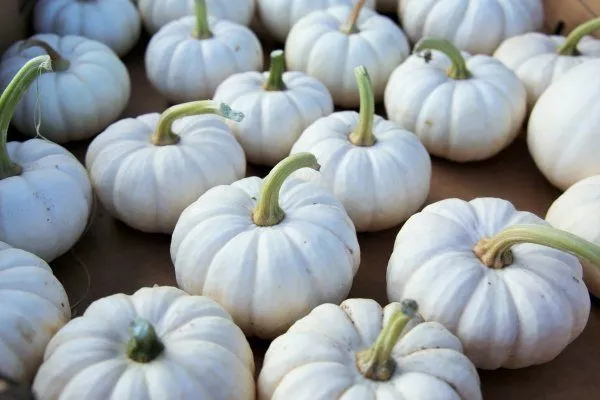
Other features:
- ripening period – about 100 days;
- pulp – high density with a neutral taste and aroma, low sugar content and light shade;
- form - round and flattened;
- peel – dense, ribbed, smooth and snow-white;
- purpose – dishes similar to potatoes (only young fruits are used for cooking);
- average weight – very small – 150-300 g;
- seminal chamber - big, seeds are small.
Growing features:
- prefers moist soil, so watering is carried out regularly;
- It is not susceptible to bacterial diseases, but is susceptible to powdery mildew and pests.
Distinctive features of white pumpkin
The main characteristic of any white pumpkin variety is the snow-white or creamy surface of the fruit. The flesh can vary, but the most common is a classic orange or light color. Hybrids have a shelf life of at least one year, and a maximum of three.
Features of cultivation
Each white pumpkin variety has its own cultivation principles. However, there are also general rules specific to this crop:
- Planting method. In regions with a warm climate, seeds are planted directly in open ground; in cool climates, seedlings are first grown indoors and then transplanted into the garden; in cold climates, they are planted only in a heated greenhouse.
Experts do not recommend picking or transplanting, as white pumpkins have a hard time adapting to new locations. Therefore, in temperate regions, seedlings can be grown in temporary greenhouses, and once optimal temperatures are reached, simply remove the plastic film. - Soil indicators. White crops prefer neutral soil with a pH of 6 to 7.5. The soil structure must be loose, as pumpkins will not grow in heavy soil.
A mandatory requirement is increased fertility, so before planting the planting material in the fall and spring, be sure to add fertilizers - organic matter (compost, manure, bird droppings) and minerals (superphosphate and the like). - Crop rotation. Follow these rules strictly, especially when it comes to pumpkins of a different color. If you plant them next to a white variety, the white one will cross-pollinate and not produce the desired color.
- Place. The site should be extremely sunny. Since the root system is very strong and extensive, white pumpkin can be planted in areas prone to waterlogging, thereby avoiding waterlogging.
Pay attention to the specific variety—some don't tolerate high humidity. White varieties tolerate wind well, so place the beds where other plants wouldn't. - Planting diagram. The distance between rows is about 2 m, the distance between bushes in one row is 0.8-1 m.
- Temperature conditions. The soil should warm up to a temperature of +13 to +15°C, the air – 14-16°C.
Care instructions
Care requirements vary by variety—some white pumpkins prefer plenty of moisture, while others prefer dry conditions. There are some recommendations to keep in mind in all cases:
- To maintain a true white shade, apply organic fertilizers that do not affect pigment changes - the more nourished the plant is, the more natural its color;
- do not allow the bushes to drown in water or be in soil with a dry crust on the surface - it is better water moderately, cover with mulching material (straw, peat, hay, grass);
- Loosen the soil more often – without oxygen the root system dies;
- Long-vine varieties must be tied to trellises, otherwise the shoots will get tangled up with each other, which will disrupt the circulation of nutrients;
- Plant nearby crops that attract bees for pollination - sunflower, lavender, bee balm, etc.;
- Apply fertilizers about 4-5 times during the entire growing season.
Harvesting and Storing White Pumpkins
All white pumpkins differ from other varieties in the thickness of their skin, which becomes even rougher with age. For this reason, experienced gardeners recommend harvesting the fruit 10-14 days before it reaches technical maturity.
Other special rules for collection and storage:
- Do not leave white vegetables in the garden for too long - in addition to the crust becoming hardened, the color will also change (the surface will turn yellow, and freckles will appear on the skin);
- To check the ripeness level, use the watermelon method: click the pumpkin with your finger (the sound should be dull), press your fingernail on the surface (when ripe, the skin will not be damaged);
- The fruits are cut from the vine with a knife so that a stalk of about 8-12 cm in length remains;
- Never pull out or twist the pumpkin - this will damage the structure of the stalk, which will reduce the shelf life and introduce bacteria;
- After cutting, place the pumpkins in the open sun or in a well-ventilated area and leave until completely dry;
- After this, brush off any remaining dirt with a rag or brush;
- For storage, use a dry, cool and ventilated place;
- If you need the seed part, cut the pumpkin open, remove the seeds by hand, and use the peeled pulp for other purposes;
- Rinse the seeds and dry them on a paper towel under natural conditions (about 7-9 days);
- If they are intended for planting next year, store the seeds in paper bags at room temperature or on the refrigerator door;
- If you need to roast the seeds for later consumption, roast all the ingredients immediately and only then place them in glass jars, sealing them tightly with lids to prevent moisture from penetrating.
Pests and diseases of white pumpkins
White pumpkin varieties are considered hardy and resistant to many squash diseases. diseases and pestsHowever, if agricultural conditions are not fully met, the following problems may arise:
- Aphid. It's found on the plant's green mass and flowers. A strong stream of water will help eliminate the infestation in the early stages; later, spraying with a soapy solution or introducing ladybugs to the plants will help.
- Beetles. These are usually squash and cucumber beetles. They are usually collected by hand and destroyed (burned or thrown into ammonia).
- Powdery mildew. Fungicides are used. Action is necessary immediately, as the bacteria spreads quickly (via wind, insects, etc.).
- Zucchini yellow mosaic. If the virus infects immature pumpkins, the plant dies. Fungicidal treatments are also used to combat the disease.
| Variety | Resistance to powdery mildew | Aphid resistance |
|---|---|---|
| White Forest | Average | High |
| New Zealand | Low | Average |
| Benincasa | High | High |
| White acorn | Average | Low |
| Fortune | Low | Average |
| Little Boo | Low | Low |
White pumpkins are distinguished by their beautiful, decorative coloring, often a soft, snow-white hue, which is sure to enhance any garden bed or landscape design. The key is to choose the right variety (based on climate conditions and other factors) and adhere to the proper growing practices.