
How to properly water beets? To answer this question, you need to be able to determine when plants need watering and know the basic methods of applying water. You can learn about this, as well as about watering rates for root crops and the secrets to a good harvest, by reading this article.
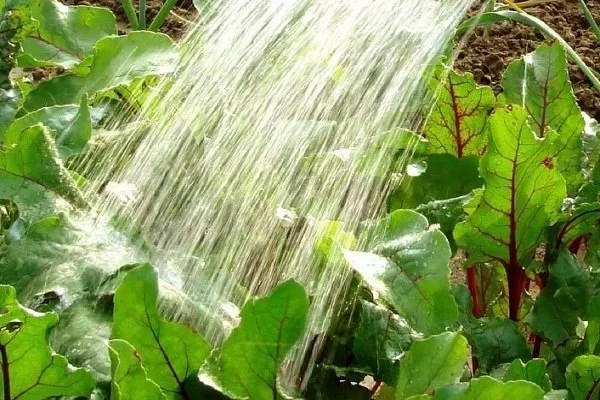
Signs of lack of moisture
What to look out for:
- Soil. If you pick up a small lump of soil, it should slightly stick to your hands. Dryness and crumbling indicate the need for watering.
- Roots. The system is underdeveloped and weak.
- Leaves. Flabby, deformed, yellowish in color.
- Fruit. Small, dry, fibrous in structure.
Irrigation methods
There are several basic methods for soil moistening. The advantages and disadvantages of each are discussed in more detail below.
Using a watering can
This option is more suitable for moisturizing a small area. It uses a special plastic container that holds up to 10 liters of water.
What you need to know:
- Plus. Allows each plant to be sufficiently moistened.
- Minus. It takes a lot of time and effort.
Sprinkling
It is necessary to install a special system that will spray water over the area, irrigating the beets.
Information:
- Advantage. It is carried out without human intervention and does not require subsequent soil loosening.
- Flaw. Works only with good water pressure.
Watering hose
A special spray nozzle is used, thanks to which the water pressure does not damage the tops.
About the method:
- Fine. Large planting areas can be moistened.
- Badly. Extra caution is required, as moving a heavy hose can crush or break plants. A fence of glass bottles embedded in the ground around the perimeter of the garden will help prevent this.
Drip irrigation
A belt water supply system is used, which is installed between the rows of beets.
What's noteworthy:
- Positive pointVegetables are watered evenly, with the same regularity and frequency.
- The downsidePurchasing the installation requires a lot of money.
Moistening occurs to a depth of 30 cm.
Water requirements
Criteria:
- Purity. Before watering, it is better to let the liquid sit for 1-2 days so that all harmful impurities precipitate.
- Temperature. It should be 16-20 degrees.
- Softness. Hard water can be improved with a wood ash solution. For 20 liters, only 50 g is required.
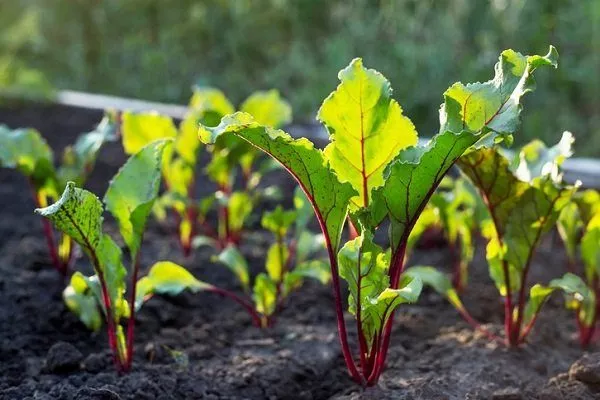
Basic rules for watering beets
It is necessary to follow the recommendations:
- Location of the garden bed. The area must be level to prevent water from spreading.
- Abundance. If you water plants daily, but little by little, the soil will constantly dry out.
- Time. The procedure is carried out in the morning or late afternoon, when exposure to sunlight does not lead to evaporation of moisture.
Frequency and norms
At different stages of growth and development, plants' need for water varies somewhat.
Depending on the stage of vegetation
In total, there are 5 periods:
- Before sowing. The soil in which the seeds are to be planted is watered generously.
- Before the first shoots appear. The soil should be consistently moist, with no signs of drying out or excess water. Approximately 3 liters of water per square meter is required.
- Emergence of sprouts. The rate is increased to 10 liters per square meter. Watering occurs three times every seven days. Once the plants reach 15 cm in height, the frequency is reduced to once a week.
- Fruit formation. During this time, vegetables require a lot of moisture. Approximately 15-20 liters per square meter are used. This procedure is performed once every 7 days.
- Before harvesting. 2-3 weeks before removing from the ground, watering is stopped so that the root vegetables become sweeter and juicier.
Considering the weather
Among the observed conditions:
- Heat. Plants require plenty of fluids. They are watered at least three times a week, using 15-20 liters of water per square meter.
- Neutral climate. Moistening occurs as the soil dries out.
- Rains. The frequency of watering is reduced or stopped completely until the weather changes.
Special solutions
They are carried out using special recipes that help make the plants even stronger and the harvest richer.
Below are some popular methods.
Salt solution. How to cook:
- Take 100 g of table salt.
- Pour in 10 liters of warm water.
- Mix.
- Wait 15-20 minutes for the salt to completely dissolve.
- Distribute over 1 square meter of the plot.
- Use the liquid twice – at the 4-leaf stage and 1 month before harvest.
Watering with a salt solution helps make the fruits sweeter.
The video below explains the benefits and timing of using a saline solution as a nutrient-rich irrigation for beets:
Boric acid solution. Method of creation:
- Take 1/2 teaspoon of the product.
- Add 10 liters of water.
- Stir.
- Water 1 square meter of the area with liquid.
Boric acid promotes active growth and development of beets. This solution can be used every 7-10 days.
Infusion of mullein. Instructions:
- Take 1 kg of mullein.
- Pour in 5 liters of water.
- Stir.
- Cover and leave to infuse for 10 days.
- Stir the product every day until smooth.
- Add another 5 liters of water.
The infusion will help the formation of fruits, it can be used regularly, every 2-3 weeks.
Lime solution. The steps are as follows:
- Take 250 g of lime.
- Pour in 12 liters of water.
- Mix well.
- Use to water the entire area.
This product is used for highly acidic soil. The treatment is carried out after the plants have developed four leaves.
Helpful Tips
Among the tricks that experienced gardeners use to:
- Prevent the development of fungus. Water should be poured directly under the root so that it does not spread over the tops.
- Reduce the frequency of watering. It's important to mulch the soil with peat or sawdust. This will help the moisture be absorbed better and retained longer.
- Improve the quality of the harvest. Avoid planting too closely together, as this will hinder the root system from developing, the vegetables will receive fewer nutrients, and will grow small and weak.
- Increase the digestibility of nutritional mixtures. This can be achieved by watering at the same time as top dressing.
- Protect beets from dying. During irrigation, it is prohibited to use water from wells and boreholes. It is too cold and may cause developmental delays.
- ✓ Check the soil moisture at a depth of 10-15 cm before watering to avoid over-watering.
- ✓ Use mulch to conserve moisture and reduce the frequency of watering.
Beetroot has its own specific watering requirements and requirements at different stages of growth, which require special attention. Special recipes and tricks can help improve the effectiveness of the procedure. This is the only way to obtain a rich and high-quality harvest of root vegetables.