
Swiss chard is a rootless beet variety used like regular greens. It's not exactly a popular crop, and it's rarely grown by gardeners. Let's learn about the unique features of this leafy vegetable, how to plant and grow it, and how to reap a bountiful harvest.
Origin of culture
Swiss chard, also known as Swiss chard, is a subspecies of the common beet. Its origins are believed to be in southern and central Europe.
Swiss chard is considered one of the most ancient vegetable crops. Scientists believe it was cultivated as early as 2,000 BC. Swiss chard beetroot emerged as a result of popular selection. Some believe it was artificially bred from common beets.
In Russia, the crop has been cultivated since the 16th century. Here, it has long been called "svetkovychnik."
Due to climate and soil changes, the plant evolved—the root expanded in width, and the tough tissues became juicy and fleshy. Swiss chard is essentially the ancestor of beetroot, so the two crops share similar cultivation practices.
Description of the plant
Belonging to the genus Beet, the Amaranthaceae family, the crop develops on a two-year cycle. In the first year, the plant develops a rosette of leaves, and in the second, it flowers and produces seeds.
Swiss chard resembles common beet tops in appearance. Its roots are inedible; only the leaves and petioles are edible.
Brief description of the plant:
- Leaves. Glossy, elongated, bubbly. They vary in curliness depending on the variety.
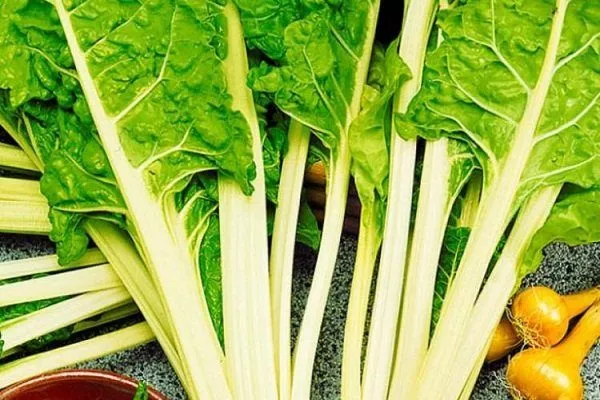
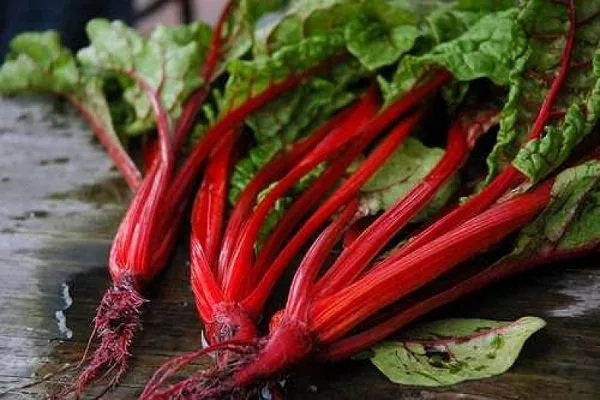
- Stems. Fleshy and sturdy. The stem color varies depending on the variety: bright yellow, silver, burgundy, and green.
- Root. Elongated, cylindrical. The flesh is white or reddish. It has a firm texture and an unpleasant taste. By the end of the season, it grows to the size of a fist and takes on the same color as the petioles.
Characteristics of leaf beet:
- Swiss chard stems are tastier than the leaves, with a flavor reminiscent of rhubarb or celery.
- It's more cold-hardy than the table variety, so it can be sown earlier and harvested right up until the first frost.
- The yield in industrial cultivation is 70-100 t/ha.
All varieties of leaf beet are divided into two large groups:
- Petiolate (stem). They have distinctively prominent veins. The leaves are small, and the petioles are very thick and juicy. They can be used as a substitute for asparagus.
To make the stems grow longer and thicker, gardeners resort to pruning the leaves. - Leafy. These varieties produce lush rosettes of large, fleshy leaves. This type of chard is also known as Roman kale. It can be used as a substitute for lettuce, cabbage, spinach, and other leafy vegetables in various dishes. The plant can overwinter in the soil, producing a crop of fresh leaves in early spring.
Pros and cons
When deciding whether to grow Swiss chard in their garden, gardeners should evaluate the advantages and disadvantages of this crop:
Benefits of Swiss chard:
- ripens early;
- looks nice;
- tastes good;
- unpretentious;
- bears fruit for a long time;
- rich in vitamins and minerals;
- tolerates cold well;
- does not deplete the soil;
- is a favorable neighbor for other vegetable crops;
- withstands adverse environmental influences;
- has high immunity;
- productive;
- contains a lot of proteins and pectin;
- low-calorie.
Popular varieties of Swiss chard and their characteristics
| Name | Disease resistance | Soil requirements | Ripening period |
|---|---|---|---|
| Emerald | High | Fertile, loose | 60 days |
| Scarlet | Average | Fertile, moderately moist | 35-40 days |
| Green | Low | Fertile, well-drained | 85-120 days |
| Gorgeous | High | Fertile, loose | 60 days |
| Silver | Average | Fertile, moderately moist | 90 days |
There are many varieties of leaf beet (salad beet), which differ from each other in the color of their stems and the roughness of their leaves.
First of all, it is worth paying attention to the varieties:
- Early-bearing. Mirage (41-42 days), Ruby (34-38 days), Scarlet (35-40 days), Garnet (32-41 days).
- Resistant to flowering. These are the varieties Garnet, Ruby, and Scarlet.
Popular varieties of chard:
- Emerald. Compact plants with vertical rosettes and wide petioles. Plant height is 30-45 cm. Leaves are light green. Each bush yields 1 kg of petioles and leaves. This is an early-ripening variety with a growing season of 60 days.

- Scarlet. A hybrid resistant to bolting. Early maturing, the first harvest is ready in 35-40 days, reaching full maturity in 90 days. The rosette is spreading, with purple-green, vesicular leaves up to 60 cm long. Petioles are up to 25 cm long. The color is red. 3-5 kg of leaves and petioles are harvested per square meter, and 10 kg in a greenhouse.
- Green. A late-ripening variety, maturing in 85-120 days. The rosette is semi-upright. The plant height is up to 60 cm. The leaves are dark green, vesicular, and glossy. The petioles are green, up to 25 cm long.
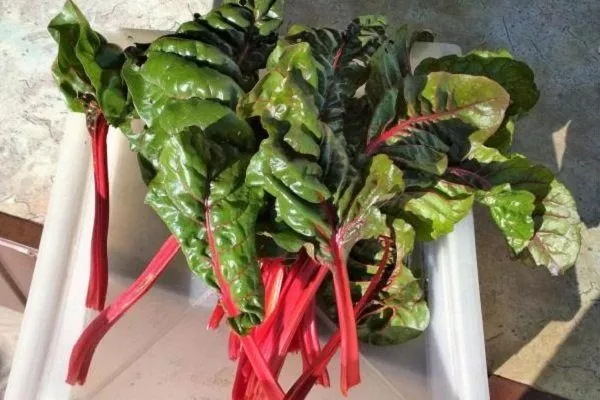
- Gorgeous. A hybrid variety with compact, upright rosettes. The leaves are large and dark green, with bright red petioles. The length is 40-45 cm. The leaves are wavy, juicy, and fleshy. It matures in 60 days. One plant yields 0.8 kg of greens.
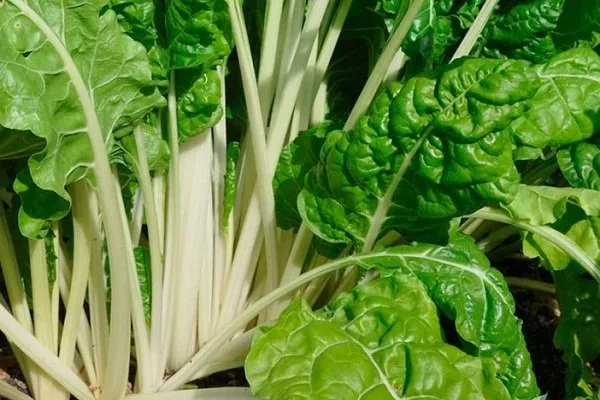
- Silver. The bushes are vigorous, with fleshy, green leaves. The petioles are silvery-white. The leaves are either curly-blistered or smoothly wavy. Yields can reach 6 kg per square meter.
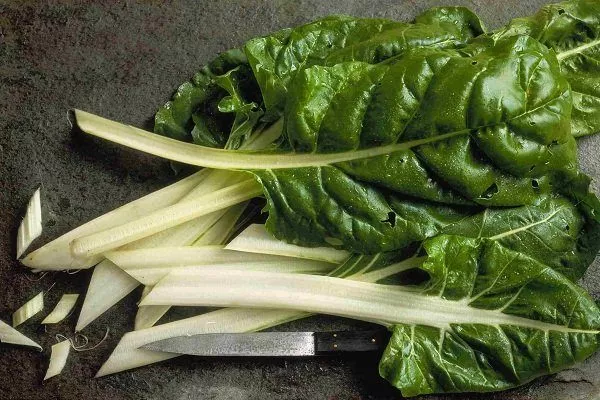
Growing conditions
Growing conditions determine not only the yield but also its quality. The taste of the above-ground portions is influenced by soil composition, agricultural practices, temperature, light, and other factors.
Choosing a location
Good Swiss chard yields can only be achieved in fertile soils. In poor and heavy clay soils, Swiss chard leaves grow coarse and tasteless.
What kind of area should be used for growing Swiss chard?
- Soil acidity from pH 6.
- Good lighting.
- Avoid planting in low-lying areas where water stagnates. The crop does not tolerate waterlogging.
- ✓ The soil pH level should be strictly within 6.0-7.0 for optimal nutrient absorption.
- ✓ The soil should have high moisture capacity, but without stagnant water to prevent root rot.
When choosing a site, follow crop rotation rules. Swiss chard grows poorly after spinach.
Recommended predecessors:
- carrot;
- radish;
- legumes;
- tomatoes;
- cucumbers;
- potato;
- radish.
In one place, leaf beet is grown at intervals of 3-4 years.
Soil preparation
Soil preparation for Swiss chard is similar to that for beets. The crop requires loose, permeable, fertile soil. In poor soil, Swiss chard loses its juiciness, and its petioles become rough and stringy.
In autumn, the soil is dug up to a depth of 30 cm, adding the following components:
- compost, peat, humus or other organic fertilizer – 4-5 kg per 1 sq. m;
- superphosphate – 20-25 g;
- potassium chloride – 15-20 g.
In heavy, dense and clayey soils, sand is added to loosen the structure.
Temperature and lighting conditions
In order for Swiss chard to produce lots of tasty leaves, it requires certain temperature conditions and proper lighting conditions.
Temperature regime features:
- the optimal temperature for growth is from +16 to +25°C;
- during flowering – from +20 to +25°C;
- if the crop is well watered, it can grow normally even at +35°C;
- seeds germinate at +6….+7°C;
- Young plants, being in the phase of 3-4 true leaves, are able to tolerate low temperatures down to -3°C.
Swiss chard doesn't require much light. This plant grows well in both sunny areas and light shade.
When planting a crop in partial shade, the following points must be taken into account:
- When there is a lack of sunlight, a lot of nitrates accumulate in the leaves of Swiss chard;
- Long-term shading leads to slower growth and smaller leaves.
Planting chard
Swiss chard can be grown using a variety of methods. Let's learn how and when to plant Swiss chard.
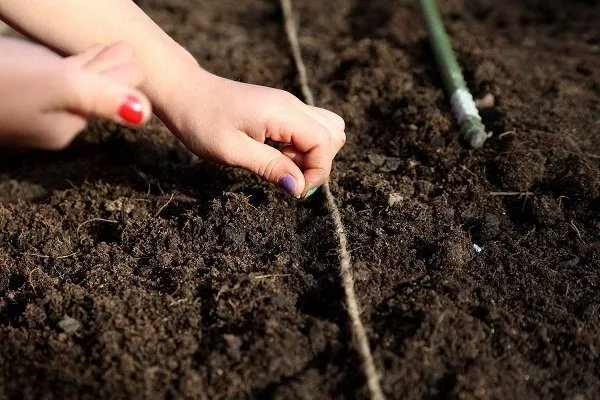
Deadlines
Swiss chard is a cold-hardy crop that produces early greens. The first Swiss chard harvest occurs before other green vegetables have grown.
To ensure a constant harvest of leaf beet, it is sown three times:
- at the beginning of May;
- in July;
- at the end of October.
The exact sowing time depends on the variety and the regional climate. The key to sowing seeds is soil warming to 5°C.
In the south of the country, seeds are sown 2-3 weeks earlier than in other regions. In areas with cool, short summers, seedling or greenhouse cultivation is recommended.
Spring sowing technology
Before sowing seeds in the ground in spring, soak them in warm water (40°C). After two days, the seeds are ready for planting. Instead of water, you can use a biostimulant, such as "Epin," and soak the seeds in it for two hours. Swiss chard is planted in rows.
How to plant Swiss chard:
- Make small furrows in the beds. The spacing between adjacent furrows depends on the type of chard:
- for petiolate varieties – from 35 to 50 cm;
- for leafy ones – 20-30 cm.
- Place the sprouted seeds in the furrows, spacing them 2 to 5 cm apart.
- Cover the seeds with soil to a thickness of 3-4 cm.
To sow 1 sq. m. you need 1-1.5 g of seeds.
Winter sowing
Swiss chard can be sown before winter. This growing method is practiced in regions with short winters and mild frosts.
Features of winter sowing:
- Prepare furrows for sowing in advance.
- Prepare a bucket of dry soil and leave it in a warm room.
- Wait until frost sets in. Sow the seeds into the frozen soil. Space them in furrows 2-5 cm apart. The sowing pattern is the same as for spring sowing.
- Cover the seeds with prepared soil – dry and warm.
- The seedlings appear in early spring, and if there is a risk of frost, it is recommended to cover them.
Seedling method
The seedling method of growing is practiced in regions with long winters and short, cool summers. Harvests from seedlings are harvested a month earlier than those from seedbeds.
Growing Swiss chard using seedlings:
- Sow seeds for seedlings in March or early April. Use commercially available growing medium or garden soil. Sow sparsely to avoid seedlings crowding each other. Space adjacent seeds 2-3 cm apart.
- Cover the seeds with a transparent material and place them in a warm place. Seedlings will appear in 4-5 days.
- Move the seedlings closer to the light. The optimal temperature for seedlings is 13 to 15°C.
- Thin the seedlings once, leaving 7 cm intervals between seedlings.
- 30-35 days after sowing, the seedlings will have 2-3 true leaves, transplant them into open ground using the same scheme as when sowing in open ground - 40-50 × 20-30 cm.
Care instructions
Swiss chard requires little care; it's a hardy and undemanding plant. The gardener's job is to create conditions that ensure not only a bountiful harvest but also excellent flavor.
Thinning
Each seed produces several sprouts, so the plantings must be thinned repeatedly. Crowding chard too close together is unacceptable. Plants growing too close together will not thrive and increase the risk of fungal diseases.
Features of thinning chard:
- Several thinnings are carried out during the season.
- All weak seedlings should be removed. Also, any sprouts that emerge later than others should be removed.
- The result of thinning should be the distance between neighboring plants:
- for petiolate varieties – 40 cm;
- for leafy varieties – 15 cm.
Watering
Leaf beet is a moisture-loving crop that slows down its growth and development when there is a lack of moisture.
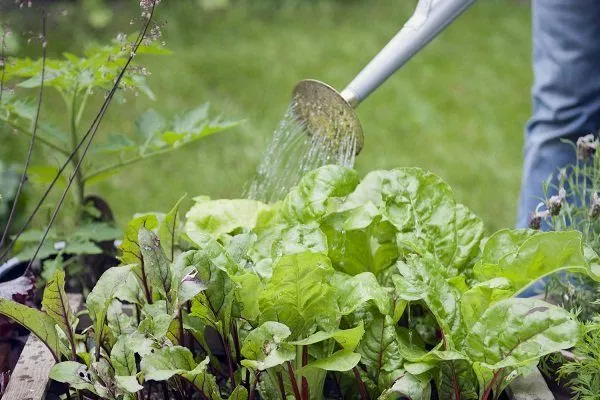
Features of watering chard:
- Watering frequency: once every 2 days.
- During drought, watering becomes more frequent, as water deficiency leads to wilting of leaves.
- The crop is especially demanding at the stage from sowing to the moment of emergence.
- To retain moisture, the soil is mulched.
- At watering beets It is important to maintain a balance – Swiss chard reacts equally negatively to drought and stagnant water.
Loosening and weeding
After watering, it's recommended to loosen the soil, removing weeds along the way. Use a rake to loosen the soil, working across the rows. Loosening the soil improves aeration and prevents the development of many diseases.
To prevent weed growth and slow down moisture loss, the soil is mulched with peat or humus.
Top dressing
The crop responds well to fertilization. Most fertilizer is applied before sowing or planting seedlings.
Fertilizers are applied:
- during growth;
- at the stage of cutting leaves and petioles.
Chard can be fed:
- diluted mullein (1:5);
- herbal infusion;
- urea (10 g per 10 l).
- The first feeding should be carried out 2 weeks after germination, using a mullein solution (1:10).
- The second feeding should be carried out in the phase of 4-5 true leaves, using a herbal infusion with the addition of ash.
- The third feeding should be carried out before the start of mass cutting of leaves, using urea (5 g per 10 l of water).
When growing Swiss chard, it is not recommended to apply mineral fertilizers, as nitrates actively accumulate in the leaves.
Growing Swiss chard at home
Leaf beet can be grown not only in vegetable gardens or greenhouses, but also in pots placed on a balcony or windowsill.
Features of growing at home:
- The crop is planted in pots or boxes at least 15 cm high.
- A special substrate is used for planting – it already contains a full range of nutrients.
- To further enrich the soil, you can add organic matter. Adding charcoal is also recommended.
- The seeds are prepared for planting in the usual way, by soaking them for 2 days.
- Sowing is carried out at the beginning of May.
Disembarkation order:
- Water the soil in the pots with hot water – you need to warm up the soil.
- Make furrows in the soil 2 cm deep.
- Place the seeds in the furrows, spacing them 12-15 cm apart.
- Sprinkle with soil and compact it lightly.
Care instructions:
- The main care factors are lighting, watering, and loosening the soil. The optimal temperature is between 16 and 22°C.
- Water the plants generously and loosen the soil after each watering. Use only settled water. Until seedlings emerge, water the plants with warm water once every two days.
- Add complex mineral fertilizers to the soil every two weeks.
- In winter, place beetroot pots closer to the light.
- If chard is growing on a balcony and the temperature drops below 0°C, cover the crops with film.
The first leaves are harvested after a month or a month and a half. The yield of Swiss chard grown in pots is much lower than when grown outdoors.
Reproduction
The crop is propagated by seeds. Seeds form in the plant's second year.
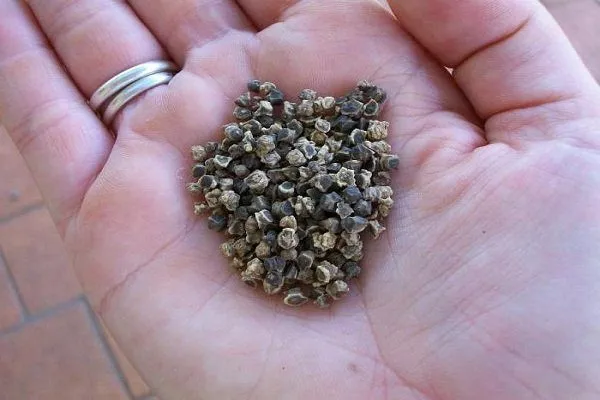
How to prepare seeds:
- cut off the ripe testicles;
- hang to dry under a canopy;
- When the seeds are fully ripe, remove them from the seed pods;
- Place the seeds in paper bags and store in a dark, dry place.
Major diseases and pests
Swiss chard has a strong immunity and usually does not cause problems, but under unfavorable conditions it can be affected by diseases and pests.
The most common diseases of Swiss chard are:
- Cercospora leaf spot. This fungal disease affects the leaves, causing gray spots with a purple border. Treatment involves spraying with a 1% Bordeaux mixture or a 70% Topsin solution.
- Powdery mildew. The underside of leaves is affected, with a white coating appearing. Fungicides are used for treatment.
- Blackleg. Leaves wilt, stems turn black, and roots dry out. This often leads to plant death. Prevention helps: cleaning and disinfecting garden beds and maintaining a proper watering schedule.
Main pests:
- beet aphid;
- wireworm;
- beet flea beetle;
- slugs;
- ticks and caterpillars.
Pest control is primarily through prevention, such as crop rotation and agricultural practices. Insecticide treatments are not recommended for greens; if pests are attacking plants, it's better to use biological control agents.
Harvesting and storage
The succulent leaves are harvested as they ripen. The leaves are cut several times during the season.
Collection Features:
- The first leaves are harvested 8-10 weeks after germination. Young leaves are tastier than older ones.
- Harvesting begins when 8-10 leaves appear on the plant.
- The leaves are cut regularly, choosing the largest and most beautiful ones.
- Each leaf is torn off individually, twisting and pulling upward. Avoid cutting the leaves with a knife, as this will release a lot of juice.
Storage features:
- Leaves and petioles don't keep for long. At optimal temperatures (0°C) and humidity (up to 90%), they only last a few days.
- The vegetable is stored in the refrigerator, packed in bags, or in the basement - in containers with soil.
- Swiss chard can be frozen. To do this, wash the leaves, cut them, and pack them into plastic bags.
- Before the onset of frost, the plants are dug up along with the roots, the leaves are torn off and they are buried in the ground - in a basement or in a greenhouse.
For information on how to grow Swiss chard, watch the following video:
Uses of Swiss chard
Swiss chard is usually eaten fresh, but it is also widely used in cooking.
Culinary uses:
- They are used to prepare salads, appetizers, soups, and are fermented alone or together with cabbage.
- Young leaves are fried and stewed, and the stalks are steamed. The leaves make delicious cabbage rolls.
Application in folk medicine and cosmetology:
- Decoctions are prepared for burns, frostbite and abscesses.
- The leaves, crushed into a paste, are applied to the eyes. The leaves contain substances that prevent cataracts.
- The juice helps with toothache, freckles and warts.
- They make moisturizing and nourishing masks for the face and stimulate hair growth.
You can watch the recipe for Swiss chard in the following video:
Reviews
Growing Swiss chard is a simple way to provide yourself with early, vitamin-rich greens. With proper care, you can harvest the leaves from June until frost.