
To grow the perfect beetroot for making borscht, gardeners are increasingly choosing the beet variety of the same name. This high-yielding crop with excellent flavor doesn't require any special growing conditions and is suitable even for winter planting. More information about the variety's characteristics and growing techniques can be found below.
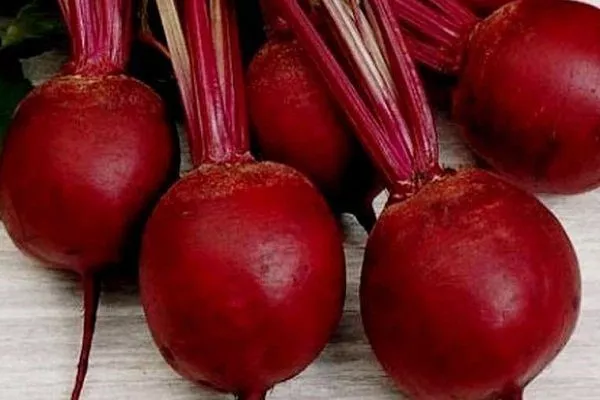
Borschevaya beetroot has a long shelf life
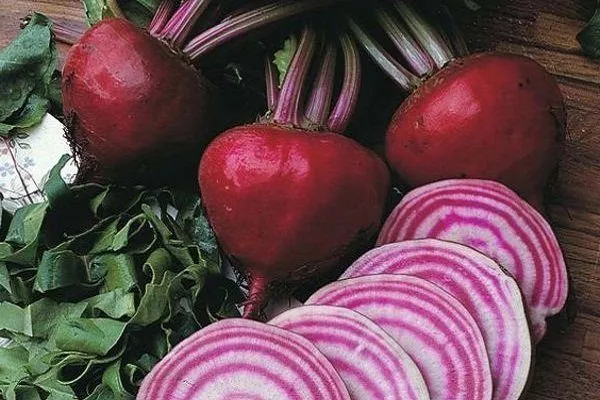
Borschevaya beetroot has sweet pulp.
Description of the variety
Agricultural companies in Russia, Ukraine, and other CIS countries offer gardeners Borshchevaya beetroot. The seeds undergo pre-sowing treatment, making them fully compliant with GOST standards and suitable for direct sowing without additional soaking.
The characteristics of the culture can be found in the following table:
| Parameter | Description |
| Ripening time | The variety is a mid-season crop – from the emergence of the first shoots to technical maturity it takes 85-100 days. |
| Plant | The bushes' root system penetrates deep into the soil, actively saturating the entire plant with nutrients. This gives it strong immunity and resistance to many diseases, including rot. Moreover, it is resistant to flowering and moderately cold-hardy, so it performs well when sown before winter. The leaf rosette, pressed into a compact shape, is very neat and consists of short green leaves covered in anthocyanin-colored veins. |
| Roots | Borshchevaya beetroot roots have the following characteristics:
|
| Application | This table variety is versatile—suitable for fresh consumption, entrees, and canning. Furthermore, beets have a long shelf life, lasting until the following season, and withstand long-distance transportation even after processing. |
| Productivity | One hectare can yield 53-56 tons of root crops. The seeds begin to germinate even at low temperatures (around 4°C), which allows the harvest to be advanced by 2-3 weeks. |
Agricultural technology
To obtain a good harvest of Borshchevaya beets, it is necessary to follow the rules of agricultural technology:
- Sowing datesSeeds can be sown in spring or fall before winter. In the former case, sowing begins in early May, when the soil warms to a depth of 10 cm to +8…10°C. For winter sowing, seeds are sown from late October to early November to achieve the earliest harvest by the end of June.
- PlotBeets should be grown in sunny areas protected from winds and drafts. Planting them in shaded areas will stunt their growth.
- SoilThe soil must be fertile and moist, as the crop is demanding. The acceptable soil pH is slightly acidic or neutral (pH 6-7). The crop responds well to nutrient-rich loams, sandy loams, and loamy chernozems with a fine, crumbly structure. Avoid sowing seeds in acidic, heavy soils with a close groundwater table.
- PredecessorsBeets should not be grown in the same plot for more than two consecutive seasons. Furthermore, they should not be planted next to any type of cabbage, rapeseed, or potatoes. They are best planted after the following crops:
- cereals;
- legumes;
- cucumbers;
- Luke;
- tomato;
- pepper;
- eggplants.
Beets make good use of the remains of organic fertilizers, so it is advisable to plant them as a second or third crop after cultivating the above-mentioned crops.
- NeighborhoodBorshchevaya beetroot can be planted in the same field as onions or carrots. Typically, gardeners don't grow it as a separate crop, but rather plant it as a filler crop with cucumbers or potatoes, along the edges of beds or irrigation ditches.
Site preparation
The selected site needs to be prepared for beetroot cultivation. The method of cultivation depends on the soil condition:
- FertileIn the spring, dig up the bed, adding only mineral fertilizers (per 1 sq. m):
- 15-20 g of ammonium nitrate or 20-30 g of ammonium sulfate;
- 30-40 g of superphosphate;
- 10-15 g of potassium chloride.
- Low fertilityYou will also need to add organic fertilizers to the beets (per 1 sq. m):
- in autumn – fresh manure (4-5 kg);
- in spring – humus (2-3 kg) or compost (3-4 kg).

If the soil has increased acidity, 0.5-1 kg of slaked lime per 1 sq. m should also be added to the soil.
Sowing seeds
In spring, seeds are sown on a flat surface, and in autumn – in beds, choosing one of the following methods:
- row - row spacing 25-70 cm;
- broadband – the distance between the centers of the stripes is 45 cm;
- tape - intervals between furrows are 15-20 cm (optimal method when using drip irrigation).
When sowing in spring, seeds are planted 2-3 cm deep at a rate of 1.5-2 g per square meter, and in autumn, seeds are planted 3-4 cm deep at a rate of 2-3 g. Roll the area before and after sowing. When sowing in winter, it is also advisable to mulch the bed with peat or humus.
Planting care
Borshchevaya beet is not a demanding crop, but it does require timely implementation of agricultural procedures – from watering to protection from various misfortunes.
Watering
This moisture-loving plant requires regular watering to ensure that soil moisture does not drop below 75-80% at a depth of 0-40 cm during the period from seedling emergence to root formation. During root formation and growth, soil moisture can be reduced to 65-70% at a depth of 0-60 cm.
- ✓ Watering should be done early in the morning or late in the evening to minimize water evaporation.
- ✓ Use mulching to retain soil moisture and reduce the frequency of watering.
When watering, it's best to use the drip method. On average, throughout the growing season, water consumption is 23-35 cubic meters per hectare per day. The crop should be watered according to the following schedule:
- from germination to the formation of root crops, when the tops on the surface are small, the average daily moisture requirement reaches 7-24 cubic meters per 1 ha;
- during the period of formation and growth of heads – 40-50 cubic meters per 1 ha;
- during the period before reaching technical maturity – 15-30 cubic meters per 1 ha.
Stop watering 2 weeks before the expected harvest.
Loosening and weeding
Once the seedlings emerge, loosen the space between the rows using a hoe or rake when the soil is moist. The second loosening should be done at the 4-5 leaf stage, to a depth of 6-8 cm. During loosening, the area should also be weeded, as weeds inhibit beet growth.
Thinning
Borschevaya beetroot requires two thinning procedures:
- When 1-2 true leaves appear – at a distance of 3-4 cm;
- In the 4-5 leaf phase, when the root crop reaches 3-5 cm in diameter, at a distance of 6-8 cm.
Thinning of plantings should be done when the soil is moist and on a cloudy day.
Top dressing
The crop needs to be fed at least 2 times:
- After thinning, apply nitrogen fertilizers.
- When forming root crops, apply potassium-phosphorus fertilizers.
If young plants and the upper part of the root crops die off, and core rot and dry rot of beets develop, this may indicate a boron deficiency, which leads to the following consequences:
- impairs carbohydrate and protein metabolism in plants;
- causes accumulation of sugar and starch in the leaves;
- delays their outflow into root crops.
To eliminate boron deficiency in a plant, you need to apply boron fertilizers at a rate of 1-2 kg/ha or carry out 2-3 foliar treatments with Solubor (500 g per 100 l of water).
Protection from diseases and pests
To protect beets from all sorts of troubles, you will need to follow a number of preventative measures:
- do not violate crop rotation rules;
- cultivate the soil before sowing seeds;
- regularly carry out manual weeding in the rows;
- carry out chemical measures (use herbicides).
Harvesting
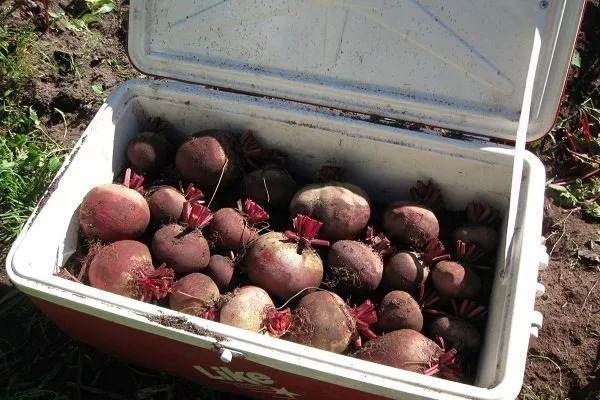
Once the roots are fully ripe, they should be removed from the plot. Their ripeness will be indicated by dry, yellowed petioles. The fruits should be carefully dug up with a shovel and pulled out of the ground, then dried in the sun, eaten, or stored in a cellar, covered with sand.
Reviews
The Borshchevaya beetroot is a mid-season variety that, when grown with proper cultivation practices, produces roots of uniform shape and size. These can be eaten or stored until next season, as they have excellent shelf life.