
On the one hand, wild radish is a noxious poisonous weed, but on the other, it has medicinal properties and is often used in folk medicine. The plant also produces nectar and pollen in sufficient quantities for bees to collect, making it a good honey plant. Read on to learn more about the characteristics of wild radish, its botanical characteristics, classification, benefits, and harms.
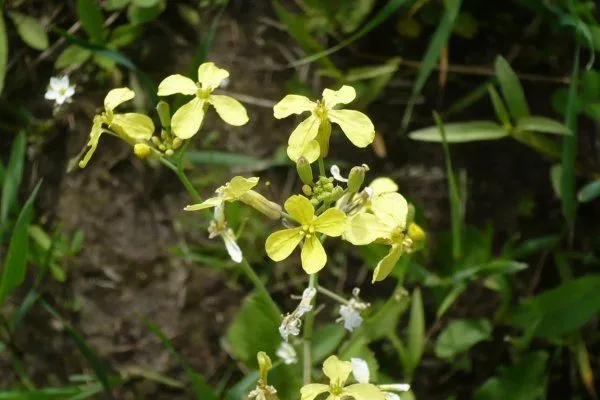
Botanical description
Wild radish (Raphanus raphanistrum L.) is a spring herbaceous annual plant commonly found in abandoned plots of land, roadsides, fields, and open wooded areas. It thrives in temperate, subtropical, tropical, and semi-arid climates. It has the following botanical characteristics:
- Stem. It grows upright, reaching a height of 40-60 cm. It has a rounded or slightly lanceolate shape and a bluish-green color, sometimes tinged with purple. Most often, several long branches extend from the main stem, but some plants occasionally have an unbranched stem.
- Root system. It is characterized by a powerful, weakly branched taproot that extends shallowly into the soil. Initially, the plant develops a basal rosette with large, lobed leaves, then a stem elongates.
- Leaves. Petiolate leaf blades vary in size and shape, ranging from lyrate to oblong-ovate. They feel slightly rough to the touch, as the bluish-green or purple leaflets are covered with stiff hairs. They are arranged alternately on the branches. The lower leaves are large, reaching 15-30 cm in length and 5-10 cm in width. The higher up the plant's stem, the smaller and more widely spaced they become.
- Flowers. The plant blooms in early summer with small, four-petaled flowers (no more than 18-40 mm across) gathered in loose, elongated racemes. European wild radish produces flowers that are predominantly white or yellowish. Eastern wild radish produces lilac or almost purple flowers.
- SeedsAfter flowering, the plant produces elongated seed pods resembling miniature pods—they reach 3–9 cm in length and 3–6 mm in width. Each pod ends in a sharp beak. Inside, the seed pod is divided into several segments containing the seeds.
- ✓ The flowers are predominantly white or yellowish in the European wild radish, and lilac or almost purple in the eastern one.
- ✓ The seed capsules end in a “sharp beak” and are divided into segments.
The pods are initially green or purple, but as they ripen, they turn yellowish-brown or grayish. When ripe, the pod opens easily and splits into 3-10 segments. Each segment contains a single seed.
Wild radish seeds are almost perfectly round and red or yellowish-brown in color. They are no more than 4 mm in diameter. A plant can produce 150-300 seeds in a single season. The pods that fall into the soil take a year to germinate, as they require stratification in natural conditions. If the seeds fall into the soil without their segments, they germinate very quickly, provided they are buried at a depth of 1-4 cm.
Origin
Radishes have been known since time immemorial. Attitudes toward this root vegetable have been ambivalent. The ancient Egyptians considered it an "unclean" vegetable because it was part of the diet of slaves who built the pyramids.
The ancient Greeks, on the other hand, valued this root vegetable and offered it as a gift to the god Apollo at the Delphic Games, as well as casting it in gold. Moreover, ancient Greek physicians considered the root vegetable a medicinal herb and prescribed it to patients.
Wild radish is known as field radish in the western part of the country and as coastal radish in the eastern regions. It also has many common names:
- gorlyupa;
- chicken nap;
- field mustard;
- jaundice;
- celandine;
- blister grass;
- radish;
- saffron milk cap;
- fierce;
- rapeseed;
- horseradish;
- Borbora.
Taxonomy and range
The species of wild or field radish (coastal) refers to:
- to the genus - Radish;
- family - cabbage (cruciferous);
- class - dicotyledons;
- department - angiosperms;
- kingdom - Plants.
Radish grows in the non-chernozem forest belt of the European part of the former USSR. It is also found in Africa, Asia, and European countries. Its favorite habitats are meadow thickets, roadsides, and abandoned areas.
Features of cultivation
The plant is quite unpretentious, however, when deliberately growing wild radish for medicinal purposes, some features must be taken into account.
Basic rules of planting
When planting wild radish, adhere to the following rules:
- Previous cultures. Avoid planting radishes after crops from the same family, the Cruciferae (radishes, cabbage, daikon, and other members). This is due to the potential presence of the flea beetle, which attacks plants of this family, in the planting area.
- Soil composition. To get a good harvest, add 2-3 year old humus and dilute it with a quarter of wood ash.
- Landing time. Field radishes reliably yield two harvests per season. The first harvest does not keep well. This quality is typical of the autumn harvest. The second planting is done in the first ten days of June, and in southern regions, at the end of June.
- ✓ Optimal seeding depth: 2-3 cm, but not more than 4 cm to ensure rapid germination.
- ✓ Soil temperature for germination: minimum 2-4°C, optimal 12°C.
Features of agricultural technology
When carrying out agrotechnical measures, the following rules are followed:
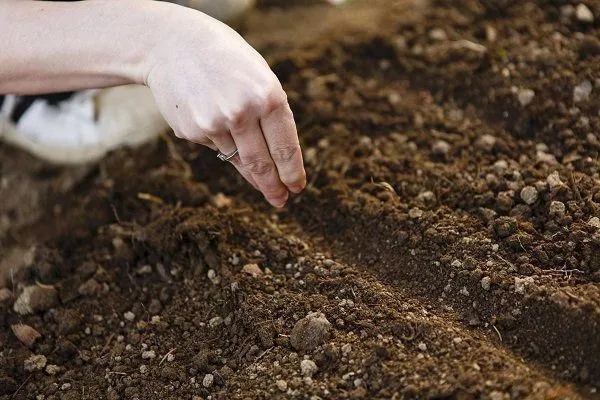
- Place and method of planting. The plant prefers well-lit areas. When planting, the seeds are buried 2-3 cm into the soil.
- Thinning and loosening. After the first shoots appear, the soil is loosened and the seedlings are thinned to a distance of 5-6 cm. When the seedlings become stronger, a second thinning is carried out to a distance of 15 cm.
- Top dressing. When 3-4 leaves appear, apply the first fertilizer. Use only mineral fertilizers. The next fertilizer is applied one month after the first. For the fertilizer, dilute the following in 10 liters of water:
- urea - 20 g;
- superphosphate - 60 g;
- potassium chloride - 15 g.
- Watering. Wild radish requires careful watering. Even short periods of exposure to dry soil negatively impact the quality of the harvest. Water regularly, depending on weather conditions, and avoid allowing the soil to dry out.
Features of growth and reproduction
Wild radish seeds germinate at a depth of 2-5 cm. Temperature fluctuations, especially within a 12°C range, facilitate germination after a dormant period of 6 to 8 months. They remain viable in the soil for up to 10 years. Germination requires soil warming to 2-4°C after overwintering.
Radish reproduces only by seed, which typically spreads close to the parent plant. Experts explain the weed's greater spread by the fact that grain from cereal crops such as wheat, oats, and rye has been contaminated with weed seed.
Wild radish seeds usually ripen by harvest time. When the grain is cut, some of the pod segments fall into the soil, thereby contaminating the soil, while others end up in the harvest, contaminating the grain.
Economic significance and application
Wild radish is a weed that infests all spring crops—cereals, legumes, cereal grains, and forage grasses. It chokes out all seedlings by drawing large amounts of nutrients from the soil and, due to its rapid growth, shades the crops. Due to a lack of sunlight, cereal crops grow poorly and lag in growth and development.
When harvesting, removing the impurities from radishes is quite difficult, as the radish pod segments are almost the same size as a grain of wheat. Farmers clean the grain by immersing it in water while stirring it. Radish pods are lighter than grain, so they float easily to the surface of the water.
Wild radish is dangerous for livestock. If it grows in pastures, it can cause poisoning and even death.
However, wild radish is considered a medicinal plant due to its beneficial properties. Oil is extracted from wild radish seeds, and, although rarely used, the plant is used as a honey plant. The toxic substances in radish only evaporate when the tops are completely dried, which is why it is often used as a spice.
Beneficial properties and harm
The plant contains a large number of vitamins, essential oils, trace elements, and minerals. The juice contains significant amounts of phosphorus, calcium, sodium, as well as iodine and iron. Other beneficial properties of wild radish include:
- strong antibacterial and bactericidal action, which makes it a good remedy for the treatment of various skin diseases;
- a decoction of seeds helps with rheumatism, urolithiasis and restores the functioning of the gastrointestinal tract;
- Radish absorbs and removes harmful substances from the gastrointestinal tract.
However, during the flowering period, mustard oils containing toxins are formed in the foliage and inflorescences. The root always contains toxic substances, regardless of its developmental stage, so it should never be consumed. Ingestion of even small amounts of green parts or inflorescences causes severe poisoning.
At the first signs of poisoning, you must immediately call an ambulance and have your stomach flushed.
The main signs of wild radish poisoning:
- change in urine color, it becomes more saturated;
- gastrointestinal tract disorders that manifest as nausea, colic and vomiting;
- an inflammatory process occurs in the kidneys, and the liver degenerates and is destroyed;
- toxins cause disruptions in the functioning of the heart, and at high concentrations, cardiac arrest may occur;
- All symptoms are accompanied by physical weakness.
When preparing and using medicinal products based on parts of the wild radish plant, it is necessary to know the exact dosages and technology for making decoctions and infusions.
How to get rid of a weed?
Farms that suffer from the invasion of wild radish carry out the following measures to destroy it:
- Weed seedlings are destroyed at the "white thread" stage—this occurs in early spring, when only a few shoots appear on the soil surface, but the seeds have already sprouted en masse beneath the soil. To destroy most of the weeds, loosening the soil to a depth of 5 cm with a hoe or rake is sufficient.
- The soil is dug up in the autumn.
- Alternate sowing of winter and row crops.
- Use herbicides that are approved for use.
- If the area of the plot is small, then weeds are removed manually.
Wild radish causes great harm to agriculture, so there is a constant fight against it.
To learn about what wild radish looks like and its taste, watch the following video:
Wild radish is a weed with some beneficial properties. It is rarely cultivated intentionally; in fact, it is often eradicated because it interferes with the growth of many crops, especially grains. When using wild radish medicinally, strictly follow the instructions to avoid possible poisoning.