
Radishes, like other members of the cabbage family, can be affected by various diseases and insect pests. Gardeners should be aware of these in advance so they can take all necessary measures to protect their crops and promptly identify the cause of any damage to ensure proper garden health.
Radish diseases and their control
In high-humidity conditions, especially in the northwestern and northern regions, radishes are most susceptible to infection. The main diseases are listed below.
- ✓ Maintain soil pH in the range of 6.0-7.0 to prevent clubroot development.
- ✓ Regular application of wood ash (100-150 g/m²) to reduce acidity and enrich with potassium.
White rust
Compared to other cruciferous vegetables, radishes are more often affected by white rust, which is mainly due to the following factors:
- air temperature around +15°C;
- sudden changes in temperature;
- cool rainy weather with persistent fog and/or heavy dew.
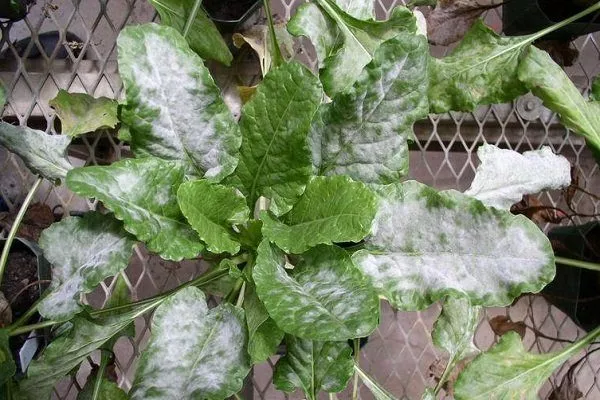
White rust manifests itself with the following symptoms:
- The leaves become covered with light green spots on the upper surface. The tissue in these areas gradually thickens, turns brown, and dies.
- Pustules, similar to abscesses, form on the underside of the leaf blade. The tissue around them swells. When the pustules rupture, a whitish, oily coating can be seen, resembling flakes of peeling paint.
- On the root crops, if they have already formed, growths appear.
- The stem branches and becomes deformed, resembling deer antlers. If left untreated, it will eventually wither and fall to the ground.
If signs of white rust are too pronounced, the crops should be treated with biological fungicides. These include:
- Ridomil-Gold;
- Ditan-M;
- Folicure.
In the early stages of the disease's development, folk remedies can be used. Here's an effective recipe:
- Dissolve 10-15 g of one of the following powders in 10 liters of water:
- potassium permanganate;
- soda ash or baking soda;
- colloidal sulfur.
- Add 3-5 ml of liquid soap or 10-15 g of soap shavings to the solution so that it stays better on the plant being treated.
As a preventative measure, radishes should be treated with the resulting mixture once every 7-10 days (or more frequently during consistent rainfall). To combat rust, the plant should be sprayed 3-4 times at 4-5 day intervals.
Powdery mildew
It thrives in hot weather or sudden temperature changes. The fungus spreads in several ways:
- by the wind;
- with drops of water;
- through direct contact of diseased plants with healthy ones.
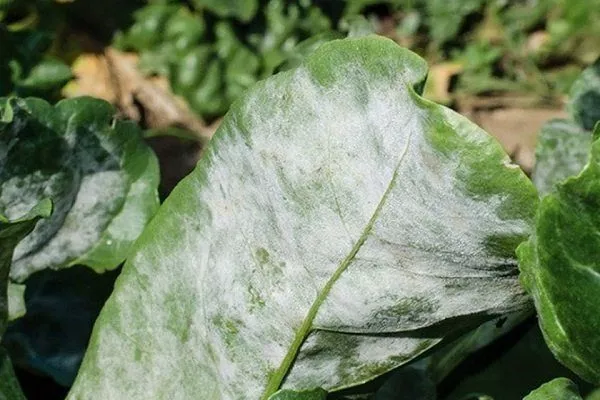
- ✓ The coating is initially white, then becomes light brown, reminiscent of scattered flour.
- ✓ Affected tissue dies, leaving behind holes.
Powdery mildew primarily affects the leaves and petioles of radishes, but in some cases, it can also affect the stems. Symptoms include:
- a whitish or pale gray coating forms on the affected organs, which gradually acquires a light brown color, reminiscent of scattered flour;
- gradually the plaque thickens and turns into painful brown spots with black inclusions;
- tissues affected by fungus die and leave behind holes;
- The leaves become deformed and dry out quickly, and the bushes begin to noticeably lag behind in growth.
Powdery mildew causes a drop in yield by 50% or more, as well as a decrease in the quality of root crops.
To prevent the development of powdery mildew, the plant should be sprayed once a week with the following agents:
- colloidal sulfur solution;
- infusion of wood ash;
- sour milk;
- sour milk diluted with water;
- horsetail root decoction.
If signs of the disease have already appeared and the fungus is actively developing, chemicals should be used against it:
- fungicides containing copper – Skor, Quadris, Raek, Fundazim;
- biological products – Alirin-B, Gamair, Planriz.
Old but effective remedies can also be used against powdery mildew: copper sulfate and Bordeaux mixture.
Downy mildew (peronosporosis)
It develops under conditions of prolonged precipitation and primarily affects radish leaves. The disease progresses as follows:
- Chlorotic angular spots appear on the upper side of the leaf blade, which gradually expand, become oily and acquire a light yellow color.
- The leaves turn brown, and a greyish-purple coating forms on their undersides in areas where the spots are located.
- Infected tissues die, which greatly depresses the entire plant or causes its death.
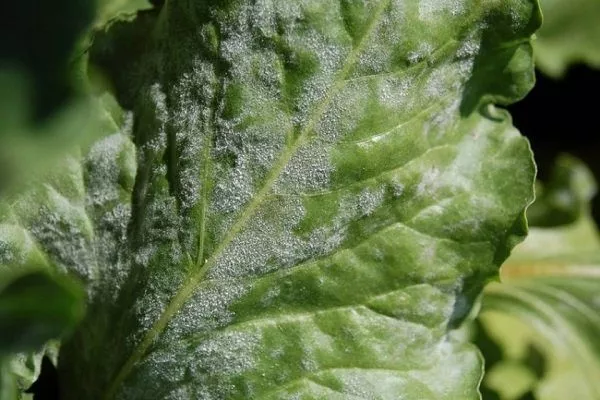
From the moment of infection until the complete death of the radish, it often takes about 10-13 days.
To prevent downy mildew, seeds should be soaked in warm (50°C) water before planting, then dipped in a cold bath for 2 minutes and dried. They can also be soaked in an infusion of onion or garlic shoots for 1 hour. Effective treatments include:
- Bud;
- Energen;
- Potassium humate;
- Fitosporin-M.
During the growing season, it's recommended to spray radishes with a boric acid solution (10-15 g per 10 liters) or Pseudobacterin. If the disease has already affected the plants, the same treatments as for powdery mildew should be used.
Kila
Clubroot, a dangerous fungal disease affecting all plants in the Cruciferae family, attacks the plant's root system. The fungus is transmitted through contaminated seeds, soil, or manure. It can also be spread by earthworms. The following factors contribute to the disease's development:
- compacted or acidic soils;
- heavy soil in which moisture stagnates for a long time;
- excessively frequent and/or abundant watering;
- long periods of drought;
- high air temperature (+25°C and more).
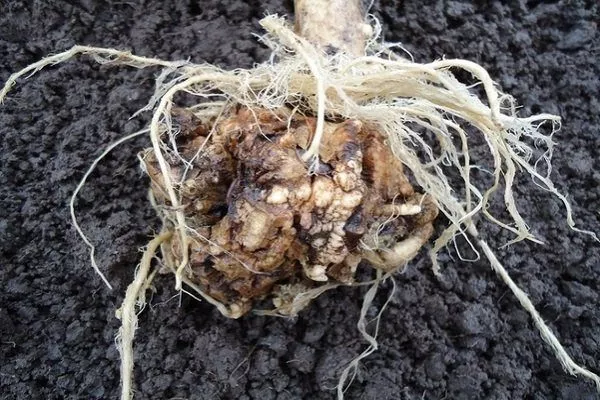
Clubroot doesn't show any symptoms on the above-ground portion of the plant, but during the incubation period (20-30 days), it attacks the roots and root crops. It manifests itself with the following symptoms:
- round growths of various sizes, spherical or spindle-shaped, are formed on the roots;
- noticeable swelling appears less frequently;
- Gradually, the formations darken and rot, causing the plant to noticeably lag in growth, and the root crops to become smaller or not form at all.
Clubroot can destroy more than half of a crop, even ruining it entirely. This disease has no cure, so the primary focus is on prevention.
The clubroot pathogen is particularly resilient, so radishes should not be planted in areas where the disease has been observed for approximately 8-10 years. This period can be halved by planting the following:
- tomatoes;
- potato;
- beets;
- legumes.
To prevent clubroot, it is also worth following these measures:
- 2-3 days before sowing, loosen the soil, adding wood ash to it, or water with lime “milk” (2 glasses of slaked lime per 10 liters of water);
- to disinfect, treat the bed with chemicals - Carbation (40 g per 10 l) or Fundazol (10 g per 10 l);
- After sowing the seeds, water the soil with colloidal sulfur;
- Hill up the planted bushes a couple of times.
Rotten
In conditions of high humidity combined with low air temperatures during growth or storage, radishes can be affected by rot, which is classified into different forms:
- Dry (phoma)Affects seedlings and seeds. It appears on the plant roots as numerous brown spots with black dots. On young plants, sunken gray spots, also dotted with black dots, may appear. These lesions are especially visible on leaf petioles. The tissue in the affected areas becomes rotten, and the stems weaken and break off, causing the death of the entire plant. The same measures are used to combat phomosis as downy mildew.
- GrayIt manifests itself as brown spots on root vegetables, which immediately become covered with a fluffy, bluish-gray coating with small black dots. The tissue underneath softens and rots, the stems and petioles become watery, and the leaves lose their vitality. Fruits affected by gray mold are unfit for consumption, but the disease can be prevented or cured with the following measures:
- periodically add wood ash to the soil;
- dust the bushes with colloidal sulfur or activated carbon powder;
- spray plants with a solution of mustard powder (50 g per 10 l of water) or iodine (10 drops per 10 l);
- Add a few crystals of potassium permanganate to the water for irrigation once every 7-10 days;
- Plant plants that produce natural phytoncides (marigolds, calendula, nasturtiums) near the radish;
- if gray rot is detected in a timely manner, treat the planting with a solution of a glass of sifted wood ash and the same amount of crushed chalk, 10-12 ml of copper sulfate per 10 liters of water;
- in case of severe infestation, treat the area with fungicides (Teldor, Horus, Switch, Gamair).
- WhiteIt manifests itself as a whitish coating on the roots, which resembles cotton wool. Gradually, the plants become waterlogged, rot, and die. To prevent the development of white rot, avoid overwatering the radish. It's also a good idea to sprinkle ash on the plant and follow the same measures as for gray mold.
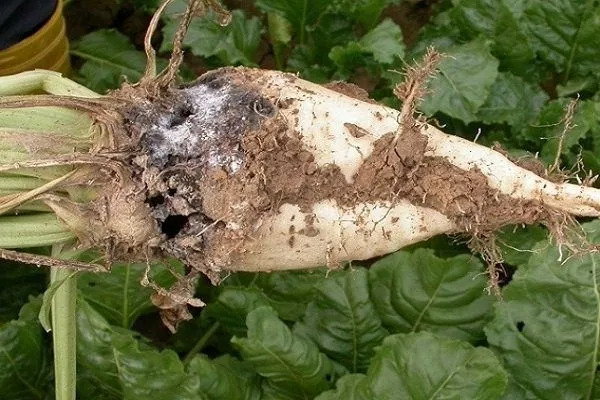
Excessively high humidity and temperatures can cause radishes to become infected with red rot (felted rot), which appears as purple and brown spots on the roots. Dark-colored fungal sclerotia form at the affected areas. Affected plants should be destroyed.
Bacteriosis (vascular, mucous)
During the root formation stage, radishes are susceptible to bacterial blight. The following factors contribute to its development:
- high temperature;
- increased soil moisture;
- presence of mechanical damage.
The bacterium lives in plant debris, seeds of infected plants, and fresh manure. It remains viable for two to three seasons. Its spread is facilitated by raindrops and various insects.
Bacteriosis manifests itself with the following symptoms:
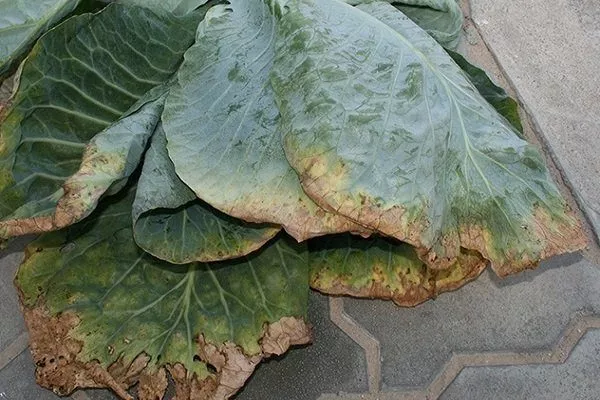
- the veins on the leaves turn black, and then spots of the same color grow around them;
- the leaf blade turns yellow and crumbles;
- The petioles become deformed, causing the plant to lag in growth.
To prevent the development of bacterial disease, you must take the following measures:
- Before planting, disinfect the seeds in hot (45–50°C) water by soaking them for 15–20 minutes;
- 10-12 days after emergence, spray the seedlings with biological agents that prevent the development of bacterial diseases (Planriz, Trichodermin).
If the radish is already sick, you can use Binoram Zh or Fitolavin against bacteriosis in the early stages, and Fitolavin in the later stages.
Mosaic
This is a viral disease spread by many insects, including weevils, aphids, and mites. Symptoms of mosaic include:
- the leaves are covered on the outside with light green or yellowish-green spots (round, angular, in the form of strokes), which are located in the spaces between the veins;
- affected tissues and veins darken;
- infected leaves become deformed, stunted and smaller;
- A dark green border appears around the main veins, and the leaves become covered with necrotic whitish spots, gradually causing the death of the plant.
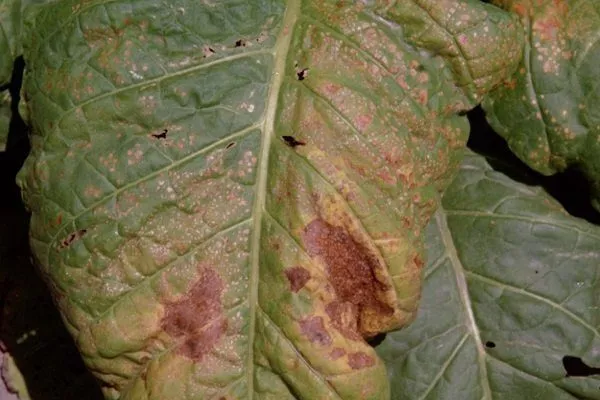
Mosaic is impossible to cure, so affected plants should be removed from the garden bed and burned to prevent infection of neighboring bushes.
To prevent mosaic disease, keep the radish bed clean and properly care for it. Seeds can be pre-treated with a seed dressing (Rovral, Horus, Topaz).
Blackleg
A fungal disease that rarely affects mature plants but poses a significant threat to seedlings and young saplings. The following factors contribute to the development of blackleg:
- sudden changes in temperature;
- excess moisture in the soil and air (result of excessive watering);
- poor ventilation or its complete absence (relevant when growing radishes in a greenhouse);
- acidified substrate;
- dense plantings.
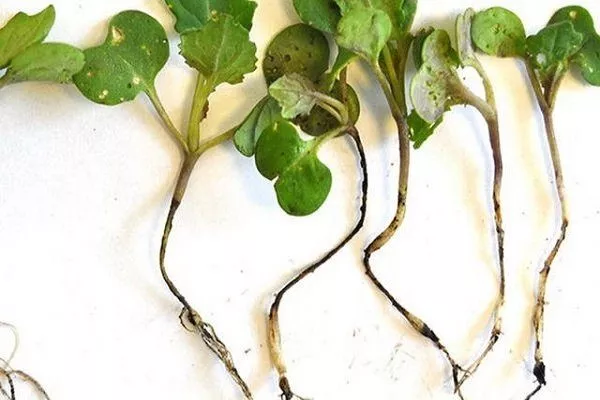
Signs of black leg disease in radishes are as follows:
- the base (lower parts of the leaf rosettes) begins to blacken, becomes thinner and acquires dark tones;
- the upper parts of the root vegetables soften and become tender, and a whitish mycelium forms abundantly on their surface;
When cutting diseased root crops, you can see very darkened tissue at the cut sites.
- the root collars rot and weaken, so they can be pulled out of the ground without much difficulty;
- Under their own weight, the seedlings fall to the ground, the leaves turn yellow, and the plant dries up.
The disease progresses very quickly and can deprive a gardener of an entire harvest, as there is no cure. However, proper measures can prevent it. These include the following:
- 3-4 days before planting, water the area with a solution of colloidal sulfur or hot water, and then sprinkle with a thin layer of sand (2 cm);
- Before sowing, soak the seeds in garlic infusion or a dark crimson solution of potassium permanganate;
- sow seeds at the optimal time, as a lack of light and low temperatures will negatively affect the immunity of seedlings;
- sprinkle the bases of emerging stems with crushed chalk or charcoal, and dust the plants themselves with sifted wood ash;
- For watering, regularly use weak solutions of Fitosporin-M or Baktofit, as well as infusions of onion peel or marigold greens.
If several diseased seedlings are found in a garden bed, reduce watering to a minimum to allow the soil to dry out, loosen the area and apply a fungicide (Trichodermin, Gliocladin, Barrier).
Radish pests and protection against them
If damage appears at the growth points of young plants, the leaves become covered with holes and lag in development, there is a high probability that the radish has been attacked by pests.
Cruciferous flea beetles
These small (up to 3 mm in diameter) matte blue and black beetles may have yellow stripes along their bodies. They have rear jumping legs, similar to those of a grasshopper, giving them excellent jumping ability and the ability to quickly cover significant distances.
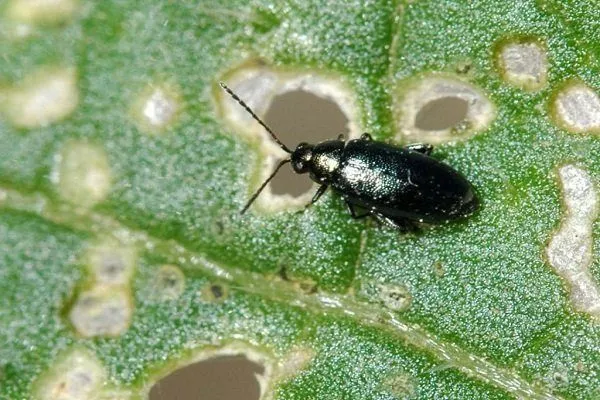
After overwintering under uncollected plant debris, adult beetles emerge in early spring, initially feeding on wild plants of the Cruciferae family, and then settling on the seedlings of cultivated plants, including radishes. The beetles are most active from early morning until 1:00 PM and from 4:00 PM to 6:00 PM, but their activity decreases sharply during hot weather and high humidity caused by frequent rainfall.
The danger of bedbugs is as follows:
- They eat the tops, leaving small ulcers on the leaf blade and causing severe damage. Severely damaged plants dry out.
- They completely consume young seedlings before true leaves emerge, leaving behind only a small portion of the hypocotyl—a stump. Therefore, they pose a significant threat during the first 14 days after emergence. Chinese and Japanese radishes are particularly susceptible.
- Females lay eggs in the soil or on plant leaves. The larvae settle on young roots and feed on them, causing the death of the plant.
To repel the cruciferous flea beetle from your planting, you can use the following measures:
- in places where seedlings appear, sprinkle the soil with a mixture of sifted ash, crushed dried tobacco leaves, ground pepper and mustard powder;
- cover the bed with a breathable white material (the greenhouse effect will repel the flea beetle, as it cannot tolerate heat);
- During the growing season, treat the radish every 5-7 days with an infusion of dandelion leaves, tomato or potato tops, previously diluted in water at a rate of 25-30 ml per 10 l;
- Place a barrier of mothballs around the perimeter of the garden bed, as the pest cannot stand the smell of vinegar.
If fleas have already settled in the garden bed, you can use the following remedies against them:
- Wood ash solutionTo prepare it, dilute 50 grams of grated laundry soap in 1 tablespoon of boiling water and mix with 2 cups of resin. Let the mixture steep overnight, strain in the morning, and use it to spray the radishes immediately after watering. Repeat this procedure every 4 days.
After watering or rain, the planting should be treated with tansy powder, tobacco dust, celandine or ash.
- ChemicalsIn case of a massive flea infestation, it is best to use the following products:
- Actellic;
- Aktara;
- Inta-Vir;
- Lightning;
- Decis;
- Sherpa;
- Fufanon;
As an alternative to chemicals, you can use flea shampoo for pets (40-50 ml per 10 liters of water).
Cabbage fly
This ash-gray fly, with a small body (5-7 mm long) and transparent wings, belongs to the flower fly family. Its mass infestation begins with the flowering of bird cherry trees (second half of May) and ends after the lilac blossoms (early June).
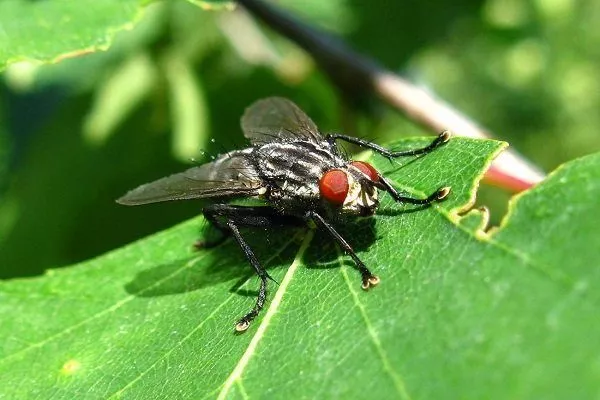
The adult insect feeds on nectar and pollinates plants, so it poses no threat to radishes. However, it lays eggs in the upper soil layers (under radish plantings), and the worm-like white larvae that hatch from them actively attack the plant:
- they feed on the lower parts, both from the outside and from the inside;
- damage the stems;
- penetrate into the central root or root collar and make passages, which can cause the death of the plant;
- They gnaw through tender root vegetables and cause their deformation.
As a result of larval attacks, the plant's leaves acquire an unnatural bluish-purple tint and dry out, and the bush itself looks depressed.
To prevent a cabbage fly invasion, the following measures should be taken against it:
- plant plants with a pungent aroma (marigolds, celery, parsley, coriander) around the perimeter of the bed and between the rows;
- stretch a fine mesh net across the plantings (a fly will not be able to overcome such an obstacle);
- mulch the bed with sawdust, wood shavings or other materials with a rough texture (or cover it with non-woven material so that the fly cannot lay eggs);
- 3-5 days after the emergence of seedlings, sprinkle the radish at the base with a mixture of equal amounts of tobacco dust and lime or dry bay leaf powder;
- treat the plantings with a solution of 5 ml of ammonia or vinegar essence per 10 liters of water.
If the fly has already laid eggs and the larvae are infecting the radish, the diseased specimens should be removed from the area and burned, and the soil should be treated with insecticides (Antio, Rovikurt, Karate, Iskra-Bio).
White butterfly caterpillars
As with the cabbage fly, the cabbage white butterfly itself poses no threat to radishes, as it feeds on the nectar of flowers (alfalfa, dandelion, and clover). However, it lays eggs on the soil and leaves, which later hatch into dangerous greenish-yellow caterpillars. The first hatching occurs in late June, and the second in September.
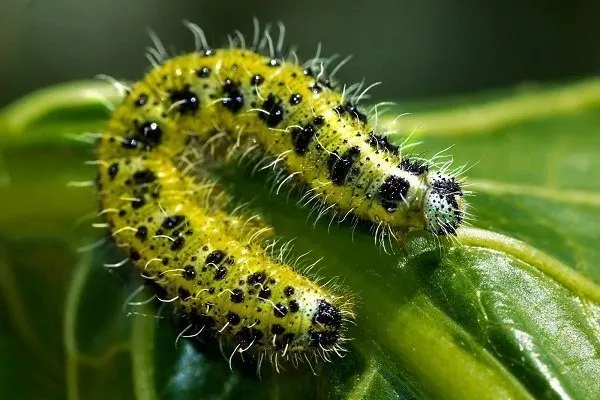
These larvae are very voracious and, within a few days, consume the leaves, causing them to curl and become covered with elongated holes. In the worst-case scenario, the caterpillars destroy all the foliage and cause root developmental abnormalities.
To repel white butterflies from a radish bed, a gardener can use the following tricks:
- scatter eggshell halves around the garden bed (insects will perceive them as relatives and, to avoid competition, will look for a new place to lay eggs);
- cover the bed with a fine-mesh net or place traps next to it - sticky fly tape, cut plastic bottles with sugar or honey syrup;
- add 2-3 drops of lavender or any citrus essential oil to the water for irrigation;
- Sprinkle the plants generously with sifted stove ash to dirty them (hares love cleanliness, so they won’t lay eggs on dirty leaves);
- treat the plantings with mustard infusion (30 g of dry mustard powder and salt, 5 g of ground red pepper per bucket of water, leave for 2 days);
- dust the soil with tree resin, which is first mixed with spices - cinnamon, ginger, saffron or mustard;
- If butterflies appear in the garden bed, immediately scare them away by watering the bed:
- herbal infusion (wormwood, tomato tops, rosemary, basil, sage);
- chemicals – Entobacterin, Bitoxibacillin, Lepidocid.
If egg clutches are already found on the undersides of leaves, they should be destroyed immediately. If traces of caterpillars are found in the garden bed, insecticides such as Kinmix, Sumi-Alfa, or Actellic should be used.
Cruciferous bug
This pest can be easily spotted on radishes, as its small body has a spotted color and red-black or orange stripes that contrast with the bright green leaves of the plant.
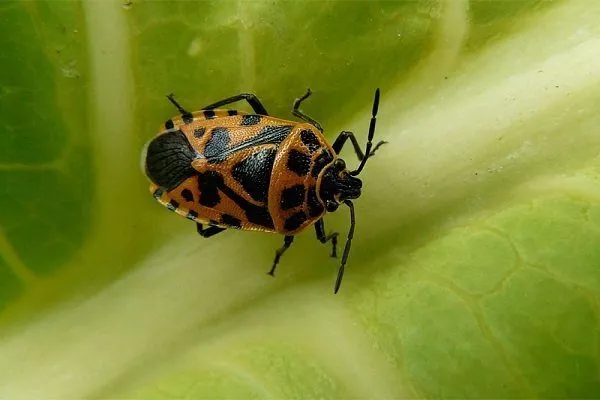
The bugs overwinter under plant debris, and with the arrival of warm weather, they emerge and attack cruciferous weeds. When cultivated species emerge, they migrate to them and cause damage:
- They suck the juice out of the root vegetable, especially in hot, dry weather. At the sites of mechanical damage, they leave "wounds" that gradually become "islands" of dead tissue with a yellowish border.
- Females lay eggs on the undersides of leaves. The hatchlings spend the winter in fallen leaves and other plant debris, emerging from hibernation in the second half of April or early May.
They are most active until August, feeding on leaf sap. This causes small spots to appear in the light, which then develop into spots, causing leaf dieback and weakening of the plants.
To repel the pest, plant tansy around the perimeter of the bed or regularly spray the plants with an infusion of its greens. You can also place swabs soaked in kerosene or turpentine between the rows.
If bugs have already been found on the plant, the following remedies can be used against them:
- infusion of datura or henbane (soak 500 g of leaves in a bucket of water for 12 hours, then add 30 g of grated laundry soap);
- infusion of onion peel or chamomile;
- insecticides - Fosbecid, Belofos, Aktaru.
Cabbage moth
This inconspicuous, light-brown butterfly feeds on nectar and is therefore harmless in itself, but it should not be ignored for two reasons:
- carries many diseases that pose a threat to radishes;
- lays larvae on leaves, which feed on their juice and eat out longitudinal tunnels in the tissue, showing the greatest activity in hot weather with a prolonged absence of precipitation.
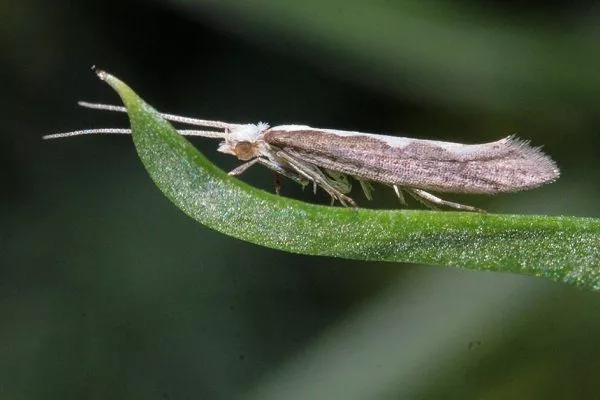
As a result of the damage, the leaf blades turn pale and dry out, which threatens the death of the entire plant.
If pests are found in the garden, inspect the undersides of leaves and the center of the rosette. Any caterpillars found should be collected and destroyed, and any eggs should be washed off with a solution of green soap. If severe infestations are detected, insecticides such as Ambush, Nurel D, or Talkord will be required.
To reduce the moth population in your garden, you can use a trap: apply grease, glue, pine resin, or another drying substance to yellow plywood or cardboard. The moths are attracted to the yellow color and fall into the trap.
Cabbage moth
The butterfly is a dirty gray color with fuzzy brown spots and stripes on its wings. It is nocturnal, making it almost impossible to spot it in a garden bed.
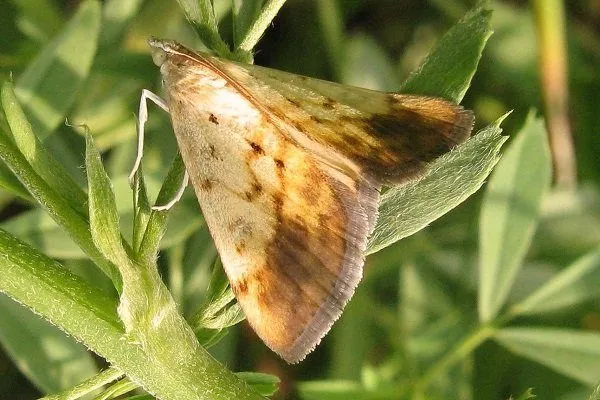
The butterfly lays eggs on the underside of leaves. These hatch into yellowish caterpillars with light-colored spots on their sides, which are dangerous to radishes. They scrape off the top layer of tissue from the leaves and gradually chew through them, leaving "pits" for various infections to enter.
To repel the pest, you can scatter pieces of synthetic material soaked in kerosene or tar around the garden bed. If egg clutches are discovered, the plant should be treated with insecticides. The following have been shown to produce good results:
- Ripcord;
- Bitoxybacillin;
- Sumicidin;
- Dendrobacillin;
- Ripcord;
- Gomelin;
- Anometrine.
Rape sawfly
A small insect (up to 6-8 mm long) with a bright saffron body and limbs and a glossy black head. It eats almost all the plant's leaves, leaving only the petioles. As a result, the radish dries up without producing fruit.
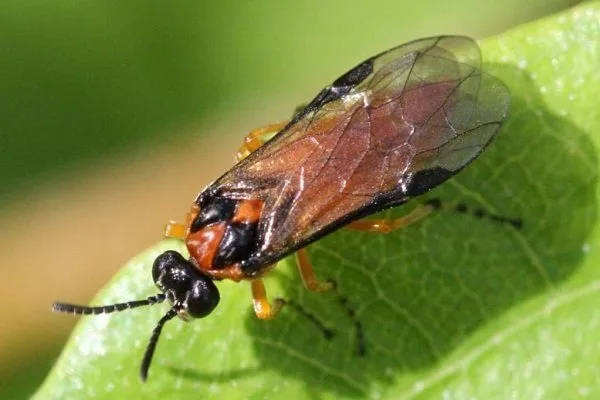
In addition, female sawflies pierce the undersides of leaves and lay eggs on them. This gives the ovipositor a serrated saw-like appearance. The hatched caterpillars also consume the foliage, leaving behind only the veins. They are most active in hot weather, but precipitation and cold snaps are detrimental to them.
A large infestation of sawflies can destroy 80-95% of the entire crop.
For prevention purposes, you can adhere to the following measures:
- Before sowing, soak the seeds in an insecticide solution (Karate Zeon, Actellik);
- against adult individuals use Bitoxibacillin;
- treat crops with an infusion of chamomile, pine needles, tansy or aconite;
- create bait plants from the Cruciferae family (when the pest moves to them, mow the grass and burn it);
- attract beneficial insects to the area, such as parasitoid wasps.
At the initial stage of infestation, caterpillars can be collected by hand (preferably during rainy weather) and destroyed. The plant can also be sprayed daily with a solution of baking soda or dry mustard (50 g per 10 liters of water). In severe infestations, chemicals such as Kinmix, Fury, Mospilan, or Arrivo will be required.
Rapeseed blossom weevil
A varnish-black beetle with brown legs that overwinters in the upper layers of soil and emerges when the air temperature warms to 10–12ºC. In the absence of rapeseed, it attacks radishes, sucking out their vital juices.
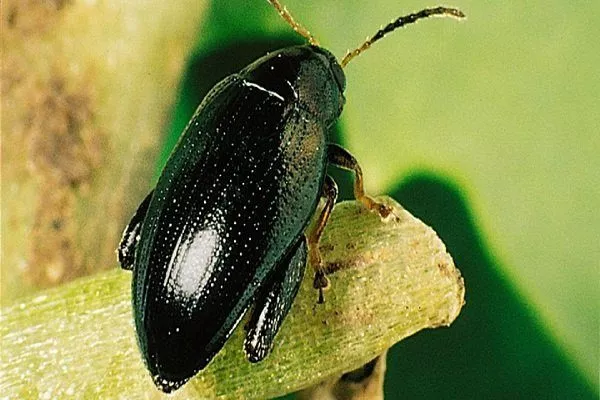
Crop losses from the rape blossom beetle can range from 20 to 70%. It causes maximum damage from the second half of May to the end of June, as this is the peak period for its activity.
Folk remedies won't help get rid of the pest, so you'll have to use insecticides:
- Karate Zeon;
- Kinmix;
- Fastak.
To distract the beetle from the radish, you can plant 2-3 bushes of rapeseed or rapeseed near the bed.
Slugs
Grayish-beige mollusks that feed on the tops and protruding parts of root crops. They are nocturnal, hiding under boards or plant debris during the day.
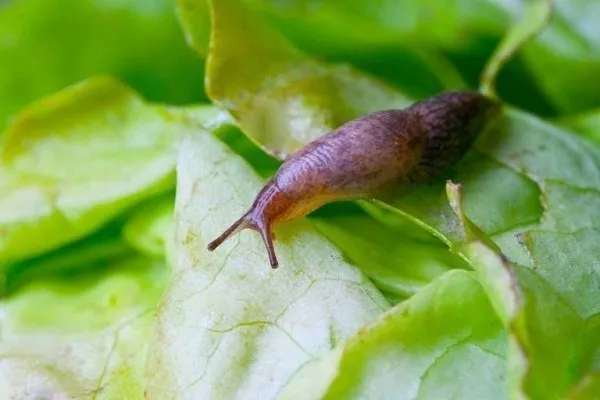
The following signs indicate that radish is being damaged by slugs:
- large holes appear on the leaf blade;
- through "tunnels" are visible in the root crops;
- Sticky marks can be seen on the plant, which have a silvery sheen in the sun.
Slugs can completely destroy young seedlings and ruin the entire harvest. If they attack mature plants, they can reduce the shelf life and appearance of the root crops.
To prevent a pest invasion, you need to take the following preventative measures:
- prepare several traps in the garden bed - dig holes and fill them about halfway with chopped cabbage, kvass, beer, last year's compost or jam (slugs collected in the traps should be collected during the day and destroyed);
- Create a “barrier” around the perimeter of the root vegetables using a thick layer of one of the following ingredients:
- crushed nut or egg shells;
- lime;
- crushed chalk;
- sand;
- wood ash.
- Place fresh nettle or wormwood leaves around the bed and between the rows, and also plant spicy herbs and other plants with a strong aroma;
- attract natural enemies of slugs – birds, frogs, hedgehogs.
If slug infestations have already been detected in the garden bed, spray the plant with a chili pepper infusion or a dry mustard solution. For a severe infestation, use chemicals (Meta, Groza, Slizneed).
Aphid
A small, yellow-green insect that doesn't move on its own but is spread by garden ants. Aphids attack crops in entire colonies, clinging to the undersides of leaves and sucking out their vital sap. Affected tissue becomes discolored, appearing as tiny, translucent, beige specks when held up to a light source.
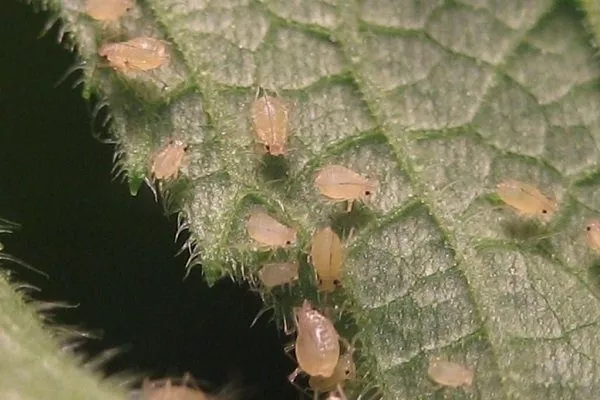
As a result of aphid infestation, radish leaves become deformed, turn yellow and wither, weakening the plant.
To repel aphids from your garden bed, follow these steps:
- destroy anthills, for example, using the drug Muracid;
- Plant plants with strong smells near the radish:
- marigold;
- calendula;
- chamomile;
- spicy herb;
- onion;
- garlic;
- fennel;
- lavender.
Many of the listed crops are good honey plants that attract the natural enemy of aphids – the ladybug.
- Spray the beds once every 8-10 days with an infusion of the above-mentioned plants, dry tobacco leaves, orange peels, pine needles or mustard powder.
If aphids are already found on the radish, they should be washed off with a solution of laundry soap, green potassium soap, or tar soap. After 30 minutes, rinse with clean water and apply the same infusions as for prevention, but spray several times at intervals of 6-8 hours.
If a plant is subject to a massive invasion of aphid colonies, it is more effective to use general-purpose insecticides:
- Confidor-Maxi;
- Admiral;
- Inta-Vir;
- Iskra-Bio;
- Tanrek.
Babanuha
A small, shiny, dark-blue beetle that overwinters in the upper layers of soil, under manure or plant piles. When the temperature warms up, they emerge, chewing up leaves and laying eggs. These hatch into dirty-yellow larvae, which also feed on plants.
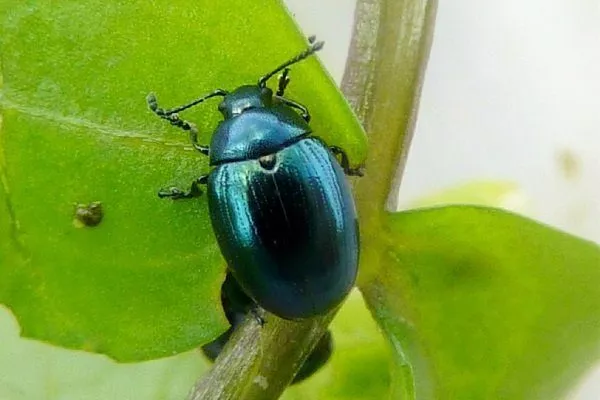
The radish blight weakens and stunts its growth. Furthermore, the pest can spread infections from diseased plants to healthy ones, significantly reducing the yield of viable root crops.
Folk remedies are not recommended against the beetle. It's best to collect it by hand, and in case of a large infestation, spray the crop with Actellic.
General prevention
To prevent radish from being affected by diseases and pests, it is worth observing the following preventative measures:
- observe crop rotation rules, planting crops in the same place at intervals of at least 3-4 years;
- remove infected plant debris from the area and burn it;
- Dig the soil deeply in the fall to destroy pests that overwinter in the soil;
- lime acidic soils, which is especially important for disease prevention;
- destroy weeds by regularly weeding the area and loosening the space between rows;
- add mineral fertilizers to the soil, dust the bed with ash and tobacco dust.
Radishes are an easy-to-grow crop, but they do require a number of agricultural practices to prevent diseases and pests. If the plant weakens, stunts, or develops characteristic spots, it's important to determine the cause and take all necessary measures to restore the planting and ensure a harvest of delicious root vegetables.