
Babka turnip is a relatively new, high-yielding variety that embodies all the characteristics of the classic cultivar. It's ideal for any garden and will be appreciated by all turnip lovers.
Who and when developed the Babka variety?
The Babka variety was created by employees of Agrofirm Aelita LLC. It was bred in 2015 by a group of breeders: Kachainik V.G., Gulkin M.N., Karmanova O.A., Matyunina S.V.
Description of the Babka turnip
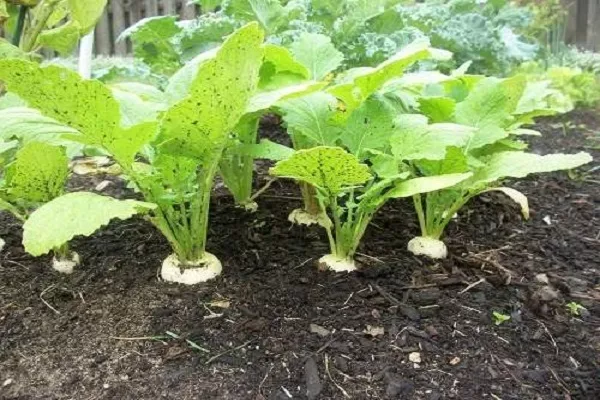
The Babka turnip has a semi-erect rosette. The leaves are quite long, making it easy to pull the roots out of the ground. The leaves are green, with curved tips.
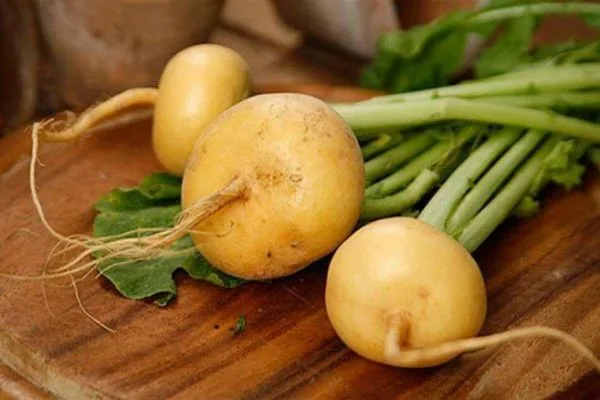
The Babka variety produces medium-sized, rounded roots. They are smooth, uniform, and can be flat-round or short-cylindrical. The average weight of a ripe root is 200-300 g. The color is yellow, with a smooth surface. The flesh is firm, juicy, and tender, with a golden-yellow hue.
Taste and purpose
The Babka turnip has an excellent flavor. It's exactly what a real turnip should be. Rich, slightly sweet, with a hint of bitterness.
Main characteristics
The Babka turnip is a high-yielding, early-ripening variety, yielding 3.5-3.9 kg per square meter. From germination to technical maturity, the roots average 45-55 days, with full maturity occurring in 60-80 days.
The variety rarely gets sick and, in particular, has a high resistance to clubroot of cruciferous plants.
Pros and cons
Gardeners did not find any significant shortcomings in this variety.
Landing features
Growing turnips, compared to many other garden crops, is quite simple. Turnips are generally quite cold-hardy, so they are usually sown in open ground, but seedlings can also be used if desired, especially in northern regions.
- ✓ The optimal soil temperature for sowing Babka turnip seeds should not be below +5°C.
- ✓ To prevent damage by cruciferous flea beetles, in addition to ash, you can use a covering material such as spunbond in the first weeks after sowing.
Landing features:
- The Babka turnip grows best in a sunny area; shading is detrimental to the crop and the ripening of large root crops.
- Turnips are sown with the desired harvest in mind. If a summer harvest is desired, turnips are sown as early as possible, from April 20 to May 10, depending on climate conditions. If a later harvest is desired, for fall and winter, sowing should be done between July 10 and 15.
- The optimal planting pattern is 20x15 cm. Small furrows are dug for planting. Seeds are planted at a depth of 1-2 cm.
Caring for turnips
Turnips don't require much effort from gardeners; their cultivation requires minimal agricultural practices. To grow large, juicy root vegetables, turnip beds need to be watered, tilled, and weeded.
- When the seedlings develop 1-2 true leaves, thin them out. The second thinning is done 10-12 days after the first.
- Once the seedlings emerge, it's recommended to sprinkle the beds with wood ash. The optimal layer thickness is 0.5 cm. This will prevent the spread of cruciferous flea beetles.
- For re-mulching, it's recommended to use straw or hay instead of ash. This type of mulch will reduce the amount of tilling, weeding, and watering required, and will also prevent the formation of a soil crust, which turnips are very sensitive to.
- The crop requires abundant and regular watering, so don't rely on rain. It's especially important to water turnips during periods of heat and drought. The best times for watering are morning and evening. It's best to keep the soil slightly moist at all times. However, avoid overwatering the beds; excessive waterlogging is not recommended.
- The approximate watering frequency is four times a week, twice in the morning and twice in the evening. The recommended watering rate is 10 liters per square meter. It's best to use rainwater or settled water at room temperature. Watering is most important during the periods of true leaf formation and intensive root growth. A week before harvest, watering is reduced to a minimum. If it rains, turnips should not be watered, as this can cause them to crack.
- Turnips are fertilized once or twice per season, around July. Potassium fertilizers are used for this fertilization. It is also recommended to add 300 g of wood ash (it contains about 5% potassium). If growth is poor, add potassium sulfate at a rate of 10 g per 10 liters of water (volume per square meter).
Pest and disease control
Turnips are susceptible to pests and diseases common to cruciferous crops, making them undesirable neighbors and predecessors.
The Babka variety is not susceptible to infection and insect damage, but if they are widespread, or if agricultural practices are grossly violated and care is poor, the crop may become diseased or attacked by pests.
The most dangerous pests for turnips are: flea beetles, cabbage moths, cabbage aphids, weevils, cabbage loopers, and cabbage and turnip whites. Babka turnips are rarely affected by clubroot. Other dangerous diseases include phoma, vascular and slimy bacterial diseases, gray mold, and blackleg.
| Method | Efficiency | Period of application |
|---|---|---|
| Wood ash | High against cruciferous flea beetle | The first weeks after sowing |
| Covering material | High against all pests | Until 2-3 true leaves appear |
| Decoctions of tops | Average against aphids and moths | At the first sign of pests |
How to harvest and store crops?
When sown early, turnips are pulled up selectively for food when the roots reach 5-8 cm in diameter. Autumn turnips are harvested all at once, before the onset of frost. It's important to remove turnips from the ground promptly; delaying harvesting will result in tough flesh and a diminished flavor.
Turnips are harvested on a sunny, dry day. A pitchfork can be used to remove the roots from the ground. It's important not to damage them; damaged turnips don't store well and will spoil.
After harvesting, the tops are cut off, leaving petioles about 2 cm long. The turnips are cleaned of soil with a cloth, dried in the sun for several hours, and sorted by size.
Turnips can be stored for up to a week directly in the garden, covered with hay or straw (12-15 cm thick). The roots are then moved to the cellar. The optimal storage temperature is +2…+3°C. Turnips are stored in boxes, sprinkled with sand or peat. In this way, turnips can be stored for several months.
Reviews
The Babka turnip is an excellent choice for turnip lovers. This variety combines excellent commercial qualities and superior flavor with good agronomic properties. This yellow turnip is very productive, hardy, and frost-resistant.