
Watermelon radish is a recently developed hybrid, so it's little known to Russian gardeners. It appeared in Russia in the early 2000s. It's the result of crossing a common radish and a horseradish. The correct pronunciation is "radish."
General information about the hybrid
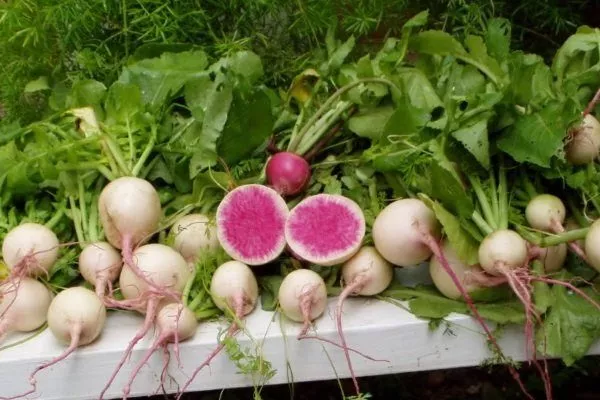
Watermelon radish is easily recognized by its distinctive appearance. The root is white on top, and when cut, it resembles a seedless watermelon. The rosette is upright. The leaves are dark green, with serrated edges.
Description of fruits
The main difference between this hybrid and regular radish is its firmer, less juicy flesh. It tastes sweet, while the skin is slightly bitter.
Characteristics of root vegetables:
- average diameter – 8 cm;
- weight – 100-200 g;
- pulp color – deep pink;
- peel color - white-green;
- shape – round and oblong.
The skin of watermelon radish roots tastes bitter due to the presence of mustard oil in its composition.
Agrotechnical characteristics
Watermelon radish has a high yield – approximately 10 kg per square meter. The quantity and quality of the harvested radish depends primarily on two factors: irrigation and fertilizing. The crop can withstand temperatures down to -6°C, and its optimal growing temperature is 22…24°C.
Pros and cons of the species
Despite its relative lack of popularity, watermelon radish has many advantages. This crop has all the makings to be a favorite among gardeners.
- friendly shoots;
- early fruit bearing;
- high immunity to diseases;
- cold resistance;
- high yield.
- short shelf life;
- rapid loss of taste.
Features of planting and growing
To ensure a good radish harvest, it needs to be provided with the most favorable conditions possible. Giving the crop a good start significantly increases the chances of a decent harvest.
Planting dates
Watermelon radish achieves its highest yield in temperate climates. Like common radishes, watermelon radishes don't like intense sun and heat. The best yields are achieved when the crop is grown early. Seeds are planted when the soil warms to 8–15°C.
Radishes are sown for the first time in late April or mid-May. Gardeners practice "supplemental sowing," which allows for repeat harvests. Watermelon radishes are sown a second time in July, and a third time in early August.
Site selection and crop rotation
Seeds are planted in well-prepared soil. Radish grows well both outdoors and in greenhouses. It produces the best yields in sandy and loamy soils with an acidity of up to pH 7.
- ✓ The optimal soil acidity should not be higher than pH 7; for accurate measurement, use a pH meter.
- ✓ Sandy loam and loamy soils must be well drained to avoid water stagnation.
If the soil is too acidic, it needs to be deacidified using lime, applied at a rate of 600 g per 1 square meter. Instead of lime, you can add dolomite flour, chalk, or wood ash.
Good predecessors for radish are:
- cucumbers;
- tomatoes;
- potato.
It is not recommended to plant radishes after root crops (beets, carrots, radishes, etc.), as well as after cabbage.
The plant prefers to grow in well-lit areas, but in sunny areas it requires some shade during high sun hours. Soils with stagnant water are not suitable.
Soil preparation
Before planting, soak the seeds for 24 hours. Place them in cold water to swell. This ensures uniform germination and uniform root growth.
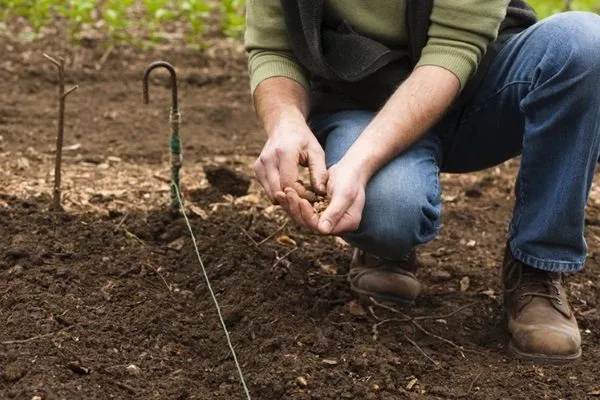
The beds for planting radishes are prepared in the fall. This ensures the soil is thoroughly saturated with fertilizer, and all the mineral granules are completely dissolved.
How to prepare the soil:
- Dig the soil to a depth of approximately 30 cm.
- Add organic matter during digging – humus (4 kg per 1 sq. m) or compost (1 bucket per 1 sq. m), phosphorus or potassium fertilizers according to the instructions.
Sowing
Regardless of the planting time, radishes are planted according to the same pattern. The difference with spring sowing is the use of covering material.
The order of sowing seeds:
- Make furrows in the beds at a distance of 40-50 cm from each other.
- Plant the seeds in furrows at a depth of 3-4 cm. Space the holes 10-15 cm apart. Add a pinch of superphosphate to each hole (10 g of fertilizer per linear meter). Cover with soil.
- Place two seeds per prepared hole. Cover them with nutritious soil mixture.
- Water the crops with warm, settled water.
- Cover the planting with a covering material, such as plastic film.
Seedlings emerge quickly—in 3-4 days. Subsequently, thin the plantings as needed, leaving only the strongest and healthiest shoots.
Caring for the crop
Watermelon radish grows quickly and requires little care. To ensure the plant develops well and produces large roots, it requires regular watering and fertilizing.
The soil is also loosened and weeded every 3-4 days. Loosening is necessary to prevent crust formation and improve soil aeration. Regular tilling allows the roots to receive oxygen, which accelerates root development.
Watering
If radishes are watered improperly and the proper moisture regimen is violated, the roots will grow "empty," dull, and with a poor flavor. If there's a lack of moisture, the plants will quickly sprout, resulting in elongated, fibrous, and hard roots.
How to properly water watermelon radish:
- Use clean water for watering. You can also add an ash solution to the beds (this will serve as both fertilizer and watering). To prepare the solution, dissolve a cup of ash in a bucket of water.
- The radish is watered through a watering can with a rain nozzle.
- Watering frequency: once a day. In the summer, when the weather is hot, water the radishes twice – morning and evening. If it rains, watering the beds twice a week is sufficient.
- The crop is watered at least 5-6 hours before harvesting.
- Watering rate: 10-15 liters per 1 sq. m of area.
If overwatered, radishes are susceptible to fungal diseases.
After watering, the space between the rows is mulched with organic or inorganic mulch.
Fertilization
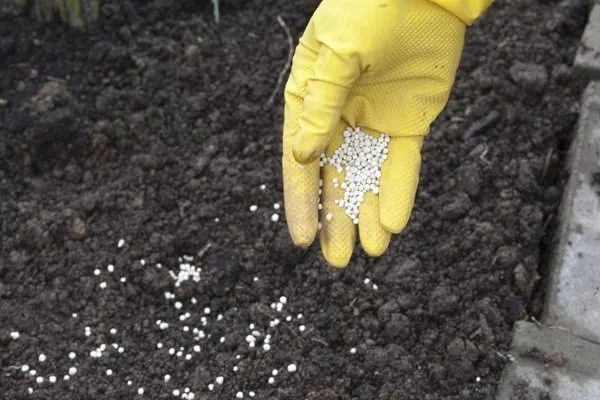
Watermelon radish is an early-ripening crop, so it doesn't respond well to excess mineral and organic fertilizers. Phosphorus-potassium fertilizers are applied only once—to the soil before sowing.
Radishes grow very quickly, absorbing no more than 10 grams of micronutrients per square meter of area. Therefore, there's no need to apply a lot of fertilizer during the growing season. Most of the fertilizer is applied before planting.
If there is too much nitrogen in the soil, the radish will begin to actively grow tops, but root vegetables will not form.
To feed radishes, use the following:
- Nitrogen. Radish receives this nitrogen from saltpeter (15 g per 1 sq. m) or urea (10 g per 1 sq. m). In spring, nitrogen is applied to the soil no later than 2 weeks before sowing.
- Potassium. For example, potassium sulfate is used – 10 g per 1 sq. m when digging.
- Phosphorus. The most popular source is superphosphate. It is applied in the fall during soil preparation (50 g of fertilizer per square meter). Ammonium phosphate can also be used as a source of nitrogen and phosphorus.
| Fertilizer type | Quantity per 1 sq.m. | Time of application |
|---|---|---|
| Saltpeter | 15 g | 2 weeks before sowing |
| Urea | 10 g | 2 weeks before sowing |
| Potassium sulfate | 10 g | When digging |
| Superphosphate | 50 g | In the fall |
How to protect watermelon radish from diseases and pests?
This vegetable crop rarely loses its yield due to diseases and pests, as it has a fairly strong immune system. Problems usually arise when cultivation practices are improper. Radishes are especially susceptible to disease when the soil is overwatered or highly acidic.
Soil-dwelling pests pose a serious threat to watermelon radishes. They can gnaw at the roots, rendering them unfit for consumption. Plants can also suffer from insects that feed on their above-ground parts.
The main pests of watermelon radish:
- Wireworm. This is the larva of the long-legged beetle. This hard, orange worm burrows through root vegetables, creating long tunnels. Timely weed control helps solve the problem, as the beetle larvae feed on their roots.
- Cabbage fly. The larvae that chew through radish leaves are harmful. They are controlled primarily with folk remedies, such as sprinkling the beds with ash and spraying with ammonia solution. These methods also help get rid of the cruciferous flea beetle, which also likes to nest on radish leaves.
Watermelon radishes (radishes) can be susceptible to fungal diseases due to overwatering, rapid weed growth, and other agricultural practices. They are particularly susceptible to clubroot, an incurable disease. They can also be affected by powdery mildew, gray mold, and white rust. Products such as Skor, Fundazol, Hom, and their analogs help combat these diseases.
Harvesting
Watermelon radish inherited the common radish's early maturity. Gardeners can grow 3-4 harvests in a single summer. They are harvesting root crops Once they reach a certain size—5-8 cm in diameter—they're ready to be planted. If you leave radishes in the ground for too long, they'll lose their flavor.
Watermelon radishes are harvested exactly 30 days after germination. They are grown not for storage, but for fresh consumption, as they quickly lose their freshness and flavor. The roots begin to lose moisture and wilt within two days of harvest.
To grow juicy, large roots with sweet flesh, watermelon radishes require careful care. Regular watering and fertilizing, as well as other agricultural practices, are key to high yields.