
Radishes are the earliest-ripening crop with very rapid root formation, making them the first vegetable to be grown in your greenhouse. Furthermore, they are relatively easy to maintain, making them easy to grow even for novice gardeners.
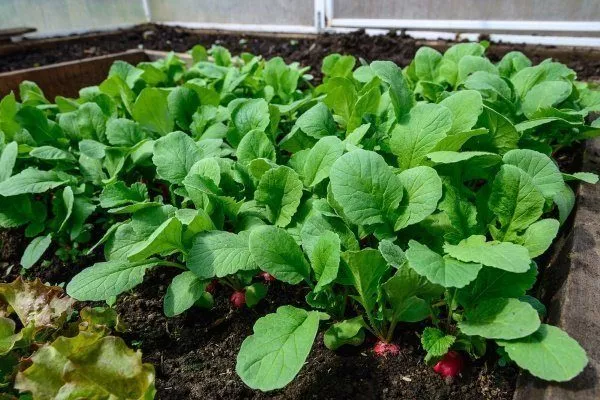
Greenhouse for growing radishes
The best option for quickly ripening radishes is a permanent greenhouse that is well-lit and warmed by the sun. A less attractive but quite convenient option is a small polycarbonate greenhouse.
If radishes are grown in regions with cold winters, the greenhouse must be well-heated. In this case, the crop can be planted directly into the soil, which will be heated by an underground hot-water pipe or heating cable.
If soil warming isn't provided, it's better to plant using shelving, but even then, the greenhouse should be heated. Electric heaters, infrared heaters, gas equipment, or a stove can be used for this purpose.
In any case, to obtain a rich harvest of radishes with even and beautiful roots in a greenhouse, it is necessary to guarantee the following conditions:
- Optimal temperatureDuring the day, it should be kept between 18 and 20°C, and at night, no more than 10°C. The optimal soil temperature is no less than 11 and 14°C. Only under these conditions will the plant not stretch out over the course of several days while the leaf rosette is forming.
- Acceptable air humidityIn the greenhouse, it is necessary to ensure average air humidity – at the level of 70%.
- Long-term illuminationThe room should be illuminated for 8-12 hours a day. To maintain these conditions during the winter or on cloudy days, additional overhead lighting should be provided. Keep in mind that radishes will bolt if they receive too much or too little light (14 hours or more).
The growing season for each variety depends on light intensity, temperature, and humidity. Under unfavorable conditions, root development and formation will be delayed. Furthermore, the plant may begin producing flowering shoots and seeds, and mature root vegetables will quickly lose their marketability.
When to plant?
Radish seeds can be sown in protected soil immediately after the snow melts and nighttime temperatures reach near freezing. These conditions typically occur in late March or early April. For an early harvest, radishes can be planted from mid-January, but it's important to ensure nighttime temperatures remain around 0°C and daytime temperatures reach 15°C.
In a greenhouse or hotbed, the first shoots will appear in approximately 3-5 days, depending on the stability of the temperature regime.
Among all vegetables, radishes have the shortest growing season, so they can be grown in protected soil as a preceding, post-harvest or catch crop.
Selecting a variety and purchasing seeds
| Name | Growing period (days) | Yield (kg/m2) | Root crop weight (g) |
|---|---|---|---|
| Greenhouse | 22-25 | 1.7 | 25-28 |
| Dawn | 30 | 1.8 | 18-20 |
| Heat | 18-27 | 3.5 | 13:30 |
| Saxa | 20-30 | 4 | 8-10 |
| Early red | 20-30 | 1.6 | 20-30 |
| Helro | 20-25 | 2.9-3.3 | 20-25 |
Selecting a variety should be done carefully, as seeds intended for outdoor planting may bolt in greenhouse conditions. The length of the growing season (from the first shoots to full maturity) is a significant factor in this regard.
- ✓ Resistance to bolting in short daylight conditions.
- ✓ Minimum temperature requirements for seed germination.
For greenhouses, choose early-ripening varieties with a growing season of 22-25 days. Mid-early varieties (25-30 days) can also be grown, but mid-late (35-40 days) and late (more than 40 days) varieties are best avoided.
For growing in a greenhouse or hotbed, you should also choose varieties that are resistant to external influences. These include:
- GreenhouseAn early-ripening Russian variety with a marketable yield of 1.7 kg per square meter. The roots are round-oval in shape, smooth in surface, and have a thin tip. The average radish weight is 25-28 g. Recommended for growing in protected soil in a spring greenhouse.
- DawnAn early-ripening variety, the fruits ripen 30 days after sowing. The roots are round and dark red, with juicy, tender flesh that is not bitter. Fruit weight is approximately 18-20 g. This variety is grown only indoors.
- HeatAn early-ripening variety with a growing season of 18-27 days, it produces an early and abundant harvest when grown in a greenhouse (up to 3.5 kg per square meter). It produces round, crimson-red roots with a smooth surface and weighing approximately 13-30 g.
- SaxaAn early-ripening variety with a growing season of 20-30 days. It has a high yield of 4 kg per square meter. It tolerates drought and low temperatures well. The roots are round, bright red, with juicy, snow-white flesh and weigh from 8 to 10 g.
- Early redAn early-ripening variety bred by Russian breeders, it produces dark-red, round roots weighing 20-30 g. Yields are relatively low—up to 1.6 kg per square meter. It is resistant to early stemming. This variety is designed for growing in winter greenhouses.
- HelroAn early-ripening variety bred in Holland, it is suitable for early spring and late fall cultivation in hotbeds and greenhouses. The roots are perfectly rounded, brightly colored, and weigh up to 20-25 g. The yield is good – 2.9-3.3 kg per square meter.
The listed early-ripening hybrids are characterized by excellent qualitative and quantitative yield indicators.
Once you've chosen a specific variety, you can head to a gardening store to purchase seeds. They should be healthy and medium-sized (2.5 to 2.8 mm). The store sells ready-to-plant seedlings, so you won't need to process them yourself.
In the following video, a gardener will explain which radish varieties to choose for growing in a greenhouse to ensure an excellent harvest:
Preparatory work
Before sowing seeds, it's necessary to treat the seed, if necessary, and properly prepare the soil. The quality of this work will determine the time it takes for the roots to fully mature and the yield.
Seed preparation
Seed treatment is performed before sowing to disinfect and further stimulate growth. It is carried out as follows:
- sift the seeds through a sieve with cells of about 2 mm in size to select the best planting material;
- soak the seeds in a weak solution of potassium permanganate for several hours to reduce the risk of disease;
- soak the seeds for a day in a solution of wood ash (1 teaspoon per 100 ml of water) to stimulate the growth of seedlings, and for this purpose you can also use other substances - Epin (2 drops per 100 ml of water, soak for 18 hours) or Potassium Humate (20-25 drops per 100 ml of water, soak for 12 hours);
- Dry the seeds on a paper towel after soaking.
Soil preparation
Radishes need to be grown in light, loose soil with a neutral pH, otherwise the crop will become diseased. Following this rule, you can prepare the following soil mixtures:
- field soil (40%), humus from manure (60%);
- lowland peat (20%), manure humus (40%), turf soil (40%);
- turf soil (40%), manure humus (60%);
- turf soil (50%), greenhouse soil (50%).
Soil preparation begins in the fall and requires following a number of rules:
- Apply mineral fertilizers at a rate of 40 g of superphosphate and 15 g of potassium chloride per 1 sq. m of area.
- Additionally, add one bucket of compost per 1 square meter of the plot if the soil needs organic matter or is depleted after the previous crop.
If sufficient organic matter was used during the previous planting in the greenhouse, it is not necessary to add fertilizer to the soil before sowing radishes.
- Dilute overly heavy soil with sand.
- After applying fertilizer, dig up the soil, level it, prepare ridges 1 m wide and leave until spring.
- If necessary, no later than 10-15 days before sowing the seeds, you can reduce the acidity of the soil by adding slaked lime, dolomite flour or ordinary wood ash to the soil.
- A few days before sowing, cover the soil with film to allow it to warm up additionally.
For convenience, many gardeners prepare cassettes of the same depth, width and length – 5 cm each – for planting radishes.
Planting seeds
Seeds are sown in early spring, when the soil has softened to a depth of 2-3 cm. The plastic film should be removed, and then the seeds should be sown by hand. Planting should be uniform to avoid the need for thinning later. However, seeds in a greenhouse should not be sown too densely, as even thinning will not prevent this.
Planting should be carried out taking into account the following parameters:
- seeding depth – no more than 1 cm;
- distance between seeds – 2 cm;
- distance between rows – 6-8 cm;
- seed consumption is approximately 4-5 g per 1 sq. m.
These are optimal parameters to make it easier to care for the planting in the future.
Some gardeners use a flat-cutter to create even, attractive furrows. However, this can be difficult to maintain even spacing between the furrows, requiring thinning later.
To avoid this problem, you can use a more convenient marker for marking out the bed – a cardboard egg carton with 30 nests. Simply press it into the soil to create perfect holes for the seeds. In each hole, the soil will be almost compacted and covered with light, loose soil.
Learn how to easily sow radishes in the ground using a marker in this video:
The following video also explains the little secrets of planting radishes:
Planting care
To obtain a full harvest of root crops, the seedlings will require proper care, adhering to the following rules:
- Maintaining optimal temperatureDuring the seedling germination period, the temperature should be between 16 and 18°C. Once the seedlings emerge en masse, the room should be cooled to between 6 and 8°C. This is the optimal temperature to prevent the seedlings from stretching. Maintain this temperature for 3-4 days. Then, the temperature should be increased to between 15 and 20°C during the day and between 8 and 10°C at night. It's important to note that radishes are cold-hardy crops, so they are frost-resistant and can even withstand nighttime temperatures as low as -5°C.
- Organizing optimal lightingThe ideal daylight period for root crops to ripen is up to 12 hours. During the summer, the greenhouse should be covered with black or dark film to ensure daylight does not exceed this time. Otherwise, flower stalks will form, preventing a full harvest.
- Watering and ventilationRadishes require frequent and regular watering. In hot weather, plants should be watered daily, and in cool or cloudy weather, every 2-3 days. Water the seedlings to a depth of 10-15 cm. If the soil is allowed to dry out, the roots will become tough, and if it's too wet, they will crack. After watering, the room should be well ventilated, as high humidity can cause radishes to become infected with blackleg.
- MulchingTo reduce moisture evaporation and retain it in the soil, gardeners add peat or humus to the soil. The optimal layer depth is up to 1 cm.
- ThinningIf the seedlings are too dense, they need to be thinned out. Ideally, plants should be spaced 2-3 cm apart. If they are too crowded or shaded, the roots will stop developing and remain small. After thinning, the plant's foliage will droop and become horizontal, preventing the risk of bolting.
- FertilizationNitrogen-containing fertilizers are the best fertilizer for radishes. Apply during watering at a rate of 20-30 g per square meter of planting area. Fertilize the soil up to twice per season. If the soil under the radishes has been sufficiently fertilized, there is no need to fertilize it during the growing season.
- Weeding and looseningWeed and loosen the space between rows as needed.
- Pest controlTo protect the planting from pests, treat it with a mixture of tobacco dust and ash in a 1:1 ratio. This is a reliable and effective remedy against the cruciferous flea beetle, the main pest of radishes.
The technical maturity phase of the root vegetables takes 1.5-2 weeks, after which a flower stalk 60 to 130 cm tall forms. Flowering takes approximately 30-35 days. Depending on the variety, the flowers, gathered in a raceme, can be white, light pink, or purple. The fruit is an indehiscent pod containing round-oval seeds that are black or brown. They remain viable for 4-5 years.
An experienced gardener explains how to properly care for radishes growing in a greenhouse in the following video:
Harvesting and storage
Greenhouse-grown crops should be harvested in 2-3 stages, with the first harvest occurring 1-1.5 months after sowing. The total yield is typically at least 1.5-2 kg per square meter.
Gardeners advise not to delay harvesting too much: harvest medium-sized radishes when they are juicy and have acquired the color characteristic of the particular variety.
A few hours before harvesting, the plant should be watered. For example, you can water it in the morning and harvest the radishes during the day. Next, they need to be properly processed. If the roots won't be sold immediately, the leaves should be trimmed along with the tops. Next, rinse them under cold water and dry them lightly. These radishes can be stored in the refrigerator for 3-4 weeks.
Experienced gardeners recommend a method that allows for longer storage of the vegetable. To do this, prepare a wooden box with a plastic sheet covering the bottom. Place the radishes in the container, lightly sprinkling them with a mixture of peat and sand. The sand-peat mixture helps prevent the roots from rotting.
Is it possible to grow in a greenhouse without heating?
Radishes are frost-resistant, even when grown in an unheated greenhouse or hothouse. Their shoots can withstand temperatures as low as -1°C, while mature plants can withstand temperatures as low as -5°C. Therefore, they can be planted in the spring even in an unheated greenhouse or hothouse.
In this case, some additional rules should be observed:
- Provide a warm, supportive environment for the beds. To do this, you can add fresh, unrotted manure under the plantings. It can be regular horse, goat, or cow manure, but the latter two types must be mixed with straw. The manure should be moistened until it dries slightly. If manure is unavailable, you can add regular hay, wood shavings, or autumn leaves under the beds. Any dead wood should be compacted to a depth of 30 cm, doused with boiling water and a weak solution of potassium permanganate, covered tightly, allowed to steam, and then covered with planting soil. After 5-7 days, you can begin sowing the seeds.
- After preliminary preparation, plant the seeds directly into the ground or in individual pots, depending on the gardener's capabilities. Optimal planting parameters are: hole depth of 1 cm, row spacing of at least 7 cm. If planting round radish varieties, the soil depth should be at least 15 cm, and for long radish varieties, at least 20 cm.
- When planting densely, thin the seedlings by 3-5 cm so that the vegetable does not just stretch into tops, but produces good root crops.
- Provide proper care for the seedlings according to the rules outlined above. Regularly pull out weeds by the roots, loosen the soil, and water the radishes 1-2 times a day with warm water (22-23°C). Feed the first shoots with nitrogen at a rate of 1 teaspoon per 10 liters of water, but be careful not to overdo it, as radishes accumulate nitrates like a sponge. To accelerate root growth, the plant can be fed with potassium (2 teaspoons per 10 liters of water) and superphosphate (3 teaspoons per 10 liters of water).
- If the temperature drops sharply, provide additional protection for the plant by spraying it with water and covering it with plastic film. This will trap moist air, preventing the plant from freezing. During the day, the film should be lifted.
Growing radishes as a business
Radishes can be harvested year-round in a greenhouse, so many gardeners grow this crop for sale. Remarkably, this type of business is easy to start from scratch, as produce grown on your own plot is tax-free.
So, you should start with small sales, and later, if the business becomes profitable, you can register as a sole proprietor. This will allow you to not only sell root vegetables yourself but also supply products to stores and markets.
When registering a business follows Please indicate "agricultural production" as your activity, as agricultural producers receive support from the state.
There are several recommendations that aspiring entrepreneurs should consider:
- To continuously obtain root crops for sale, it is worth planting seeds every 1.5-2 weeks;
- The emphasis in your business should be on quality - choosing varieties for cultivation and subsequent sale that produce tasty fruits;
- mainly grow classic varieties, but you can gradually add exotic ones;
- increase production in winter and summer, when radishes are in high demand.
Compared to other crops, radishes are easy to grow in a greenhouse; however, the plant may bolt prematurely and produce woody or flabby roots. To prevent these consequences, follow proper radish cultivation practices and provide the plant with optimal growing conditions.
I live in the central part of Russia, so growing radishes in greenhouses is a big deal for me. Your advice is invaluable. I especially appreciated the detailed description of the seed and soil preparation. I also appreciated the selection of greenhouse varieties. In short, thank you for this excellent and useful article.