
Planting radishes before winter to reap tasty, juicy fruits in the spring is every gardener's dream. To make this a reality, it's important not only to choose the right variety, but also to sow the seeds at the right time and then provide thorough care.
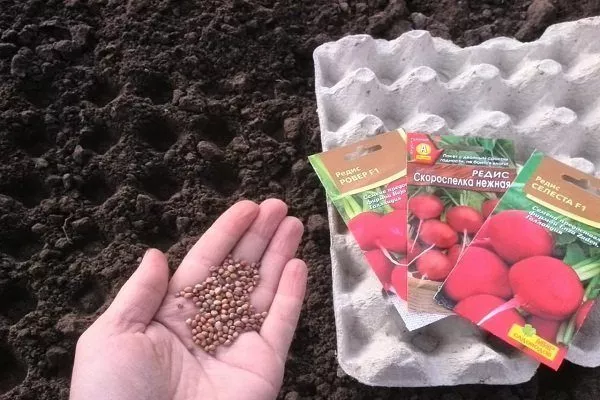
Benefits of growing radishes in winter
Winter sowing of radishes has many advantages, leading gardeners to plant them despite the risk of crop failure. The main benefits of growing radishes in winter include:
- Possibility of harvesting in MayRoot crops ripen 2-3 weeks earlier than those planted in the spring. Covering the bed with plastic wrap can reduce this time by another 7-10 days.
- The harvest is of high qualityAll diseased and weak seeds die in frozen soil. Only the strongest seeds remain, from which healthy radishes grow.
- In early spring, the seeds do not require watering.For germination, they need only the moisture they receive from the soil during snow melting.
- Plants are resistant to pests, since their main enemies, the carrot fly and the cruciferous flea beetle, are still asleep.
- Frost resistance of cropsCrops that survive the winter are not affected by spring frosts.
If the seed is of poor quality and fails to germinate, the gardener won't be left without a harvest. They always have the option of sowing new beds in the spring.
Autumn radish varieties for winter planting
| Name | Ripening period | Frost resistance | The need for light |
|---|---|---|---|
| Heat | 15 days | High | Low |
| Dawn | 18-25 days | High | Low |
| Pink-red with a white tip | 25-30 days | Average | Average |
| Champion | 20-25 days | High | Average |
| Presto | 16-20 days | High | Low |
Choosing variety of radish For winter planting, you need to focus on three main criteria:
- resistance to bolting;
- good frost tolerance;
- low need for sunlight.
The best radish varieties that are suitable for planting in the fall are listed in the table below:
| Name of the variety | Ripening speed | Taste qualities | Productivity |
| Heat | Early maturing, after emergence the crop can be harvested in 15 days. | Delicate, slightly spicy taste. | High. |
| Dawn | Early maturing, fruits can be harvested 18-25 days after emergence. | Mild taste with a slight spiciness. | Tall. The variety thrives in low-light conditions. |
| Pink-red with a white tip | Mid-early. Harvest is 25-30 days after planting. | Pleasant delicate taste. | High. |
| Champion | Early maturing. The crop can be harvested 20-25 days after emergence. | The taste is sweet, with a slight bitterness. | Average. About 1 kg of fruit can be harvested from 1 square meter. |
| Presto | Early maturing. The crop can be harvested 16-20 days after emergence. | Mildly spicy taste. | High. About 2.5 kg of radish can be harvested from 1 square meter. |

Radish Heat

Radish Zarya

Radish Pink-red with white tip
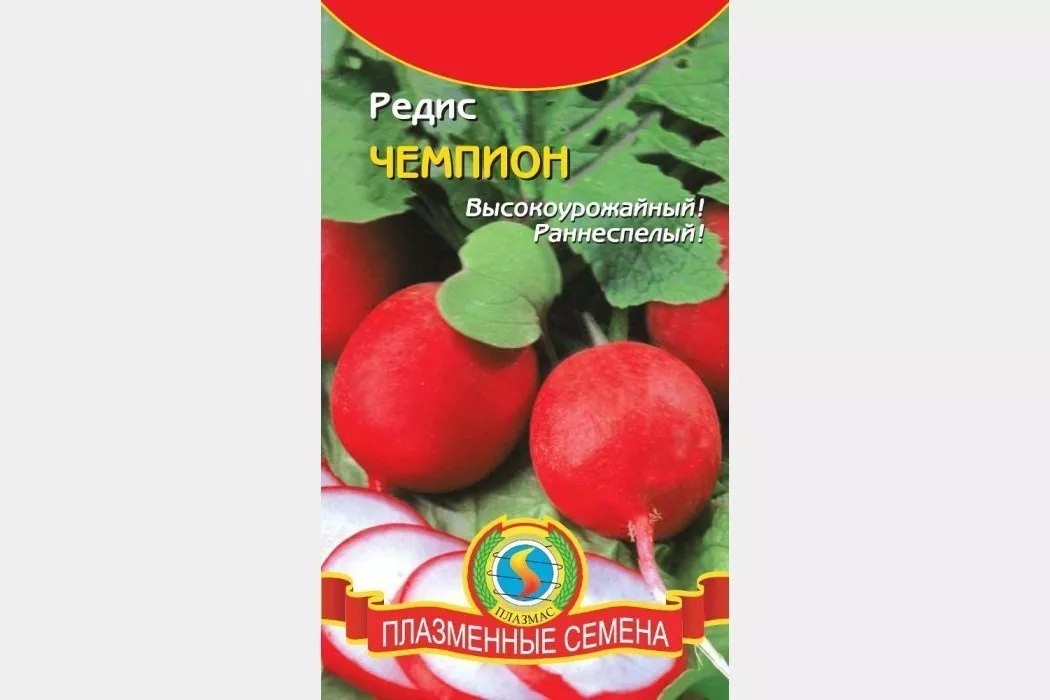
Radish Champion

Radish Presto
The listed varieties of radish are used for winter planting, as they tolerate frosts best.
Conditions for growing radishes in winter
To get a long-awaited radish harvest in the spring, you need to plant the seeds correctly in late autumn. To do this, you need to meet five conditions:
- The bed should be on a raised platform.This will prevent the seeds from being flooded when the snow melts.
- The predecessors of winter radish seeds can be cucumbers, tomatoes, legumes, potatoesAvoid planting root vegetables in areas previously occupied by horseradish, watercress, cabbage, or radishes. Radishes don't grow well in beds previously occupied by cruciferous vegetables. They shouldn't be planted in the same spot three years in a row, even with fertilization.
- For winter planting, you need to take twice as many seeds as in spring.This will reduce the likelihood of crop loss due to crop death or poor quality.
- It is essential to calibrate the seeds before adding them to the soil. To do this, they are dipped in salt water for a few minutes. Only the seeds that sink to the bottom are planted. Any seeds that float to the surface are discarded.
- After drying, the seeds are disinfectedA weak solution of potassium permanganate is suitable for this purpose. The future radishes should be soaked for no more than half an hour. After removing the seeds, they should be dried. This will allow them to absorb moisture and swell, but not germinate.
By following these recommendations, you can minimize the risk of seed damage and get a high radish yield.
Planting dates
The timing of winter radish planting depends on the region of Russia, as the climate varies significantly across the country. It's also important to consider the weather conditions at the time of sowing.
The optimal soil temperature is -1 to 0 degrees Celsius. Under these conditions, the ground freezes slightly. A steady frost is essential. Otherwise, the seeds will germinate during the thaw, only to freeze when the cold weather sets in.
In the Moscow region, winter radishes are planted in the second half of October. In northern regions of Russia, seeds are sown earlier, in early October. Residents of the southern regions can sow seeds as early as early November.
There's no exact date for planting radishes in winter. It's important to consider the weather forecast for a given year. Plant when you're confident the temperature won't rise above 0 degrees Celsius. A lunar gardening calendar tailored to your specific location can help you determine the right time.
Soil preparation
The plot should be well-lit. Shaded areas are not suitable for planting radishes in winter. The better the soil warms, the sooner the first shoots will appear. Furthermore, insufficient sunlight will cause the radishes to grow leaves, and the radishes themselves will be small.
- ✓ The optimal depth of furrows for sowing should be at least 4 cm, but not more than 5 cm, to ensure sufficient protection of seeds from frost.
- ✓ To prevent seeds from being washed away by melt water, the bed should be located on a slope with an angle of at least 5 degrees.
If the soil is too compact, add peat or sand beforehand. Over the winter, the soil loses its looseness, making it difficult for the seeds to reach the sun.
If the soil is poor, it needs to be fertilized. Organic fertilizers such as humus or compost are suitable for this purpose. Apply 1 kg of fertilizer per square meter. Alternatively, you can use minerals containing phosphorus and potassium. Apply them according to the instructions. Radishes prefer soil rich in ash, so you can add a cup of this fertilizer to the bed.
Beforehand, you need to ensure you have warm soil available to cover the seeds. To do this, you'll need to keep it in a warm room for a while.
Prepare the beds before frost sets in. Making furrows and applying fertilizer to hard, frost-bitten soil will be difficult.
Once fertilizer has been applied to the radish planting site, the soil is dug over and furrows are made in the bed. These furrows should be about 4 cm deep. The minimum spacing between furrows is 10 cm. If the garden space allows, this distance can be increased by another 5-10 cm. Make sure the bed is free of stones and clods. The seeds will thrive only in loose soil. If the soil is highly acidic, slaked lime should be used.
To prevent the prepared plot of soil from being washed away by rain or blown away by wind, it is covered with plastic. Regardless of the planting time, the bed should be prepared in the first half of October.
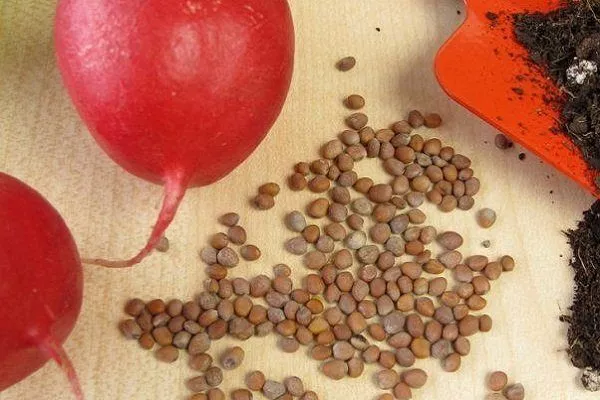
Features of planting radishes in autumn
To prevent radish seeds from being damaged by winter frosts, certain precautions must be observed when planting them in the fall. These mandatory rules include:
- Seeds should not be planted deeper than 5 cm into the soil. They must be dry.
- For better visibility, the seeds are pre-marked. They are soaked in a 1% iodine solution for about 3 minutes. The seeds are then sprinkled with chalk. This will allow them to be distributed more evenly throughout the bed.
- The distance between each seed should be about 3 cm.
- When planting is complete, the bed is covered with pre-prepared soil.
- Cover the seedlings with a layer of mulch. This will act as a cushion, protecting the seeds from the sudden temperature changes, thaws, and frosts that are typical in spring. Good materials include spruce or pine branches or dry shrub branches. The mulch layer should be at least 20 cm thick.
- In winter, you should visit your garden plot to additionally cover the bed with snow. This will increase the chances of successful seed survival.
Watering the bed after planting is not recommended. Otherwise, the seeds will begin to germinate and die when the real frost sets in.
Caring for the crop
Radishes don't require any care during the winter. Once the weather warms up, remove the mulch from the bed and wait for the first shoots to emerge. The covering material can be removed only after the weather warms up.
- ✓ The first leaves should be bright green, without spots or signs of wilting.
- ✓ The stems should be strong, not elongated, which indicates sufficient lighting.
After the first shoots emerge, the bed needs to be thinned. This is especially important if the seeds were sown loosely rather than individually. Remove any weak shoots. The distance between seedlings should be at least 5 cm.
The garden bed should be regularly inspected for weeds. If they appear, weed them out, as they prevent the young fruits from developing properly.
Features of watering
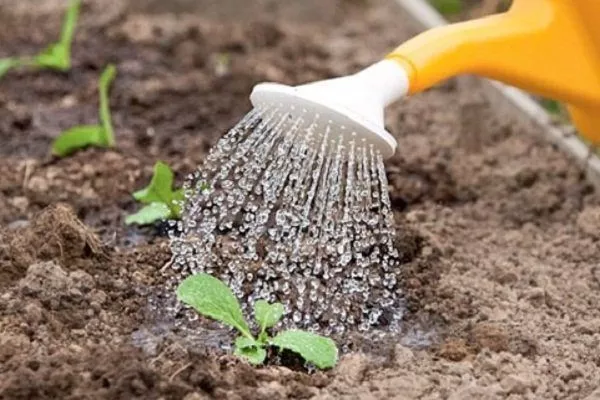
The frequency of watering depends on how rainy the spring was. It's important not to overwater the sprouts or let them dry out. If there's not enough moisture, the radishes will grow tough and bitter. If there's too much water, the roots will become watery, loose, and lose their natural flavor. Another sign of overwatering is cracks in the radishes.
The optimal soil moisture level for radishes is 80%. To determine this without any equipment, squeeze the soil in your hand. If it forms into a ball and leaves a damp sheen on the surface of your palm, the radishes will thrive in that soil. If the soil crumbles but doesn't disintegrate, there's not enough water. If water appears after squeezing, reduce watering.
If the spring is dry and rainless, water the bed sparingly. Be sure to loosen the soil to prevent a hard crust from forming on the top layer. This will allow the fruits to receive oxygen, which will encourage their growth.
Fertilization
Fertilization is required in depleted soils. This procedure is mandatory if the soil was not fertilized before planting.
For nourishment, you can use an infusion of young grass. The recipe for this is:
- 1 kg of collected grass is poured with 10 liters of water.
- Add 2 kg of chicken manure to the resulting mixture.
- Cover the container with a net.
- The resulting composition is stirred daily.
- When the fermentation process begins, the same amount of fresh water is added to the infusion.
- Water the plants with the prepared mixture. Apply the fertilizer to the roots, being careful not to get it on the leaves.
The infusion takes about 7-14 days to prepare. To speed up the fermentation process, keep the container in a warm place. Very poor soils require two fertilizing sessions throughout the growing season. Applying nitrogen fertilizers to the bed is not recommended, as this will cause the tops to grow while the radishes themselves remain small.
In addition to herbal infusion, you can use compost, humus, saltpeter, and ash. Fertile soil does not require fertilizer.
Pest and disease control
If warm weather sets in too early, even winter radishes can be susceptible to pest and disease attacks. The following are dangerous for the plant:
- fleas;
- white butterfly;
- keel;
- blackleg;
- bacteriosis.
To protect fruit from pests in early spring, simply sprinkle the tops with ash. The ash will be absorbed by fleas and midges, killing them.
A mixture of ash and lime helps prevent further insect reproduction. The components are used in equal proportions. The powder is sprinkled on the tops of the plants once a week. This treatment is carried out after rain and during dry weather.
As a preventative measure, you can use a decoction of onion peels. Water the seedlings with this solution. The aroma of the decoction repels pests, preventing them from damaging the young shoots.
A solution of 2 tablespoons of mustard and 1 tablespoon of salt helps against whiteflies. Dissolve these ingredients in 10 liters of water and water the plant.
If insects are actively breeding and attacking radishes, chemical treatments are necessary. You can use Tod, Zolon, Kaiser, and other products. Apply the products according to the instructions.
A lime solution (100 g of lime per 2 liters of water) helps combat bacterial rot. For blackleg, a mixture of laundry soap (50 g) and copper sulfate (1 tbsp) can be used. Dissolve the mixture in 10 liters of water and water the radishes.
Harvesting and storage
To ensure the roots emerge easily from the soil, the bed needs to be watered. It's recommended to water 3 hours before harvesting. Radishes will emerge from moist soil without any effort. Simply pull the plant by the tops.
Radishes are suitable for harvesting when they reach 3 cm in diameter. Small radishes should be left in the ground to ripen. It's important not to let the radishes sit in the soil for too long, as this will negatively impact their flavor.
Vegetables don't need to be washed before storage. Shake off any soil, trim off the leaves, leaving 3-cm petioles. Place the peeled roots in plastic bags and store in the refrigerator. Winter radishes generally don't last long. The juicy, vitamin-rich fruits are eaten within a few weeks.
Common mistakes when planting radishes in the fall
Top 5 mistakes inexperienced gardeners make when planting radishes in winter:
- planting seeds too early in warm soil;
- sowing on the eve of the thaw;
- use of wet covering material;
- introducing a small amount of seeds into the soil;
- planting radishes in areas where water stagnates.
Knowing the most common mistakes and avoiding them will help you grow juicy and tasty fruits.
You can plant radishes before winter not only in open ground, but also in the greenhouseThis video explains how to do this correctly:
Once you've mastered the technique of planting radishes in the winter, it'll be hard to give up this method for an early harvest of delicious and juicy vegetables. To achieve this, simply follow a few simple rules, choose the right planting timing, a frost-resistant variety, and the optimal location for the bed, and carefully care for the seedlings in early spring.