
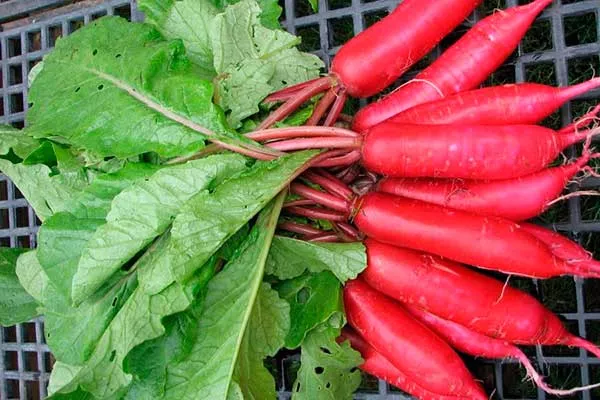
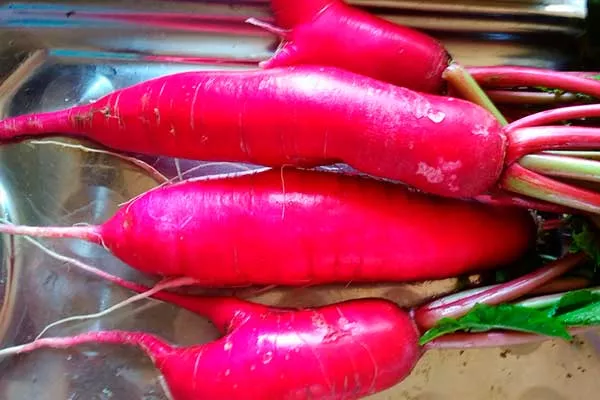
Red Giant is an exclusive radish variety with a striking appearance. Its large, elongated fruits resemble carrots, but they have a classic, sweet, slightly spicy flavor. It is distinguished by its productivity and tolerance to adverse conditions, making it suitable for both private and commercial gardens.
Peculiarities of breeding work
The history of this variety dates back to 1958, when it was developed by specialists from the Far Eastern experimental station of the All-Russian Research Institute of Plant Breeding.
To this day, the Red Giant remains very popular among gardeners due to its excellent characteristics.
Introduction to the variety
The Red Giant stands out from most other radish varieties in several ways: large fruit size, lack of characteristic bitterness, rapid growth and development, and rare bolting.
Description of tops and roots
The Red Giant is a plant with a rosette of leaves, which can be either spreading or erect, and consists of 6-12 leaflets.
Other varietal characteristics:
- The bush reaches a height of 10-14 cm and a diameter of 15-28 cm, depending on the type of development.
- The leaves are solid, oval, and deep green. They are covered with sparse, short hairs, and the petioles are a vibrant crimson hue.
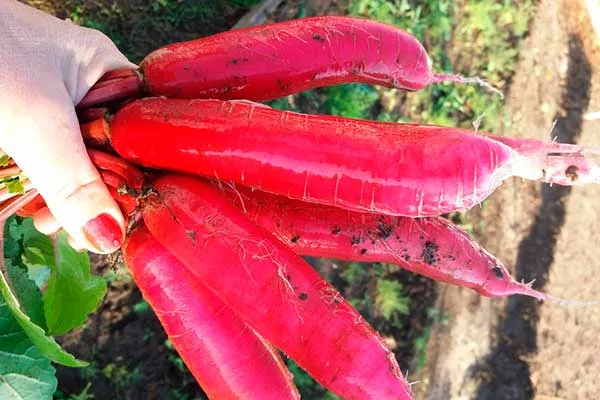
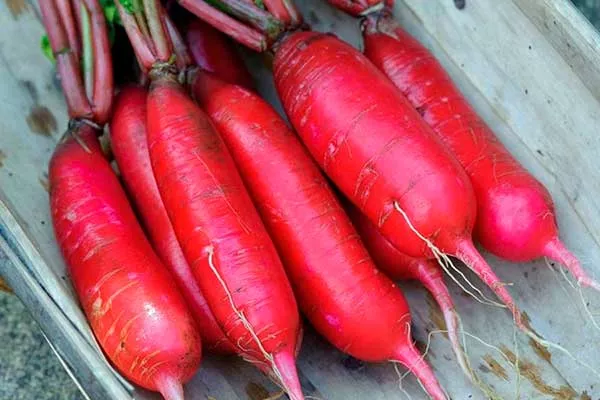
- Root crops that have reached maturity can be from 11 to 15 cm long, with some specimens reaching 30 cm, having a diameter of 2.5– cm.
- The root vegetable has an elongated cylindrical shape.
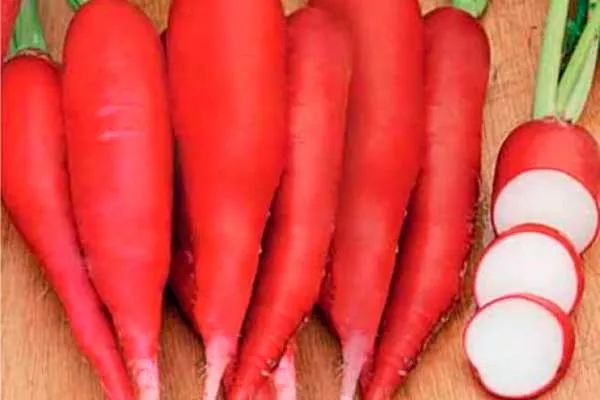
- The radishes are red in color, sometimes with a white-pink stripe at the bottom.
- The pulp of this variety is characterized by increased juiciness and a delicate structure.
- The weight of one root crop ranges from 45 to 80 g.

Taste qualities
The Red Giant's flesh is particularly sweet and juicy, white in color. This variety is characterized by its excellent flavor. It has a slightly spicy, yet non-bitter taste.
Usage
The roots of the Red Giant can be eaten as a separate dish, or used to prepare snacks and salads.
This variety is usually consumed fresh, and its young leaves are added to salads instead of regular greens.
When ripe, the yield
The ripening time for the root crops of the Red Giant variety is from 40 to 50 days from the moment the first green shoots appear until they are fully ripe.
Radishes are highly productive, with an average yield of 2.5 to 4.5 kg of root vegetables per square meter. To achieve maximum results when growing this crop, it is important to provide it with sufficient light and moisture, as well as strictly adhere to crop rotation principles.
Where is it recommended to grow?
Red Giant is suitable for both open and closed cultivation. It is ideal for summer sowing.
The variety is known for its ability to tolerate low temperatures, making it suitable for cultivation not only in the central but also in the northern, East Siberian, and Far Eastern Federal Districts of Russia.
Landing rules
Red giant belongs to a category of plants that require long days to thrive. When daylight hours exceed 14 hours, these plants begin to grow actively, but instead of forming roots, they focus on developing green leaves, flowering, and seed maturation.
As a result, during the period of maximum daylight hours, that is, during the hottest summer, it is impossible to achieve the desired yield.
To ensure the productivity of root crops, seeds should be sown in such a way that the plants undergo their development cycle under conditions of shorter daylight hours.
Recommended timeframes
When growing Red Giant in open ground, you can plant it several times during one season:
- The beginning of spring. Early sowing occurs immediately after the snow has completely melted. Protective structures, such as greenhouses and hotbeds, are used to speed up harvesting.
- From May 20 to June 10. For these purposes, you can choose those beds where lettuce or bulbs were previously grown.
- From August 20 to September 10. Suitable for southern regions only.
Depending on the geographical location, the landing time of the Red Giant also varies:
- in the southern regions it is sown immediately after the snow has melted, which corresponds to the beginning of March;
- in the central sowing occurs from the end of March to the beginning of April;
- in the northern regions Sowing is carried out in late April.
The earliest harvest can be achieved by sowing radishes before winter. On average, this will allow for harvesting two weeks earlier than with spring sowing. However, it's important to keep in mind that under unfavorable weather conditions during the winter and spring, plants planted before winter may flower without forming roots.
When growing Red Giant radish in closed ground conditions (in greenhouses and hotbeds), the following sowing times are recommended:
- February-April;
- August-November.
Ideal growing conditions for radishes include temperatures ranging from 16 to 22 degrees Celsius. Root crops will also develop at lower temperatures, starting at 12 degrees Celsius.
Selecting a location and preparing beds
The variety is distinguished by its winter hardiness, which allows it to be used as a precursor for more heat-demanding crops without creating a separate bed.
It is important to provide sufficient lighting to the area in the morning and evening hours, avoiding direct sunlight at midday, so as not to stimulate unwanted development of green mass.
- ✓ The soil pH level must be strictly within 5.5-7.0, otherwise the root crops will not be able to develop properly.
- ✓ The soil must be well aerated to avoid cracking of the roots.
Soil conditions include sandy loam, slightly acidic, with a pH of 5.5 to 7.0. The soil should be well-aerated to prevent cracking of the roots.
Peculiarities:
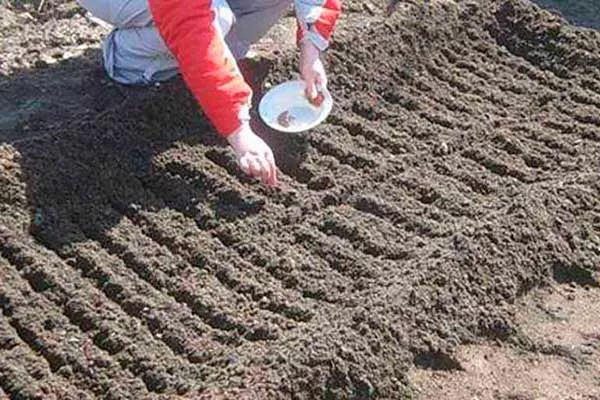
- Preparing the beds for spring planting begins early, in the fall, with the addition of compost and humus. Additional fertilizers are added, such as superphosphate and potassium salt. Afterwards, the area is carefully leveled with a rake.
- The garden is dug to a depth of 18 to 20 cm to ensure the necessary looseness.
- Avoid sowing radishes in the fall after cruciferous crops such as daikon, horseradish, cabbage, or horseradish, as they can transmit the same diseases through the soil.
- The best predecessors for radishes are garlic, potatoes, cucumbers, tomatoes, peas and beans.
Landing algorithm
The Red Giant is a variety with large fruits that should be planted according to a specific pattern:
- the interval between plantings in one row is 10-15 cm:
- inter-row spacing – from 40 to 60 cm.
Before sowing, the seedlings should be soaked for 10-14 hours. Radishes are best planted in cool, humid weather.
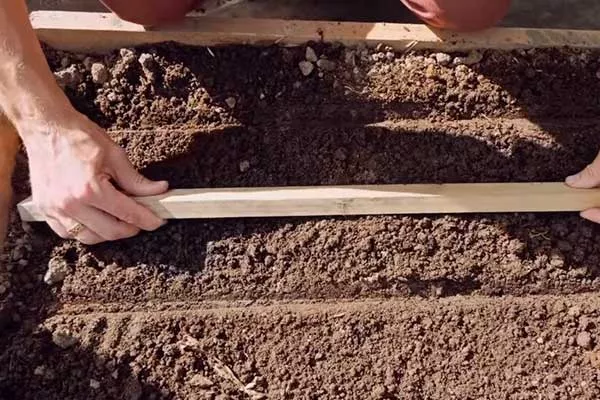
The process looks like this:
- Make grooves and compact their bottoms.
- Fill the grooves with water.
- Spread the seeds evenly.
- Cover the furrows with soil.
The planting depth should be 2-2.5 cm. Planting the seeds too deeply can lead to deformation of the root crops.
When rotating crops over large areas, radish seeds should be sorted by size, separating small and large ones. They should be planted separately to ensure uniform and harmonious growth.
Features of cultivation
Immediately after sowing, cover the beds with dark plastic for 10 to 14 days. Remove the cover in the morning, starting between 7:00 and 9:00 AM, and reapply it in the evening, between 6:00 and 8:00 PM, to reduce daylight hours to 10-12 hours per day. This allows the plant to focus its growth on root development.
Watering
When growing Red Giant in the fall, maintaining optimal soil moisture is especially important. In the spring, natural moisture is sufficient for healthy plant growth.
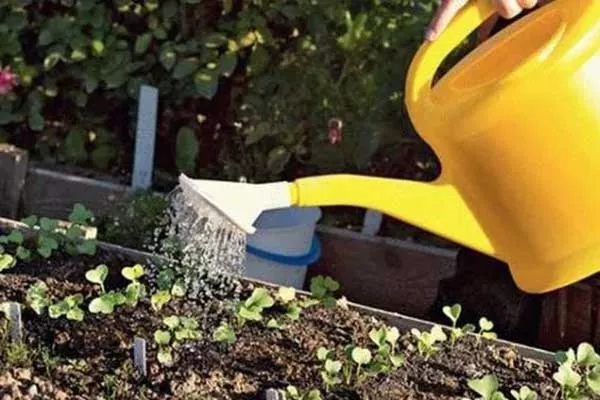
However, in summer and fall, a lack of soil moisture can result in fruits with a rough texture, a bitter taste, and dryness. Changes in moisture levels can also cause unevenness on the roots.
Features of irrigation of the variety:
- The Red Giant requires regular but moderate watering. If the water level is insufficient, the roots may become hollow, dry, and have a bitter taste. However, excess water can lead to rot. Therefore, it is important to monitor and precisely regulate the amount of water entering the trunk area.
- After each procedure, the soil should be thoroughly loosened.
- To avoid early and unwanted flowering, it is recommended to water the plants no more than two to three times a week, using small amounts of water. This will help reduce soil temperature.
- During hot weather, daily moisturizing may be necessary.
The Red Giant radish variety has a robust root system, which requires special attention when choosing irrigation methods. The water penetration depth should be equal to the following values:
- after sowing – up to 7-8 cm;
- after the formation of root crops – up to 13-15 cm.
Radishes can be irrigated using simple water, herbal infusions, or ash and tobacco solutions. Watering is best combined with pest and disease control measures. The last watering should be done a few hours before harvesting, which will ensure longer shelf life.
Thinning
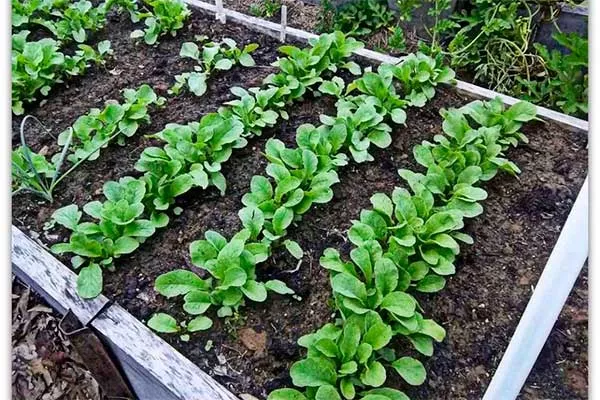
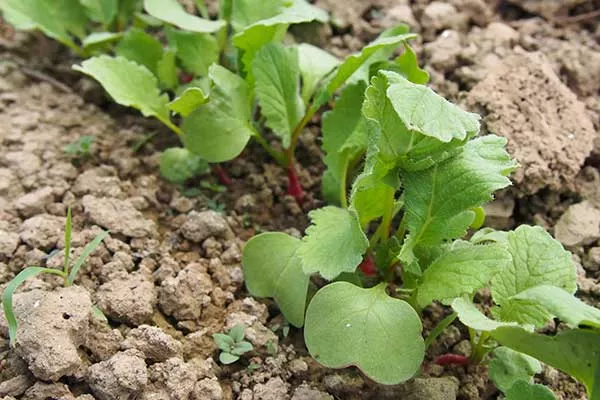
This variety thrives on intensive seed placement. This promotes better germination, makes it easier for the seeds to break through the soil, and protects them from weeds. However, as a result, the seedlings often become too dense. Seedlings begin to compete for water, light, and nutrients, resulting in small, irregularly shaped roots.
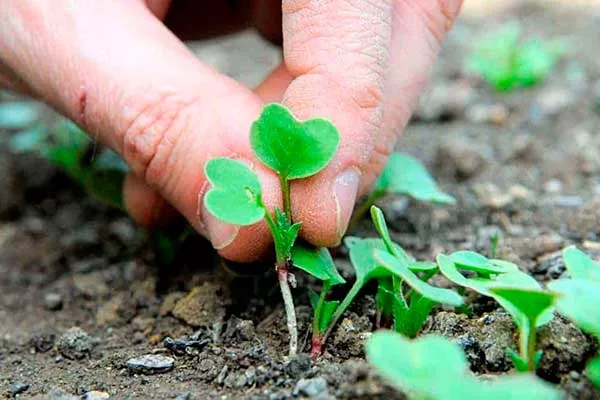
To avoid this, it is necessary to carry out the procedure of thinning crops at least twice during the growing season:
- After 5-8 days of sprouting, to prevent them from stretching due to overcrowding, leave 3 cm between plants.
- One month after sowing, space the seeds 6-8 cm apart.
During the first thinning, you can transplant the sprouts with unfolded cotyledon leaves (except for those that are small and weak), and during the second thinning, you can already harvest the radishes for consumption.
Necessary rules for carrying out the procedure:
- Thin out in the evening after watering.
- Holding the soil around the sprout with one hand, pull the sprout out of the ground with the other.
- After the event, be sure to compact the soil around the plants.
- Spray the crops with water after the procedure.
Top dressing
When caring for radishes, you need to be especially careful, as this vegetable is prone to nitrate accumulation. If your soil is already fertile enough, organic fertilizers won't be necessary. The amount applied last fall will be sufficient.
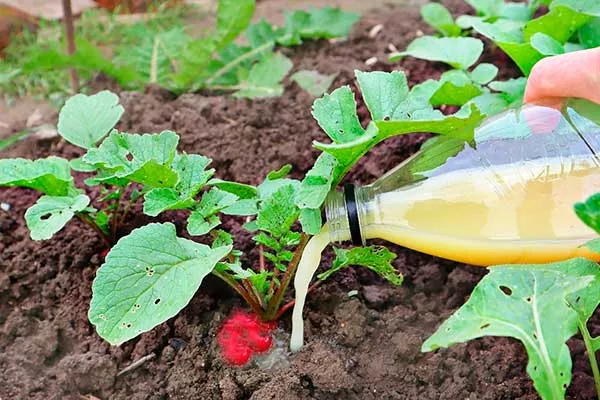
- Before planting, add compost or humus at a rate of 10-12 kg per 1 sq. m.
- Two weeks after germination, feed the plants with a mineral complex (40-45 g per 1 sq. m).
- Stop applying nitrogen fertilizers one month before harvest to avoid nitrate accumulation in root crops.
However, if necessary, you can add mineral fertilizer. Recommended fertilizer doses (per 1 sq. m):
- Superphosphate – 25-45 g;
- ammonium nitrate - the same amount;
- potassium salt – 35-45 g.
On soils with low fertility it is recommended to apply:
- humus, rotted manure or compost – 10-12 kg;
- mineral complex mixture – 40-45 g.
Pests and diseases
The Red Giant is not afraid of flea attacks, while its immunity to diseases is average:
- If planted in areas that are too damp and lack ventilation, it may be susceptible to downy mildew.
- During periods of heavy rainfall, black spot often appears on plants.
- When growing Red Giant in greenhouses with high humidity, there is a risk of developing black leg.
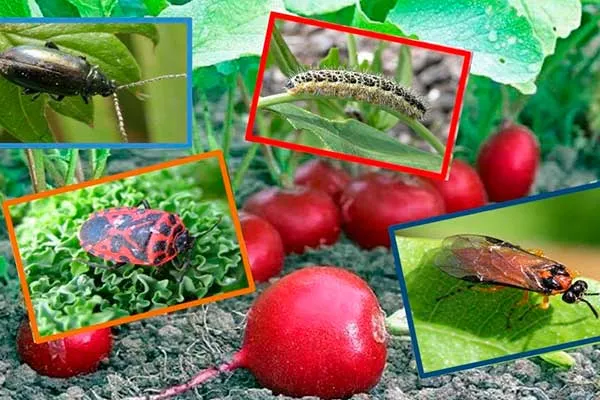
To prevent problems, carry out preventative spraying with fungicides.
Harvesting and storage
Harvesting of root vegetables occurs 35-38 days after sowing in southern regions and 40-50 days in other regions. To preserve radishes until winter, a special approach is used: only the base is cut off, leaving the stems intact.
Next steps:
- Root crops are placed in strong boxes (no more than 20 kg each) and covered with wet sand.
- The sand is covered on top with a layer of chalk or wood ash, which will protect the vegetables from decomposition and loss of juiciness.
Optimal conditions for storing radishes in sand include air humidity of 90-95% and a temperature of 0 to 1°C. Radishes can be stored in the refrigerator for up to a week, after being washed and packaged in plastic bags.
Problems
Growing radishes isn't always successful—many beginners make mistakes. Therefore, pay attention to the following:
- The seeds did not germinate. Perhaps the planting material was of poor quality or died due to excessive waterlogging.
- The root crop has not formed. This may be due to a lack of potassium or light.
- The leaf rosette is actively growing, but the root crop is not. The bush is overfed with nitrogen.
- The fruits are fibrous and empty, with cracks. This may be due to excess nitrogen in the soil or improper watering.
- The radish has blossomed or started to shoot. This can happen due to hot weather and lack of moisture.
- Tough and bitter root vegetables. It is possible that the plant was over-fertilized before harvesting.
Vegetables similar to this variety
There are several radish varieties that resemble the popular Red Giant in their characteristics. These include White Icicle, French Breakfast, Autumn Giant, and Russian Size.
Positive and negative qualities
Review of reviews
Red Giant radish can be sown in spring or summer to produce large, tasty roots twice a year. This versatile variety requires little care. It is popular with gardeners for its marketable qualities, good yield, and long shelf life.