
Every experienced farmer has their own tips for growing crops, including how to speed up the ripening of tomatoes. Many methods have been devised, each with its own advantages, disadvantages, and peculiarities. It's also important to know the causes of delayed growth, so you can prevent it.
Why is it necessary to speed up the ripening of tomatoes?
The main goal is to preserve the harvest, as in many regions, cold weather sets in during the tomato ripening period, with sharp temperature fluctuations (day/night). This can cause tomatoes to remain green, brown, or turn red unevenly.
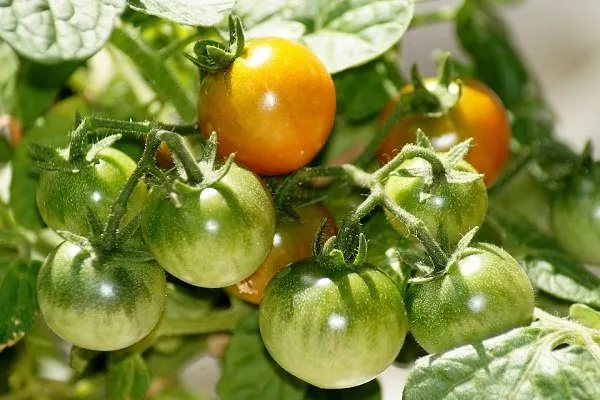
These same temperature fluctuations lead to condensation on the green mass of tomatoes, which contributes to the development of putrefactive diseases, in particular late blight.
The best ways to speed up the ripening of tomatoes
To speed up the ripening of tomatoes, two types of methods are used: agronomic and chemical. In the former, the fruits and leaves are treated with folk remedies and agricultural techniques, while in the latter, chemicals are used.
More sunshine
To provide the fruits with more sunlight, simply trim off excess leaves that create shade on the tomatoes. Additionally, do the following:
- Place supports under the brushes that are located at the very bottom.
- Turn the vines with unripe tomatoes towards the sunny side.
- Secure with a soft rope.
Thanks to this manipulation, the fruits will be located further from the soil surface, so they will not become too cold at night.
Covering plantings with film
In August and September, nights become too cold for tomatoes. The temperature contrast leads to the formation of cool dew in the morning, which further aggravates the situation. Therefore, create a cover with thick plastic every evening.
To avoid damaging the bushes, make an arch from metal arcs and stretch the film over it.

Picking brown fruits
Nightshade crops ripen well after being picked, so sometimes gardeners pick them when they're brown or even green, but this should be done early in the morning before they have time to warm up. Ripening occurs under the following conditions:
- Providing light - place the tomatoes in a lighted area, which will allow them to ripen quickly (it is essential to turn them over periodically);
- store tomatoes in the dark so they turn red slowly but as evenly as possible;
- For slow ripening, it is enough to create a temperature of 9-11°C, for rapid ripening – from 20 to 25°C.
Artificial stress with a through cut at the base of the trunk
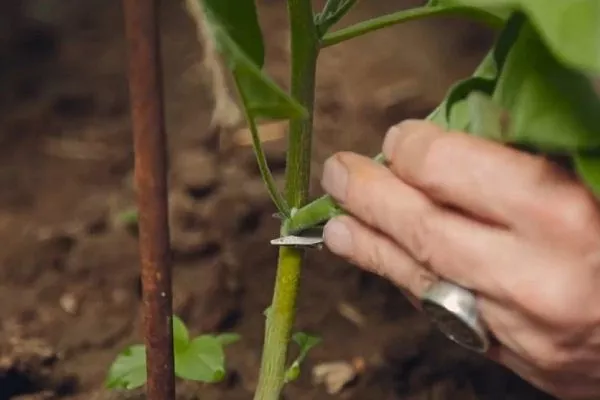
Plants become stressed when their nutrition is restricted, which disrupts sap flow along the stems. Here's how to do this correctly:
- Prepare a sharp knife – treat it with alcohol or a solution of potassium permanganate to prevent infection.
- Take the main stem with your fingers and at a height of 10-12 cm make a through and necessarily longitudinal cut of 3 cm in length.
- Insert a wooden sliver (or toothpick) into the cut. Ideal dimensions are 2 x 0.5 cm (length x width).
This procedure causes partial rupture of plant tissue without completely blocking sap flow. This type of stress ensures that all energy is directed toward accelerating fruit ripening.
Pulling a plant out of the soil
This method also causes some stress, but in the root system. The trick is to sever the roots. This stops the transport of nutrients to the roots and directs them to the tomatoes. Here's how to pull them out correctly:
- Grasp the base of the trunk with your hand.
- Pull it out of the ground gradually.
- As soon as you hear a crunch in the roots, stop and let go of the bush.
Reduce watering and eliminate nitrogen fertilizers
Temperature fluctuations always trigger guttation—early morning moisture builds up on the plant, causing the bush to cry, releasing excess water. This halts the ripening process. If you reduce watering, all the plant's energy will be devoted to finishing ripening.
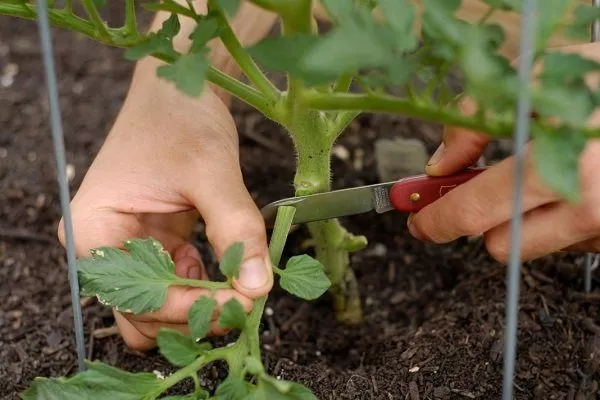
Removing side shoots and lower foliage
All gardeners know that when a bush has increased branching, the fruit takes longer to ripen, so in late July-early August, it is necessary to remove side shoots and lower leaves so that they do not drain the plant's energy.
What you need to do:
- cut off all foliage and side shoots down to the upper flower clusters;
- cut the branches so that only stumps remain;
- Disinfect garden tools.
Stimulation with ripe fruits
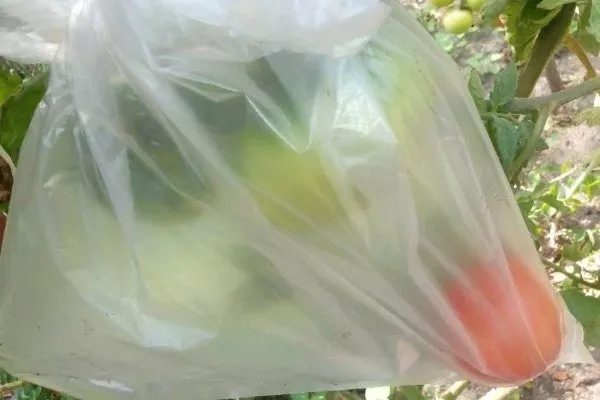
Ripe vegetables release the phytohormone ethylene, which accelerates the ripening of their green counterparts, so it's enough to place ripe tomatoes next to brown ones. Here's how to do it correctly:
- Take a plastic bag.
- Place a bunch of green tomatoes and 1-2 red tomatoes in it.
- Tie the bag loosely and leave it in the garden.
- Keep the tomatoes together for 3-4 days. This will allow for rapid ripening.
Treatment with iodine solution
Iodine stimulates fruit ripening, so gardeners recommend spraying the foliage and tomatoes with an iodine solution, but no more than twice. How to prepare the solution:
- Take 10 liters of water.
- Bring it to room temperature.
- Pour in 30 drops of iodine.
- Mix thoroughly.
Banana peel in a plastic bag
Banana peels significantly speed up the ripening of tomatoes. Simply place a bunch of brown tomatoes and a banana peel in a plastic bag for two days, then remove the bag and discard the peel.
Wire tightening
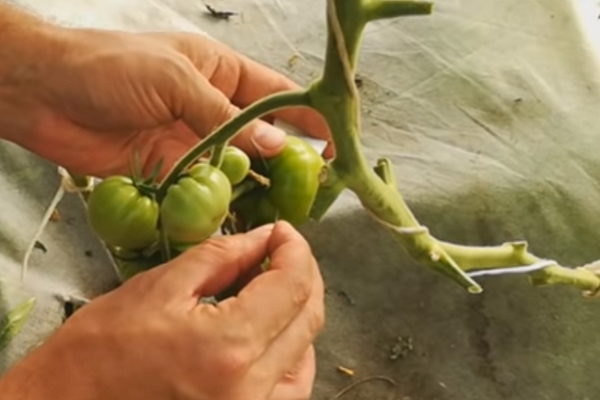
This is another way to stress a plant by reducing the amount of nutrients reaching the roots. Here's what to do:
- Measure 3 cm from the base of the stem.
- Wrap the trunk with soft wire so that it does not cut into the plant too much.
In a few days the tomatoes will begin to turn red.
Watering with special solutions and fertilizing to accelerate ripening
You can speed up the ripening of tomatoes with special products and fertilizers. What to use:
- Magnesium sulfate. For 10 liters of water, take 2 teaspoons of the preparation and spray the bush along with the fruits.
- Ash. Add 200 g of wood ash to 10 liters of water and let sit for 3 hours. Before applying, be sure to moisten the soil to prevent burning. Pour 1 liter of the ash solution under each bush.
- Superphosphate. Take 2 tablespoons of the preparation and add it to 2 liters of water. Let it sit for 24 hours, then mix the concentrated solution with 10 liters of warm water. Spray.
- Potassium humate. For every 10 liters of water, add 50 to 100 ml of liquid solution. Apply 5-7 liters per square meter under each bush. Spray the plants with water as well.
Fertilize once every 9-10 days.

Topping
To prevent fasciation, which causes the fruit to grow in a distorted shape, pinching should be done in late July. To do this, remove all small fruits, inflorescences, and ovaries, as they won't have time to ripen and will continue to draw out all the nutrients.
Piercing the fruits
This method works on the same principle as the through-cut method. However, in this case, you need to make up to four longitudinal punctures with a needle or toothpick in the stem area. The holes must be through and through.
Chemical methods
The methods are based on the use of special chemicals and alcohol. There are several options:
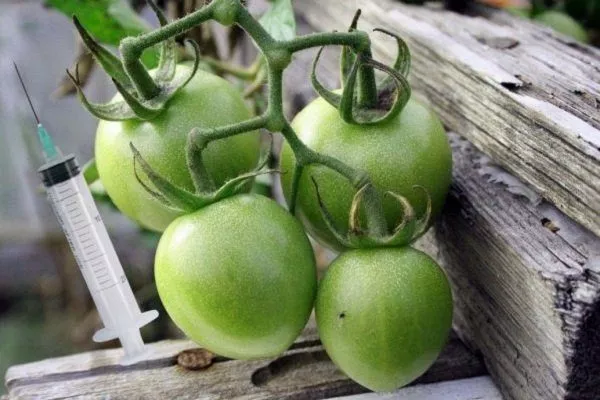
- Alcohol stimulation. High-quality vodka (40%) is used. The procedure is performed when the tomatoes reach their peak size but are still green or brown. To do this, inject 0.5 ml of vodka into each tomato (stem area) using a syringe.
Ethylene promotes accelerated ripening of brown tomatoes within 3-5 days. - Ethanol. It's used in the same way as vodka, but works better when the color is green. After administration, it takes about 10 days for the tomatoes to turn red.
- Ripener. This is a special alcohol-based product. It is most commonly produced by Agromiks and Orton, but other manufacturers are also available. Use strictly according to the included instructions.
Emergency ripening measures
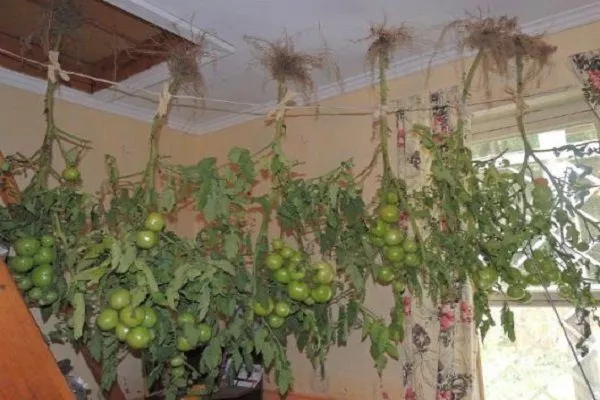
Many gardeners accelerate the ripening of tomatoes artificially by removing them from the ground and placing the harvested plants indoors. The main goal of this method is to cut off the supply of nutrients.
How is the procedure performed:
- Dig up the tomato bushes.
- Shake off any remaining soil from the roots.
- Hang the plants in a dry and warm room so that the root system is at the top and the fruits are facing down.
How to speed up the ripening of tomatoes in a greenhouse?
Accelerating the ripening of tomatoes in a greenhouse is completely identical to the process in the open field. However, to speed up the ripening process in a greenhouse, follow these guidelines:
- pinch off the tops and remove side shoots;
- Monitor the temperature, it should be within the range of +23-25°C, if the temperature is higher or lower, all life processes will stop;
- turn on artificial lighting so that daylight hours are at least 10-12 hours;
- Use a smoke bomb to release carbon dioxide, which will speed up the ripening of the fruit.
Reasons for delayed ripening of tomatoes
There are a number of factors that delay the process of tomato reddening. The main ones include the following:
- the timing of planting seeds or seedlings has been shifted (when weather conditions do not meet agricultural technology requirements);
- violation of the watering regime (do not over-water or allow the soil to dry out);
- excess of nitrogen or, conversely, lack of fertilizers;
- dense plantings (they are too close to each other);
- lack of light;
- plant diseases or pest damage.
For these reasons, strictly follow agricultural practices. The following is strictly prohibited:
- applying too much nitrogen-containing fertilizer;
- water tomatoes too often – not only will they not ripen, but they will also burst/crack;
- ignore fertilizing with potassium and phosphorus - these are important substances for the proper ripening of tomatoes;
- do not plant tomatoes too close together, the bushes should not “rub” against each other when they grow.
- ✓ Resistance to temperature changes.
- ✓ Ripening period corresponding to the climate zone.
- ✓ Resistance to late blight and other common diseases.
Select varieties based on their intended use and climatic conditions.
Tips and reviews from gardeners on accelerating tomato growth
Experienced gardeners also use other methods to speed up the ripening of tomatoes, which they are happy to share.
Gardeners' tips for speeding up tomato growth:
- You can use regular plastic bags - put them on brown tomatoes, tie them tightly at the base, but make a small hole in the middle for ventilation;
- water with an infusion of nettles and dandelions - place 1/3 of the herbs in an equal proportion in a 10-liter container, pour boiling water to the very top, leave for 2-3 days, and before use, dilute with water in a ratio of 1:10;
- collect the tomatoes without removing the stems, place them in a single layer in the room, leave the light on for at least 12 hours;
- If there was a late blight infection, be sure to leave the tomatoes in a different place - separate from healthy fruits, otherwise blackening will occur.
Before you begin accelerating the ripening of tomatoes, carefully study all the methods and intricacies of this process. But it's best to adhere to preventative measures beforehand—avoid any prohibited actions. Follow the growing requirements for your specific variety, and your tomatoes will ripen on time.
Calcium chloride is mentioned in the article on blossom-end rot in tomatoes. Note the contradiction: the text recommends spraying with calcium chloride, but the end of the article does not recommend this procedure.