
Uluru Ochre is a unique tomato variety with the original name Uluru Ochre. It is characterized by its medium ripening time and growth, high productivity, and exotic appearance, as well as its membership in the Dwarf series. Originally imported from Australia, it has already become a part of our gardening culture, winning the hearts of consumers thanks to its excellent taste and unique, attractive fruit color.
Patrina Nuske-Small, along with other enthusiasts, is one of the founders of the Dwarf Tomato Project, which was launched in 2005. This association of vegetable gardening enthusiasts from around the world strives to create new varieties characterized by large fruits and compact growth habits, making them suitable for growing in confined spaces such as greenhouses, balconies, and containers.
The project began with an online exchange of ideas, and Patrina, who has a background in speech therapy, took on the role of leader in the Southern Hemisphere. She created the first dwarfs, named after characters from the Snow White fairy tale. By 2019, the project had bred over 120 varieties of dwarf tomatoes.
One such variety is Uluru Ochre, created by Patrina Nuske-Small of Australia. It was first introduced in January 2017 and is the result of crossing Orange Heirloom and Rosella Purple. Descriptions of this variety include the names Dwarf Uluru Ochre and Gnome Uluru Ochre.
Features of fruits, plants
Uluru Ochre is a dwarf tomato that belongs to the determinate category. This variety is characterized by short bushes, which typically reach a maximum height of 60 cm and do not require topping. However, under favorable conditions, the bushes can grow up to 150 cm, while maintaining strong stems.
Varietal characteristics:
- The leaves are medium-thick with an emerald sheen. They are large, standard-sized, and covered with wrinkles.
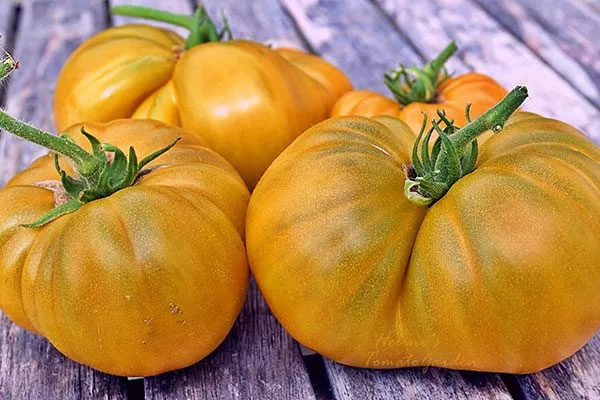
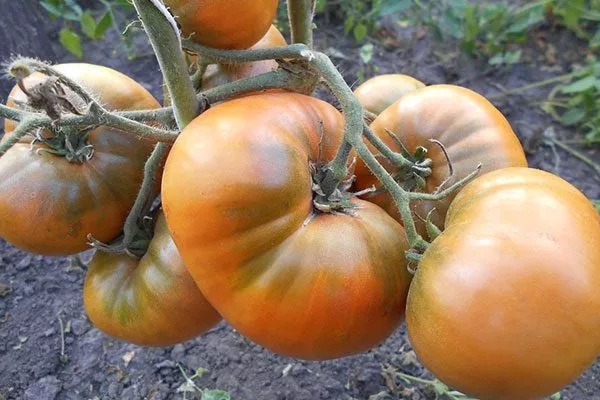
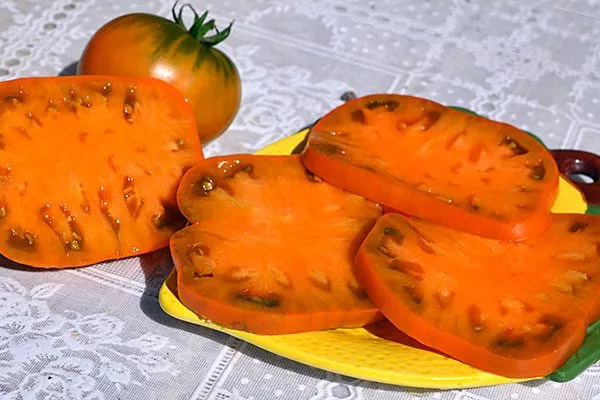
- The Uluru Ochre fruits are flattened and round with a slight ridge at the top, resembling the puffy sleeves of a lantern with slight folds.
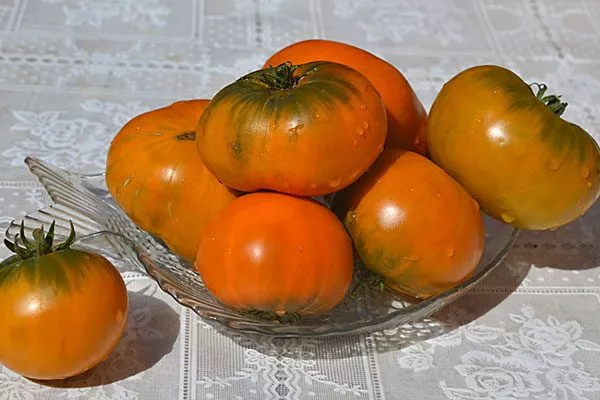
- The colour changes from golden-green to orange-ochre as it ripens, sometimes leaving a brown-green hue at the stem.
- The peel is resistant to cracking and is not subject to mechanical stress.
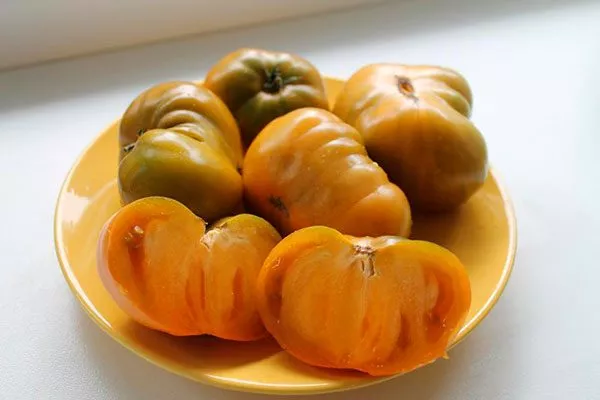
- The mustard-colored flesh with a sunny hue is juicy, oily, tender, and at the same time meaty.
- The seed chambers are located close to the walls of the fruit and contain a few seeds.
- The size of tomatoes varies from 200 to 300 g, although sometimes larger specimens weighing up to 400-500 g are found, and experienced gardeners can reach a weight of 1 kg.
Characteristics of the variety
This tomato variety is pure, meaning that seeds can be collected from ripe fruits for further sowing in future seasons. Its reputation for resistance to rot is mixed: some report that the tomatoes do not spoil, but only slightly wilt over time, while most report a short shelf life after harvest.
Please note other characteristic features:
- It's considered a mid-season variety, with the time from sowing to harvesting the first batch of ripe fruits taking 100 to 115 days. The bushes bear fruit from July to October 10-15.
- The productivity of this variety is impressive: regardless of cultivation location (open ground, greenhouses, or pots), it always produces a good harvest. The simple clusters, each containing 3-5 ovaries, are densely arranged with short internodes, resulting in numerous fruits that touch each other side by side.
A strong, thick stem usually produces 3 clusters. Indicators:- plants that reach a height of 50-60 cm produce 2.5-3 kg of fruit;
- If you allow the bush to grow higher, the total weight of the harvest can reach 5-5.5 kg.
- Like all varieties in the Dwarf series, Uluru Ohra has impeccable resistance to nightshade diseases. Phytophthora attacks are rare, especially with preventative measures such as removing lower leaves and preventing waterlogging.
Growing and care
The variety can be grown both with and without seedlings. However, direct sowing into beds is only advisable in the southern regions of the country. In more northern and climatically unstable regions, cultivation in protected conditions is recommended.
Sowing and growing bushes
In late February or early March, the Uluru Ohra variety is sown to produce seedlings. The seeds germinate quickly, forming strong and vigorous plants. In May, when the seedlings reach the desired size, they are transplanted to their final location.

Features that are important to know:
- The best substrate for Uluru Ochre is light and aerated soil.
- To place the bushes of this variety, it is preferable to choose a well-lit place in an open area.
- For low-growing Uluru Ochre shrubs, space plants 40 cm apart and rows 50 cm apart. For taller shrubs, a 50x60 cm spacing is optimal.
- If the manufacturer has not pre-treated the seeds, this must be done independently according to the standard.
- To provide favorable conditions for seedlings, it is necessary to maintain the temperature in the range of 18-22 degrees during the day and 16-18 degrees at night.
- It is important to provide sufficient lighting, using additional light sources to extend daylight hours to at least 16 hours.
- Watering should be moderate and done once every 5 days.
- When the seedlings reach the third leaf, they are transplanted into individual containers.
- A week after picking, begin using fertilizers, preferably complex mineral ones, to stimulate growth and development.
- Before transplanting into open ground, it is necessary to adapt the young plants by placing them outside or on a balcony for short periods of time, gradually increasing them.
Before replanting, choose a location where cabbage, carrots, or greens were previously grown, but avoid areas where nightshades were grown. Despite the sturdy stems, staking is necessary due to the large fruits and the large number of them on the branches.
Care activities
Uluru Ochre prefers a moist environment, but overwatering can lead to fungal infections, so overwatering is not recommended. It is recommended to remove lower leaves on the plants to ensure adequate air circulation. Regularly loosen the soil to promote healthy growth of young tomatoes. Remove weeds as they appear.

During the growing season, at least three to four fertilizing sessions are carried out, and tomatoes respond well to both mineral and organic mixtures:
- the first fertilizer containing nitrogen is applied two weeks after transplanting;
- Gardening professionals recommend using a solution of cow dung or bird droppings diluted in water for the second feeding;
- the third should be carried out with the help of a complex of mineral agents.
Culinary uses
Uluru Ochre tomatoes are deservedly popular for their unique flavor combination. Sweetness, rich fruity notes, and a subtle spiciness make them ideal for salads and also a great ingredient for sauces.
Tomatoes are used in soups, pizza, and many other dishes. They are excellent for pickling in barrels. However, their unique shape doesn't always make them suitable for whole-fruit canning.
Pros and cons
Reviews
Uluru Ohra tomatoes are a unique variety distinguished by their high yield, disease resistance, and attractive appearance. They are ideal for both indoor and outdoor cultivation, and their flavor and aroma make them popular among lovers of healthy and delicious food.