
Want to harvest fresh tomatoes before anyone else? Then consider the Lyubasha tomato hybrid (F1 is an abbreviation for "hybrid"). The description, advantages, conditions for growing seedlings and transplanting them into the ground, providing the plant with essential nutrients, and measures to protect against adverse effects are discussed in detail later in the article.
| Characteristic | Lyubasha F1 | Other hybrids |
|---|---|---|
| Disease resistance | High | Depends on the variety |
| Yield (kg/m²) | 10-15 | 5-20 |
| Ripening period (days) | 65-75 | 70-120 |
| Bush height (cm) | 60-100 | 50-200 |
| Fruit size (g) | 120-150 | 50-300 |
Description of the hybrid Lyubasha
The ultra-early hybrid Lyubasha was bred relatively recently—in 2016—and just a year later was officially included in the Russian state register and recommended for cultivation in all regions, both indoors and outdoors.
This tomato is characterized by a relatively short vegetative period—65-75 days after sowing. It belongs to the group of standard determinate hybrids, meaning its growth is limited once it reaches a height of one meter.
Bushes
The average height of mature bushes ranges from 60 to 100 cm, so they must be pruned and tied to supports. The bushes grow into a regular shape with strong stems that can withstand the heavy weight of the harvest. Each bush bears approximately 4-5 clusters. The leaves are bright green and small.
Fruit
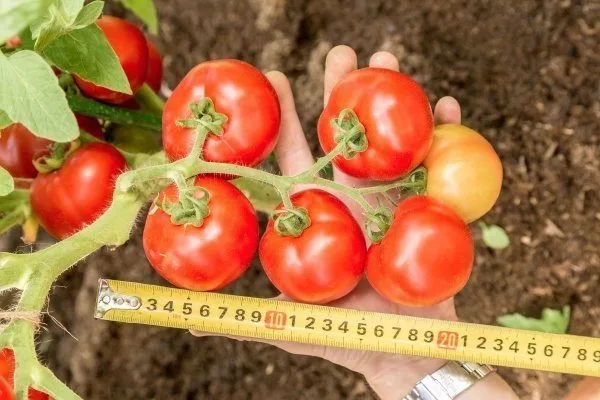
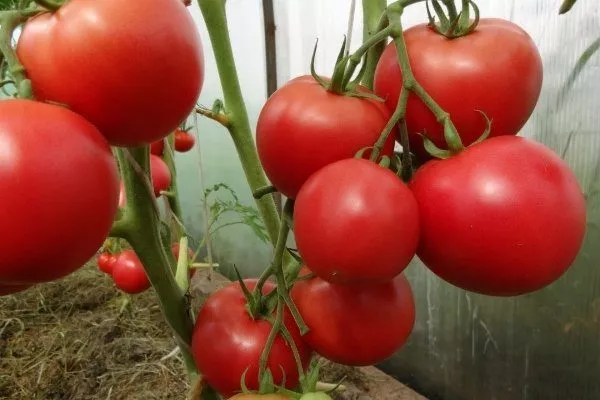
The tomatoes grow to a medium size, have a regular round shape, and are bright red. Each fruit weighs approximately 120-150 g. The skin is smooth and glossy, and the flesh is firm, preventing cracking. These tomatoes have a marketable appearance and withstand long-distance transportation well. The fruit is juicy, fairly fleshy, and has a delicate flavor. The fruit contains a moderate number of seeds, with 3-4 seed nests.
Features of the variety, pros and cons
A distinctive feature of the Lyubasha hybrid is that a single internode can produce two inflorescences, both of which will produce full-fledged tomatoes in all clusters. This characteristic does not affect the taste of the fruit and does not interfere with the formation of fruit clusters in the remaining internodes.
Advantages:
- Ultra-early simultaneous ripening of all fruits, which is of great importance when growing tomatoes for sale.
- Possibility of cultivation both in open ground and in a greenhouse.
- High yield.
- Resistance to blossom-end rot and tolerance to Alternaria, late blight and tobacco mosaic virus – the main diseases that actively affect other tomato varieties.
- Easy to care for.
- Excellent taste and convenient fruit size mean Lyubasha F1 tomatoes can be eaten fresh, processed, or canned.
Flaws:
- Poor tolerance to low temperatures.
- The need for regular loosening of the soil, as well as fertilizing, requires constant presence on the site.
- The simultaneous ripening of fruits will not allow them to be eaten fresh throughout the season.
The features and benefits of the ultra-early hybrid tomato Lyubasha are described in detail in the video below:
Agrotechnical measures
To achieve maximum results from growing the Lyubasha hybrid with minimal effort, time, and money, you should first familiarize yourself with the correct agricultural technology.
Growing seedlings
The sowing time for Lyubasha F1 tomato seeds depends on the climate zone and is usually mid-February to early March. Alternatively, transplanting into open ground is possible 50 days after the first sprouts appear. A prerequisite is the absence of night frosts. The seeds should be planted in a pre-prepared soil mixture containing:
- Loose soil, disinfected from pests. For this purpose, it is recommended to dry it in the oven for 40 minutes.
- Lowland peat.
- Humus.
- Rotted manure.
For planting seedlings Any container that allows you to plant seeds in rows will do (wooden boxes, plastic containers with pre-drilled holes for drainage). Seedlings are virtually undemanding in terms of light, humidity, and temperature. They can even be grown indoors (preferably on a south-facing surface), using supplemental lighting.
Tomato seeds are planted in rows, with a minimum distance of 3-4 cm between them. The holes are about 1 cm deep. The soil is then watered, covered with cling film, and the containers with seedlings are moved to a warm place.
To avoid rapid overheating of the soil, it is not recommended to place containers on radiators.
Caring for Lyubasha hybrid seedlings is standard. The photoperiod should be at least 12 hours per day. The room temperature should be no higher than 23°C to 25°C during the first week, and 20°C during the second week. Water as the soil dries out: every 6-7 days for the first three weeks, then every 4-5 days thereafter. Never overwater the soil, as this may kill the seedlings.
At the stage growing seedlings Fertilizing the soil is not necessary. However, if you have any doubts about its quality, it is recommended to apply a complex fertilizer containing phosphorus, potassium, and magnesium during the first week. Then top dressing This is done when three leaves have already formed on the stem. In this case, fertilizers rich in nitrogen and potassium are applied.
Transplanting seedlings into a greenhouse or open ground
First, prepare holes for planting the seedlings, spaced 50 cm apart. Afterward, fill the holes with water and add compost mixed with mineral fertilizer.
Before removing seedlings from their containers, moisten the soil to prevent possible root damage and to easily release the seedlings from the containers. To properly grasp the bushes, carefully grasp their trunks and slowly lift the plant out of the soil. Next, place the bush vertically in the hole and cover with compost. Mulch the soil with sawdust, straw, or grass clippings.
Caring for Lyubasha tomatoes
Formation of bushes. To maximize the harvest, the manufacturer recommends training the Lyubasha hybrid bushes into 2-3 stems, depending on the frequency of planting. If no more than four plants are planted per square meter of soil, training is done into 3 stems. To achieve this, leave two side shoots growing above and below the first flower cluster.
When planting more densely, it's preferable to leave only two stems on the hybrid bushes—the main stem and a secondary stem below the first flower cluster. Any remaining side shoots should be removed as they appear. Although the bushes are medium-sized, it's recommended to tie them to supports, as the heavy load of the harvest can cause the tomatoes to droop toward the ground. The stems, in turn, become very thick, even thicker than the stakes they're tied to.
Watering. Watering is carried out mainly in the evening with a frequency of one (in spring and early summer) to several (in mid-summer) days a week.
Experts recommend watering the plant at the roots so as not to disturb the growth of the bushes.
After watering, it is advisable to loosen the soil and weed it.
Top dressingFertilizers are applied for the first time two weeks after planting the seedlings. Subsequently, the soil should be fertilized every ten days. Cow manure, mineral fertilizers, and chicken manure can be used as fertilizer. Throughout the growing season, tomato plants should be fertilized repeatedly by spraying with effective microorganisms (EM) and a wood ash solution.
Disease prevention
To protect plants from various diseases and insect pests, it is recommended to spray them with Bordeaux mixture or onion tincture 2-3 times a month. You can also add one tablet of Gliocladin fungicide to each hole during the planting stage.
Harvesting the Lyubasha tomato
Harvesting depends on climate conditions, the frequency and composition of fertilizers. Typically, it begins in the first month of summer. Tomatoes ripen simultaneously on the vine. When planted in open ground, a yield of approximately 10 kg per square meter can be obtained. If grown in a greenhouse, this figure can increase to 15 kg.
An experienced gardener provides an overview and characteristics of the Lyubasha tomato hybrid in the following video:
The Lyubasha tomato hybrid is an excellent choice for both commercial and personal use. It's relatively low-maintenance, yet produces an early and abundant harvest. Its excellent flavor will impress everyone.