
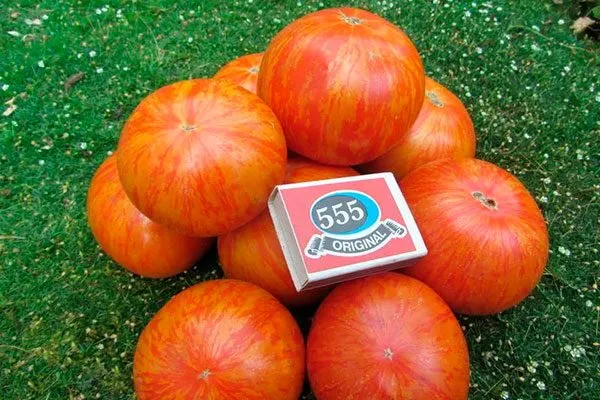
The Fat Boatswain tomato is a large-fruited variety with an unusual coloring. Its variegated fruits are truly large and delicious. This salad variety will be an excellent purchase for any gardener.
Description of the plant and fruits
The Fat Boatswain tomato plant grows to a medium-sized, standard size, and is a determinate variety. It reaches a height of 0.7-1.2 m. The foliage is medium. The leaves are standard, dark green, and medium-sized.
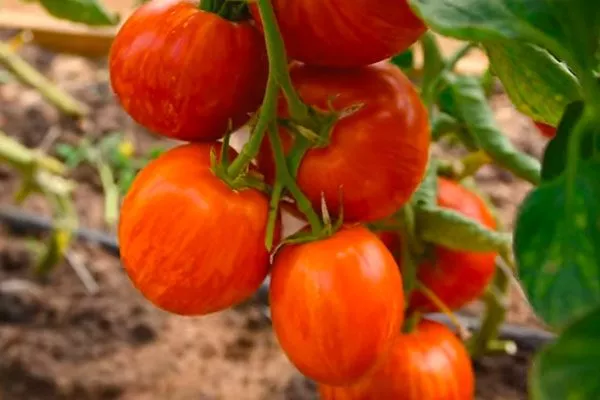
Brief description of fruits:
- Unripe fruit color: green with dark green stripes.
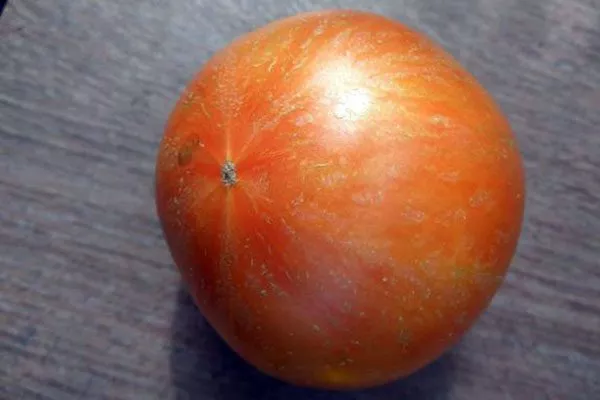
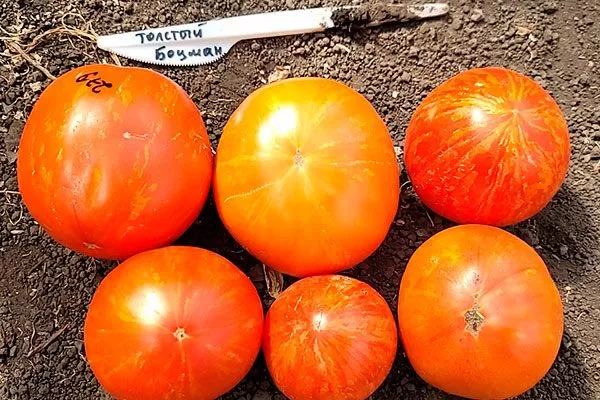
- Color of ripe fruit: bright red with gold stripes.
- Form: rounded.
- Number of chambers (nests) in the fruit: 4.
- Weight: 140-200 g
On the main stem, 7 clusters are formed, in each of which 6-7 fruits ripen.
The History of the Fat Boatswain Tomato
The variety was developed by breeders at the Central Siberian Botanical Garden. In 2008, the Fat Boatswain tomato was added to the State Register of the Russian Federation and recommended for cultivation in all regions of the country.
Authors of the variety: G.A. Kudryavtseva, L.P. Altunina, Yu.V. Fotev.
Originator: Agrofirm "Seeds of Altai".
The taste of fruits and their purpose
The Fat Boatswain tomato has a sweet, slightly tart flavor. The flesh of ripe tomatoes is medium-dense, juicy, and plump, and the skin is thin but firm.
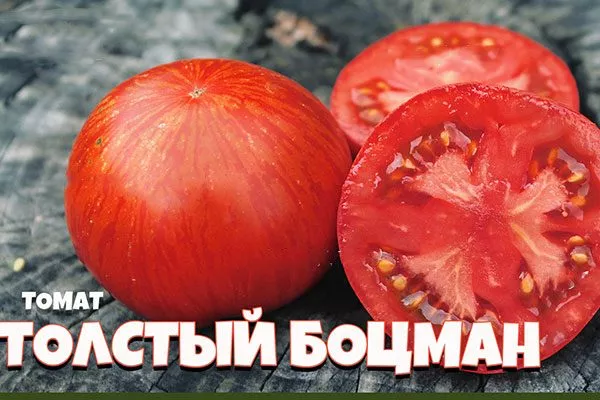
The fruits are intended for fresh consumption, but can also be used for a variety of winter preparations.
Characteristics
The Fat Boatswain tomato is a mid-season variety, with 100-115 days from germination to fruit ripening. The yield is 5-6 kg/sq. m. With proper care, a single bush can yield up to 5 kg of fruit.
This tomato is able to withstand both heat and cold, and it also has increased resistance to tomato mosaic virus, cladosporiosis, and blossom-end rot.
Pros and cons
The Fat Boatswain variety attracts gardeners not only with its unusual and memorable name, but also with its other advantages, including its appearance, flavor, and agronomic properties. Before planting this interesting variety in your garden, it's helpful to familiarize yourself with its full range of advantages and disadvantages.
Landing features
The Fat Boatswain tomato can be grown with or without cover. The latter option is more suitable for the south; in all other regions, greenhouses or plastic covers are preferred. In all climate zones, this variety is grown primarily using seedlings.
Selecting a site
The Fat Boatswain tomato is very photophilous, requiring 11-12 hours of daylight. The warmest and sunniest areas are chosen for planting it.
Soil preparation
Tomatoes require fertile, well-drained soil to grow and thrive. The optimal soil pH for this crop is 6 to 6.5. Preparing the site for tomato planting begins in the fall.
The soil is cleared of plant debris, and organic and mineral fertilizers and other components that will help improve the soil quality are scattered. Organic and mineral fertilizers are added during tillage.
In the fall, you can sow green manure and various cruciferous crops, such as mustard or oilseed radish, in the greenhouse or open field. The resulting greens are incorporated into the soil, enriching it with organic matter.
Growing seedlings
Seedlings are grown for 60-65 days. This is the amount of time needed to subtract from the expected planting date to calculate the sowing time for seedlings, which varies depending on the climate zone. In temperate regions, sowing occurs in March, while in the south, it occurs in late February.
Features of growing tomato seedlings Fat Boatswain:
- Before planting, seeds are disinfected in a solution of potassium permanganate (1 g per 200 ml of water) or garlic infusion (2-3 crushed garlic cloves, pour 100 ml of water, strain after 24 hours). Seeds are also soaked in a growth stimulant, such as Epine or Energen Aqua, hardened, and germinated.
- For planting, use containers or individual containers filled with soil—either store-bought or homemade—made from peat, humus, and sand. Seedlings can also be grown in peat pots, which are planted in the ground along with the seedlings.
- The containers are filled with soil, leveled, and moistened with warm, settled water. The seeds are sown in rows within the containers. The seeds are spaced 1.5-2 cm apart, with a 3 cm gap between rows. The seeding depth is 1 cm. If sowing in individual containers, sow 3-5 seeds per container. After planting, the seeds are moistened again.
The containers with seeds are covered with transparent film and placed in a warm and light room, where the temperature is maintained at +22…+25 °C.
The seedlings are grown for 2 months, carrying out the following manipulations:
- For the first three weeks, before transplanting, water the seedlings once a week. After transplanting, water them every two to three days. Use only warm, settled water. The soil should be slightly moist, but avoid standing water, as dampness can lead to the development of an incurable disease called blackleg.
- Seedlings are pricked out when they have two true leaves. Plants are transplanted from containers into individual containers. If sown in cups, the seedlings are transplanted into larger containers. When pricking out, in addition to replanting, the roots are pinched back by a third.
- After picking, tomato seedlings are fed twice with complex fertilizers at intervals of 2 weeks.
- Hardening off the seedlings begins two weeks before planting them in the ground. Tomatoes are brought outdoors, gradually increasing their time outdoors—starting with half an hour and building up to 8-10 hours. If the nighttime temperature doesn't drop below 10°C, leave the seedlings outside overnight the day before transplanting.
Transplanting
Seedlings are planted in open ground or under plastic. The latter option involves earlier planting—approximately 2-3 weeks earlier than in open ground. The latter option is used when the threat of frost has passed, and the soil and air temperatures have warmed to 14 to 16°C and 18 to 22°C, respectively.
Features of planting Fat Boatswain seedlings:
- For planting, dig holes measuring approximately 15 x 20 cm. Their size should be such that the root system of the seedlings, along with the root ball, can easily fit into them.
- The optimal planting pattern is 40 x 40 cm. Holes are dug in rows or in a checkerboard pattern.
- Add a handful of organic fertilizer and wood ash to the holes. You can also use granulated fertilizer made from chicken manure or horse manure.
- The holes are watered with warm, settled water, the soil is allowed to settle (half an hour to an hour), and then tomato seedlings are planted in them using the transshipment method. Seedlings grown in peat containers are placed in the holes along with their containers.
- The tomato roots are covered with soil, compacted, and a depression is formed around the stem. The planted plants are watered, and once the water has been absorbed, the soil is mulched with compost, straw, hay, or simply dry soil.
Care Features
The Fat Boatswain tomato is responsive to care but not fussy. If provided with standard growing conditions, as recommended by agricultural practices, it will surely yield a good harvest of high-quality, large, tasty, and abundant fruits.
Watering
It's recommended to water this variety infrequently but thoroughly. Usually, watering the bushes once or twice a week is sufficient; if it's hot and there's no rain, increase the frequency to two or three times a week.
Loosening
To maintain good aeration, it is recommended to loosen the soil after watering and heavy rainfall. The soil should be loosened to a depth of 8-10 cm at the beginning of the growing season, gradually decreasing to 4-5 cm. This is because plants develop shallow roots, which can be damaged by excessively deep loosening.
Top dressing
Fertilizing the Fat Boatswain tomato follows the standard pattern. During the active growth period, plants are given nitrogen and phosphorus, wood ash, and complex fertilizers such as nitroammophoska.
- ✓ Use only hardwood ash, avoiding softwood due to its high resin content.
- ✓ The ash must be completely cooled and sifted to remove large particles.
During the flowering and fruiting stages, tomatoes require potassium and phosphorus fertilizers, so superphosphate or potassium sulfate is added to the roots.
Shaping and garter
It's recommended to train this variety with 2-3 stems. The plants also require pinching—regularly removing shoots growing in the leaf axils. The bushes should be tied to regular supports or trellises.
Diseases and pests
Tomatoes are resistant to most nightshade diseases, including gray mold, mosaic, and verticillium wilt. However, the plants require preventative measures against fungal infections. If symptoms appear, spray them immediately with Fundazol or Bordeaux mixture.
- Treat the soil and plants with a solution of copper sulfate (50 g per 10 l of water) a week before planting.
- Repeat the treatment 2 weeks after planting.
- Use biological preparations (Fitosporin) every 10 days for prevention.
Among the pests, aphids can cause the most damage to the Fat Boatswain tomato. Tomato moths and mole crickets are also common. To control the insects, use Karate, Actofit, Profi, or similar products.
Harvesting and storage
The fruits ripen one after another, so the harvest is gradual—from late July to early fall. Unripe tomatoes, still in the milky stage, ripen beautifully indoors without losing their flavor.
Tomatoes are stored in cool, shaded places, such as a cellar or basement. The optimal humidity is 70-80%, and the temperature is between 3 and 4°C. Brown (unripe) tomatoes are placed in boxes, lined with paper.
Reviews
The Fat Boatswain tomato is an excellent choice for lovers of unusual varieties. This large-fruited tomato, with stripes reminiscent of a boatswain's vest, possesses all the qualities of an ideal variety—it's productive, tasty, hardy, versatile, and has excellent commercial qualities.