
"Geranium Kiss" (or "Geranium Kiss") is a rare, collectible cherry tomato variety that attracts gardeners with its delicious, truss-grown tomatoes. Learn more about this unusual variety, what makes it unique, and how to plant, grow, harvest, and preserve it.
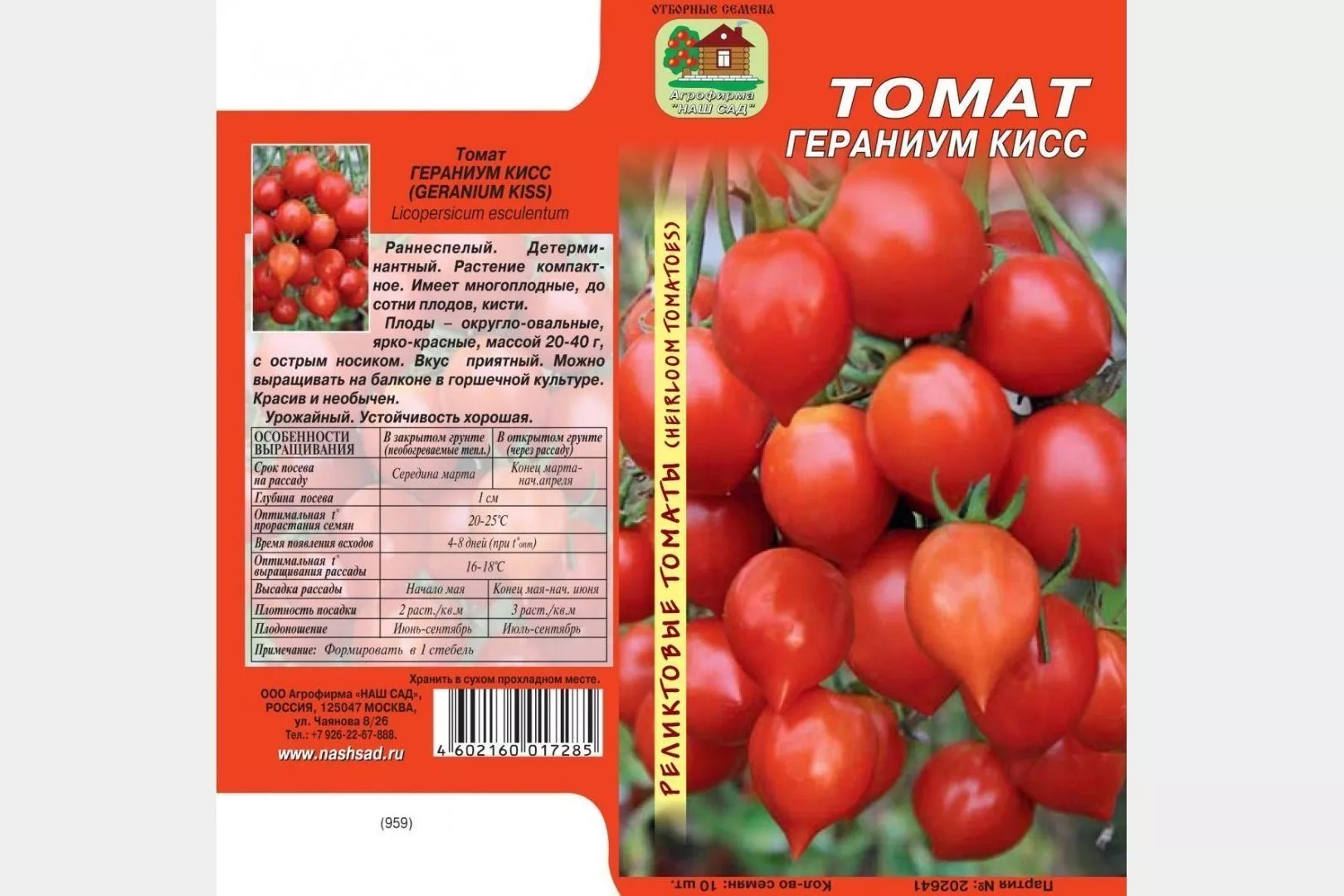
Tomato seeds "Geranium Kiss"
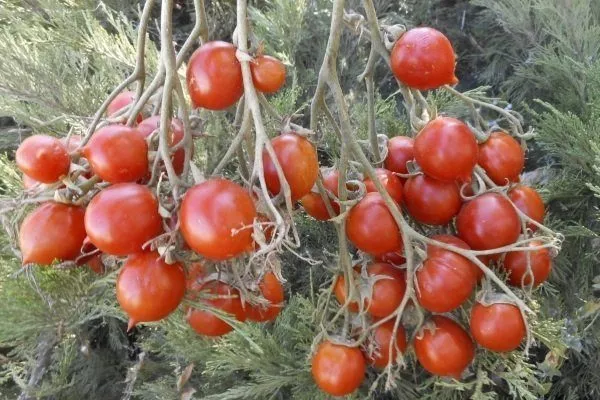
Geranium Kiss tomatoes on a vine
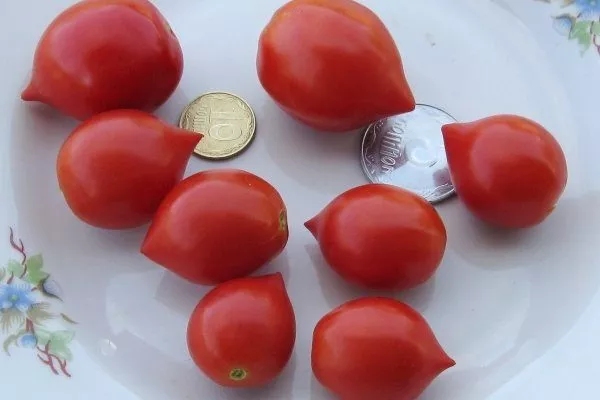
The size of the fruits of "Geranium Keys"
Description of the variety
| Name | Plant height | Fruit weight | Ripening period |
|---|---|---|---|
| Kiss of the Geranium | 50-60 cm | 20-40 g | 90-95 days |
| A Little Kiss of Geranium | 30 cm | 20-40 g | 90-95 days |
'Geranium Kiss' is unique due to its unusual combination of plant and fruit characteristics:
- Bushes. Compact, dense, low-growing, well-foliated, and highly branched. The plant is a bush rather than a standard. The stem is moderately thick. Height: 50-60 cm. The central shoot can support the weight of the fruit without additional support.
- Leaves. Heavily fretted, green, oblong, with blunt teeth along the edges. The petioles are thick.
- Inflorescences. Complex, lush. The flowers are lemon-yellow. During flowering, the bushes are covered with flowers. A single inflorescence contains 50-100 flowers. Ovaries and fruits do not develop from all the flowers.
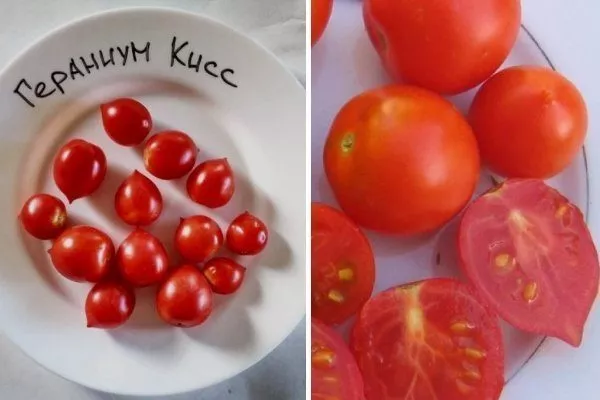
- Fruit. Three to four or more fruit clusters are formed. They resemble grapes. Each fruit in these clusters weighs 20-40 g. The fruit is oval-round in shape, with an elongated "nose" at the end. When ripe, the green fruits turn bright red. The skin is thick, with a glossy sheen. There are few seeds inside the fruits.
The weight of the fruits on the bunches depends on their quantity – the more tomatoes in the bunch, the smaller they are, and vice versa.
The clusters of ripe tomatoes vaguely resemble the flowers of bright red geraniums – hence the unusual name.
Origin
"Geranium Kiss" is an American cultivar developed by an Oregon farmer. Its creator, A. Kapuler, introduced it to the world in 2008. This cultivar is not yet listed in the Russian State Register.
On vegetable forums, growers often describe this variety as tall. This discrepancy is due to a lack of information and seeds—they are distributed by the growers themselves. Authentic seeds should be purchased from reputable companies. For example, "Kiss" seeds can be purchased from the company "Biotekhnika."
Characteristics and yield
The "Geranium Kiss" tomato is a determinate variety. This variety is relatively new and little known among gardeners. Table 1 shows the main varietal characteristics.
Table 1
| Characteristics | Description/Meaning |
| Ripening time | early maturing variety, from germination to fruiting – 90-95 days |
| Pollination | self-pollinating |
| Number of fruits per bunch | 90-110 pieces |
| Fruit weight | 20-40 g |
| Weight of a bunch of fruits | 500-1000 g |
| Taste | The flesh is sweet and sour, juicy, dense, tender, and aromatic; the taste is predominantly sweet; similar in taste to cherry tomatoes. |
| Resistance to temperature anomalies | blooms and produces ovaries at temperatures above +30°C |
| Pinching out stepsons | not required |
| Purpose | universal - for salads, pickling, canning |
| Productivity | unstable, depends on growing conditions (on average, 2-3 kg are collected from a bush) |
| Transportability | high, thanks to its strong skin and dense pulp |
| Resistance to diseases and pests | average (may be affected by late blight, whitefly and spider mites) |
This variety has a subvariety, "Little Geranium Kiss Tomato." It differs from its "big brother" only in size, growing up to 30 cm tall. These little ones are ideal for growing on balconies.
Advantages and disadvantages
Pros:
- Suitable for growing in any region.
- Simple agricultural technology.
- Grows well in open and closed ground.
- You can provide yourself with seeds, since Geranium kiss is not a hybrid.
- Within a cluster, the fruits ripen almost simultaneously.
- There is no need to install supports or trellises – there is no need to tie up the bushes.
- There is no need to waste time on pinching out the bushes.
- Resistant to cracking and blossom-end rot.
- The bushes are decorative during flowering and fruiting – they decorate plots, balconies, and greenhouses.
Cons:
- Despite the early maturity, not all clusters have time to ripen.
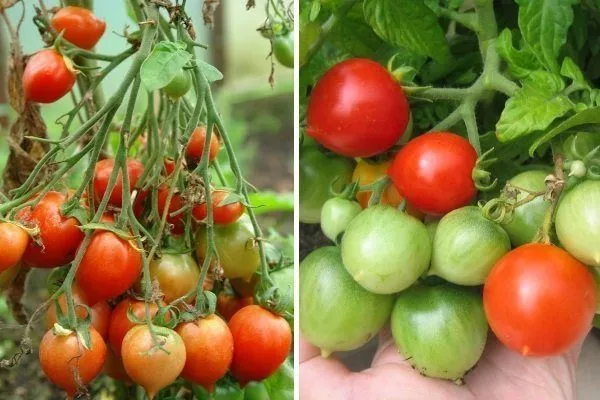
- In extreme heat, green "shoulders" form on the fruit. However, they are not tough and do not spoil the flavor.
- Does not tolerate high humidity well.
How to choose seedlings?
If you're unable to grow seedlings yourself, you can buy them. However, to avoid disappointment, it's important to choose the right planting material.
Rules for choosing seedlings:
- Take strong seedlings with undamaged roots.
- The seedlings should be showing their first flowers. If they haven't yet bloomed, this indicates they're not ready for planting. If they're planted too early, they'll lag behind in development or stop growing altogether.
Soil preparation
The Geranium Kiss variety, likes fertile, loose soil just as much as other tomatoes. Recommendations:
- The soil should be neutral or slightly acidic, with a pH level of no more than 7.
- If the soil is poor and infertile, it should be fertilized with humus and peat. River sand is also helpful.
- Tomatoes are best grown in areas previously occupied by pumpkins, squash, and cabbage. The worst predecessors are all nightshade crops. If the area previously contained potatoes, tomatoes, peppers, or eggplants, it is not suitable for "Geranium Kiss."
- If the soil is fertile, there is no need to add a lot of fertilizer – it is not needed at the beginning of the growing season.
Soil for growing seedlings must be disinfected: frozen or treated with potassium permanganate. Steaming for 45 minutes is also recommended.
Growing conditions
This variety thrives in warmth and sun. For good growth, it requires warm soil and temperatures no lower than 15°C. If the summer is cool and nighttime temperatures drop significantly, cover the plantings with plastic wrap.
Growing seedlings
This variety can be sown directly into open ground, or you can grow seedlings yourself. The latter option allows for a faster harvest. While seedlings can be purchased, there's no guarantee they were grown in favorable conditions, which will impact the future harvest.
How to prepare seeds?
If seeds are purchased from a reliable source, they not only carry the same varietal characteristics but are also completely ready for planting. They are treated with seed dressings and have undergone all necessary pre-planting treatments. Soaking is contraindicated. Store-bought seeds should not be soaked in water or stimulants, as this will damage the protective coating created by the nutrients during the special treatment.
- ✓ Check the expiration date of the seeds indicated on the packaging.
- ✓ Make sure there is a quality or conformity certificate.
- ✓ Pay attention to the storage conditions of the seeds before purchasing.
Tomato seeds harvested from the fruits must be prepared for sowing:
- Soak in boiled water (40°C) for 3 hours.
- Immersion in a potassium permanganate solution (1 g dissolved in 100 ml) for 15 minutes. This enriches the seeds with potassium and manganese, which stimulate growth.
- Germination of seedsThey can be germinated, for example, on toilet paper. Some gardeners use cotton pads for germination. The key is not to overexpose the seeds. They should barely "hatch." Avoid allowing the sprouts to develop into long white threads.
Where to sow seeds and where to place crops?
Swollen or sprouted seeds are sown in any suitable container filled with a pre-prepared nutrient-rich soil mixture. Regular plastic boxes, containers, disposable cups, wooden crates, and special seed trays are all suitable.
To speed up germination, place the seeds in a warm place. Once the seedlings emerge, place them closer to the sun. Seedlings can be grown indoors on a windowsill or in a greenhouse, if available.
Sowing seeds for seedlings
Sequence of actions:
- The substrate in containers or boxes is watered. There should be no excessive watering.
- Furrows are made in the moistened soil. If sowing in cups, small depressions are made. The depth should be up to 1 cm.
- In large containers, seeds are sown according to a 2x3 cm pattern, in small containers – 2x2 cm.
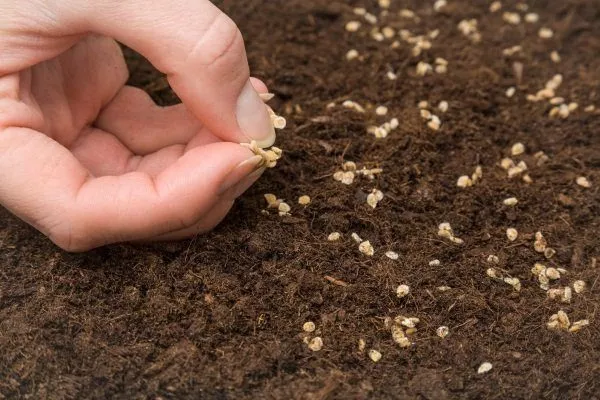
- Place the seeds in the holes. If the seeds are sprouted (with sprouts), use tweezers. Handling the seeds can cause breakage of the fragile sprouts.
- The seeds are placed in the soil and sprinkled with soil. The container itself is covered with plastic wrap.
Caring for seedlings
Features of crop care:
- When the shoots appear, the film is removed.
- Do not allow over-watering or water stagnation.
- The grown seedlings are transplanted into separate cups.
- Before planting in the ground, the seedlings are fed twice with a weak solution of mineral fertilizers.
- Before planting, the seedlings are hardened off by being taken out into the fresh air for a short time.
Read more about feeding seedlings.
Planting seedlings in the ground
If seedlings are being planted directly into the open ground rather than under cover, temperature conditions are crucial. At night, the thermometer should not drop below 15°C. Even if the weather is warm, it's still a good idea to prepare a plastic sheeting layer appropriate for the size of the area. If the weather gets colder, tighten the plastic sheeting immediately.
The best time to plant seedlings is after 2:00 PM. As soon as the first flowers appear, the plants are ready for transplanting.
The procedure for transplanting seedlings:
- Stop watering the seedlings 3 days before planting.
- Planting holes are prepared in the area. Four holes are placed per square meter. The holes are deeper than the height of the container in which the seedlings were grown.
- Add 1 tablespoon of superphosphate and tomato substrate to each hole.
- Pour water into the hole. Once it's absorbed, add water twice more—the soil should be well-hydrated.
- The seedlings are placed in the holes, being careful not to damage the roots, and covered with soil.
- Water with warm water. The next watering is after 7 days.
Growing tomatoes in open ground
In the south, tomatoes can be sown directly into the ground. However, even in the south, gardeners typically use seedlings as the most promising method. Let's learn how to grow "Geranium Kiss" tomatoes by sowing seeds directly into the ground.
Growing conditions
In regions with short summers, sowing seeds directly into the ground doesn't make sense; they simply won't have time to ripen before frost. In such areas, tomatoes should only be sown in greenhouses. In the south, however, sowing can begin as early as spring, as soon as the soil warms.
Tomatoes are grown in sunny areas, sheltered on the north side to protect them from piercing cold winds. Fences, house walls, shrubs, etc. can serve as protection. The area under the tomatoes is fertilized with humus.
Tomatoes thrive in greenhouses, grow faster, and produce a harvest earlier. However, plants grown outdoors are stronger, more robust, and healthier, and the fruit tastes better than their greenhouse counterparts.
Planting seeds in open ground
Seeds are sown outdoors no earlier than April – the soil must warm to 13-15°C. There's no clear consensus on whether seeds sown outdoors need to be soaked. Those who prefer soaking the seeds soak them in fungicides and growth promoters, just as they would when preparing seedlings for cultivation. Both approaches have their advantages and disadvantages.
Dry seeds are safer. If a cold snap hits, nothing will happen to them. They don't germinate for about ten days after sowing. Sprouted grains germinate in just four or five days. Furthermore, sprouted seeds are planted in warm soil; if the temperature drops, they too will perish.
Sowing order:
- The soil is loosened; it should be fluffy and soft. If the soil hasn't been fertilized in the fall, this is done in the spring. Humus is added; if the soil is dense, it is loosened by adding peat, sawdust, or sand. The soil and fertilizer are dug over.
- Prepare a nutrient substrate and add it to each hole.
- Make small depressions – 1-1.5 cm deep. The arrangement pattern is 30 x 50 or 40 x 60 cm.
- The depressions are watered. A weak solution of potassium permanganate would also be helpful.
- Place 3-4 seeds per hole. Cover with a thin layer of soil and firm down. No need to water—the soil is already moist.
- When 3-4 leaves appear, select the strongest sprout from each hole and pull out the others. These can be discarded or replanted.
How to water?
Features of watering "Geranium Kiss":
- Don't water the beds until the seedlings emerge. Otherwise, the top layer of soil will become hard, making it difficult for the sprouts to emerge.
- The ideal water is rainwater. It should be warm, approximately 22-24°C.
- Water the seedlings in the morning, before the sun comes out, or in the evening.
- Watering frequency before flowering is once every 7 days. Flowering plants should be watered twice as often. In summer, watering frequency depends on rainfall.
- Water should be applied at the roots, preventing water from reaching the above-ground parts of the plants. Drip irrigation is preferred, as it helps maintain the required soil moisture level.
Loosening
Geranium Kiss, like any tomato, requires regular weeding and loosening. If neglected, the tomato roots will not receive adequate oxygen and water, as the dry soil crust prevents them from reaching the soil.
Features of loosening:
- The first loosening is carried out after all seedlings have emerged.
- Frequency of loosening: once every 14 days.
- Along with loosening the soil, weeds are removed by the roots. Weeds not only interfere with the normal development of tomatoes but also promote various diseases.
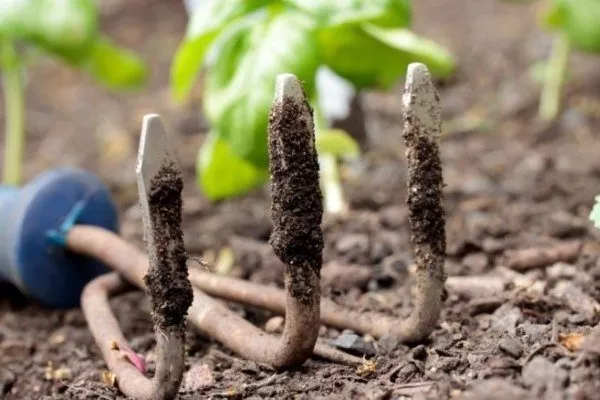
It is recommended to mulch the soil with hay, straw, or freshly cut grass. Mulch protects the roots from overheating, inhibits weed growth, and retains moisture in the soil. Read more about mulching. Here.
Do I need to tie up and remove side shoots?
The Geranium Kiss variety is low-growing, making it easy to care for—in open ground, it doesn't require staking or side shoots. However, the leaves at the base of the plant should be removed during fruiting. Improved air circulation helps prevent disease.
In greenhouses, Geranium kiss bushes grow up to one and a half meters in height – they are tied to supports.
Fertilizing
The roots of Geranium Kiss tomatoes grow up to 0.5 m deep, but spread out to the sides across the entire area of the bed - therefore, fertilizer is poured over its entire surface.
Features of fertilizing:
- Fertilizers are applied once every 10 days.
- During the growth of green mass, nitrogen is needed.
- During flowering and fruit ripening, plants need potassium.
- Carry out the first feeding 2 weeks after planting the seedlings, using nitrogen fertilizers.
- The second feeding should be carried out during the flowering period, using potassium-phosphorus fertilizers.
- The third feeding should be carried out during the fruiting period, using complex fertilizers.
The ratio of nutrients for the "Geranium Kiss" tomato fertilizer is N:K:P – 1:1.8:0.5. Tomatoes also need zinc, copper, iron, boron, magnesium, and calcium – which plants obtain from complex fertilizers.
Diseases and pests
"Geranium Kiss" has excellent immunity. It ripens early, managing to complete fruiting before the main tomato diseases begin to rage. "Geranium Kiss" avoids even the most serious diseases, being virtually immune to late blight, fusarium wilt, powdery mildew, and verticillium wilt. However, it lacks immunity to bacterial diseases.
Disease prevention:
- seed treatment with fungicides;
- using only healthy seedlings;
- in a greenhouse - renew the soil every year;
- removing weeds and tearing off lower leaves;
- observe crop rotation – do not plant tomatoes in one area for more than 4 years;
- It is not recommended to plant tomatoes near nightshades;
- Preventive spraying of plants with 5% copper sulfate.
If bacterial diseases cannot be avoided, plants are sprayed with Fitolavin-300 and copper-containing fungicides. To combat fungal diseases, plants and soil are treated with Hom, Barrier, and Bordeaux mixture.
The main enemies of any tomato plant are mole crickets, aphids, Colorado potato beetles, wireworms, and whiteflies. The insecticide chosen depends on the insect species. Affected plants are sprayed with Confidor, Komandor, and Iskra Bio.
Harvesting and storage
If care has been provided correctly, harvesting begins three months after germination. Two to three harvests are made during the season. The fruits are harvested before the onset of cold weather; delays will cause them to spoil.
Features of the "Geranium Kiss" collection:
- All the fruits from a ripe cluster are picked at once—they ripen almost simultaneously. Or the entire cluster is plucked.
- There is no need to wait until all the tomatoes on the bunch are ripe – the bunch is picked when the fruits are still green or brown.
- Clusters of unripe tomatoes are placed in wooden crates, in two or three layers. Two or three ripe tomatoes are also placed in the crate—they will stimulate the ripening of the unripe tomatoes. The tomatoes will ripen evenly, taking about a week to ripen.
Ripe tomatoes don't have a long shelf life. To preserve their freshness longer, keep them in the refrigerator. Green tomatoes, however, can be stored for a long time if provided with favorable conditions—for example, by storing them in a cellar. The optimal storage temperature for unripe tomatoes is 10°C.
Brushes picked at the blanched stage of ripeness ripen perfectly in a suspended state - if they are placed in a warm, dimly lit place.
Potential problems and advice from gardeners
While the Geranium Kiss bush is growing, blooming, and bearing fruit, it's very beautiful, and it's no wonder this variety is often used as an ornamental plant. Gardener's tips:
- To ensure the bush remains beautiful for longer, it is necessary to provide it with a flower pot of appropriate volume – at least 5-9 liters.
- Using stimulants often produces the opposite effect to what was expected, as different medications contain different phytohormones. It's important to strictly follow the instructions when using such products.
Use of fruits
The fruits of the "Geranium Kiss" are versatile. Their flavor, size, density, and other characteristics allow them to be used for a wide variety of purposes.
- eaten fresh;
- freeze;
- dried;
- dry;
- salt;
- canned.
Reviews
Just hearing about "Geranium Kiss" is enough to create an irresistible desire to plant this unique variety. Simple cultivation techniques combined with the excellent taste of the fruit make these American tomatoes a welcome addition to any garden.