
To produce a healthy tomato crop, plants need to be fertilized. The best way is to use natural products. One such option is to feed tomatoes with iodine, which replaces nitrogen.
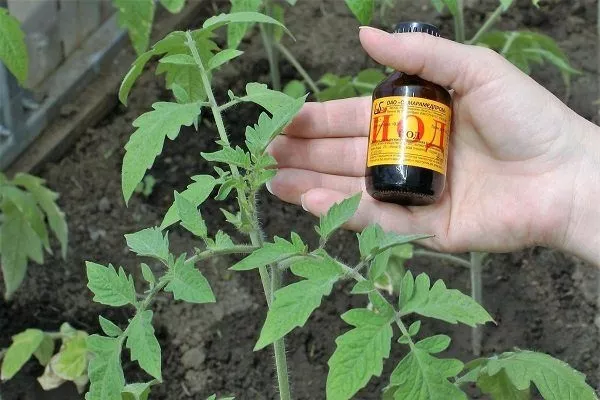
Benefits of iodine for tomatoes
Iodine fertilizer for tomatoes is used as a preventative and therapeutic treatment, as well as a fertilizer. It also enriches the soil with nutrients (when applied to the roots).
- ✓ The concentration of iodine in the solution should not exceed 5 drops per 1 liter of water for foliar feeding.
- ✓ The water temperature for the solution should be within the range of +23-25°C for optimal absorption of iodine by plants.
Iodine is a natural antiseptic and plays a role in plant respiration, metabolism, and photosynthesis. It promotes the production of amino acids and suppresses pathogenic microorganisms. Regular use eliminates the need for high-dose nitrogen fertilizers.
Feeding tomatoes with iodine solution has the following effect:
- accelerates seed germination;
- the plant's immune system is strengthened;
- nitrates do not accumulate in vegetables, as happens after using nitrogen fertilizers;
- more ovaries are formed;
- the degree of resistance to negative factors increases;
- bacteria, especially fungal ones, are destroyed;
- diseases are eliminated;
- fruit ripening time is accelerated;
- increases resistance to frost and drought;
- crop yields increase.
According to agronomists and gardeners, iodine helps tomatoes acquire a redder and more uniform hue, improving their appearance (shape). This last factor is linked to the fact that the plants are less susceptible to diseases and pests.
How can you tell if your tomatoes lack iodine?
Of all vegetable crops, tomatoes require the most iodine, which they absorb from the soil, water, and air. It's impossible to say exactly how much iodine is needed per day, so keep an eye on the plant.
Iodine deficiency manifests itself with the following symptoms:
- low yield (if you are sure of the variety and seeds);
- small fruits;
- too slow growth;
- susceptibility to diseases and pests;
- delay in fruiting time;
- thinness of stems;
- wilting and pale leaves.
Features of application in open ground and greenhouses
In greenhouse conditions, due to the lack of rain, root feeding is essential. In the garden, spraying the plants occasionally is sufficient, as raindrops wash the iodine from the leaves into the soil. When sprayed in a greenhouse, the iodine is completely absorbed by the tomato stems and leaves. Consequently, foliar feeding is required less frequently than in open beds (approximately half as often).
Greenhouses are prone to disease because the area is completely enclosed, so air disinfection is recommended. Here's what to do:
- hang a bottle or other container with iodine on each bush support;
- place the container vertically;
- open the lids.
The volatile substance spreads through the air and is absorbed by plants. During this period, try to avoid frequent visits to the greenhouse, as volatile iodine can be harmful to the human body.
In open ground Tomatoes should be fed early in the morning or evening, as iodine can cause sunburn. Foliar feeding is also recommended if it rains within 12 hours of feeding.
Disinfection and types of fertilizers
Effective tomato nutrition is achieved through both root and foliar feeding. However, experts recommend disinfecting the seeds with iodine, which will speed up germination and emergence, resulting in stronger seedlings and reduced disease risk.
How to disinfect seed material?
Tomato seeds are traditionally treated with manganese before planting, but it's almost impossible to find commercially. Iodine is an alternative.
- ✓ Seeds must be completely immersed in iodine solution for 10 minutes for effective disinfection.
- ✓ After disinfection, the seeds must be rinsed under running water to remove residual iodine.
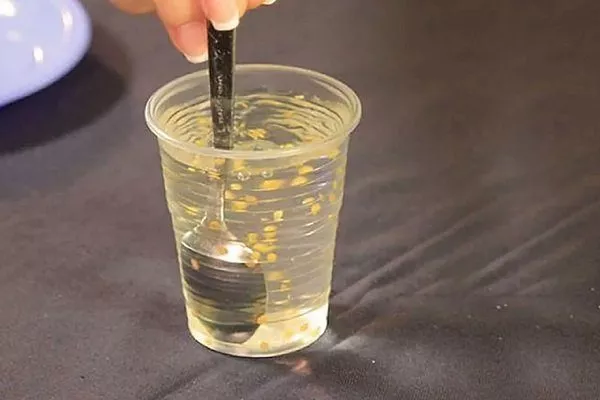
Disinfection process:
- take 0.7 l of warm water (temperature +23-25°C);
- add 3 drops of iodine (5%);
- fill the planting material;
- leave for 10 minutes;
- drain the solution;
- rinse the seeds under water;
- Dry the grains on paper towels.
Root treatment
Fertilizing is necessary when the root system is formed. Iodine is added in three stages. The first feeding seedlings Fertilizing is carried out when the plant has formed 2-3 full leaves. Prepare an iodine solution at a rate of 1 drop per 3 liters of water. The water should be warm. The fertilizer application procedure is as follows:
- moisten the soil around the seedling;
- Water the plant with a nutrient mixture from a watering can at a rate of 0.3-0.5 liters per bush.
The second time, top dressing is carried out when the racemose ovaries are formed:
- dissolve 3 drops of iodine in 10 liters of warm water;
- Pour 0.7-1 liter of solution under each bush, depending on the variety (less is needed for low-growing ones).
The third root feeding is carried out during the fruiting phase:
- bring water to a boil;
- add wood ash - a 3-liter jar;
- cover the container with a lid and leave for 1-1.5 hours to infuse;
- add water to get 10 l;
- drop 10 ml of iodine;
- add 10 g of boric acid;
- stir, leave for 24 hours;
- dilute 1 liter of tincture in 10 liters of warm water;
- water the tomatoes at the roots (1 liter per bush).
Foliar fertilization
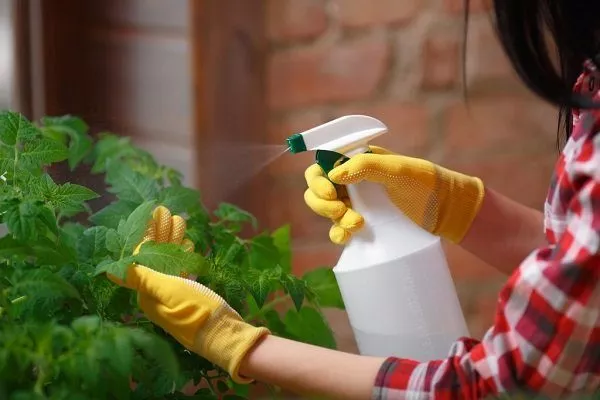
Spray the tops between root feedings. For 1 square meter, 1 liter (500 ml) of solution is required, prepared as follows:
- Add 5 drops of pharmaceutical iodine to 1 liter of warm water;
- add 250 ml of skim milk;
- Using a spray bottle, spray the liquid onto the surface of the bushes.
Do not exceed the recommended dosage. Otherwise, tomato tops will be burned. Do not spray this solution more than three times per season. Otherwise, overdosing will result in deformed fruits and trusses.
Recipes for combined fertilizers
Feeding tomatoes with iodine also involves using other components that are essential for the plants. The main ingredient interacts well with the other ingredients, enhancing the therapeutic effect of each.
Milk with iodine
Much has been said about the benefits of iodine. But what are the benefits of milk? Scientists have proven that pests and pathogens are intolerant to lactose and milk sugar. Milk should be natural (not store-bought).
Milk-iodine solutions kill fungi, promote beautiful fruit appearance, and accelerate growth. Dairy products contain a huge amount of amino acids, microelements, phosphorus, and potassium, which improve plant photosynthesis.
There are several effective recipes that you can use:
- Mix 10 liters of water with 1 liter of raw milk and 10 drops of iodine. Spray the bushes with 0.5 liters of the solution per bush. You can use it 3-4 times per season, as the mixture is not very concentrated.
- A water-free solution. For 1 liter of cow's milk, you'll need 15 drops of iodine. Mix thoroughly and spray the bushes at a rate of 1 cup of the mixture per seedling. Use no more than 3 times per season.
Boric acid and iodine
Boron is essential for tomatoes during fruit set and flowering. Beneficial properties for tomatoes:
- formation of the root system;
- increase in the number of buds;
- strengthening the immune system;
- increase in sugar content;
- acceleration of the ripening process;
- development of tops;
- improving the absorption of other nutrients.
Boric acid does not accumulate in the soil or plant tissue. Therefore, overdosing is impossible.
Recipes for boron-iodine supplements:
- Slightly warm 10 liters of water, add 12 g of boric acid, and 5 drops of iodine. Use for foliar feeding (1-1.5 liters of solution per 1 square meter).
- For every 5 drops of boron, mix 3 drops of iodine, 200 ml of fresh milk, and 3 liters of water. Apply 500 ml of the solution under each bush three times per season.
Not all tomato varieties require boric acid, so monitor the leaves closely. If they wilt, stop fertilizing.
Serum with iodine
Fermented milk products contain whey bacteria, which inhibit the growth of pathogenic microorganisms. When sprayed, the whey reaches the tops and fruits, forming a protective film. Additionally, the plant is enriched with micronutrients, which accelerates growth and improves the taste of the fruit.
Recipes:
- For root feeding, use a solution of 1 liter of whey, 15 drops of iodine, and 4 liters of warm water. Apply 0.5-1 liter under the bushes 2-3 times per season.
- For foliar fertilization, combine 2 liters of water with a glass of whey and 3 drops of iodine. Spray as usual.
Iodine with brilliant green
Brilliant green is considered an antiseptic, containing a high content of copper and other beneficial substances. It has the same effect on tomatoes as iodine. Avoid overusing the mixed solution, as it will cause burns to the plant.
Recipes:
- Root application mixture Fertilizer: a bucket of water, 20 drops of iodine, 40 drops of brilliant green. Water 0.5 liters per bush.
- For spraying: for 10 liters of water – 10 and 20 drops (iodine/brilliant green). For 1 square meter you need 1.5 liters of solution.
- If plants are affected by fungal diseasesMake a concentrated solution: 1 teaspoon iodine, 2 teaspoons each of brilliant green and water. Wet the stem at the base (maximum 10 cm from the soil surface). Repeat this procedure three times a week.
Iodine against pests and diseases
Since iodine is an antiseptic, it is used against pathogenic microorganisms. Tomatoes are most often susceptible to fungal diseases, so the preparation is used for prevention and treatment.
Recipes for late blight, which often affects nightshade crops:
- The fungus appears on the leaves and fruiting parts of the plant, forming dark spots. Spraying the foliage is necessary. Add 40 drops of iodine to a bucket of water, or 1 liter of sour milk or whey. To speed up the healing process, add 15-20 ml of hydrogen peroxide. Spray 4-5 times a week.
- For prevention, dilute 10 drops of iodine in 10 liters of water. Spray a couple of times a month.
- To enhance the effect, add crushed garlic or salt to the treatment solution.
Powdery mildew Characterized by yellowing of leaves and a white coating. The following methods are used to control the disease:
- Finely grate 20 g of brown laundry soap, add 10 drops of the preparation, and 1 liter of sour cream. Spray the tops daily for a week.
- Mix 8 drops of iodine with 0.7 liters of milk and 6 liters of water. Spray as described above.
For cladosporiosis (brown spot) The pathogen is localized on the leaves and first appears when the bush blooms. Foliar treatment is carried out as follows:
- add 40 drops of iodine to warm water (10 l);
- add 30 g of potassium chloride;
- Spray the plant every other day.
Prevent infection by gray mold fungus you can do it this way:
- Chop 0.5 kg of garlic cloves;
- add 30 drops of the preparation;
- treat the seedlings.
Tobacco mosaic It is not curable, but it can be prevented:
- dilute 1 liter of fresh milk in a bucket of water;
- enter 10 drops of iodine;
- Treat tomato seeds or seedlings before planting.
From fusarium This solution will help:
- add 2 drops of iodine to 1 liter of warm water;
- Chop 1 large head of garlic;
- add to the solution;
- spray the tops.
The crop is susceptible to attacks from May beetles, aphids, and weevils. These can be controlled using the following methods:
- As a preventative measure, water the roots with a solution of 10 liters of water and 15 drops of iodine. Apply 1 liter of solution per bush.
- For treatment, foliar application is used. Warm cow's milk slightly (200 ml), inject 1 cc of iodine from a syringe, and dilute with 2 liters of water.
Can the prepared solution be stored?
Prepared solutions can be stored for up to 24 hours. This is because the iodine evaporates. Since the mixtures are prepared in large quantities (the basic recipes are for 10 liters of water), it is impossible to cover them tightly.
Helpful Tips
Experienced gardeners advise adhering to the following rules:
- Always apply iodine fertilizer to moist soil. This will help the micronutrients be absorbed more quickly.
- Water for solutions should be warm and settled.
- When spraying, use a spray bottle with the finest mesh so that the liquid hits the tops as a mist.
- To enhance the effect, potassium salt (15 g) and superphosphate (10 g) can be added to the solutions at a rate of 10 liters of water per mixture. In this case, no more than 500 ml is added per bush.
- Add a little urea or humate to the standard iodine solution for foliar feeding of tomatoes.
- Never use the solution if 10 days have not passed since planting the seedlings.
- To avoid overdose, add diluted aspirin (1 tablet per 1 liter of water) along with iodine.
- Never apply fertilizer to the tops and roots at the same time. Allow at least two weeks between applications.
You can also learn about fertilizing tomatoes with iodine from the following video:
Reviews
Feeding tomatoes with iodine is a cost-effective fertilizing option. Plants grow faster, produce larger, more marketable fruits, and are less susceptible to diseases and pests.