
The Orange Heart tomato has won acclaim from both gardening enthusiasts and agronomy professionals. Its distinctive shape and vibrant color attract consumers, and its flavor is considered a delicacy. This tomato retains its quality well and does not spoil during transportation.
Features of the bush and fruits
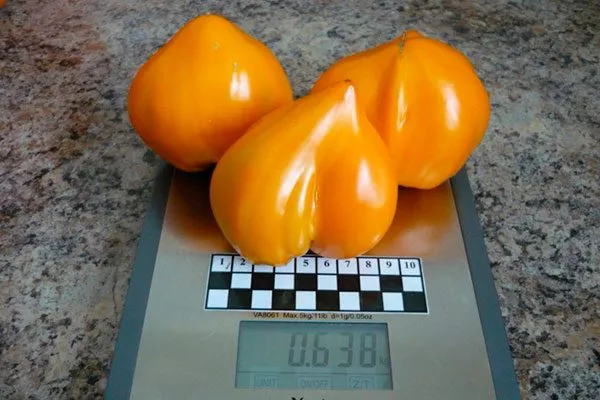
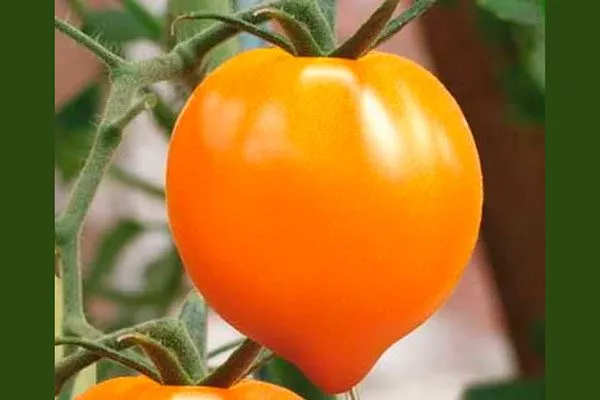
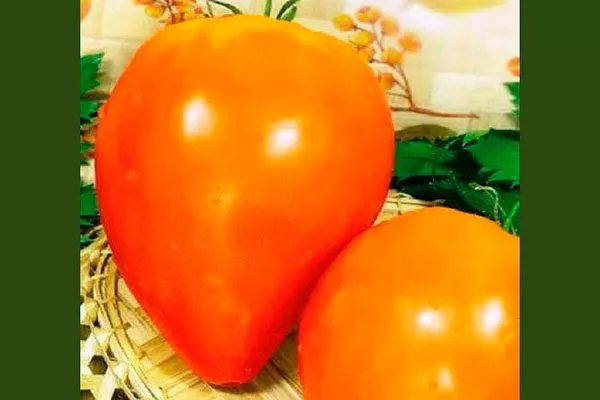
The distinctive feature of the Orange Heart variety is the unique shape and color of its fruits. They have a heart-shaped configuration with a pointed tip. The tomatoes range in color from orange to dark yellow. The flavor is sweet, with a noticeable fruity aroma and a subtle tartness. The fruits are juicy and high in sugar.
Varietal characteristics:
- Fruits growing at the top of the bush are usually larger and have a more pointed beak compared to the lower vegetables.
- Orange Heart tomatoes are indeterminate varieties with a robust foliage and reach heights of 150 cm, sometimes 200 cm or more. Growing them requires careful shaping and secure support. For this, the double-stemmed method should be used, which ensures the highest yield.
- The leaf blades are large and have a deep greenish hue. They form abundantly on the stem. To optimally distribute nutrients throughout the plant and increase yield, it is recommended to periodically remove the lower leaves every 12-15 days, removing 3-4 leaves at a time. This also helps minimize the risk of disease.
- The root system is powerful and requires significant space to develop, so experts recommend planting no more than two bushes per square meter of land.
- Flower clusters form every 2-3 leaves, with the first emerging in the seventh or eighth axil. Each flower cluster contains 3 to 6 buds. Fruit set is usually successful, resulting in high tomato yields.
- The shape resembles a heart with several protrusions near the stem. The skin of these vegetables is very thin and smooth.
- The tomato pulp is rich in dry matter and contains few seeds. The aroma is particularly vibrant, and the flavor combines sweetness with a subtle tartness. Experts note that Orange Heart tomatoes have a fruity flavor.
- Heart-shaped tomatoes, colored in bright orange tones, are large in size, weighing on average from 120 to 200 g, and the first ripe specimens can reach a weight of up to 300 g. Under ideal growing conditions, tomatoes can demonstrate even more impressive dimensions.
- These vegetables are ideal for making fresh salads, pastas, and canning for the winter. They are an excellent source of nutrition for children. Orange Heart juice is particularly sweet.
- This variety is not only ideal for home growing but also has commercial potential. Slightly unripe fruits are resistant to damage and can be transported over long distances without damage, maintaining their marketable appearance for a long time.
Main characteristics and history
The Orange Heart tomato is a first-class choice for greenhouse cultivation. The tomatoes mature on the vine, maintaining their ideal size and attractive appearance. Growers praise the rapid germination rate and yield, which exceeds grower expectations.
Growing regions, origin
The variety was created by the team at Agrofirma Poisk LLC and passed all necessary tests, receiving permission for cultivation in 2007. It is registered in the State Register of the Russian Federation and was developed by breeders S. V. Maksimov, A. N. Kostenko, and N. N. Klimenko.
Orange heart is successfully cultivated not only in the south of the country, but also in Central Russia, in the Black Earth Region. In colder regions, it is grown under protective canopies or in sturdy greenhouse structures made of glass or polycarbonate.
Ripening, fruiting and productivity
The Orange Heart tomato has a high yield if all cultivation recommendations are followed. In open ground conditions, a single bush can yield up to 2-2.5 kg of fruit, and in a greenhouse, over 4 kg. To achieve this, when planting in open ground or a greenhouse, it is recommended to plant in two rows with a spacing of 50-60 cm between plants and 40-50 cm between rows.
Peculiarities:
- Given the dense foliage and large size of the bushes, planting should be limited to two to three plants per square meter. Therefore, yields can range from 4 to 12 kg per square meter, depending on the chosen cultivation method.
- In real conditions, the yield of Orange Heart tomatoes is about 8-10 kg.
- A key factor influencing yield is the method of cultivation: with single-stem cultivation, productivity will be low, and it will be difficult to harvest more than 2 kg per bush in a greenhouse.
- Growing the Orange Heart tomato on three stems is technically challenging due to the high density of the bushes. Therefore, the double-stem technique is preferred, which ensures optimal distribution of the bushes and maximum yield per square meter.
In a greenhouse, tomatoes take about three months to ripen, officially 90-95 days, with technical maturity occurring a week to a week and a half before full maturity. In open ground conditions, this period increases by another month, to 120-135 days.
Scope of application
Recently, American researchers announced that yellow tomatoes are more beneficial than red and pink ones. These tomatoes are considered hypoallergenic, rich in vitamins, minerals, and carotene, and also contain tetra-cis-lycopene, which helps maintain a youthful appearance.
Methods of use:
- most often consumed raw;
- used for preparing first and second courses, including hot and cold soups, side dishes and sauces;
- Tomatoes have proven themselves well in the production of juice and paste.
The absence of red pigment, a strong allergen, makes orange tomatoes almost hypoallergenic and suitable for baby food. This variety is not suitable for canning—extensive heat treatment and marinating significantly degrade the flesh's consistency and flavor, leaving it stringy and sour.
Growing seedlings
Tomatoes are grown using the seedling method. Orange Heart seeds are sown in late February or early March. In more northern climates, seedling growth begins at the end of March.
Preparation of planting material
Before planting, seeds need to be prepared. This will help reduce the risk of contamination and ensure faster germination. Seeds purchased from a specialty store have usually already been disinfected. This is confirmed by markings on the packaging and the green or orange color of the seeds.
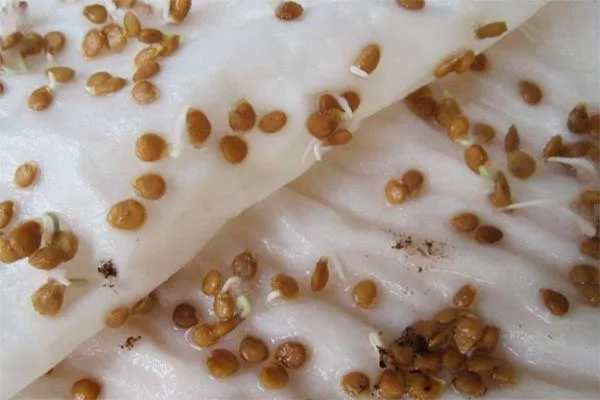
If there are no disinfection markings on the packaging or the planting material is from last year's harvest, it is recommended to prepare it yourself:
- the seeds are left in a weak solution of potassium permanganate for half an hour, after which they are thoroughly washed;
- To stimulate rapid germination, treat with special agents: Epin, honey solution, soda or aloe tincture, Fitosporin.
Selecting containers and soil
For tomatoes, the following approach is often used: first, the seeds are planted in a single large, but not too deep, container. Once the seedlings sprout, they are transplanted into individual pots, each with a minimum capacity of 300-500 ml.
Other nuances:
- Before using seedling containers, disinfect them. You can do this by soaking them in a potassium permanganate solution for 30-40 minutes or simply by rinsing them with boiling water.
- To grow tomatoes, you can use a store-bought soil mix, which is available in specialty stores. However, you can also make your own by mixing equal parts peat, black soil, and humus, adding ash and sand.
- Before adding the soil mixture, it is important to disinfect it by pouring boiling water, a solution of potassium permanganate, or baking it in the oven.
- To minimize the risk of blackleg infestation in seedlings, it is recommended to add a layer of drainage material to the bottom of the transplant pots. Crushed brick, expanded clay, or ceramic can be used as a drainage material.
Sowing seeds
To begin growing Orange Heart, plant the seeds 1-1.5 cm deep in the soil, leaving at least 2 cm between each seed. After planting, moisten the soil with warm water using a spray bottle. Then cover the seedlings with plastic wrap and place them in a warm room.
Ambient temperature directly affects the rate of seed germination: the warmer the room, the faster the first shoots will appear. At this stage of growth, light is not essential for the seeds (until they have germinated).
Caring for seedlings
Optimal seedling care ensures strong, healthy plants. Here's how to grow seedlings:
- Before the seeds awaken, they are placed under film to create the ideal humidity and microclimate for the beginning of growth.
- Once sprouts appear, the containers are moved to a location with adequate light. To prevent stems from elongating, gardeners recommend using fluorescent lamps.
- A week after germination, the film is removed.
- For watering, use water at room temperature, previously settled, avoiding water getting on the leaves during the process.
- Plants are pricked out when the first true leaves appear. It is recommended not to damage the roots during transplantation.
- During the growing season, seedlings are fertilized three times using complex fertilizers or vermicompost. Three days before planting, apply fertilizers containing phosphorus and potassium.
- Before transferring to a permanent location, tomatoes are hardened off: two weeks before the event, they are regularly taken out into the air, gradually increasing the time.

Cultivation of Orange Heart tomatoes
The Orange Heart tomato is grown both outdoors and in protected soil, with the latter being preferred in areas with colder climates.
Transfer rules
Tomato plants are transplanted when the soil has warmed up sufficiently. This is usually in May, but in southern regions, planting can be done as early as late April, while in northern regions, it's best to wait until early June. Before planting, tomatoes require preparation: water and fertilize the plants three days beforehand.

- ✓ The optimal soil temperature for transplanting seedlings should be at least +15°C.
- ✓ The distance between plants when planting should be at least 50 cm to ensure sufficient space for the root system to grow.
The process is standard, but there are some recommendations:
- For tomatoes, it is necessary to prepare the beds in advance:
- In autumn, the soil is dug up and cleared of weeds, and then enriched with cow dung, ash and lime;
- In the spring, the soil is dug up again and watered with a solution of copper sulfate.
- the hole is dug 15 cm deep;
- half of the hole is filled with organic fertilizer, such as rotted manure or compost;
- then a young plant with a lump of earth is placed into the hole, lightly compacted and watered with 3-5 liters of water;
- It is best to transplant tomatoes into a greenhouse or open ground in cloudy weather or towards evening;
- The first watering after planting can be done at least two weeks later.
How to care for a tomato?
Orange Heart is an easy-to-grow tomato variety. It doesn't require much fertilizer, and if you follow basic rules, even novice vegetable growers can succeed. Here's what to do:
- Tomatoes require three to four feedings throughout the season, but two is sufficient for Orange Heart. Use a complete fertilizer.
- To water tomatoes, use warm water and pour it directly onto the roots, avoiding the leaves. After each watering, remember to lightly loosen the soil to a depth of 2-3 cm if you're not using mulch.
- To get the maximum yield, form the bush into two stems, removing all the lower leaves and side shoots, leaving only one, located below the first flower brush.
- Long, vine-like stems, reaching 150-200 cm in height, require staking in several places to supports or trellises. It's also important to secure large fruit clusters.
During cloudy days or during periods of widespread late blight, it's recommended to pick large tomatoes that haven't yet ripened. Be sure to preserve the stems. This will help the tomatoes ripen quickly indoors.
Features of growing in protected and open ground
When growing the Orange Heart tomato variety outdoors, it's crucial to protect the plants from freezing temperatures for the first two weeks after transplanting. To do this, cover them with plastic at night. The same method is used during cooler days.
It is necessary to thoroughly mulch tomato beds growing outdoors to protect them from cold, drying out of the soil, and from attacks by pests and parasites.
To maintain an optimal microclimate in greenhouses, it is important to regularly ventilate the room by opening the windows.
Resistance to diseases and pests, prevention
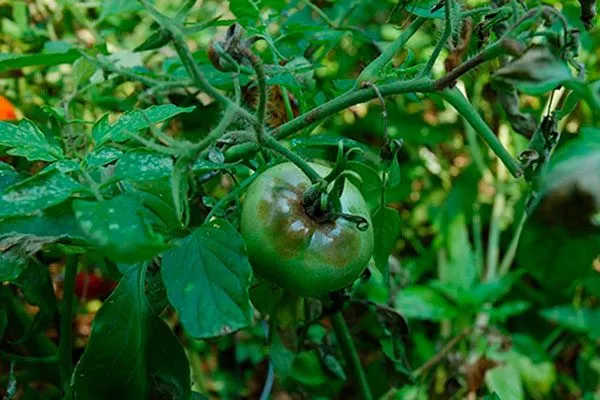
One of the key advantages of the Orange Heart tomato variety is its enviable resistance to various diseases. However, it's important to understand that genetic immunity isn't a panacea for all problems. To ensure optimal plant protection, certain rules and recommendations must be followed:
- Regularly loosen the soil, remove weeds and mulch it to prevent the spread of diseases;
- watering should be regular, but without stagnant moisture, so as not to create favorable conditions for the growth of microorganisms;
- When planting tomatoes, crop rotation recommendations should be taken into account to avoid the accumulation of pathogens in the soil;
- For optimal growth and fruiting of tomatoes, a temperature in the range of +23 to +26 degrees and humidity of about 50-70% is required. To maintain this microclimate, regularly ventilate the greenhouse;
- To prevent the development of diseases, you can resort to specialized biological preparations or traditional recipes - use fungicides, preparations with copper or iodine solution;
- if it is necessary to repel insect pests, there are herbal infusions (for example, celandine or wormwood), ammonia or soap solution;
- Regularly and carefully monitor the condition of the bushes so that if problems arise, you can quickly respond and prevent their development.
Pros and cons
The only drawback, which is more likely a feature of the variety, is the need for proper shaping of indeterminate bushes, including the removal of side shoots and large lower leaves.
Reviews
The Orange Heart variety is popular among both novice and experienced gardeners. It produces healthy and tasty heart-shaped orange tomatoes. These tomatoes require little care and can be grown even in small garden plots.