
Legend of Koktebel is the name of a mid-early tomato variety characterized by good yields and heat and drought tolerance. It is suitable for cultivation in greenhouses or open ground under temporary plastic cover. Its hallmark is its gigantic, beautiful, and delicious fruits.
Description of the bush and fruits
This variety is classified as an indeterminate vegetable. Its bushes are vigorous and tall, possessing unlimited growth energy.
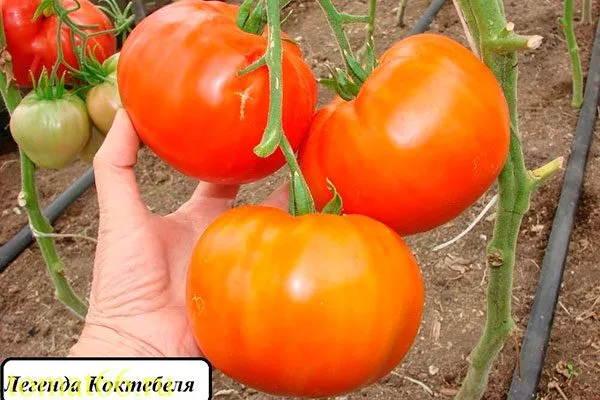
The description of their appearance includes the following indicators:
- height - 2 m or more (in protected ground conditions);
- strong shoots;
- foliage: long, pointed, dark green;
- flowers: yellow, medium-sized;
- fruit clusters of simple or semi-compound type, consisting of 5-6 tomatoes (the first one is formed above the 8-9 leaf, the next ones - after 2-3 nodes).
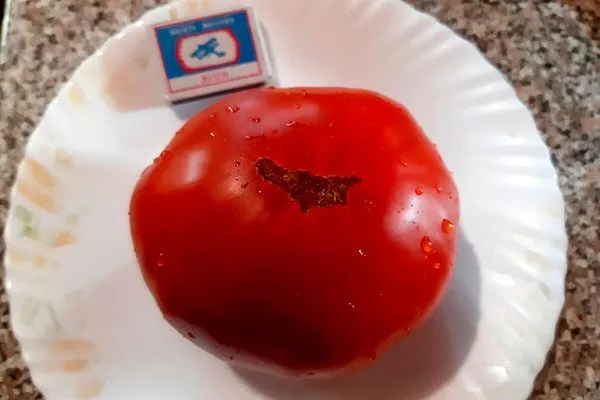
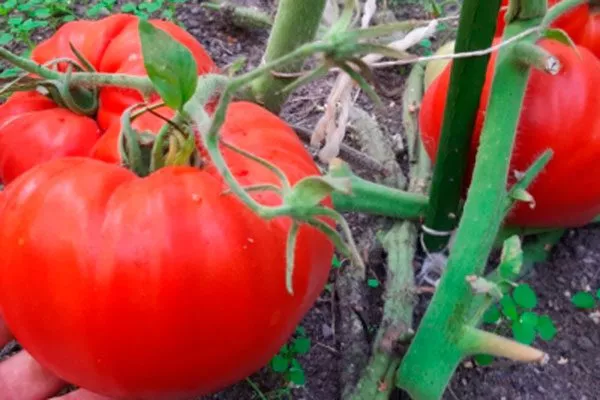
Legend of Koktebel plants require secure staking and training. Gardeners train them in 1-2 stems to maximize productivity. To produce giant fruits, weighing up to 1.3-1.5 kg, they leave two fruits on each cluster.
The harvest of this varietal variety is pleasing to the eye with its large fruits and attractive presentation. These tomatoes possess the following characteristics:
- flat-round shape;
- weight - 300-600 g (up to 1.5 kg with a decrease in the number of fruits in bunches and increased application of fertilizers);
- slightly pronounced ribbing;
- rich red color;
- skin: smooth with a glossy sheen, strong, not prone to cracking;
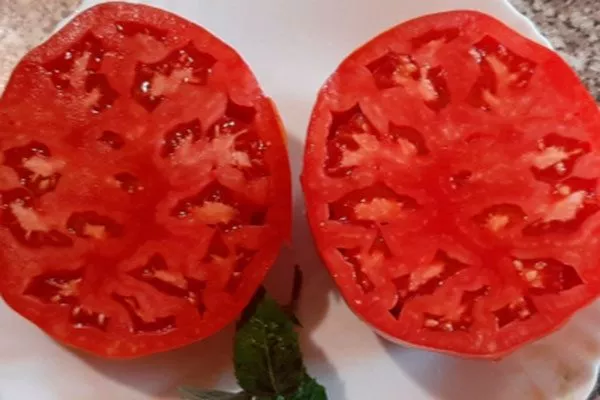
- pulp: red, medium-dense, fleshy, juicy, multi-chambered, with a small content of miniature seeds.
- ✓ The height of the bushes can exceed 2 meters in protected soil conditions.
- ✓ Fruits can reach a weight of up to 1.5 kg with proper care.
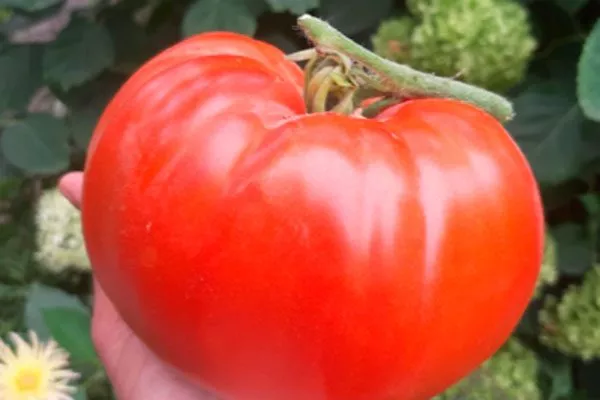
Koktebel Legend tomatoes surprise the eater with their abundance of pulp. They are rich in sugars, lycopene, vitamins, and minerals. They have a delicious tomato flavor, very rich, dominated by sweetness and a subtle, refreshing tartness.
Main characteristics and history
This variety of vegetable crop was bred in Crimea in 1999. Its authorship belongs to the agricultural firm "Partner" and V. I. Blokin-Mechtalin.
It was added to the State Register in 2021. It was grafted with characteristics such as heat and drought resistance, and resistance to diseases, including blossom-end rot.
Ripening and fruiting, productivity
Legend of Koktebel belongs to a group of productive mid-early tomato varieties and hybrids. Its technical characteristics are as follows:
- fruit ripening period is 110-115 days after germination;
- harvest time is September;
- productivity - more than 5 kg of fruit from 1 bush;
- The yield rate is from 25 kg/sq.m in greenhouses, 18-20 kg/sq.m in an open garden bed.
This southern vegetable variety thrives in protected soil conditions. Gardeners successfully grow it throughout the country. It is approved by the state registry for cultivation in the following regions and districts of the Russian Federation:
- Northern;
- North-West;
- Central;
- Volga-Vyatka;
- Central Black Earth Region;
- North Caucasian;
- Middle Volga;
- Lower Volga;
- Ural;
- West Siberian;
- East Siberian;
- Far Eastern.
Scope of application
Gardeners consider the Koktebel Legend an excellent salad variety. Its giant, fleshy fruits are especially delicious fresh. They pair beautifully with other vegetables, garden herbs, vegetable oil or sour cream, and spices.
In addition to fresh consumption, the Crimean variety's harvest is widely used in home cooking. Housewives use it in the following ways:
- processed into juice, puree, tomato paste;
- added to first and second courses, casseroles, pies;
- they make sauces, ketchup, and borscht dressing from them;
- they are preserved using them as the main ingredient in lecho and adjika;
- frozen in cubes or slices.
These large fruits, with medium-dense, beefsteak-like flesh, tend to hold their shape well when sliced. Their texture prevents them from falling apart when cooked. They are suitable for grilling, frying, and stewing. Their rich flavor makes them an excellent addition to many dishes.
Growing seedlings
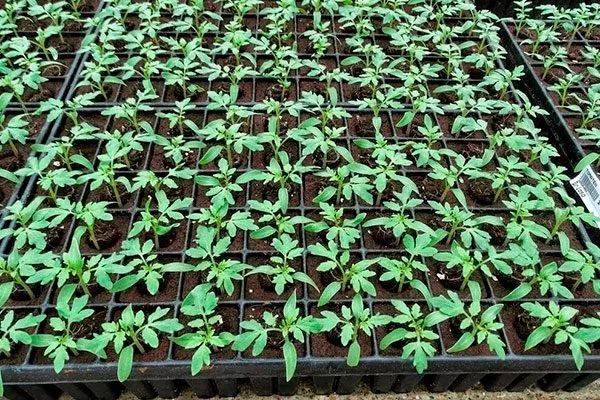
The Crimean variety is traditionally grown using seedlings. Sow the seeds 60-65 days before the planned transplanting date for the tomato seedlings to a greenhouse or to the open ground under plastic. Typically, gardeners do this in the first ten days of March, and transplant the plants to their permanent location in mid-May.
Before you begin sowing, prepare your Koktebel Legend seeds. Follow these pre-planting procedures:
- calibration;
- rejection of substandard items (empty, damaged, deformed, spoiled);
- etching them with a solution of potassium permanganate with a concentration of 1-2% or a fungicide;
- treatment with a preparation that stimulates crop growth.
Fill a seedling container with drainage holes in the bottom with moist, store-bought potting soil. Make furrows in the soil 1-2 cm deep. Plant the seeds in the soil, leaving a few centimeters between them. Water the seeds. Cover them with plastic wrap and keep them in a warm place (22-25°C).
After 8-12 days, seedlings will appear. Once they emerge, remove the covering material. Move the seedling container to a sunny windowsill in a room with a temperature of 18-20°C. Carry out the following care for the seedlings:
- Supplementary lighting with phytolamps. To ensure long daylight hours (the optimal duration for young tomatoes is at least 10-12 hours).
- Watering. It should be moderate and regular).
- Loosening the soil. Carefully, in a box with seedlings.
- Fertilization. Feed the seedlings several times with liquid mineral complexes.
- Picking. When the plants reach 35 days of age, transplant them from the common box into individual containers for better root system development.
Before planting seedlings in the garden, harden them off to increase their hardiness. Begin this process 10 days before transplanting them to the garden. For the first few days, leave them in an open, sunny window for 1-2 hours. Then, increase the amount of time the seedlings are exposed to the air.
Hardening off the seedlings will gradually acclimate them to lower temperatures, ultraviolet light, and breezes. Let them spend the last night before transplanting them to their permanent location on the balcony. To increase their resilience, using stimulants such as Epin is also recommended.
Planting in the ground
Transplant giant tomato seedlings into warmed garden soil (at least 15°C). The optimal time for transplanting established seedlings to an open bed is considered to be late May. You can easily determine their readiness for transplanting to their permanent location by their roots: they will almost completely encircle the soil ball in the planting container.

Follow this planting pattern:
- the distance between holes is 45 cm;
- row spacing - 65 cm;
- density - 2-3 plants per 1 sq. m.
Plant tomato seedlings in a permanent location (in an open garden bed or in protected soil), following the step-by-step instructions:
- Dig holes in the designated planting area. They should be 25-30 cm deep and 40-45 cm in diameter.
- Add water to each planting hole. The recommended dosage is 4 liters.
- Carefully remove the seedling and its root ball from the planting container. To facilitate this process, water the seedlings generously the day before transplanting them to the garden.
- Place the root ball in the planting hole. Fill the voids with soil. Plant the seedling up to the cotyledons. Point the tomato stem north and the roots south. This will ensure faster growth of the seedlings.
- Lightly compact the soil around the stem.
- Water the tomato planting.
- Place stakes near each plant. Tie the seedlings to them 10-12 days after transplanting them to the garden bed.
- ✓ Optimum soil temperature for planting seedlings: not lower than +15°C.
- ✓ The distance between plants should be at least 45 cm to ensure sufficient space for growth.
Care instructions
To obtain a bountiful harvest of giant Crimean tomatoes, care for them properly. Follow standard agricultural practices to ensure rapid development of seedlings, maintain their health, and achieve maximum productivity:
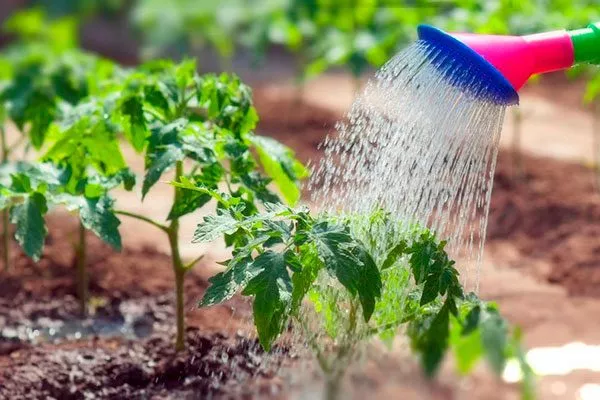
- WateringWater your tomato bed moderately, avoiding prolonged periods of dry soil. Overwatering is also unacceptable. Stagnant moisture can lead to crop diseases and reduced yields.
Maintain a watering regime: before flowers appear on the bushes, water once a week, using 1-2 liters of water per plant; before the fruits ripen, water 2-3 times every 7 days, using 4-7 liters per bush; during the ripening period of tomatoes, water once every 7 days, using 3-4 liters of water per plant.
Pour water directly at the roots. It shouldn't be cold. Water the beds early in the morning or in the evening.

- Hilling, loosening and weedingWhen cultivating vegetables outdoors, soil manipulation is essential. After watering and rain, loosen the soil under tomato plants to prevent a dense, air-impermeable crust from forming.
At the same time, remove weeds. Their presence in the garden can lead to nutrient deficiencies, infection, and pest attacks on tomatoes.
Hill up the plants. This technique promotes the formation of additional roots. Regularly add moist soil under the stems. Perform this procedure for the first time two weeks after planting the seedlings in their permanent location. Continue as needed. - MulchingCover the soil around the trunk with a layer of organic matter to retain moisture and prevent weed growth. Use hay, straw, sawdust, or pine needles as mulch. Perform this procedure at any stage of tomato development.
- Top dressing. 7-10 days after “relocating” the tomato seedlings to a permanent location, water them with a solution of mullein or milk whey.
During the flowering period of the crop, “treat” it with Superphosphate in dry granular form or in liquid form.
Fertilize Crimean tomatoes for the third time during the fruit set period. Feed them with potassium humate. At this stage of plant development, spraying them with a nutrient solution based on boric acid is also recommended. - Formation, pinching outTrain the plants to form 1-2 trunks. The Koktebel Legend variety tends to produce numerous side shoots. Remove them weekly. Prune the shoots when they reach 4-5 cm in length. Leave stumps 1 cm high.
Thin out the leaves, removing all those located underneath or touching the ground. Pluck 1-3 leaves at a time. Repeat this procedure once every 7 days, starting in mid-June.
Removing excess foliage will prevent rot and fungal diseases. All the plant's vital energy will be focused on fruit formation.
Pest and disease control
This tomato variety boasts strong immunity. Its bushes have good natural protection against the main infections of nightshade crops. They are not susceptible to blossom-end rot. This disease can only occur with poor care and unfavorable growing conditions.
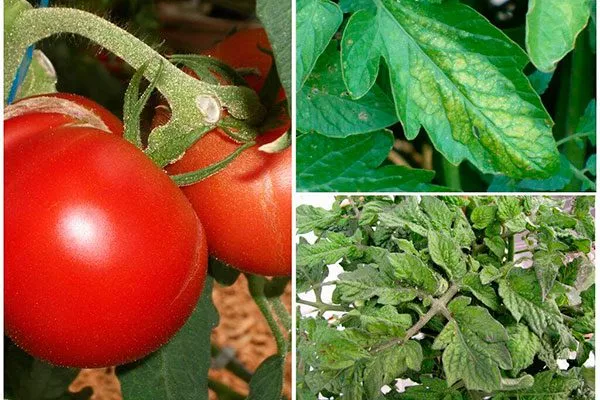
To increase disease resistance in Legends of Koktebel plants, spray them with fungicides. This is considered a powerful preventative measure against fungal infections. Treat giant tomato plants 3-4 times per season using the following products:
- HOM;
- Ridomil Gold;
- Quadris;
- Revus.
If the rules of agricultural technology for vegetable crops are violated, there is a high probability of pest infestation in the tomato bed:
- whiteflies (plants living in greenhouses are most susceptible to it);
- Colorado potato beetle (Tomatoes at the initial stage of development, growing in open beds, suffer from this enemy of nightshades).
To protect your Legend of Koktebel planting from whiteflies, ensure regular ventilation of the greenhouse. The insect is most active in conditions of high humidity and heat. Spray affected bushes with Fitoverm on the foliage and treat with Aktara. Apply insecticides every 5-7 days.
To protect outdoor tomato plants from the Colorado potato beetle, use Aktara. Apply the solution to seedlings when planting them in the garden. Use 0.25 liters of liquid solution per plant.
Pros and cons
Koktebel Legend, like other tomato varieties, has its strengths and weaknesses. Before you begin growing it, research its advantages:
The southern variety, famous for its huge sweet fruits, also has some disadvantages, including:
Reviews
The Koktebel Legend tomato is a miracle of Crimean breeding, captivating the hearts of local gardeners. This variety delights them with its excellent marketability and taste, good productivity, and heat- and drought-resistant bushes. It's an excellent choice for those who love sweet, giant tomatoes, ideal for fresh consumption and processing.