
Pinching out side shoots from tomatoes is considered a very important care procedure. Regularly removing unwanted shoots can ensure good ventilation and proper plant development. The plant will focus its energy on fruit growth rather than on growing foliage.
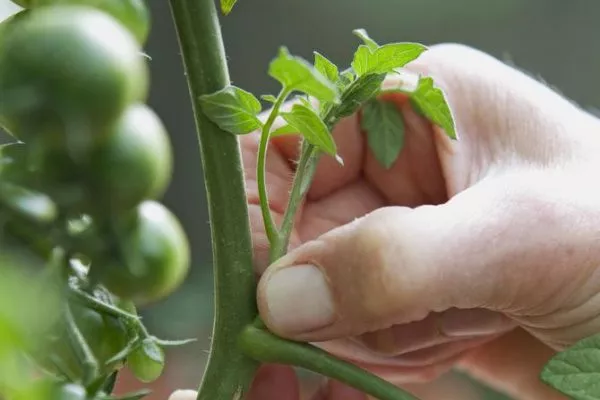
Why do step-sonning?
To increase crop yields and ensure the plant has access to sunlight and air, gardeners remove side shoots. This is essential for proper plant formation and development. You'll need to remove excess shoots, which only drain the plant's energy without producing fruit.
Tomatoes are a crop that actively grows and branches. The plant develops rapidly, and side shoots begin to emerge from its leaf axils. These are unnecessary, as they rob the fruit of nutrients. Therefore, they should be removed, directing their growth toward the tomatoes rather than the leaves.
How to distinguish a stepson from a fruit cluster?
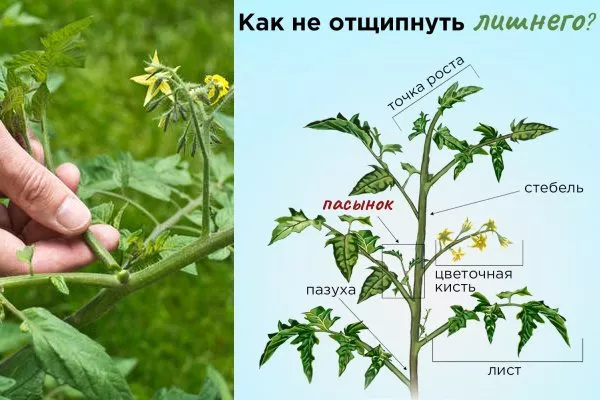
If you've never removed side shoots before, you need to learn the procedure. This will prevent you from removing unnecessary parts or mistaking a fruit cluster for a side shoot. Such a mistake can lead to a decrease in the bush's yield. Don't be careless with the process; carefully inspect the shoot you plan to remove.
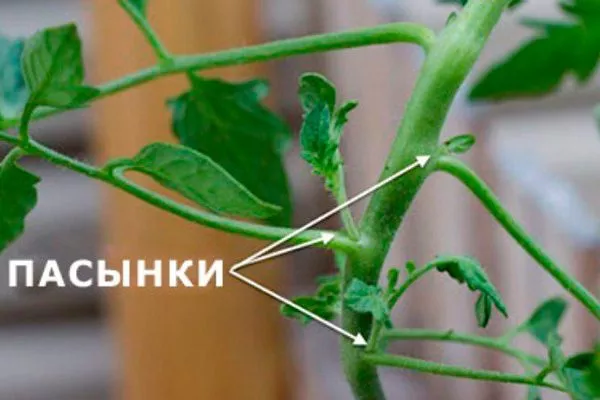
The main differences of the stepson are:
- the flower brush does not develop from the axil of the leaf, but begins its growth from the stem;
- Even a small lateral shoot has leaves, while the brush has flower rudiments.
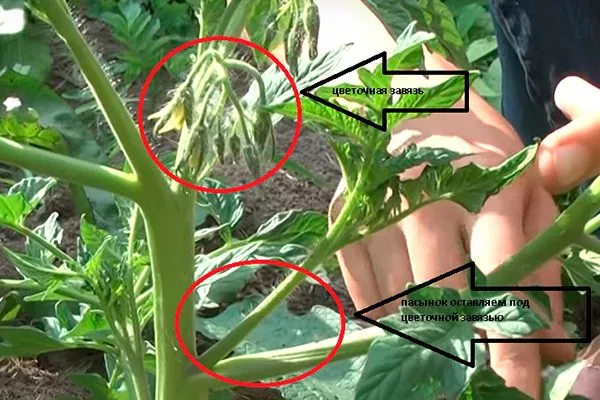
When to remove stepsons?
You may notice the first side shoots appearing on the seedlings, so begin removing them immediately after planting them in the ground. At this stage, the side shoots are short and thin, so the plants will easily tolerate their removal.
- ✓ The optimal length of the shoot for removal is 3-5 cm, which minimizes stress for the plant.
- ✓ The best time of day is morning, before 11 am, when the plants are most hydrated and wounds heal faster.
The process of removing side shoots is considered a complex one, especially if you have many bushes in your garden. It's recommended to start removing side shoots in the morning, as branches break off more easily before lunch, and the wounds heal faster. Go to the garden between 9 and 11 a.m., then lightly moisten the soil.
How to remove stepsons correctly?
At first glance, it may seem that cutting or breaking off side shoots is not at all difficult, but not many gardeners cope with this task and often fail.
The main rule for removing suckers is to begin the procedure promptly, that is, no later than when they reach 4-5 cm in height. At this point, the seedlings are still thin and have not absorbed strength from the stem, so they are easy to remove by hand or scissors.
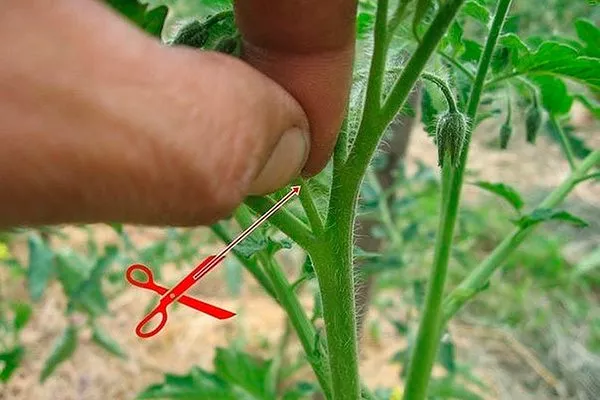
Recommendations for removing stepsons:
- Perform the procedure for the first time 10-14 days after planting the seedlings in the ground, then repeat regularly every two weeks. This will help you monitor the growing side shoots and prevent the bush from becoming too dense.
- Don't break off the entire side shoot. Leave a 1-2 mm stub. This will prevent damage to the tomato stem, and a new shoot won't grow in that spot for a long time.
- Depending on the variety, the bush branches and develops differently. As a rule, taller varieties grow faster, so without side shoots, they will become fruitless trees. These varieties require pruning and pinching (to limit the growth of the central stem).
- When removing side shoots during flowering, shake the bushes first, which will promote better pollination of neighboring plants.
- If possible, inspect the plants weekly and remove any suckers to prevent them from growing too large.
- Removing branches that are too large will stress the plants and may negatively impact crop yield.
- If you're growing tomatoes in a greenhouse, remove side shoots every 6-8 days. Don't let the shoots grow longer than 5 cm.
- To obtain large fruits and a good yield, carry out the procedure throughout the summer period.
- ✓ In greenhouses, pinching out side shoots should be done every 6-8 days due to the faster growth of plants.
- ✓ In open ground, the intervals between procedures can be increased to 10-14 days, taking into account less intensive growth.
Peculiarities of pinching out stepsons
Pinching out side-children is a crucial procedure, as without it, they will devote all their energy and strength to excess shoots and foliage. Ultimately, your efforts will be in vain, as the yield will be very low, meaning you'll spend a lot of time on care, and ultimately, you won't get the results you expected.
Tomatoes in open ground
Most gardeners grow dwarf tomato varieties outdoors. Their advantage is that they are easy to shape and tie. Avoid leaving such bushes without side shoots, as this can cause the plant to stop growing completely.
For these tomatoes, leave a continuation shoot—the stem that grows under the first flower cluster. Do this repeatedly so that the side shoots replace each other and produce fruit. If you're growing cherry tomatoes outdoors, don't forget to train the bushes.
Indeterminate cherry varieties require pinching, shaping them into 1-2 stems, and pinching. Determinate varieties should only be pinched, while semi-determinate varieties should be trained compactly into several stems, but don't forget to pinch and pinch back.
Large-fruited tomatoes
Many gardeners heavily pinch out side-sons of large-fruited tomatoes, shaping them into a single stem to prevent them from devoting all their energy to new shoots. It's recommended to leave 3-4 clusters on each plant and remove the rest generously.
Pinch off any side shoots growing under the first cluster promptly—they can rob the plant of all its nutrients, and the fruit won't look as expected. This applies to all side shoots growing under the clusters. The top side shoots can be left alone, as they won't produce large tomatoes.
For example, it's best to train the Bull's Heart variety so that only a few fruits remain in the cluster. If this isn't done, the first cluster will contain large fruits, and subsequent clusters will contain small tomatoes.
Tomatoes in a greenhouse
Even low-growing standard tomatoes can reach gigantic proportions in a greenhouse. For example, the Sanka variety grows no more than 50 cm tall outdoors, with fruits weighing around 100 g. In a greenhouse, however, this tomato can grow to 1 m or more, with significantly heavier fruits.
Because of this characteristic, removing side shoots is essential: move the growing point to a few upper shoots and do not remove the growing greenery. The upper fruits will be smaller, but this is not a problem.
For example, pinch off the side shoots of the Samorodok greenhouse hybrid as usual, but form it into two stems, while the Vityaz hybrid should be shaped into a single stem. Also, remove the side shoots promptly and transfer the growth point to the shoot that grows after the third cluster.
Low-growing varieties
There are tomato varieties that produce multiple stems, depending on the number of fruits and the growth rate. There are also tomato varieties that grow exclusively from a single stem, producing virtually no side shoots—standard varieties.
Useful information:
- These are low-growing bushes with large, robust leaves and short internodes. The lower leaves cover the soil beneath the plant. The bushes produce side shoots, but these appear very late and do not draw nutrients from the mother plant.
- Leave all the shoots that emerge first, that is, from the axils of the lower leaves. They have a positive effect on the bush's yield.
- Remove shoots located higher up. This will give the bush a rounded shape, make it denser, and increase its yield.
Varietal features of formation
Tomato varieties and hybrids can be indeterminate, determinate, or semi-determinate. Tomatoes from any group cannot thrive in a greenhouse without proper training. To increase yield and properly care for the plant, it's important to follow certain rules.
Semi-determinate
Semi-determinate tomato varieties can stop growing at any time. When growing these tomatoes, it's difficult to predict when growth will stop. Therefore, keep a spare shoot on these plants. If the top of the plant fails to bear fruit, the spare shoot at the top will become an extension of the stem.
Gardeners believe that the best semi-determinate tomato varieties/hybrids are:
- Baron F1;
- Silhouette F1;
- Merchant F1;
- Red Arrow;
- Gravity F1;
- Magnus F1.
If you succeed in this task, and the bush continues to grow after forming 8 clusters, you can remove the spare shoot. Experienced gardeners often train semi-determinate tomatoes into a single stem. Pinch out the top of the bush 45 days before the end of the growing season.
Determinant
Determinate tomato varieties stop growing after 4-5 flowering clusters have formed. Varieties in this group produce only 4-8 clusters, after which their growth stops. Train determinate tomato plants into 2 or 3 stems. Flower clusters form on each stem.
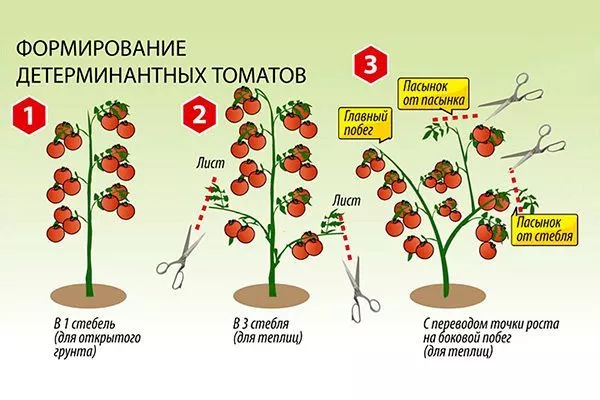
Gardeners note the following best determinate tomato varieties/hybrids:
- Openwork F1;
- Bourgeois F1;
- Olya F1;
- Alsou;
- Pride of Siberia.
Indeterminate
Indeterminate and hybrid varieties grow without restrictions. These are very tall varieties. Their stems can reach 5-6 meters in length. Gardeners can harvest up to 8 kg of tomatoes from a single bush. These varieties are rarely trained into twin trunks in greenhouses.
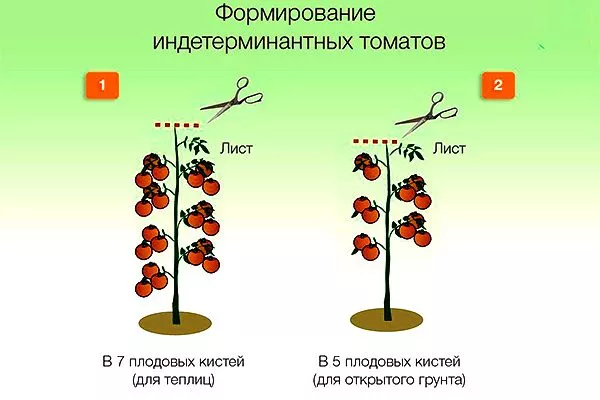
Plant indeterminate varieties in a greenhouse using a 100 x 20 pattern. This arrangement will ensure optimal ventilation and light.
Gardeners note the following best varieties of the indeterminate group:
- Bull's heart;
- Abakan pink;
- Two-color;
- Pink elephant;
- Yellow cherry;
- Watercolor.
For tall tomatoes, cut the main shoot above the last flowering cluster, leaving a few leaves above to shade the fruit. Perform this procedure in the spring 50 days before the planned harvest, around mid-May, and in the fall, around mid-September.
Tomato planting methods
There are several methods for removing side shoots from tomatoes. Gardeners use the ones they find most convenient. Regardless of the method, removing side shoots follows the same rule: the shoots should be removed before they grow 3-5 cm.
If you don't do this in time, you may damage the plant stem when plucking it, which can lead to a long healing time or even death of the plant.
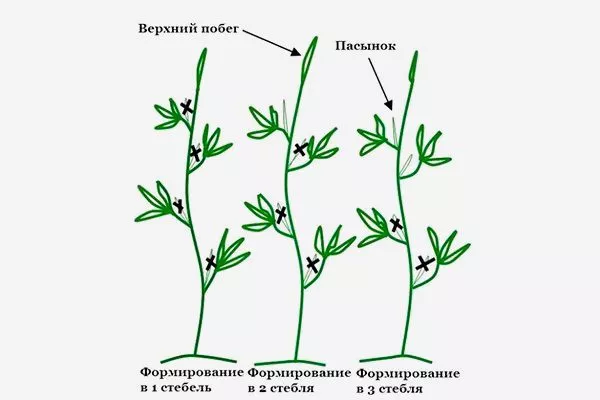
In one stem
When growing greenhouse tomatoes, train them into a single stem. This method is especially suitable for early tomatoes. This method has several advantages:
- The bushes are well ventilated and saturated with oxygen.
- The plant receives more sunlight.
- The planting density increases, and accordingly, the yield also increases.
This formation is very simple: after the first inflorescence opens, remove the side shoot growing underneath it. Remove the lower leaves as well. Remove any new side shoots that grow daily.
In two stems
Training tomatoes into two stems increases tomato yield. This is a very simple method that requires no special skills.
To do this, first train the tomato plant into a single stem, then select the strongest side shoot around the fourth leaf and leave it to grow. Over time, it will become a full-sized stem. Subsequently, remove any new side shoots that appear on both stems.
In three stems
Training tomatoes into three stems is extremely rare, and typically used on medium-sized tomatoes. This method requires the removal of numerous clusters; otherwise, plant growth may be stunted, yield will decline, and the fruits will be small.
At the first stage, form the bush into a single stem and wait for the first flower cluster to form. Then, identify two strong side shoots above the first inflorescence. Remove the remaining shoots, leaving three to four flower clusters on each.
See also the video about pinching out tomato side shoots:
Tomato varieties that don't require pinching
The main characteristic of plants that produce a decent harvest without pinching is their low maintenance. These varieties are renowned for producing excellent fruit with minimal care. Watering, fertilizing, and weeding are sufficient.
It's preferable to choose low-growing or standard varieties. They are typically grown in open ground or under lightweight plastic shelters, such as greenhouses. For greenhouses, compact forms or varieties with minimal foliage are used.
Gardeners note the best tomato varieties that do not require pinching:
- Dwarf;
- Nepas;
- Pink;
- Orange;
- Countryman.
What happens if you don't pinch out the side shoots of tomatoes?
The step-sonning procedure is essential, as this is how you'll ensure that only the fruiting branches remain. Failure to do so will result in the growth of green mass at the expense of the harvest. In other words, instead of tomatoes, you'll end up with only shoots and leaves.
Many gardeners know that caring for tomatoes requires special care. Growing tomatoes requires removing side shoots, which can interfere with the plant's stable growth. Pinching out side shoots will allow you to grow tomatoes that will delight you with abundant harvests.