
A popular practice among gardeners is planting cucumbers in large bags filled with soil. This method allows for large harvests without the need for a large space, and even allows for growing vegetables in unsuitable locations, such as on a balcony or terrace.
Features of the planting method
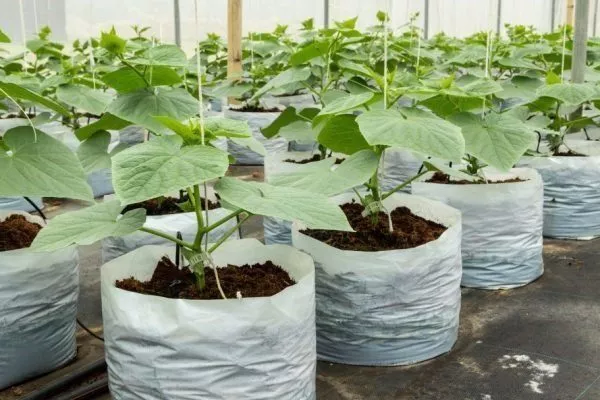
Regardless of variety, cucumbers are demanding of soil. They require fertile, warm, loose, and moist soil. This can be achieved by planting vegetables in bags: fabric, plastic, sugar bags, and other bulk food bags. These bags are filled with soil mixed with fertilizer, and a drainage and watering system is provided.
In larger containers, the root system grows deeper quickly, receiving maximum nutrients. Fruits grow and develop actively. Furthermore, if placed in the right location, the soil in the bags doesn't overheat, and the roots breathe and aren't affected by excess moisture—water drains away without additional drainage.
According to the technique, there are more than 10 plants per square meter in bags, while in open ground it is possible to grow no more than 4 healthy roots.
The "vertical bed" method of planting vegetables in bags is simple and suitable for any plot, even a small one. It saves space in the garden and allows you to grow cucumbers on a large loggia, balcony, or porch. The bags last for several seasons. After harvesting, the soil is removed, the bags are dried, and the "beds" can be reused the following year.
Pros and cons of the method
By choosing to plant cucumbers in bags, gardeners eliminate many of the problems associated with growing this crop in open ground or greenhouses. The advantages of this method include:
- Space-saving, compact design. A good harvest can be harvested from a small plot.
- Vegetables ripen earlier than in open ground.
- Mobility. The vertical garden bed can be moved in an emergency. It allows you to grow vegetables in unsuitable areas, such as under a fence, on a balcony, etc.
- No weeds or pests. Weeds don't have time to grow, moles can't reach the roots, and dangerous late blight doesn't harm plants with proper watering.
- Convenience of hilling and maintenance in general.
- The vegetables are clean and not subject to rot.
The presented agricultural technology has few drawbacks, but they do exist. Those who have tried growing cucumbers in bags describe the method as laborious and requiring thoughtful, thorough preparation. Other disadvantages include:
- need for additional materials;
- the importance of correctly calculating the landing time;
- difficulties with watering and setting up a drainage system (you can’t overwater the bushes, and if there’s not enough water, the cucumbers will taste bitter);
- The humidity level in the bags requires strict control.
Selection of bags
Preparing for a vertical garden bed begins with selecting materials. For planting, you'll need:
- bags;
- soil and fertilizers;
- sticks and ropes for tying up plants;
- irrigation pipes (plus hoses).
It's important to choose bags with particular care: choose bags of the right volume and material to ensure the root system develops within, without being exposed to drought or rot. Subsequent maintenance of such a bed will be hassle-free. How to choose bags?
- The optimal volume is at least 50 liters (optimally 70-120). Small containers hold one plant, while larger bags hold two roots.
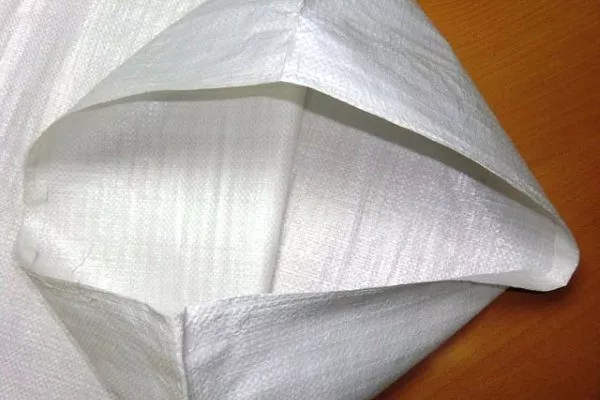
- The best materials are polypropylene fiber. It's used to make bags for sugar and other bulk products. Fabric and polyethylene are permitted, but these materials are poorly permeable to water and heat.
- Light material will not overheat in the sun, so it is good if the bag is white.
- ✓ Bags must be made of UV-resistant material to prevent rapid deterioration when exposed to sunlight.
- ✓ Microperforation is required to provide the root system with oxygen and prevent water stagnation.
Used bags from flour, sugar, construction waste, and even thick polyethylene garbage bags are suitable for cucumber seedlings. The fabric should be breathable and moisture-permeable, and have a woven weave. New bags require no additional treatment, and if they have been used previously, they should be washed, dried, and treated with fungicides.
Filling bags
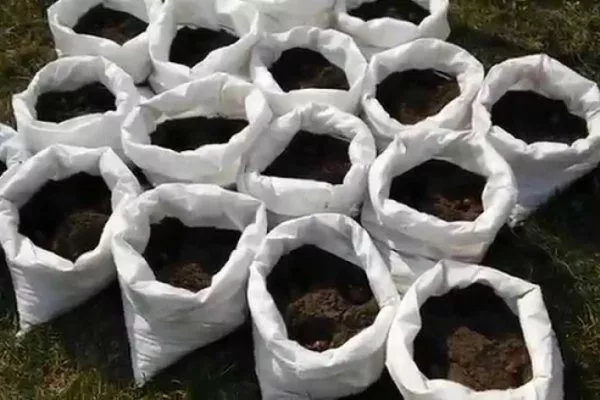
Selecting fertile soil for cucumbers is a priority. Vegetables prefer organic matter, compost, and rotted manure. Experienced agronomists add a little bit of everything to the soil, as well as complex fertilizers. But filling the entire container with fertile soil is unprofitable, especially in large containers, so they are half-filled with plant waste. The practice is as follows:
- The bottom layer is a drainage layer, making up half the total volume. The bottom is filled with grass, hay, fallen leaves, and unrotted compost. Fresh manure can be added if the roots are unlikely to reach the compost. Avoid adding sharp branches or wood chips, as they can damage the bottom.
- The middle layer makes up a quarter of the volume and consists of rotted compost or manure. This is the growing medium for cucumbers.
- Loose garden soil is the top layer.
- If necessary, add nutrients to the soil: ash, potassium, phosphorus, complex fertilizers.
Soil preparation
If you choose a standard-volume bag (50-70 l) for planting vegetables, the soil composition for one bed looks something like this:
- 2 buckets (20-24 l) of soil;
- a bucket (10-12 l) of humus;
- hay, sawdust and other organic waste – 10 l;
- potassium – 10 g;
- superphosphate – 10 g.
The bags are filled with soil in the place where they are planned to be left, so that later you don’t have to drag the heavy bed.
Once the beds are filled with soil and humus, water them sparingly. The bags are tied and placed in a sunny spot for 5-8 days to allow the soil to warm up, then moved to a shady spot. Cucumbers prefer cooler conditions and thrive under trees, near a gazebo or greenhouse, or near a fence. Untie the bags and press them slightly deeper into the soil to ensure the bed is stable. The cucumbers are ready to be planted.
Step-by-step planting procedures
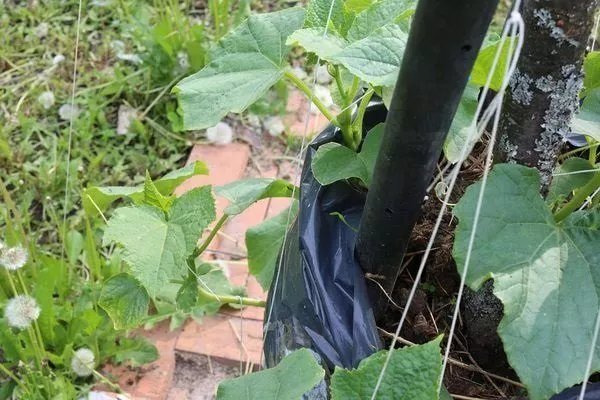
Before planting seeds in bags, gardeners ensure proper drainage and support. For the latter, a long (1.5-2 m) pole is inserted into the ground, with a nail driven into the end and a strong rope or fishing line tied to it. The pole extends to the very bottom and is positioned in the center of the bed.
The stake is installed before planting to avoid damaging the plant roots. Hollow tubes with holes are inserted next to the stake if drip irrigation is planned (more on these later). Twenty-four hours before planting the seedlings or seeds, the soil in the bags is thoroughly watered.
There are several methods for growing cucumbers: using seedlings and sowing seeds in open ground—in this case, using a bag. Using seedlings is preferable, as growing seeds with a stick protruding from the ground is inconvenient. However, some gardeners choose this method because it saves time and eliminates the need to transport the seedlings.
Planting seeds
This method is suitable for warm regions where comfortable weather sets in as early as the first ten days of May. It is advisable to select two- or three-year-old seed material.
Before planting the seeds, they are prepared:
- dry;
- soak in water in a transparent container for 24 hours;
- Place in a cold place for 3 days to harden;
- are rejected.
Only seeds that sink to the bottom of the container are suitable for growing. Those that rise to the surface are empty and should be discarded. Seed planting plan:
- Planting begins at the end of May.
- There are 15-20 seeds per bed.
- The bag is watered generously, and holes are made in the soil at equal distances from each other.
- Pre-prepared seeds (dried, treated with pesticides if desired) are planted 3-5 cm deep into the ground.
- 3-4 seeds are planted near the central support, the rest are placed in the side slits made in the bag.
- The seedlings are covered with cellophane to ensure optimal humidity and temperature. This cover is not removed until the first shoots appear.
Transplanting
The seedling method is chosen in colder regions. Seeds are sown indoors in late April or early May. Each seedling is given a separate cup, to which nutrient-rich soil is added as the plant grows. By the end of May, each seedling will have formed 3-4 leaves. When the temperature outside has reached a stable temperature of above zero, the seedlings can be planted. Planting plan:
- The day before planting, cucumbers in peat cups are watered generously to easily extract the root system along with the soil.
- Holes are made in the soil inside the bags, each the size of the cup. The bottom of each hole is moistened with warm water.
- The seedlings are placed one by one in the holes and covered with soil so that all the roots are covered.
- The seedlings are shaded for 3 days so that they get used to the soil.
An experienced gardener will show you how to plant cucumber seedlings in bags in the video below:
Caring for cucumbers in bags
Once the seedlings are planted, the bags should be positioned in their designated place. Fold the edges over to form low sides. This will prevent soil from spilling out. The vertical beds should be provided with moisture and some shade, for example, by placing them under trees.
If done correctly, garden bed maintenance won't take much time. It requires much less labor for several reasons:
- there are almost no weeds growing, so weeding is minimal;
- due to the fact that the soil in the bags is ventilated, there is no need for loosening and digging;
- if the soil is supplied with nutrients, fertilizing is not done;
- These cucumbers are watered less often than those growing in regular beds.
Watering cucumbers
For vertical beds, cucumbers can be watered using conventional methods, but experienced gardeners who use this technology recommend using drip irrigation. It's a bit of a chore, but the system has undeniable advantages:
- reducing the risk of root rot and fungal diseases;
- crop ripening several times earlier;
- slowing down the growth of weeds.
The irrigation system must be set up before planting, so it's best to ensure it's ready in advance. Take a plastic pipe with a diameter of 2-4 cm and cut it so that it's 15-20 cm longer than the bag. You'll need two such lengths per bag. The lower section, buried in the soil, is fitted with holes spaced 15 cm apart. The irrigation pipes are installed at a distance from the support.
- Check the soil moisture at a depth of 5 cm before each watering.
- Use only warm water to avoid stressing plants.
- Water plants early in the morning or late in the evening to minimize evaporation.
Adapters are inserted into the top of the pipe and connected to a hose through which water, which has settled in the barrel, is supplied. Excess moisture drains into trays if the bags are stored indoors, and into the soil if outdoors. Watering frequency depends on the weather, 2-3 times a week in the evening.
Fertilizer
It's easier to deliver nutrients to the roots through the same tube used for watering. Fertilizer is poured through a funnel or a cut-off plastic bottle.
What kind of fertilizer do cucumbers need?
- Three times throughout the season, starting from the moment the shoots emerge with 2-3 pairs of true leaves, mineral fertilizers are added to the soil. These include potassium salt and superphosphates.
- Organic mineral fertilizers are added a month after watering: honey solution, nettle infusion, chicken manure.
- Several times during the summer, the leaves are sprayed with a solution containing beneficial microelements.
Formation of bushes
Once the shoots have grown to 20-30 cm and have five true leaves, they are ready for staking. This can be done in two ways: vertically and horizontally, but only the first option is suitable for vertical gardening.
How to garter:
- A nail is nailed to the top of the support, and ropes (threads, fishing line) are tied to it - one end for each shoot.
- The knot is tied between the second and third leaves. It shouldn't be too tight, as the sprout will grow in size.
- The threads are pulled tight and secured to the support.
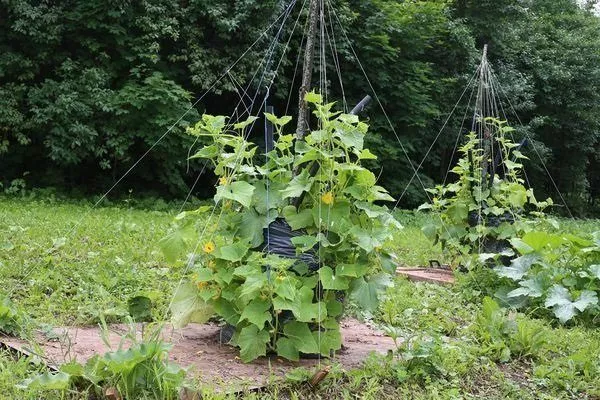
Traditional cucumber varieties produce fertile female flowers on the side stems, and male flowers on the main shoots. To encourage more side stems and female flowers, pinch them off. The top of the central stem is cut off after the sixth leaf. The side shoots are tied to the central stem with a stick to prevent them from interfering with the development of the cucumbers. A few side stems are left.
Bush formation is necessary in order to limit the growth of a large number of lateral shoots, to which the plant will give all its nutritional energy.
Difficulties in growing in bags
In terms of maintenance, vertical beds are better than traditional ones. However, even experienced gardeners face challenges growing cucumbers in bags. The main challenge, according to amateur agronomists, is soil moisture. The soil may be dry on the surface, but moisture can stagnate inside the bags, leading to root rot. A drip irrigation system is the best solution for moisture management.
Other difficulties in growing vertical beds include:
- Overheating of roots. Bags become hot in the sun, especially if they are exposed to direct sunlight.
- Planting density. Gardeners plant 4 or more seedlings in one bag, which reduces their fruiting.
How to increase crop yield?
To ensure cucumbers thrive, plant a certain number of seeds—no more than 20—and 3-4 seedlings in a 50-liter bag. The quality, not the quantity, of the shoots is the key to a good harvest. Experienced gardeners share their secrets for growing cucumbers. Pollination plays a crucial role:
- You can increase the yield of bee-pollinated varieties by spraying the plants with sweetened water in cloudy weather, which will attract insects.
- The quality of pollination of varietal cucumbers will be increased by having both female inflorescences and a specimen with male flowers.
- Trimming the lower leaves allows pollinators to reach the lower ovaries.
Harvesting
Timely harvesting will help prolong fruiting and maximize the harvest. It's best to pick fresh cucumbers as they ripen, even daily. Unripe cucumbers left on the vine inhibit the development of new ovaries. You can tell when a cucumber is ripe by the following signs:
- the structure of the fetus is formed;
- the secondary floral fragment has dried up;
- coloring is uniform.
Some gardeners harvest cucumbers earlier, preferring young gherkins. They are smaller and ideal for canning. In addition to fresh cucumbers, gardeners should regularly remove any diseased cucumbers, including those with crooked edges, scratches, and blemishes. The latter may indicate the development of a disease.
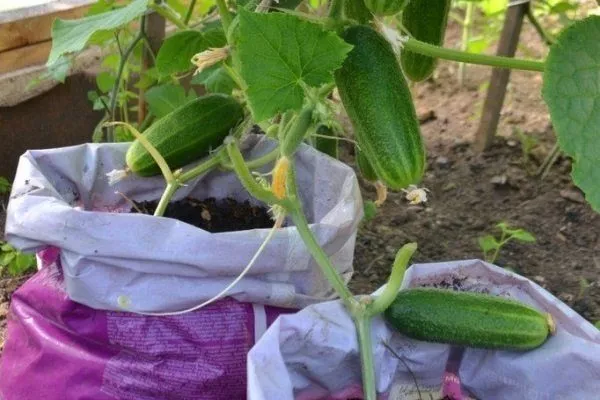
Diseases and pests
Cucumbers grown in bags are less common are susceptible to diseases and attacked by pestsThe more attentive a gardener is, the sooner the first signs of disease will be noticed and appropriate action taken. Methods for combating common diseases:
- Powdery mildew is treated with special solutions, fungicides, and sour milk.
- Copper oxychloride and Bordeaux mixture help against brown spot.
- Leaves affected by rot (gray or white) are removed. The plant is sprayed with fungicides.
- Root rot is difficult to treat. Healthy shoots are re-rooted and the watering regime is adjusted.
Properly growing cucumbers in a vertical bed guarantees a bountiful harvest with minimal labor and time investment. However, it's important to plan your vegetable growing from the start: prepare the bags, place them in a good, shady spot, provide support and a drip irrigation system, and plant the seedlings at the optimal spacing. By taking all these details into account, you can even harvest a bountiful cucumber crop on your balcony.
I wonder if the author of this treatise himself grew cucumbers in “cloth bags”?
Guys and girls, please use your brains at least once before you start spewing out rubbish from the internet!
as your publication...
Here come the boys from the backup dancers!
They're used to ruining people's lives with downvotes on iPhone forums, and they can't stop here.
Vyunosha ruddy, rei, (or not Vyunosha)! A stupid and unprofessional article won't get any better just because you gave me a minus.
You can even give it five minuses, but the article will remain a talentless hodgepodge of internet sources and will remain so.
You can create another account and put a minus again.
(And I'll suddenly get angry and review all the articles by this "author"! That will be a laugh!)
Why do you need this?! Are you trying to assert yourself at the expense of others?! I get it... your book wasn't appreciated... Well, it happens... I'm sorry.
Boy, I don't care about your regrets.
Hang out with people like you - you'll be worth something there, but I'm not interested in cowardly and stupid downvoters.
In general, you understand where you need to go, single-celled organism.
I completely disagree with the person who commented above. Just search "fabric pot" online... My wife grew small ornamental trees in a bag like this... the "fabric" is made of polyester. Women often think of "fabric" as anything made of fabric, while polyester is a synthetic fabric... weather-resistant and highly durable.
I wish I could fill your head with some brains...
It's no use - the internet has taken up all the space there.