
Growing cucumbers in a greenhouse is no less challenging than harvesting in the open ground. Covering them doesn't protect against pests and diseases and requires additional investment and effort. However, this method allows for large-scale harvests at any time of year.
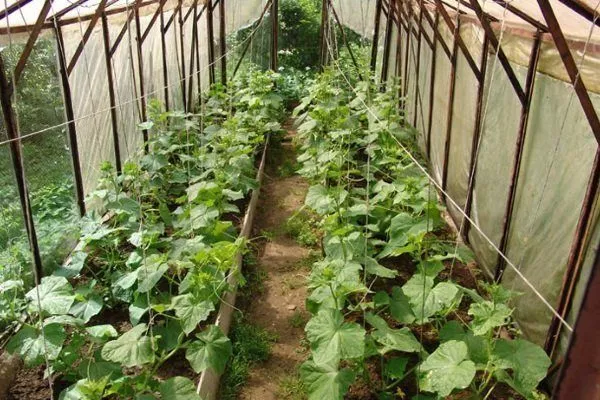
Features of growing in greenhouse conditions
Growing cucumbers indoors has its own peculiarities:
- the possibility of cultivating long salad cucumbers, which are not suitable for open ground;
- carefully monitor the quality of the soil, since in a limited area the amount of nutrients is quickly consumed by plants;
- annual replacement of soil or planting of intermediate crops after cucumbers to prevent the development of diseases;
- harvesting at any time of the year, regardless of the climate;
- with the vertical cultivation method, the color of the fruits is uniform;
- absence of the possibility of mechanical damage and influence of weather conditions on the vegetation of cucumbers.
- ✓ Soil pH should be between 6.0-6.5 for optimal nutrient absorption.
- ✓ The soil must contain at least 4% organic matter to maintain structure and water holding capacity.
Necessary equipment
Two factors are essential for growing cucumbers indoors: a suitable greenhouse and its equipment. When choosing a shelter, keep in mind that polycarbonate greenhouses offer more advantages than film-based or frame greenhouses. They are easy to transport, move, and assemble, are durable, have minimal weather resistance, and are more airtight.
The greenhouse should be at least 10 square meters in size and approximately 2 meters in height. Building a greenhouse taller is not recommended, as maintaining a microclimate will be challenging due to the thick air layer. However, a shorter height is also unacceptable for growing cucumbers. This is because the cucumber vines, when grown vertically, will lack space; their length can exceed 3.5 meters.
Choosing a location for your greenhouse is crucial. It should be on a level surface or slightly elevated to prevent groundwater from flooding and causing mold.
The greenhouse should be installed in a north-south direction to optimize the receipt of natural sunlight and heat.
Preparing the greenhouse
After selecting a location and installing the shelter, preparatory work should be carried out. This includes the following steps:
- Inspect the greenhouse for cracks and seal them. This will protect the cucumbers from the negative effects of drafts.
- Be sure to treat the inside of the shelter with an antifungal compound to avoid contamination of the soil and seedlings.
- Consider the layout of the beds and choose a method for their formation. Most often, longitudinal rows are placed along the shelter. They are approximately 50 cm wide, with a passageway of at least 90 cm. If the shelter size allows, you can use a layout method that involves constructing a shortened bed in the middle with a circular passage and two rows along the sides of the greenhouse.
- Cucumbers are a heat-loving crop, so depending on your growing plans, you may need to install underfloor heating under your beds to warm the soil for year-round cucumber cultivation.
- It is advisable to install containers with water in the shelter, which will perform two functions: warming up during the day, giving off heat at night and serving as a source for watering with warm water.
- Provide a ventilation system. This could include additional vents or an automatic ventilation system. Positioning vents on the roof and along the walls near the ceiling allows for ventilation without drying out the soil, as would happen when opening a door or vent on the opposite wall.
Choosing the right variety
Growing cucumbers indoors means pollinating insects won't have access to the plant's flower stalks. Therefore, choose varieties that are self-pollinating or those that don't require pollination at all—parthenocarpic varieties. These qualities are indicated on the seed packet.
It's important to distinguish cucumber varieties from their hybrids. When planting varietal varieties, their properties will be consistent year after year, and it's possible to grow your own seeds from the most successful harvest.
When using hybrids, home-harvested cucumber seeds do not carry the properties and qualities of the previous harvest. This means hybrid seed must be purchased annually.
Let's look at some varieties and hybrids suitable for growing under cover:
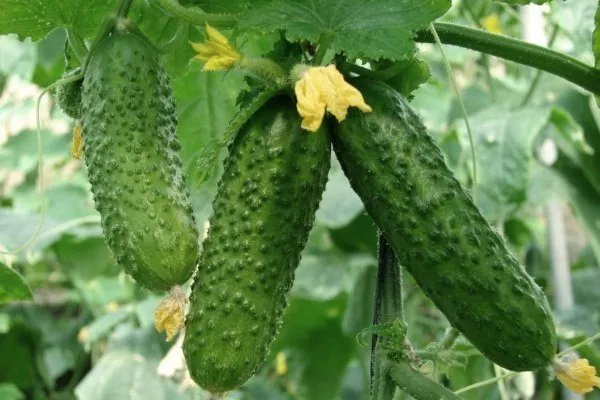
- Adam F1.A Dutch hybrid with the ability to self-pollinate and produce a rich, early harvest. The first cucumbers can be harvested within 1.5 months, and the fruiting period is quite long. Under favorable conditions, cucumbers form 5-7 fruits per node. The fruits are small, dark in color, and have small spines. They are suitable for both canning and fresh eating.
- Herman F1.A wonderful hybrid of Dutch selection. Very early, with a long fruiting period. Small cucumbers develop in bunches of 6-7. The fruits are juicy and firm. The hybrid is resistant to temperature fluctuations and diseases. Excellent fresh and canned. Suitable for planting in open ground and greenhouses.
- Son-in-law F1. A parthenocarpic hybrid. Fruits develop in nodes of 3-7, up to 10 cm long. Can be harvested at any stage of ripeness. Delicious cucumbers, yielding up to 6 kg per plant. Resistant to powdery mildew and root rot. Adaptable to sudden changes in weather conditions.
In addition to the species presented, it is possible to sow seeds of the following cucumber varieties: Metelitsa, Prestige, Ararat, Tatyana, Syty Papa, To the Envy of Everyone, etc.
Deadlines
Seedlings are ready for transplanting to the greenhouse at 25-30 days. Knowing this, you can count 30 days of growth and 5 days of stable germination from the expected planting date. This date will be the optimal time for sowing seeds for seedlings.
This formula is universal for regions with any weather conditions. When choosing a suitable seed planting date, consider whether your greenhouse is equipped with heating and an additional light source.
Soil preparation
When sowing cucumber seeds, it's preferable to use peat pots rather than reusable containers. This is because cucumbers don't like being transplanted, which disturbs their root system.
Soil for filling seed containers can be purchased at specialty stores and departments. This soil mixture is disinfected and has a special composition suitable for growing cucumbers.
The second option for obtaining soil for planting seeds is to prepare it yourself. To do this, take the following ingredients and mix them thoroughly:
- turf - 1 part;
- compost - 2 parts;
- peat - 1 part;
- sand - 1 part.
This soil mixture should be disinfected before use. One of the following options can be used for this:
- bake it in the oven at 170-180 degrees for 20 minutes;
- treat in a special steam generator for half an hour;
- Dilute 15 ml of Fitosporin in 10 liters of water and water the soil.
After processing, add fertilizer to the planting mixture to enrich it with nutrients and elements. For every 10 kg of soil, add:
- wood ash - 200 g;
- phosphorus fertilizers - 50 g;
- potassium sulfide - 35 g.
After thoroughly mixing the mixture, it needs to be moistened. The high-quality soil is ready for sowing cucumber seeds.
Properly preparing seeds for sowing
Seeds purchased in factory-packaged containers require no additional preparation. However, if the seeds were collected independently or acquired through other means, the following preparatory steps are necessary:
- Selection.From the mass, select the largest and most uniformly shaped seeds. Prepare a salt solution of 1 teaspoon of salt and a glass of water. Submerge the selected seeds in it. Discard any that float to the surface. Rinse the remaining seeds with clean water and dry until they become free-flowing.
- Disinfection.Prepare a light pink solution of potassium permanganate and soak the cucumber seeds in it for 15-20 minutes. Avoid making the solution more concentrated or soaking the seeds longer than recommended. This will burn the seeds and render them unusable.
Instead of manganese solution, you can use Fitosporin-M or Gamair-SP.
After processing, rinse the seeds with running water and dry.
- Exposure to temperature.For faster germination, place the seeds in a bag and warm it near a heating element. The opposite method is also effective: place the seeds in the refrigerator for 24 hours.
- Germination.Line a shallow plate with several layers of cheesecloth. Spread the cucumber seeds over the surface and moisten them thoroughly. Cover with a damp cloth. Make sure both the top and bottom layers don't dry out.
Growing seedlings
After selecting the container and preparing the soil and seeds, you can begin planting the seeds for seedlings. To do this, follow these steps:
- Place a drainage layer at the bottom of the peat pots, then fill them 3/4 of the way with prepared soil. Place the pots in a tray and moisten.
- Make a hole about 1 cm deep in the center of the pot and place a couple of seeds in it. Cover them with soil, pressing it down lightly.
- Using a spray bottle, moisten the soil surface with water and cover with glass or plastic film.
- Move the pots to a sunny windowsill or another place with a temperature of 25-28 degrees.
Remove the glass or film daily, moistening and airing the crops. This will prevent mold from appearing on the soil surface.
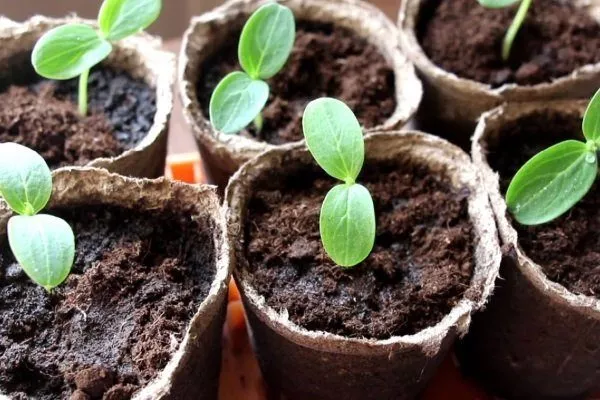
Moisten the soil not by watering, but by spraying water using a spray bottle.
The correct temperature is essential for seed germination. Seedlings emerge in 5-6 days at a temperature of 27-28°C. Once leaves emerge, maintain a daytime temperature of 19-22°C and a nighttime temperature of 15-17°C.
When the first leaf forms on the seedlings, fertilize them with a solution of complex fertilizer.
Make sure the plants don't stretch toward the light source. Rotate the containers periodically to achieve this. As the plants grow, move them away from each other so that the shade they create doesn't interfere with their proper development.
More details on how and when to plant cucumber seedlings are provided. Here.
Hardening off seedlings
After 14 days from germination, the seedlings need to be gradually hardened off to prepare them for temperature changes and strengthen their immunity. To do this, place them in a well-ventilated room or on a warm balcony overnight.
Preparing the soil in the greenhouse
Cucumbers grow well in loose, fertile soil that retains moisture and is permeable. This is why they won't produce fruit in clay or sandy soils. The former don't allow the necessary air to pass through, while the latter drain too quickly, allowing water to seep into deeper layers.
What to consider:
- If melons or pumpkins were the previous crops grown in the greenhouse, it's best to replace the soil with fresh soil, as it's depleted in nutrients and is more susceptible to common diseases and pests. It's best to plant cucumbers after cabbage, carrots, potatoes, onions, and peppers.
- Greenhouse beds should be prepared in the fall. Remove all plant debris and dig the soil, adding humus or compost at a rate of 1 bucket per square meter. With this option, you can forget about organic fertilizers for 2-3 years, using only mineral fertilizers.
- Another solution for replenishing nutrients when digging the beds in the fall is to spread 2 tablespoons of superphosphate and 1 cup of dolomite flour (can be replaced with wood ash) per square meter of soil. In the spring, two weeks before planting the seedlings, add peat moss, sawdust, and humus to the soil, and dig again shallowly.
- To prevent cucumber diseases, be sure to treat the surface of the beds with a copper sulfate solution. To prepare it, dissolve 1 tablespoon of the solution in 10 liters of water. The application rate is 1 liter per 1 square meter.
- A good solution is to plant green manure in the fall, such as leaf mustard. Before frost, dig up the beds with the plants. Over the winter, they will decompose, enriching the soil with nutrients and disinfecting it.
An important aspect of growing cucumbers is soil warming. If the beds have a warm base, seedlings can be planted at any time of year. If such equipment isn't available in the greenhouse, there are two options: wait for the soil to warm naturally or insulate it with organic matter:
- To do this, remove the top soil layer to a depth of 15-20 cm, lay down straw, spread humus and compost on top, and fill the soil layer back up.
- Water the beds with hot water and cover with dark plastic. As the organic matter decomposes, it releases not only nutrients but also the heat the seedlings need. This process should be carried out a few days before planting.
Transplanting
Plant seedlings in greenhouses without additional heating no earlier than the end of May, when the soil temperature inside reaches 14-16 degrees Celsius (57-61 degrees Fahrenheit). This will prevent the fragile roots from freezing and allow them to adapt to the new conditions. To measure the soil temperature, insert a thermometer 20 cm into the soil in the morning for 30 minutes.
Cucumbers can be planted in heated shelters once the seedlings have formed four leaves. This occurs approximately 35 days after sowing the seeds.
The most commonly used scheme for planting cucumbers in a greenhouse is:
- two rows of cucumbers are placed in a longitudinal bed;
- the distance between adjacent bushes in a row is maintained at 30-40 cm;
- seedlings in one bed, but in adjacent rows, are planted in a parallel or checkerboard pattern, maintaining a distance of at least 50 cm between them;
- The hole should be located directly under the trellis, or stretch a cucumber net between the rows.
Algorithm for planting seedlings in a greenhouse:
- Moisten the soil in the beds with hot water.
- Make holes and place the peat pots with seedlings in them. The holes should be deep enough so that the top edge of the pot protrudes above the soil surface. Lightly compact the soil.
- Sprinkle a 2-centimeter layer of peat with sawdust on top, mulching the root part of the plants.
- Do not water the planted seedlings for 2 days.
Watch a video about planting cucumber seedlings in a greenhouse:
Optimal conditions for growing cucumbers
To ensure high-quality cucumber growth, it is necessary to create and maintain a microclimate with specific conditions, as well as carry out agricultural work in a timely manner.
Watering
Cucumber beds require regular watering, but be careful not to let them become waterlogged. Warm the water in the sun or take it from containers inside the greenhouse. Watering with cold water will encourage rot and spotting.
If the temperature of the irrigation water is too low, the fruits will become narrowed in the middle and become deformed.
After watering, loosen the soil to prevent a crust from forming on the surface. This will block air from reaching the root system and promote faster moisture absorption into the lower soil layers. This procedure will also help cover the roots washed out by watering. This will help retain moisture in the beds for longer. mulching.
Sprinkler irrigation is crucial for the crop. This involves generously spraying the green parts of the plant with water. This allows the liquid to drain slowly to the roots, allowing the cucumbers to better absorb moisture. It also increases the humidity inside the greenhouse, which has a beneficial effect on the plants.
Top dressing
Fertilizing the soil in your greenhouse should be especially careful, as it directly affects fruit set and ripening. Keep in mind that an excess of mineral components in the soil is just as undesirable as a deficiency. Calculate the total amount of fertilizer applied per season, including fertilizers and mineral supplements. The number of times you apply fertilizer to the soil for cucumbers should not exceed five.
If there's a nitrogen deficiency, the fruit will narrow at the tip and turn yellow. If there's a potassium deficiency in the soil, pear-shaped cucumbers will develop.
Cucumbers respond particularly well to an infusion of chicken manure, humus, and cow dung. To prepare the mixture, mix 150-200 g of organic matter with 10 liters of water. Leave in a warm place to ferment for 2-3 days, stirring occasionally. Add 30 g of superphosphate. Apply 1 liter of the infusion per 1 square meter of beds or 4-5 plants.
During flowering, add 30 g of potassium salt to this infusion.
The amount of mineral nutrition per 10 liters of water (per 1 sq. m) varies slightly during different stages of cucumber growth:
- before fruiting:
- ammonium nitrate - 5-10 g;
- superphosphate - 20 g;
- potassium fertilizers - 10 g.
- during the period of fruit formation:
- ammonium nitrate - 20-25 g;
- superphosphate - 20 g;
- potash fertilizers - 20 g.
Fertilizers can be applied either through root or foliar application. They are best applied in the evening or during cloudy weather.
Light mode
A 10-hour daylight period is sufficient for cucumbers to grow and develop. If the amount of light decreases, growth rates decrease significantly. Therefore, if sunlight is absent due to weather conditions, the use of phytolamps or other artificial light sources is essential.
Temperature
Cucumbers are highly dependent on greenhouse temperature. Different heat levels need to be maintained during different growth stages:
- planting seedlings - 20-22 degrees;
- flowering - 25-28 degrees;
- fruiting - 25-30 degrees.
At temperatures from 17 to 19 degrees and from 35 to 40 degrees, the formation of ovaries does not occur.
Critical temperatures for cucumbers:
- growth arrest - 15 degrees;
- growth cessation - 10 degrees;
- death - 7-8 degrees.
Humidity
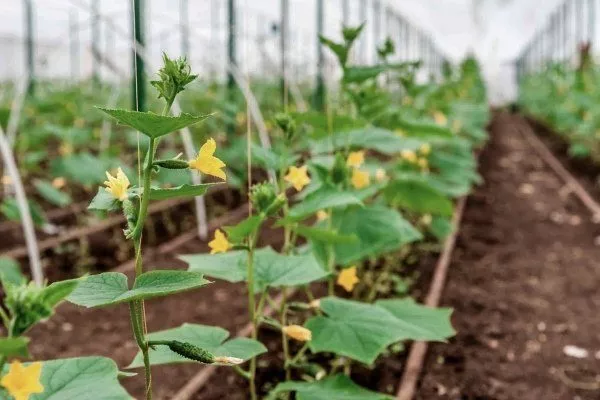
Cucumbers are very sensitive to humidity, so it should be maintained between 90 and 95%. If humidity drops below this level, ovaries stop forming and cucumbers slow down their development.
Ventilation
Ventilation is essential to prevent the spread of diseases, especially rot, which thrives in warm, humid environments. It also provides additional access to clean air in the greenhouse. Ventilation helps reduce the air temperature to the required level on hot days.
Bush formation
Formation helps prevent bushes from becoming too dense and optimizes their yield. Cucumber plantings not only become beautiful but also receive even sunlight, are easily aerated, and are convenient for various agricultural activities. This procedure involves pinching off shoots and tying them to guide the main shoot.
It's important to remember that all cucumber plant training should be done strictly before flowering. Once the first flowers appear, any work involving moving the vines is prohibited.
The necessity of forming a bush is explained by the following arguments:
- When branches become excessive, the root system can't keep up with the entire plant's needs. This results in deformed fruits, and their flavor deteriorates.
- Dense vegetation prevents air from penetrating the foliage. This negatively impacts fruiting and creates a favorable environment for pathogens.
- Weeding, loosening, spraying and watering are more convenient when cucumber bushes are already formed.
Pinching (step-sonning)
Pinching helps reduce foliage for a more active and prolonged fruiting period. Removing vines with male flowers that are not producing fruit stimulates the development of fruiting female inflorescences. This increases the yield and quality of the harvest.
To perform the procedure correctly, you need to be able to distinguish between male and female flowers:
- female inflorescences are formed in pairs, and empty flowers in 6 pieces;
- the stem of the female flower is longer than that of the male flower;
- ovaries are present only on female inflorescences.
Pinching is not performed only on specially bred hybrids that have single-vine development or do not form an excessive number of empty flowers.
For self-pollinating varieties, leave enough male flowers to produce roughly equal numbers of female flowers. Parthenocarpic varieties do not require male flowers.
The procedure for pinching cucumbers after tying them up is as follows:
- When the 5th leaf is formed, all shoots and tendrils located below it are removed.
- When the 7th or 8th leaf appears, a pair of shoots are left from the central stem.
- After the 11th leaf, pinch off the tips of the shoots, encouraging their peripheral development and fruit set. Three leaves and three fruit sets are left on each shoot.
- Parthenocarpic varieties are trained by leaving a single stem. Once it reaches 50 cm, runners, flowers, and branches are removed, and lateral shoots are pinched back to the first leaf.
Pinching out the side shoots forms the bush into an inverted pyramid shape.
Tying up
Cucumbers are tied up in order to:
- the whips were not connected to each other by means of tendrils;
- the process of caring for the plant and harvesting was simplified;
- the bush had enough sunlight for all its plant parts.
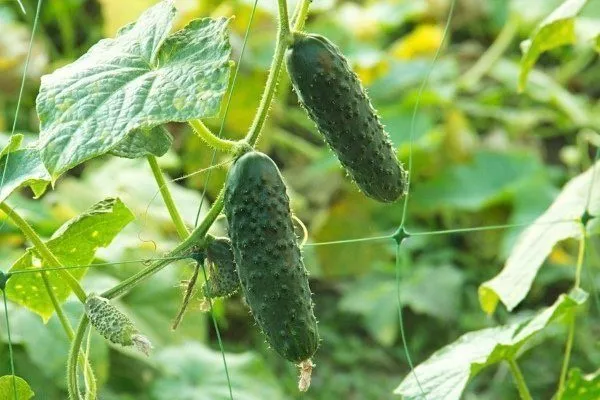
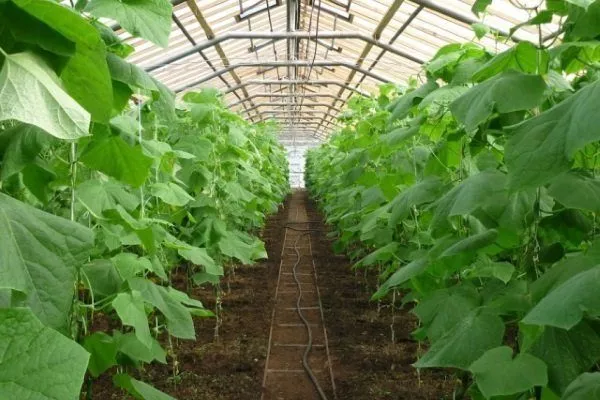
These measures allow for horizontal cultivation of cucumbers and bush formation. They prevent mechanical damage to the vines and fruits, as well as their rotting on the ground. Staking should begin when the seedlings in the greenhouse reach 30-40 cm. At this time, the vines are still flexible and do not break when repositioned.
To carry out garter work you will need:
- wooden or iron supports;
- strong, tightly stretched wire;
- trellis net for cucumbers;
- garters made from long strips of cotton or nylon fabric about 3 cm wide.
Avoid using thin strings or wire to tie cucumbers, as they will pinch the stems as they grow. Disinfect all tying materials by boiling or using bleach before use.
You can purchase special plastic ties. Their clamping is adjustable with notches and they are reusable.
Diseases and pests
It's foolish to assume that growing cucumbers indoors protects them from pests and various diseases. Therefore, it's important to know the dangers that threaten the crop and how to combat them. The following diseases are common:
- White rot.A fungal disease characterized by the presence of a light, almost white, coating not only on the fruit but also across the entire surface of the bush. It spreads rapidly, destroying the plants. The fungus persists in the soil. Control measures include the destruction of affected plants and soil replacement.
- Gray rot.It is identified by slippery gray spots on the surface of fruits, flowers, and ovaries. At the first stage of infection, spray with a solution of copper sulfate (1 teaspoon and 1 tablespoon of ash per 5 liters of water). The product "Barrier" is effective. In advanced stages, only radical treatments can help.
- Root rot.Drying leaves, discoloration, and cracks in the stems are all signs of infection. Rotting can be triggered by planting seedlings too deeply, overwatering, or using cold water when watering.
Sprinkle the affected areas with crushed chalk or wood ash and let them dry. Avoid getting the plant wet when watering. Destroy dead plants by fire, and remove the soil from the holes by watering them with a solution of potassium permanganate or copper sulfate. Then, fill the holes with new soil. - Powdery mildew.It is characterized by the appearance of a white coating first on cucumber leaves and then on the stems. The fungus spreads rapidly in warm and humid conditions, so if it is detected, treat the cucumbers as soon as possible. Powdery mildew is effectively treated with Topaz and Zaslon. When preparing a solution, always follow the instructions for use.
- Downy mildew.It is identified by the appearance of burn-like spots on cucumber leaves. Within a couple of days, the leaves dry out completely. To stop the spread of the disease and eliminate it, spray with Quadris (5 g per 10 liters of water). Watering should be stopped and the greenhouse should be ventilated more frequently, preventing excessive humidity.
- Brown spot.When infected, wine-brown spots appear on the fruit, oozing from the inside. The rot then spreads throughout the plant. Spots of the same color appear on the leaves and stems. The plants die within a week.
Control measures include destroying diseased plants and reducing the level of soil and air humidity in the greenhouse. - Black mold.Symptoms of the fungus include the appearance of spots on the leaves, which eventually merge and become covered with black, cobwebby mold. Preventive measures include using treated seeds and disinfecting the soil and the area.
In addition to diseases, greenhouse crops can be attacked by insect pests. Common ones include:
- Melon aphid.The negative impact of aphids manifests itself in curling and wrinkling of leaves on the vines. If you turn them over, you'll notice a cluster of small insects on the underside of the leaf blade. They feed on the plant's sap, leading to nutrient deficiencies, stunted growth, and the drying out of the plant.
For small areas, it's recommended to use traditional methods to control aphids. These include an infusion of onion peels or an ash solution with laundry soap. In larger greenhouses, chemicals are used. - Greenhouse spider mite.It's difficult to detect due to its small size, but a web-like coating on the plant is a sign of mite presence. The insects' appearance is associated with the presence of weeds in the greenhouse, creating favorable conditions for the parasite.
It is recommended to combat it only with chemicals to avoid wasting valuable time. Products such as Plant-Pin, Actellic, Fitoverm, and others are permitted. Applications should be carried out strictly according to the product instructions.
Harvesting
Cucumbers can be harvested 7-14 days after flowering. This depends on the variety and the desired fruit size. It's best to keep cucumbers from growing more than 10 cm long and 5 cm thick. This reduces the formation of new ovaries, and therefore the overall yield. Pick cucumbers at least 2-3 times a week.
Problems and their solutions
Sometimes, even though disease infection is ruled out, certain problems still arise on the plantation. Let's look at some of them.
No ovaries
Reasons for the problem of ovary formation on cucumbers:
- insufficient ventilation;
- deficiency of mineral substances in the soil;
- impossibility of pollination (on pollinated varieties);
- unfavorable temperature conditions, or microclimate in general.
The lower branches are drying out
Such manifestations are possible for several reasons:
- scorching sun rays;
- contact of mineral root fertilizers with leaves;
- over-watering or lack of moisture in the soil;
- nutritional deficiency or surplus;
- lack of light and air.
The fruits grow slowly
Slow fruit growth is due to:
- poor quality seed material;
- failure to comply with the deadlines for planting seeds or transplanting seedlings;
- disturbances in the microclimatic regime;
- lack or excess of nutrition;
- dense planting without bush formation.
The cucumbers are bitter
A bitter taste (excess cucurbitacin) in cucumbers can be observed due to plant stress for several reasons:
- too bright scorching sun rays;
- sudden changes in temperature;
- violation of the temperature regime necessary for fruiting;
- lack of nitrogen and phosphorus in the soil;
- interruptions in watering or cold water;
- The plants interfere with each other due to their close proximity.
Growing cucumbers in a greenhouse isn't easy. A high-quality harvest and its quantity depend on many factors, which must be considered from the preparation stage to harvest. By following all the right agricultural practices and creating the right conditions for the crop, you'll enjoy growing cucumbers, and they'll delight you with their fragrant fruits for a long time, year-round.