
The Envy of Everyone cucumber is a hybrid (as indicated by the F1 label), so it's impossible to grow high-quality seeds from such crops at home. This premium variety boasts high yields and excellent taste, as well as versatility in use and cultivation (outdoors, greenhouses, barrels, containers, etc.).
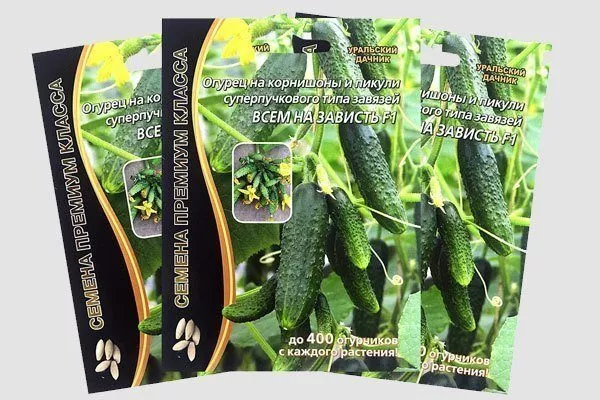
Cucumber seeds "The envy of everyone"
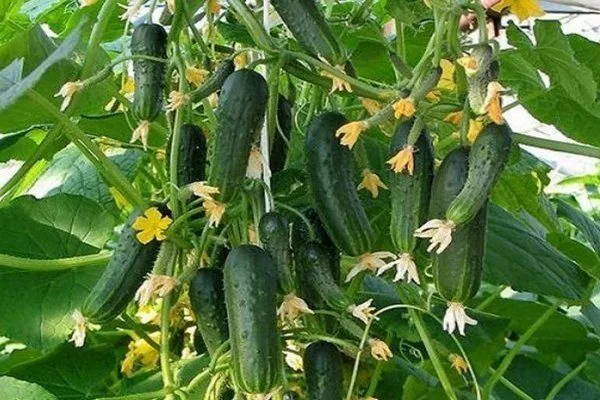
Ripening cucumbers "to the envy of everyone"
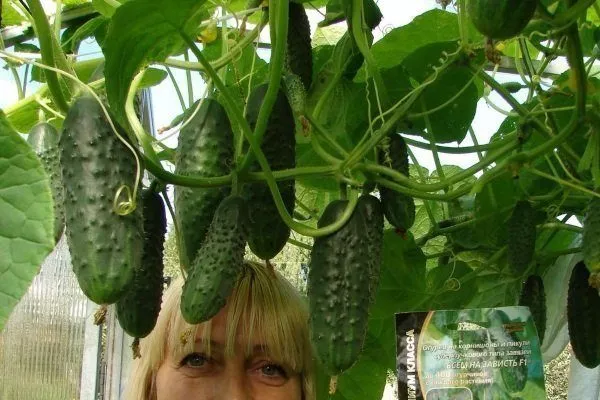
Cucumbers "The Envy of Everyone" produce a good harvest
Description of the hybrid
Being a first-generation hybrid, cucumbers, to the envy of everyone, have incorporated the best quality characteristics of their "parents." The cucumber is parthenocarpic, so it pollinates itself. Consequently, it does not require insect pollination, which accelerates and increases fruiting. Moreover, the seeds do not have time to ripen, resulting in perfectly smooth fruits that are resistant to yellowing and overripening. This same characteristic allows for long-distance transportation and long-term storage of cucumbers.
Other features:
- According to the flowering type, it is female, which indicates that all flowers have full-fledged ovaries.
- Branching is self-regulating, so shaping the bush is not necessary, but it is advisable to increase yield.
- The growth type is fascicular, which indicates a well-developed central stem and the absence of lateral shoots.
- Fruiting lasts quite a long time – from June to October.
- The hybrid easily tolerates the lack of sunlight, so the bushes can be planted in the shade.
Appearance of cucumbers
The fruits have the following characteristics:
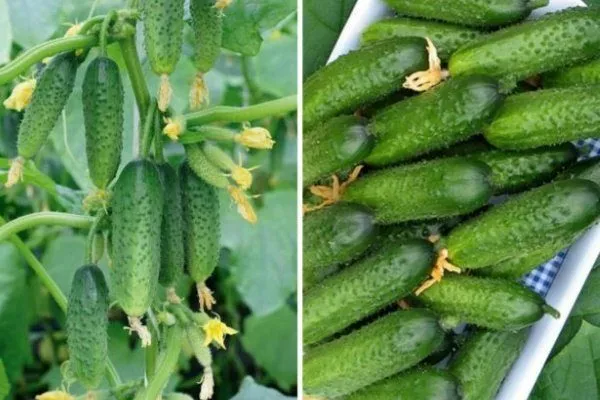
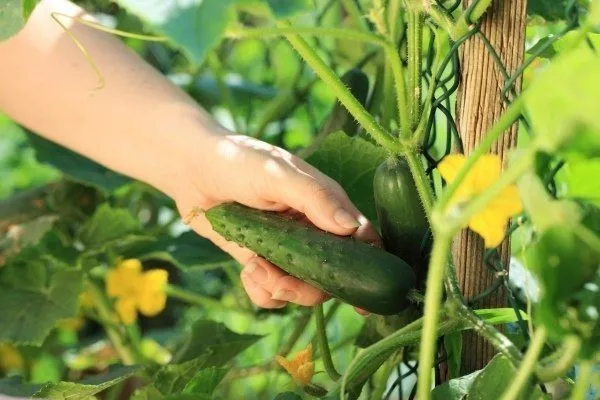
- the minimum length is 8 cm, the maximum is 12;
- average weight varies from 80 to 100 grams;
- color - rich bright green;
- along the sides there are stripes of light shades;
- surface - finely tuberculate;
- whitish fluff is present;
- thorns are rare and large;
- the pulp is crisp, dense, juicy;
- aroma - distinctly cucumber-like.
Productivity
The clustered arrangement of fruits at the nodes guarantees the highest yield. A single ovary can contain from three to six, and sometimes more, gherkins.
Fruiting yield depends on growing conditions and climate, but on average, 10 kg of fruit can be obtained from 1 square meter.
Advantages and disadvantages
Positive aspects cucumbers to the envy of everyone:
- excellent yield;
- duration of fruiting;
- transportability;
- excellent taste;
- preservation of crunch and elasticity after heat treatment;
- marketable appearance;
- keeping quality;
- versatility of use (salting, canning, marinating, fresh consumption);
- absence of bitterness;
- the possibility of growing in different ways and under different conditions, even indoors;
- disease resistance;
- quick adaptation to any temperature conditions;
- stability of fruiting.
Negative aspects this cucumber hybrid:
- relatively high cost of seed material;
- the need to purchase new seeds every year, since it is impossible to obtain them at home.
Growing seedlings
Growing cucumbers, to the envy of everyone, is possible without seedlings, which saves time and effort. However, seedling method Allows you to harvest your first crop much earlier. Seed sowing should begin after March 20th or in early April.
- ✓ The soil temperature during planting should not be below +15°C to ensure optimal germination conditions.
- ✓ Soil pH levels should be in the range of 6.0-7.0 to prevent diseases and ensure nutrient availability.
Seed preparation
The first thing to do is thoroughly warm the seeds 10-14 days before planting. Various methods are used for this:
- spread the grains out in direct sunlight;
- place the seeds in a cloth bag, which is placed near a heating device (radiator, stove, etc.);
- Pour the seeds into a thermos, add hot water (not boiling water), and let it warm up for 2 hours.
The seed should be heated to a temperature of 45-55 degrees Celsius. If a thermos is not used, the seed should be heated for three days.
Next comes the actual preparation:
- Sorting. Each seed must be manually sorted, removing any damaged or shriveled parts. Then, the seeds are placed in water mixed with table salt and left to soak for 15-20 minutes. Any seeds unsuitable for planting will float to the surface. The final step is to rinse them under running water.
- Disinfection. This procedure is necessary to prevent future seedlings from becoming disease-free. There are several disinfection methods, including soaking them in a weak solution of potassium permanganate (usually 3%) for half an hour or soaking them in a garlic infusion. However, many gardeners consider aloe vera juice to be the most effective. To do this, trim the plant's leaves, place them in a dark place for five days (at a temperature of 18-20 degrees Celsius), and then squeeze out the juice. The seeds are then soaked in the resulting liquid for 24 hours. They are then washed and dried.
- Treatment to strengthen immunity and stimulate rapid growth. To do this, soak the seeds in one of the following preparations: Gummi, Epin, or Immunocytophyte. If you don't want to use store-bought solutions, you can try folk remedies. For example, soak the seeds for 24 hours in a mixture of wood ash (1 tablespoon of ash per 1 liter of water). This method can be used until the seeds germinate.
- Soaking for sprouting. Use warm water - soak the seeds for 20-30 minutes, then place them on a damp cloth.
If the seeds have sprouted, but weather conditions or other circumstances do not allow planting, place the seedlings in the lower part of the refrigerator, where the temperature does not exceed 4 degrees, but does not fall below 3 degrees.
Learn how to germinate cucumber seeds in this video:
Planting, growing conditions and care of seedlings
Sprouted seeds are planted in a single large container or placed in peat pots. Place the containers on a windowsill to allow sunlight to reach the seedlings.
Rules:
- the depth of planting the seed material is one and a half to two centimeters;
- air temperature – 23-25 degrees, ground temperature – 15;
- soil type – earth, sand, peat;
- Before the sprouts emerge, the containers are covered with a thick film, which must be removed during the day for ventilation;
- when the first shoots appear, they need to be slightly shaded, otherwise the fragile leaves will get burned;
- The sprouts are watered every day (the soil should be moist, but not wet);
- when the bushes begin to form, watering should be done once every 3 days;
- if lateral shoots form, they are cut off;
- To speed up growth, you can feed them with organic matter and minerals.
If natural sunlight and warmth are insufficient, it's advisable to use fluorescent or other lamps. They should be turned on for 12 to 16 hours a day.
Indicators of excellent seedlings that are ready for planting in a permanent location:
- age – 28-35 days;
- height – minimum 25 cm, maximum 30 cm;
- thickness – from 5 to 10 mm;
- number of leaves – 5-6 pieces;
- the distance from the root collar to the cotyledon is 4-5 cm;
- stem appearance – strong;
- short internodes;
- absence of foreign odors (pay special attention to rot).
Landing
Soil requirements
The soil should be moist, neutral in pH, and permeable. Organic fertilizer is added before planting. For this purpose, manure is used (10 to 15 kg per square meter).
There are two ways to prepare the soil:
- In autumn. The soil is dug and a drainage layer is laid. This layer consists of straw, grass, branches, etc. The layer is laid to a depth of 30-40 cm. Next, the layer is compacted, and manure is added on top. It is advisable to cover it with plastic film. In the spring, the cover is removed, and a layer of soil is added.
This method has several advantages: the manure and film keep the soil warm all winter, making it perfectly prepared for planting seedlings. Furthermore, the soil is maximally enriched with nutrients. - In the spring. As in the previous case, a drainage system is installed. Wood ash and Nitrophoska are sprinkled on it (300 grams of the first component and 100 grams of the second per square meter). A small amount of manure is scattered, followed by soil. Be sure to cover the area with plastic wrap and let it sit for 7-10 days.
On such fertile soil, you can set up a greenhouse for seedlings or plant the bushes in a permanent location. In the latter case, you'll need to cover the seedlings with plastic for a while to retain heat.
Cucumbers are the envy of everyone, and are best planted after potatoes, tomatoes, cabbage, beets, oats, sweet clover, rye, phacelia, alfalfa, mustard, and leeks. Avoid using the soil after melons.
Transplanting seedlings
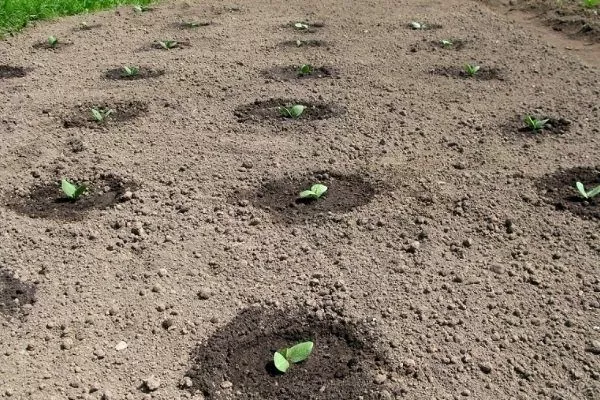
Planting in open ground begins after May 15th. The process is as follows:
- make holes at a distance of 15 cm from each other, between rows - 60 cm, which allows you to get the maximum yield;
- remove the seedlings from the container so that a little soil remains on the root system (do not remove from peat pots);
- deepen the bushes into the hole;
- pour warm water;
- cover with soil;
- attach the sprouts to the support.
Planting seeds in open ground
If you use the seedless method of growing cucumbers, you must adhere to the following rules:
- Prepare the seeds as described above.
- The soil temperature should not be below +15 degrees.
- The distance between the holes for horizontal cultivation is 50 cm, for vertical cultivation (on a trellis) – only 20-30 cm.
- Place up to 5 seeds in one hole.
- The width between rows should be at least 30 cm.
- The depth of planting the seed material is a couple of centimeters.
- When the first shoots appear, thinning is carried out. This involves removing weak plants. However, they should not be pulled out of the ground; they should be carefully cut off at the root with small scissors. This will prevent damage to the stronger plants.
- When the first 4 leaves form, the apical bud is pinched, which will speed up the process of flower and ovary formation.
- After planting the seeds, the crop is watered with warm water and covered with plastic film.
- Later, after the seedlings appear, the cover is removed during the daytime to allow the plant to adapt and ventilate.
Cultivation techniques and care features
Any cucumber variety requires adequate light, but the hybrid "To the Envy of Everyone" is distinguished by its ability to thrive and produce fruit even in the shade. The following cultivation guidelines are essential:
- the optimal air temperature is from 22 to 25 degrees;
- It is forbidden to plant the crop in lowlands, as there is high humidity and cold there;
- humidity level – 80%.
Watering
Rules:
- To make everyone envious, cucumbers need to be watered moderately and regularly. Avoid overwatering, where water stagnates in the soil. This will lead to root rot and the development of pathogenic microorganisms.
- If the summer is rainy, the amount of water decreases.
- The water temperature should be around 25 degrees.
- The drip method is best; you can use sprayers on a watering can.
- Watering time: morning, evening.
How to water based on the stages of bush development:
- before the first flowers appear: water every day in the proportion of 1 liter of liquid per 1 seedling;
- during the formation of flowers and until the middle of the fruiting period, watering is carried out every 3 days, 7-10 liters are required per 1 sq. m;
- from mid-fruiting until the end of harvest - once every 7 days, 5 liters per 1 sq. m.
Weeding, loosening and mulching
Loosening is carried out every 9-10 days. If seeds are planted outdoors, the soil should be loosened for the first time after the seedlings emerge. This should be done carefully to avoid disturbing the root system.
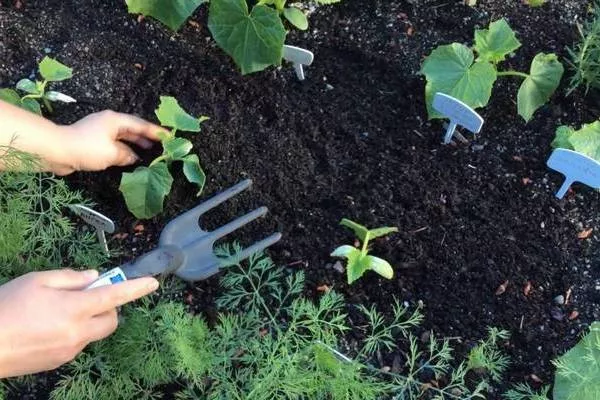
Weeding is carried out regularly - as the weeds grow. Mulching Mulching is done after each watering. To do this, place grass, sawdust, or similar natural material under the roots. Mulching maintains optimal moisture levels and prevents grass from spreading too quickly.
Pinching out stepsons
This cucumber hybrid requires pinching to increase yield. This involves removing side shoots through pruning. It's best to leave a few side shoots, which bear female flowers.
Garter
To everyone's envy, you can grow it horizontally, that is, without staking. The bush's branches spread along the ground on their own and choose their own growth direction. However, this method is considered impractical, as it has many disadvantages:
- Infection occurs upon contact with soil;
- the fruits will be dirty and too wet;
- creates inconvenience when removing side shoots and harvesting;
- sunlight and wind are distributed unevenly.
Based on this, it must be acknowledged that staking is essential. Especially since it significantly saves space in the garden. There are different staking methods:
- Vertical method involves installing supports near each bush.
- Horizontal method This method involves using a trellis: tall wooden stakes are installed every 1 meter along the bed, and wire or string is stretched across them in several rows, parallel to the ground surface. These stakes are what the cucumber stem will "catch" onto.
- Installing the grid: A metal net is installed along the ridge, onto which the plant clings.
Top dressing
Fertilizers are applied to the soil after watering and loosening. The rules vary depending on the period:
- The first feeding of the plant occurs 14 days after planting the seedlings in open ground or seedlings are released. Organic fertilizer is used primarily. For this purpose, chicken manure (1:15 ratio) or cow or horse manure (1:6 ratio) can be added to the root system. The best time to feed is after sunset.
- Fertilize a second time after flowers appear. Root feeding is used in hot climates, while foliar feeding is used in cooler weather. These should be minerals: wood ash (add one cup of crushed ash per bucket of water) or superphosphate (35 grams of active ingredient per 10 liters of water).
- Further fertilizing is carried out during the fruiting period. Wood ash or urea (15 grams per bucket of water) are used. We also recommend reading the article on application. top dressing when growing cucumbers in open ground.
- 14 days after planting, add organic fertilizer (chicken manure or manure) in a ratio of 1:15 or 1:6, respectively.
- During the flowering period, use mineral fertilizers such as wood ash or superphosphate, according to the specified proportions.
- During fruiting, apply urea or wood ash to maintain yield.
Strictly adhere to the proportions, try not to overfeed the plants, as this will lead to the death of the bush, a decrease in yield and a deterioration in the taste of cucumbers.
Pest and disease control
Cucumber, to the envy of everyone, is distinguished by its increased resistance to cucumber diseases and pestsAccordingly, if crop rotation standards are followed, it is not susceptible to powdery mildew, cucumber mosaic, rot, or spotting. However, the following preventative measures are recommended:
- Maintain a hydration regime;
- Treat the plant with Trichodermin, a preparation that has a fungicidal and bactericidal effect.
Harvesting and storage
The first harvest can be collected 45 days after planting. Follow these harvesting guidelines:
- If you plan to consume the fruit fresh, it is better to choose a size of 10 to 12 cm.
- Smaller cucumbers, 8 to 10 cm in size, are suitable for canning.
- If you want to pickle gherkins, choose fruit sizes of 4-5 cm.
- When harvesting, do not pull or twist the cucumber. Instead, use garden shears and carefully cut it, leaving the stem attached.
- Harvest vegetables every day/every other day, which will encourage new ovaries to actively form.
- Collection time is early morning or late evening.
Rules for preserving fruits:
- It is forbidden to store cucumbers to the envy of everyone in a warm place, as they will lose their appearance within the next day.
- The storage temperature should be between 6 and 8 degrees.
- Humidity – 80-90%.
- To keep vegetables for up to 2 weeks, place them in dry wooden boxes and lower them into the cellar.
- You can also store the fruit in the refrigerator, after placing it in plastic containers, which should never be covered with lids.
- Choose fruits without damage and dry them thoroughly.
What problems may arise?
Problems arise due to inexperience and care errors. What can happen, what are the causes, and what to do:
| Difficulties | Reasons | What to do? |
| Lack of symmetry of shape (thickening of the stalk, thickening of the tip) | What does this mean:
| How to fight:
|
| Presence of bitterness | Lack of moisture. | Maintain an irrigation regime, watering not only the root system, but also the area around the seedling. |
| The ovaries are falling off | The plant is overcooled or lacks potassium fertilizers. | Cover with film overnight and apply appropriate fertilizer. |
| The leaves are curling | Reasons:
| How to fight:
|
Reviews
The envy of everyone, cucumbers are a prolific and resilient hybrid. Their main feature is their low light requirements, allowing them to be grown in any climate. Even when cooked, the fruits retain their firmness and crunch. And you can enjoy their delicate flavor for a long time.