
To get a good cucumber harvest, you need to provide them with all the necessary nutrients for healthy seedling growth and fruit formation. What types of fertilizers are available, when and how to organize the process, how to understand what cucumbers lack, and much more useful information—read on.
What types of fertilizers are there for greenhouse cucumbers?
Throughout the growing season, greenhouse cucumbers are fertilized. This includes not only mineral fertilizers, but also organic matter, as well as traditional and store-bought remedies.
- ✓ Soil pH should be between 6.0-6.8 for optimal nutrient absorption.
- ✓ Soil temperature must be at least 12°C for root feeding to be effective.
| Name | Ripening period | Productivity | Disease resistance |
|---|---|---|---|
| Mineral fertilizers | Early | High | Average |
| Organic | Average | Average | High |
| Folk remedies | Late | Low | High |
| Store-bought products | Early | High | High |
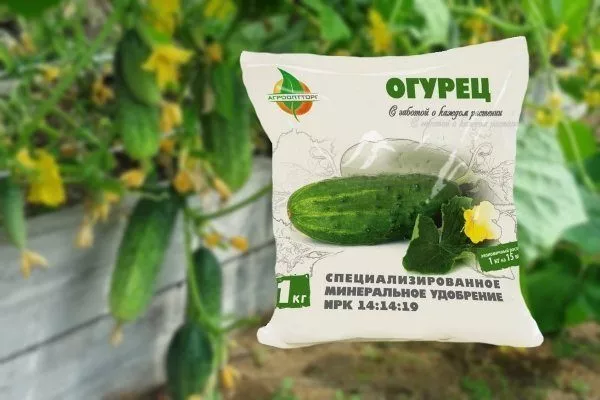
Mineral fertilizers
These fertilizers consist primarily of potassium, nitrogen, or phosphorus, and can also be complex. There are generally five groups of mineral fertilizers for cucumbers:
- Nitrogen. Nitrogen is considered an essential element for the full growth and development of cucumbers at all stages. It is used:
- ammonium nitrate;
- urea (carbamide).
- Phosphorus. Phosphorus is responsible for the normal development of the root system, so fertilizing with it is essential. It is used:
- phosphate flour;
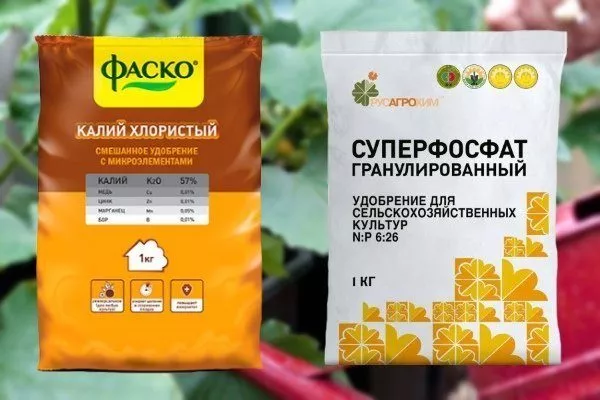
- superphosphate;
- calcium monohydrogen phosphate (precipitate).
- Potassium. They help boost plant immunity. They are used for cucumbers:
- potassium chloride;
- potassium salt;
- potassium sulfate.
- Phosphorus-potassium. Combined fertilizers for cucumbers use potassium phosphate.
- Complex fertilizers. Contain two or more beneficial components. They are used:
- nitroammophoska;
- ammophoska;
- nitrophoska.
Mineral fertilizers for cucumbers are used during the first feeding after planting in the greenhouse, when the seedlings have produced 3-4 leaves. One of the most popular mineral compositions is the following:
- 20 g double superphosphate;
- 15-20 g of potassium sulfate;
- 10-15 g of ammonium nitrate.
This amount is enough for 10-15 sprouts.
Among other useful mineral compositions for cucumbers, the following are used:
- 1 tbsp. urea and 60 g superphosphate per 10 liters of water;
- 10 g of ammonium nitrate, 10 g of potassium salt and 10 g of superphosphate per 10 liters of water;
- 15-20 g of potassium nitrate per 10 liters of water;
- 50 g of urea per 10 l of water.
Organic
The main types of organic matter used to fertilize cucumbers include:
- Compost. The product is formed by decomposing organic matter and is enriched with various nutrients. It is essential for preparing the soil substrate when forming cucumber beds.
- Manure. Enriched with nitrogen, iron, copper, and potassium, it's used fresh to form warm beds for cucumbers, and rotted for digging.
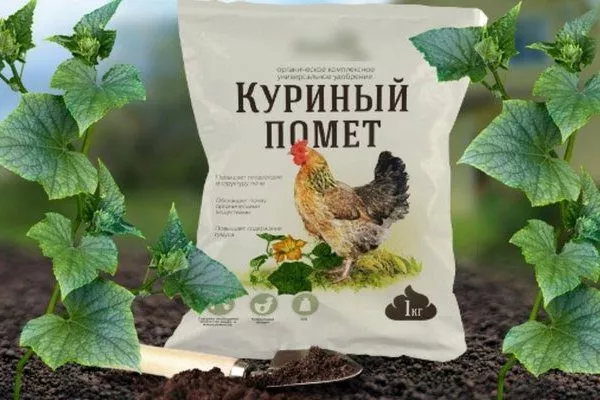
- Bird droppings. Contains potassium, phosphorus, and nitrogen. Makes the soil loose and fertile.
- ✓ Compost must be fully rotted, otherwise it may contain weed seeds and pathogens.
- ✓ Bird droppings must be diluted in water in a ratio of 1:15 to prevent root burns.
They are used in different ways, the main methods are:
- the compost is diluted in water (1:5), 4-5 liters of solution are added per 1 cubic meter of the garden bed;
- a barrel with a solution of fresh cow manure is kept in a greenhouse to accelerate the growth of ovaries and increase the yield;
- For irrigation, use chicken manure (1:15), manure (1:6), and liquid manure (1:8) diluted in water.
Folk remedies
Tried-and-true folk remedies are also used for fertilizing cucumbers in greenhouses. They stimulate the development of cucumber vines and encourage fruiting. The following are used:
- Yeast infusion. Mix 100 g of fresh yeast in 10 liters of warm water, let it sit for 24 hours, then dilute the starter with water at a ratio of 1:5 and add a liter of fertilizer to each plant. This fertilizer stimulates plant growth and enriches it with amino acids, iron, and protein.
- Ash solution. Dissolve 100 g of ash in 10 liters of water, and pour 250 ml of the mixture under each bush. This fertilizer enriches the soil with calcium and potassium.
- Infusion of onion peel. For every 10 liters of water, add 1 cup of onion peel. Bring to a boil, remove from heat, cover with a lid, and wrap in a towel. Let it steep for several hours. Strain and use a watering can to water the above-ground portion of the plants. This will help prevent yellowing of the leaves and enrich the plants and soil with essential nutrients.
- Infusion of black bread crusts. Place black bread crusts in a 10-liter container, filling it 2/3 full. Fill it to the top with water, placing a weight on top to keep the bread from floating. Let it sit for a week. Then dilute it with another 2 liters of water. Apply the fertilizer once a week during the flowering period, pouring it under the roots.
- Nettle infusion. Use fresh nettle tops. Place them in a large container, cover with water, and leave for a week. Before watering, dilute the infusion with water at a ratio of 1:7. Apply 0.5 liters of the solution only to weakened plants.
Store-bought products
The most popular and effective store-bought fertilizers for cucumbers in a greenhouse are:
- "Springlet". A chlorine-free granular mineral fertilizer that increases fruit set. Can also be used for zucchini, squash, and pumpkins. Dilute 50 g per 50 liters of water.
- "Agricola". Available in powder form. Enriched with microelements. Apply at a rate of 25 g per 10 liters of water.
- "Vegetable". A mineral powder fertilizer. Contains microelements and humic acids. Apply 20 g per 10 liters of water to cucumbers, pumpkins, squash, and zucchini.
- "Good force." Used as a disease preventative. Available in liquid form, apply 20 ml per 1.5 liters of water. Do not use on newly planted plants!
Types of feeding
Depending on the method of application, there are root and foliar feedings for cucumbers.
| Name | Ripening period | Productivity | Disease resistance |
|---|---|---|---|
| Root | Early | High | Average |
| Foliar | Average | Average | High |
Root
This type of fertilization is used during unfavorable conditions, such as low temperatures. Primary and secondary fertilization are distinguished:
- Primary. Apply after the third leaf appears. Dissolve 3-8 g of potassium chloride and 10-15 g of superphosphate in 10 liters of water per square meter and apply to furrows 3-5 cm deep. Make the furrows 7 cm away from the plant.
- Secondary. It is carried out with the same composition after a month, but the furrows are now made 10-12 cm deep, and 10-15 cm away from the plant.
Foliar
Foliar feeding involves spraying the leaves with beneficial compounds. For this, use:
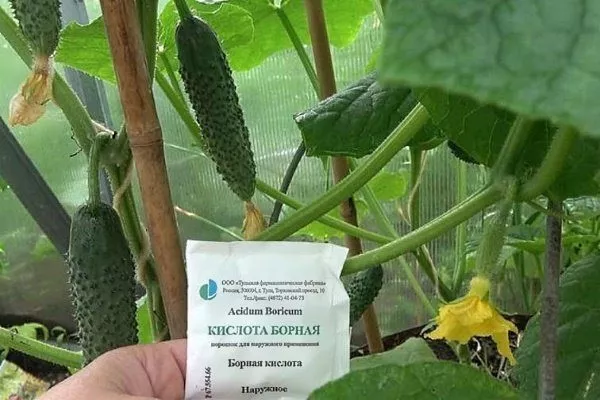
- 10 g superphosphate, 1 g boric acid, 30 g potassium nitrate, 0.4 g manganese sulfate, 0.1 g zinc sulfate;
- 1 teaspoon of boric acid, 10-12 crystals of potassium permanganate per 1 liter of water.
Although foliar feeding has a fast effect, it cannot fully provide the plant with everything it needs.
When and how to feed cucumbers?
To ensure abundant fruiting, cucumbers are fed at different stages of development, and the feeding methods differ from each other.
Feeding seedlings and fertilizing the soil before planting
The seedling growth stage is crucial; during this period, plants require nitrogen, phosphorus, and calcium. To supplement these elements, according to the instructions, use complex preparations designed specifically for seedlings.
Before planting the seedlings, fertilize the soil, approximately a week before the expected planting. The soil in the greenhouse is dug over and the following is added:
- 20-30 g of ammonium nitrate;
- 20-30 g of superphosphate;
- 20 g potassium sulfate.
After planting the seedlings
After 2 weeks, after transplanting the seedlings to their permanent growing location, fertilize them with the following composition:
- 15 g potassium chloride;
- 15 g urea;
- 20-25 g double superphosphate;
- 15-20 g of potassium sulfide.
Dissolve all ingredients in a bucket of water and inject the solution under the roots; this amount is enough for 10-15 seedlings.
Watch a video about how to feed cucumbers after planting in the ground, during flowering and fruiting:
Fertilizing bushes during the flowering period
Approximately two weeks after transplanting the seedlings, the plants begin to bloom. At this time, the next feeding is carried out. Fertilizers used during this period are organically based. The following are used:
- 500 ml of mullein;
- 1 tbsp. l. nitrophoska;
- 100 g of wood ash;
- 0.5 g boric acid;
- 0.3 g manganese sulfate;
- 50 g potassium sulfate.
The components are diluted in a bucket of water.
Mineral substances are also used, for example, ammophoska or azophoska (at the rate of 1 tbsp. per 10 liters of water).
Fertilizers during fruiting
During fruiting, cucumbers are fed with one of the following compositions:
- 25-30 g of potassium nitrate per 10 liters of water;
- 50 g of urea per 10 liters of water;
- mullein or ash diluted in water in a ratio of 1:5.
7-8 liters of the composition are needed per 1 sq. m.
Do I need to apply fertilizer after harvesting?
In the fall, after harvesting, it's also necessary to disinfect and fertilize the soil. First, remove all plant debris from the greenhouse. Then, dilute 300 grams of bleach in 10 liters of water and let it sit for 4 hours. Spray the solution onto all interior surfaces of the greenhouse and the soil.
After this, rotted manure is spread over the soil surface. Loose compost or humus-rich soil is also used. A bucket of organic matter is used per square meter of area.
How to understand what cucumbers lack?
Cucumbers react quickly to nutrient deficiencies, which affects their appearance. If the plant is stunted, fruit set and develop poorly, or leaves turn yellow, it's a sign of a nutrient deficiency.
Anyone who grows cucumbers has experienced yellowing cucumber leaves. Watch this video to learn why cucumber leaves turn yellow:
Next, we will consider deficiency states, their manifestations and methods of correction.
Potassium deficiency
Potassium deficiency often occurs due to excessive application of potassium fertilizers. Potassium deficiency manifests itself in several characteristic ways:
- excessive growth and development of shoots and leaves;
- darkening of leaves, they become bright green;
- the fruits are disproportionately narrowed towards the stalk;
- burns of old leaves - yellow edges appear, over time they curl;
- the taste of the fruit becomes neutral, the sweetness and characteristic aroma disappear.
To replenish the potassium deficiency, use an aqueous solution of potassium sulfate or wood ash.
Nitrogen deficiency
Cucumbers have a particular need for this element in the spring, when the green part of the plant is forming. If the deficiency is not met, it can also affect the fruit.
Signs of nitrogen deficiency:
- the lower leaves become pale green, eventually turn yellow and dry out;
- the vines become thinner and woodier;
- the flowers fade and the ovaries fall off;
- the fruits become hook-shaped and acquire a light color.
Even if nitrogen-containing fertilizers were applied in sufficient quantities, plants may not have been watered sufficiently, causing them to also suffer from nitrogen deficiency. To remedy this, greenhouse cucumbers are fed with a solution of ammonium sulfate or urea (10-15 g per 10 liters) using foliar application.
Magnesium is required
Magnesium deficiency is indicated by the following signs:
- light green spots on the leaves;
- chlorosis appears;
- flowers are falling off;
- The fruits ripen prematurely and are very small.
The problem can be solved by constant foliar feeding with magnesium nitrate (100 g per 10 l of water).
Lack of boron
Boron deficiency is characterized by the death of roots and growing points in cucumbers. Other signs include:
- fruit deformation;
- leaf fragility;
- flowers are falling off;
- dwarfism of bushes due to slow development.
Plants are fed with a boron solution (0.3 mg per 1 liter of water) or foliar feeding is done with boron Kelkat (50 g per 100 liters of water).
Calcium deficiency
Adequate calcium ensures proper growth of cucumbers. A deficiency can lead to:
- the appearance of narrow light stripes on the leaves, which leads to brittleness, weakness, wilting and, ultimately, death;
- rot on inflorescences;
- folding the edges down;
- the leaves become dome-shaped and even claw-shaped.
The problem is solved by foliar feeding with chelated calcium (3%).
Phosphorus deficiency
Phosphorus deficiency is indicated by:
- small size of young leaves compared to old ones;
- leaf veins turn purple;
- slowing down the growth of shoots;
- the leaves darken, acquiring a bluish tint;
- the edges of the leaves become pointed and curl upwards.
The problem is solved with a solution of ammophos and diammophos (1 tbsp per 10 liters of water) or superphosphate (1 tbsp per 10 liters of water), spraying the bushes with them.
Molybdenum deficiency
Cucumbers growing in acidic soils experience a deficiency of this element. Excessive heavy metals and ammoniacal nitrogen contribute to molybdenum deficiency.
Molybdenum deficiency is primarily indicated by discoloration—the leaves become less intense. Leaf edges also curl into tubes, and chlorosis develops.
Molybdenum deficiency is “treated” by adding phosphorus fertilizers.
Iron deficiency
Deficiency of this element is characterized by:
- the appearance of chlorosis on all young foliage;
- slow growth of bushes;
- light green, lemon and even white color of leaves, this is due to the fact that it is the lack of iron that inhibits the process of chlorophyll formation;
- growth points do not develop;
- lightening of the tops of the fruits.
To eliminate this, use root feeding with a 5% solution of ferrous sulfate.

Deficiency of copper, zinc and manganese
A deficiency of these elements delays plant development and reduces fruiting. A copper deficiency causes leaves to turn pale, shoots to become weak, flowers to fall off quickly, and leaf edges to curl.
To avoid this problem, in the spring the area where the cucumbers will grow is treated with a 1% aqueous solution of copper sulfate.
Zinc deficiency can cause asymmetrical leaves, darkening, and death. To compensate, apply zinc sulfate at a rate of 1 g per 10 square meters.
Manganese deficiency manifests itself as light, pinpoint spots on the upper leaves and a marbled coating. To address this, apply a manganese solution (0.3 mg per liter of water) to the roots.
What to feed if cucumber bushes are not growing well?
Slow growth of a bush may be due to a deficiency of one or another element. If the plant's specific deficiency cannot be determined based on the symptoms listed above, then a complex fertilizer is applied.
First, they test them on a few problematic bushes and observe the plants for several days. If growth improves, then the fertilizer is applied to all the bushes.
How to feed cucumbers in a greenhouse in winter?
Greenhouse cucumbers are fertilized every two weeks during the winter, alternating mineral and organic fertilizers. The same treatments are used as in the spring.
Cow or poultry manure and wood ash are suitable for winter feeding. A complex fertilizer would also be helpful.
How to understand and what to do if too much fertilizer has been applied?
Plants suffer not only from a lack of nutrients but also from their excess. Sometimes gardeners overdo it with fertilizers, ruining plants at the root. Excessive amounts of chemical fertilizers are especially dangerous.
If too much fertilizer has been applied, water the plant thoroughly. If the bush is still small, replant it.
At growing cucumbers in a greenhouse Fertilizing is especially necessary because it's impossible to completely replace the soil every year. Timely application of necessary fertilizers can eliminate many problems and not only significantly increase yields but also improve the taste and appearance of the fruit.