
The Rodnichok cucumber is a hybrid that has been popular with domestic and international gardeners for decades. Its appearance and characteristics make it stand out among other cucumber hybrids.
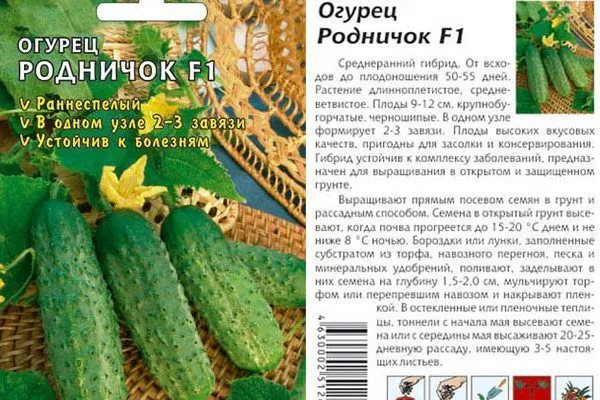
Seeds of cucumbers of the Rodnichok variety
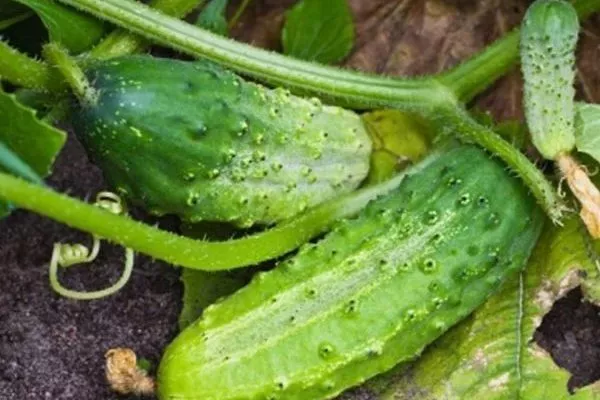
Rodnichok cucumbers on a branch
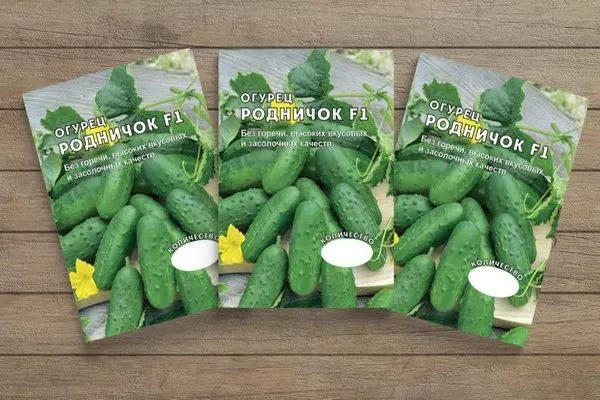
An easy-to-grow bee-pollinated hybrid. Its fruits are sweet and not bitter.
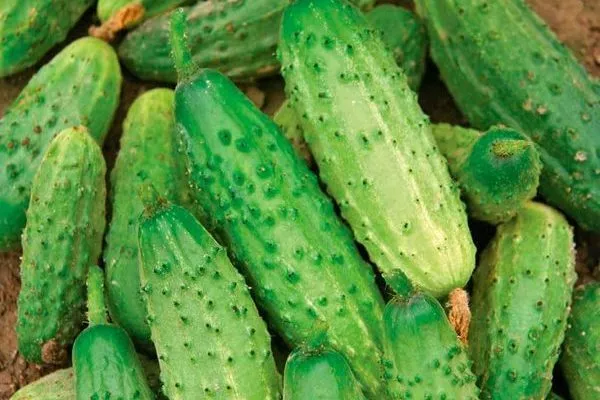
The Rodnichok variety has an excellent commercial appearance.
History of variety selection
Scientist A.A. Mashkov applied to include the variety in the state register of domestic breeding achievements in 1974, but it was not included until five years later. It was developed in Tiraspol, at the Transnistrian Research Institute of Agriculture. The variety is a hybrid resistant to powdery mildew and many other diseases.
The hybrid can be grown in any soil. At first, the breeder couldn't get rid of the hybrid's characteristic bitterness, but over time, it completely disappeared. It can be grown in all regions of the Russian Federation.
Description of the variety
The Rodnichok hybrid is a mid-early variety pollinated by bees. The plant is very tall with spreading branches, and almost all the flowers are female. Harvesting begins 50-55 days after the first leaves appear, but the variety's main advantage is its undulating fruiting, meaning the fruits can be harvested gradually, with some ripening first and others last.
- ✓ All seeds of the Rodnichok hybrid are almost female, which eliminates the need to warm the seed material.
- ✓ The fruits are of identical size, making the variety ideal for commercial cultivation.
Fruit
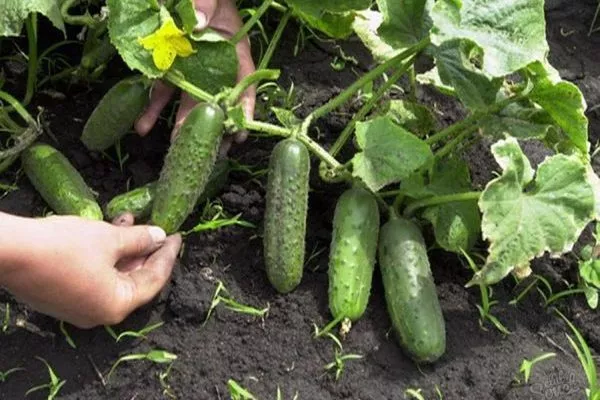
Rodnichok cucumbers are a distinctive light green. Each cucumber weighs approximately 100 grams and ranges from 9 to 12 cm in length. The skin is striped, and small black spines are scattered throughout. When cut, the cucumbers emit a wonderful aroma and have a crisp, crisp, and bitter-free taste.
Productivity and fruiting
The Rodnichok hybrid typically produces clusters of ovaries, with several per node, but sometimes up to five shoots appear on a single plant. When grown in greenhouses, you can harvest approximately 18-26 kg of cucumbers per square meter. In open ground, these figures are much lower – approximately 6-8 kg.
In addition to high yields, the variety has an excellent marketable appearance, making it suitable for large-scale commercial cultivation.
Scope of application
Rodnichok cucumbers are not very cheap, so many eat them fresh. Another reason they are not eaten canned is because they can be stored for a long time. However, many home cooks used this variety for winter platters and pickled the fruits.
Features and differences from other varieties
The Rodnichok variety is identical to other hybrids of this crop. However, there is one nuance that sets it apart from others: perfectly similar fruits of the same size. Cucumbers of identical length can be harvested from a single plant. This characteristic makes this hybrid the best variety for commercial cultivation.
If you want to grow a variety for commercial purposes, plant it in a greenhouse. This will ensure a better yield and the desired marketable appearance.
Resistance to diseases and pests
This variety is resistant to downy mildew. It is used in breeding to create other varieties and hybrids because it is an excellent donor with innate genetic immunity to a number of infections that harm this vegetable crop.
In open ground, the plant can be attacked by aphids, so regularly treat the beds with a solution of soap, ash, or other pest control agents. If insects have appeared in a greenhouse, it's not the Rodnichok that's to blame, but its owners.
Advantages and disadvantages
This hybrid, like other vegetable crops, has its pros and cons, which must be taken into account when growing.
Benefits of Rodnichok cucumber:
- excellent taste;
- beautiful appearance;
- ease of cultivation;
- strong immunity;
- the possibility of growing in any terrain and under any conditions;
- good yield;
- excellent transportation.
Disadvantages of the Rodnichok cucumber:
- demanding in terms of fertilization;
- requires regular and high-quality watering;
- Without proper storage of the harvest, the fruits lose their attractive appearance.
The above-mentioned disadvantages of the variety apply not only to Rodnichok but to all vegetable crops. This variety has no specific individual drawbacks.
Planting and growing
Sowing seeds of the Rodnichok hybrid involves a series of sequential steps, all depending on the choice of growing location: in the greenhouse or in open soil.
- ✓ The optimal soil temperature for sowing seeds should be at least +15°C.
- ✓ The distance between plants when planting in open ground should be at least 30 cm to ensure sufficient space for growth.
Seed preparation
The Rodnichok hybrid has one distinctive feature: almost all the seeds are female, so standard seed heating is unnecessary. First, inspect the seeds and select only the beautiful, whole ones. Then, place them in a weak salt solution. The bad ones will float, while the good ones will sink to the bottom.
There's no need to soak the seeds in growth stimulants, especially if you've purchased colored seeds. Otherwise, there's a high risk of damaging the seed coat.
Watch the video to learn how to germinate seeds of hybrid cucumber varieties:
You can also read an additional article about planting seeds for seedlings.
Growing in open ground
Prepare for planting cucumber seeds in the fall. Burn old leaves and dig up the soil. Mix a solution of water and 3% bleach and spray it on all wood, metal, and glass surfaces.
When digging the soil, add chicken manure or rotted cow manure. It must be well-rotted, otherwise it will burn the future sprouts. If you don't have any organic matter in your garden, you can use ready-made mineral mixtures purchased at a market or a specialty gardening store. Just be sure to choose products labeled "for cucumbers."
It's best to sow Rodnichok seeds in rows; this will make them easier to care for later. Leave approximately 0.7 m between rows and 0.3 m between seedlings.
When planting seeds, plant them about 2 cm deep into the soil, water thoroughly, and cover with agrofibre. Plastic film can be used, but the main thing is that the covering material protects the plants from subsequent frosts.
The seeds of this hybrid germinate very quickly, and you'll see sprouts 3-4 days after sowing. If the weather is warm and frost isn't expected, remove the covering material to allow the seedlings to absorb fresh air and warmth.
Keep the soil moist; don't let it dry out. Add nitrogen to the soil during the active growth season; phosphorus-rich fertilizers are good for flowering; and add potassium during fruit formation.
Growing seedlings
Some gardeners believe it's easier to grow seedlings first and transplant them than to sow seeds directly into the soil. However, in practice, this isn't entirely true. When growing seedlings, it's necessary to monitor the indoor humidity and temperature, provide additional lighting, and provide extensive care.
You can use ready-made vegetable growing mixes as a substrate for the seeds. If you can't buy them, you can make your own. The main components for creating the substrate are fertile soil, peat moss, and humus (in equal parts).
When planting seeds, treat the pots with special disinfectants, such as Gamair, Fitosporin, or Planriz. Choose pots with a capacity of approximately 50-55 mm, and plant the seeds 1.5-2 cm deep.
Until the seeds germinate, maintain the temperature at 23 to 25 degrees Celsius. Then gradually lower it. Be sure to transplant the plants into individual 45 x 45 mm, 80 ml cups.
Preparing the soil and planting seedlings
Apply fertilizers to the soil directly when planting seedlings in the soil:
- in the beds, make holes about 0.4 m deep at a distance of 0.6-0.7 m from each other;
- fill them with a layer of soil mixed with humus or compost, then add fertile soil without fertilizers;
- transfer the seedlings with a lump of earth onto it or place a peat pot with seedlings on top;
- Fill the hole with soil and water at a rate of 3 liters per plant.
In the future, mulch the area with peat or dried grass. This will provide protection from weeds and also retain moisture in the soil for longer.
The following video shows how to transplant sprouted Rodnichok cucumber seeds into pots:
Care Features
Any cucumber variety requires certain growing requirements. The most important ones are: planting should be done only in well-drained, nutritious soil; regular watering with warm, settled water and fertilizing are essential during care.
In addition, important components for the rapid growth of the Rodnichok cucumber include maintaining an optimal temperature in the greenhouse, shaping the bush, and spraying against pests.
Watering
Any cucumber variety requires adequate watering. This should be done only with warm water; the seedlings may not tolerate cold water at all. Avoid watering directly at the roots, as this can expose them, increasing the risk of various bacterial diseases.
Don't overwater either, as the root system will begin to rot and a puddle will form around the plant. This often occurs in soils with poor drainage.
If the weather becomes colder, reduce the number of waterings.
In a greenhouse, apply approximately 4-5 liters of water per plant until buds form. Once buds appear, stop the rapid leaf growth and encourage the seedlings to focus on buds. Reduce watering, applying approximately 8 liters per square meter every three days.
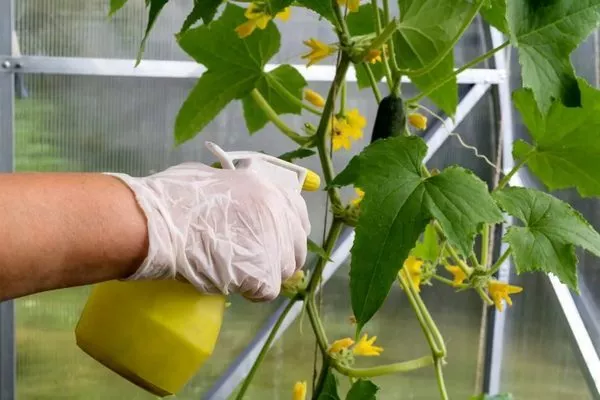
If the summer season is very hot, then in addition to regular watering, spray the glass in the greenhouse and sprinkle the foliage with warm water from a spray bottle.
Top dressing
Adding manure to the soil is an excellent option for fertilizing crops, and Rodnichok is no exception. However, this fertilizer can only be used as a special infusion: dilute 1 liter of fresh manure in 10 liters of water and let it steep for two weeks. Dilute the mixture in water at a ratio of 1:10.
Another fertilizer option: 5 liters of water and 7 g of ammonium nitrate, 7 g of potassium sulfate, and 10 g of superphosphate. Mix all ingredients and water the bushes at a rate of 1 bucket per 12 plants.
Apply the second fertilizer in two weeks, just as the plants begin to bloom and the first ovaries form. At this point, add organic matter. Additionally, add the following to 5 liters of this fertilizer:
- 3-5 g nitrophoska;
- 100 ml of wood ash;
- 0.2 g boric acid;
- 0.15 g manganese sulfate.
In this case, apply 3 liters of the product per square meter. If you can't create such a fertilizer, you can use mineral fertilizers, which should contain significantly more potassium than nitrogen.
The third feeding is done two weeks later. Use 5 liters of water and 1.5 tablespoons of mullein. A similar fertilizer can also be used as the fourth feeding, also two weeks after the third.
After applying fertilizers, plants need high-quality watering.
Bush formation
The fontanelle will only form on a trellis. Pinch the main shoot when it reaches the top row, and pinch the side branches above the third node.
Spraying
This procedure is carried out for the following purposes:
- for foliar application of fertilizers - dissolve 1 g of orthoboric acid, 30 g of potassium nitrate, 0.1 g of zinc salt of sulfuric acid, 60 g of superphosphate and 150 g of urea in 1 bucket of water;
- to protect against diseases and harmful insects, use Topaz or Confidor;
- When watering, use the sprinkler method.
Diseases and pests
The variety has strong immunity, but some diseases still attack it.
The most dangerous diseases:
- Powdery mildew. Symptoms: Small light-colored spots form. The branches turn brown and eventually fall off. Causes: Weeds growing in the same area and over-watering. Control methods: Burn the leaves and the plants themselves; treat the cucumbers with sulfur powder.
- Peronosporosis. Symptoms: Yellow-green spots with a slight coating appear. They increase in size and turn purple. Control: It's easier to take preventative measures early than to cure the disease later. If you notice the disease in its active phase, treat the bushes with Bordeaux mixture.
- Anthracnose. Symptoms: Brownish-yellow spots with a pink bloom appear. Control: Treat plants with Bordeaux mixture.
The main pests are melon aphids, ants, spider mites, whiteflies, and slugs. These can be controlled using both natural remedies and chemicals. Read more about protecting cucumbers from diseases and pests. here.
Gardeners' reviews
Following all agricultural practices, regular preventative maintenance, and quality care will help you grow the Rodnichok hybrid. And it, in turn, will reward you with delicious and crisp cucumbers.