
Recently, our gardeners have begun growing bunch cucumbers, which differ from regular cucumbers in the arrangement and number of ovaries. Let's find out why these cucumbers got their name, how to grow them, and which varieties are popular among domestic vegetable growers.
What are bunch cucumbers?
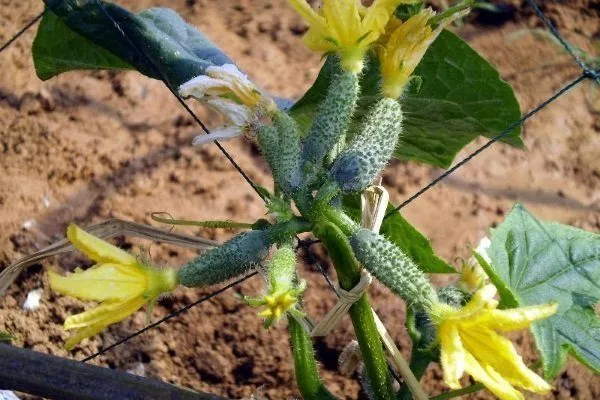
Cucumbers of this type have two names: cluster and bouquet. When the plant blooms, not just one flower, as with regular cucumbers, but several blooms in a single axil—a whole "bouquet" of flowers. When the fruits ripen, they emerge from a single node, forming a "bunch" of cucumbers.
Cluster cucumbers ripen in clusters almost simultaneously—numerous "clusters" of small cucumbers hang from the stems of the cucumber bush. Most bouquet varieties produce small, gherkin-like fruits. In addition to cluster cucumbers, there are super-cluster cucumbers, which are distinguished by an especially large number of ovaries in a cluster—8-10 or even more.
Classification
There are several types of bunch cucumbers. To make it easier for gardeners and vegetable growers to select the appropriate varieties that meet specific requirements, bunch hybrids have been categorized.
Parthenocarpic varieties are not self-pollinating; they require no pollination at all. Their ripe fruits are seedless.
Classification of parthenocarpic bouquet varieties of the gherkin type:
- Actively branching hybrids. Lateral shoots grow from almost every node on the main stem. When grown in greenhouses, lateral shoots require pinching. Extensive branching ensures long-lasting fruiting. These varieties tolerate overheating well. These include hybrids such as Strekoza, Fokus, Burevestnik, and Matryoshka.
- Moderately and limitedly branching. They produce numerous short shoots with shortened internodes. They are distinguished by their prolonged fruiting and easier bush formation. Examples of these hybrids include First Class, Kuznechik, and Muravey.
- Weakly branching. These include ultra-early maturing hybrids. Most of their harvest is collected in the first month. These include the Buket, Alphabet, and Artel hybrids.
- Balcony. Fashionable grow on balconies and verandasThe main stem is vigorous, and branching can vary from weak to strong. These hybrids differ from all existing varieties and hybrids:
- Many active ovaries - more than other bunch hybrids.
- The internodes are very short.
- The leaves are small.
- The fruits are gherkin-shaped, even, beautiful, and of regular shape.
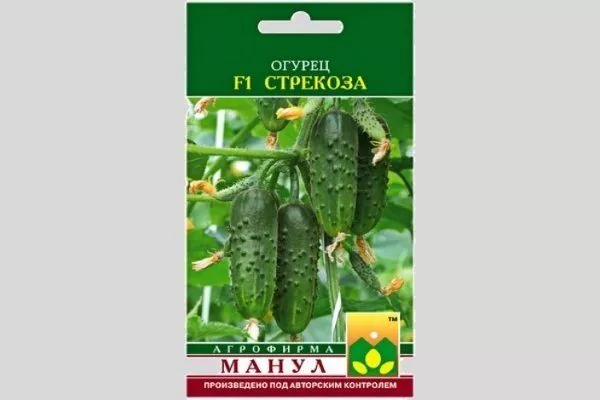
Actively branching cucumber hybrid "Strekoza"
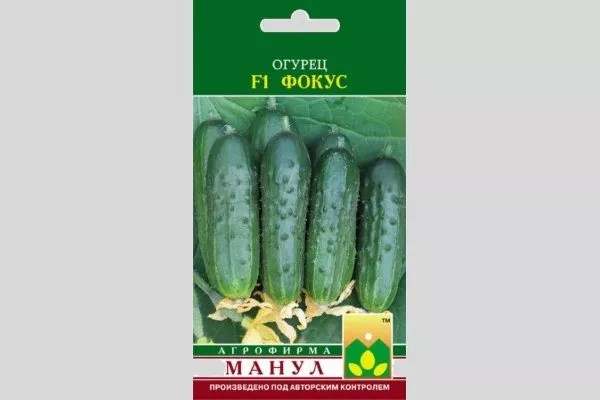
Actively branching cucumber hybrid "Focus"

The actively branching cucumber hybrid "Burevestnik"
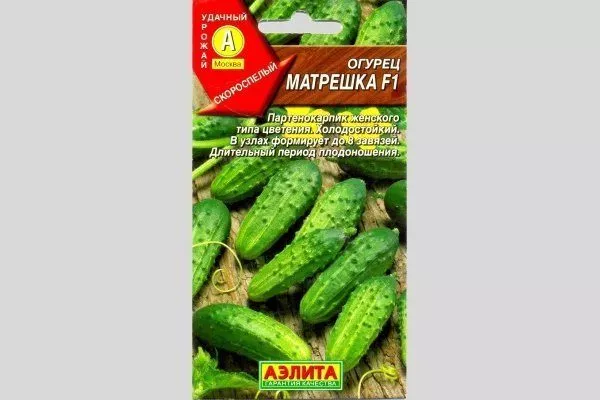
Actively branching cucumber hybrid "Matryoshka"
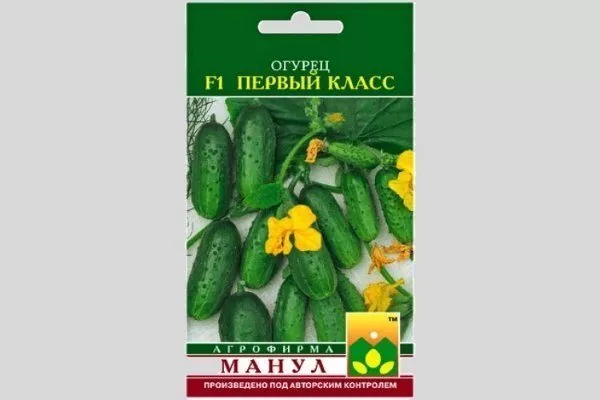
Moderately and limitedly branching cucumber hybrid "First Class"

Moderately and limitedly branching cucumber hybrid "Kuznechik"

Moderately and limitedly branching cucumber hybrid "Ant"
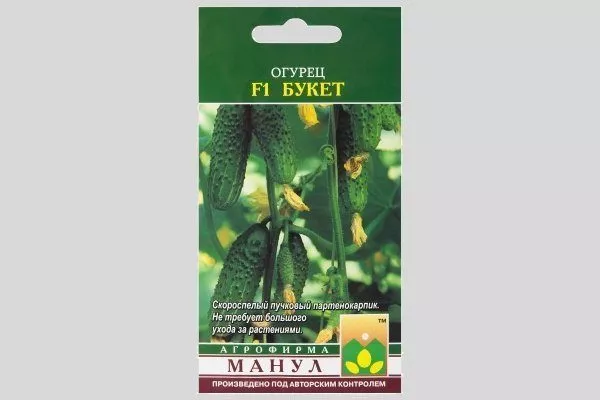
A weakly branching cucumber hybrid called "Bouquet"
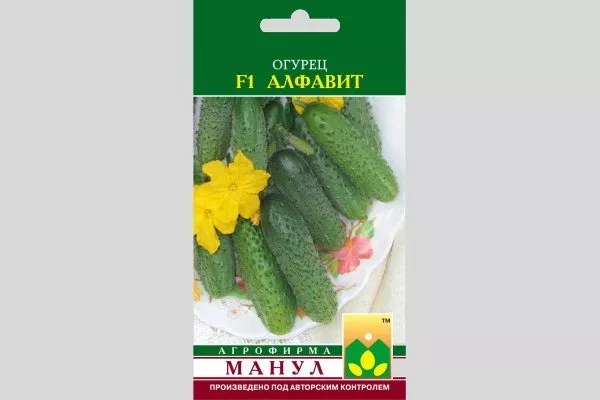
Weakly branching cucumber hybrid "Alphabet"
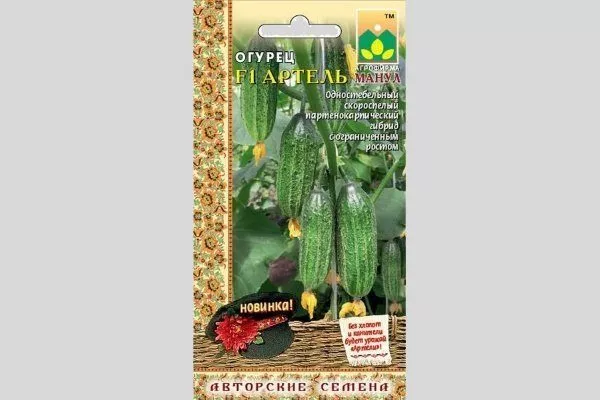
A weakly branching cucumber hybrid called "Artel"

Balcony variety of bunch cucumbers
Popular hybrids
Today, the market offers dozens of varieties of bunch cucumbers, each with distinct biological and economic characteristics. Let's look at the most successful and popular hybrids:
- Tom Thumb F1.A self-pollinating early hybrid. Ripens 38-39 days after germination. A bush yields 10-13 kg. A cluster contains 3-6 cucumbers. Cucumbers are 6-10 cm long.
- Blizzard F1.An ultra-early hybrid. Flowers are female. Pollination is not required. A bunch contains up to 5 cucumbers. Cucumbers weigh 60-70 g. The color is dark green with white stripes. The plant appears unsightly due to poor development of lateral shoots. In fact, this is a very productive hybrid with immunity to powdery mildew. A bush yields up to 16 kg. The fruits are small – up to 7-8 cm – with excellent flavor, suitable for canning. In temperate climates, it is grown from seedlings.
- Balcony F1.Suitable for growing on balconies, terraces, verandas, etc. It grows weakly, so pollination is not required. A cluster contains 2-8 ovaries. Cucumbers are pimply, with white spines. Length: 6-10 cm.
- Yamal F1.Suitable for growing in northern regions. Ripens in 45-50 days. Unpretentious, requires no pollination, has medium branching, is frost-hardy, and is resistant to cucumber diseases. Yield: 10-13 kg. No more than two fruits per bunch. Suitable for pickling and canning. Fruit length: 8-10 cm.
- King of the garden bed F1.An early parthenocarpic hybrid. Cucumbers for salads and canning. The plant is medium-sized, with weak branching and female flowers. The axils contain approximately five ovaries. Fruit weight is 100-120 g. Yield: 10 kg per square meter.
- F1 champion.A parthenocarpic hybrid with long fruiting and early ripening. The plant has a loose vine, with 2-4 ovaries per bunch. High yield – 25 kg per square meter. Length – 10-12 cm. The surface is large and tuberculate, with excellent marketability and flavor. Ideal for retail.
- Russian style F1.A mid-season parthenocarpic hybrid. Ripening time is 45-48 days. There are 3-4 ovaries per stem—one on the main stem, and 5-8 on the lateral stems. Fruit length is 10-12 cm. Cucumbers are small-bumped, dark green, and have light stripes. Resistant to powdery mildew.
- Robin Hood F1.An early-ripening hybrid with little branching. The plant is short. A bunch contains 3-4 ovaries. Cucumbers are 5-6 cm long. The fruits are green, pimply, with black spines and white stripes. The fruits are crisp, with firm flesh.
- Style F1.A self-pollinating gherkin hybrid. Plants are medium-sized. Fruit ripens in 45-50 days. Fruits are long-bearing. Fruits weigh 55-70 g and are 10-11 cm long. 4-5 kg are harvested per square meter.
- Okhotny Ryad F1.An early-ripening hybrid. Flowers are female. Branching is limited. The fruits are tuberculate, with white spines, 8-11 cm long. Fruit sets contain 2-6 ovaries. The hybrid is resistant to cucumber mosaic and powdery mildew. Ripens in 40 days.
- Prestige F1.An early parthenocarpic hybrid. The bushes are medium-sized, with a moderate climbing habit, and bear female flowers. Three to four ovaries are present in clusters. Cucumbers are short, up to 10 cm, dark green, with large tubercles and short stripes. Fruit weight is 65-90 g. They have excellent flavor and marketability. Up to 24 kg can be harvested per square meter when grown in greenhouses.
- Mother-in-law F1.An early-ripening parthenocarpic hybrid. Ripening time: 45-48 days. Fruits are 11-12 cm long, tuberculate, with brown spines. There are 3-4 ovaries per bunch. Suitable for all-purpose cultivation. Yield: 5.5-6.5 kg per bush. Stable and long-lasting fruiting.
- Sail F1.A mid-early hybrid. Ripens in 45 days. The fruits are 8-10 cm long, matte, with sparse tubercles, black spines, and light stripes. The plants are vigorous, with 2-6 ovaries per bunch. These cucumbers are versatile—they are delicious fresh, in salads, pickled, and marinated. One bush produces 5-6 kg of cucumbers.
- Avalanche F1.An ultra-early hybrid. Ripens in 38-42 days. The fruit is 8 cm long, with large bumps and black spines. Each node contains 4-5 ovaries. The taste is not bitter. Delicious fresh and pickled. Marketable yield is 99%.
- Our Masha F1.A self-pollinating gherkin variety. Ripens in 40-45 days. The fruits are firm, attractive, and a rich green color. The length of the fruits is 8-10 cm, with brown pubescence. A bunch contains 2-3 ovaries. Approximately 16 kg of cucumbers are harvested per square meter.
- Piccolo F1.This parthenocarpic hybrid ripens in 38-44 days. Each node produces 7-8 cucumbers. The fruits are dark green and 8-10 cm long. The surface is coarsely tuberculated. The flavor is pleasant, delicate, and without bitterness. They are highly resistant to disease. They are suitable for canning and delicious fresh.
- Lisette F1.Another parthenocarpic hybrid with ultra-early maturity. Ripens in 38-42 days. There are 3 to 8 fruits per node. The plants are medium-sized, with medium climbing habit, and female flowers. The fruits are large-tuberculate, green, with small seed chambers. The fruit length is 6-8 cm.
- Buyan F1.An early-ripening parthenocarpic gherkin hybrid. Each node produces 2 to 7 fruits. Cucumbers are tuberculate, with white spines, 8-11 cm long. Resistant to olive spot, mosaic, and powdery mildew. Fruiting is abundant.
- Dwarf F1.Ripens in 45 days. Parthenocarpic hybrid for any soil. Flowers are predominantly female. The plant is medium-sized, with short, dark green fruits with stripes on the surface. Fruit length is 6-8 cm and weight is 80-90 g. A yield of 10-12 kg of cucumbers is obtained per square meter. Recommended for pickling and canning. Resistant to powdery mildew and stress. It has high commercial quality and transports well.
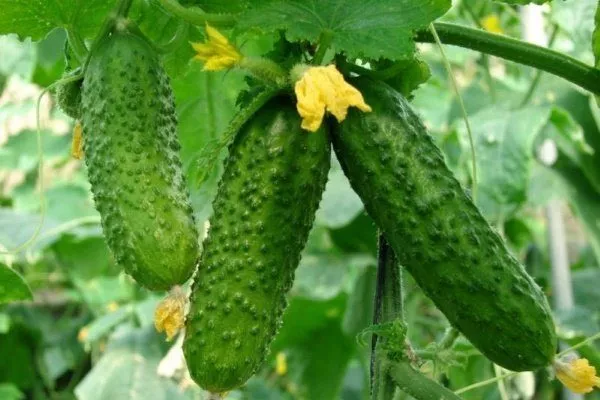
Cucumbers Tom Thumb F1
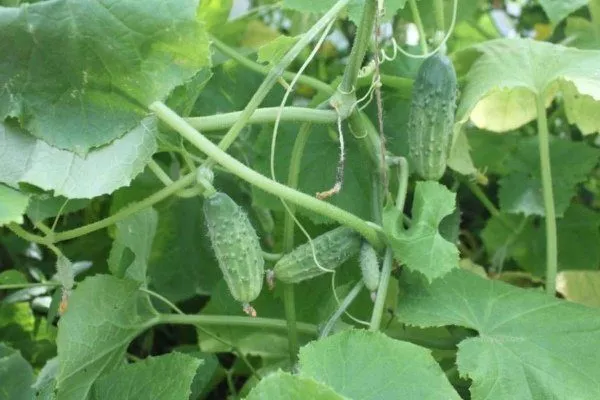
Cucumbers Vyuga F1
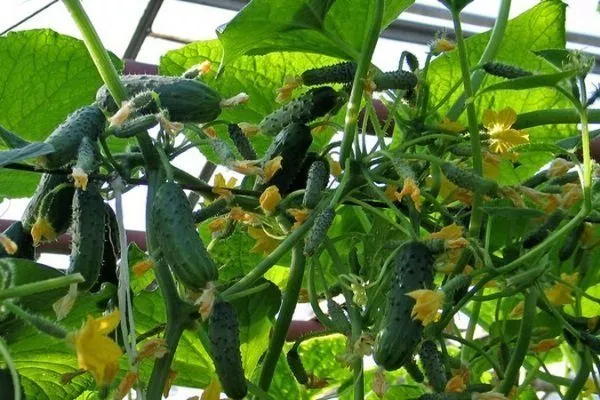
Cucumbers of the Balcony F1 variety
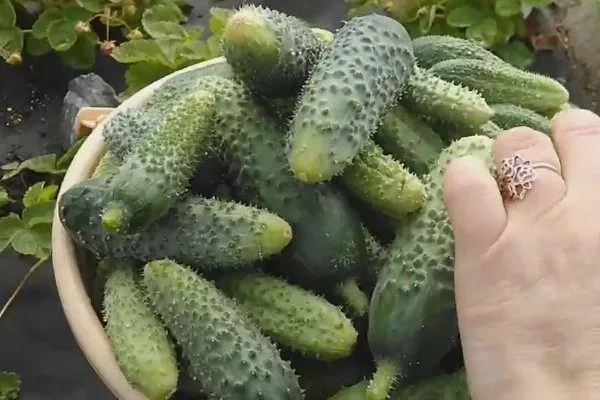
Cucumbers Yamal F1
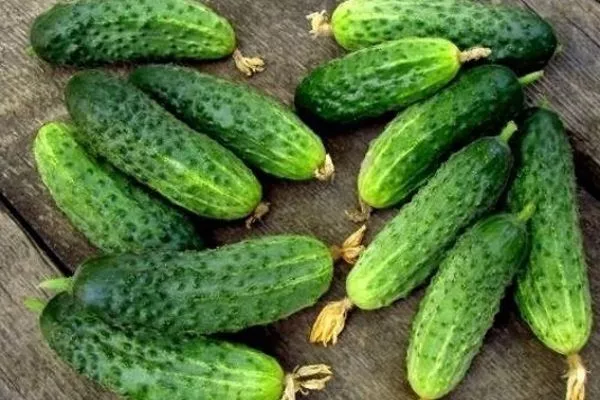
Cucumber variety King of the garden F1
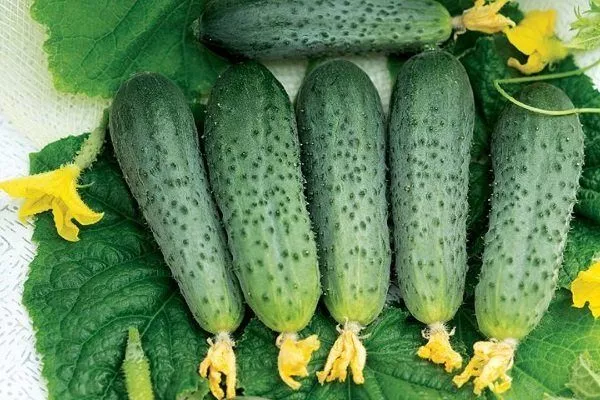
Cucumbers Champion F1
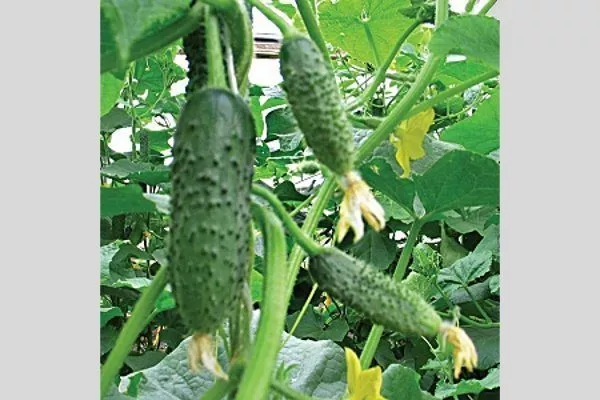
Cucumbers Russian Style F1
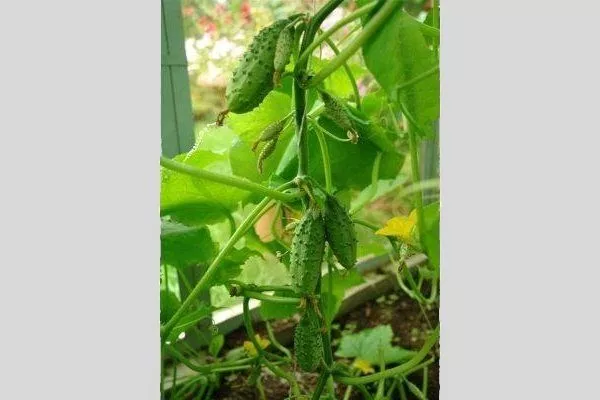
Cucumber variety Robin Hood F1
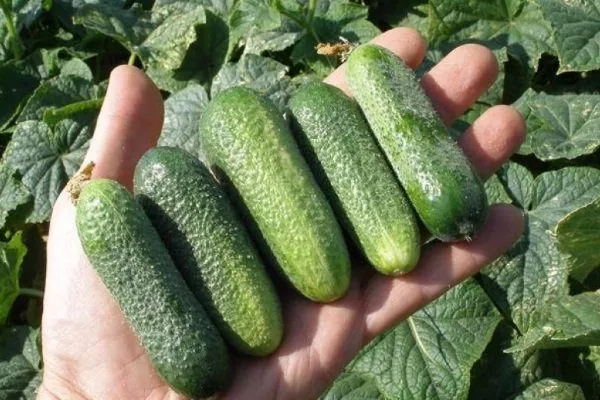
Cucumbers, F1 Style
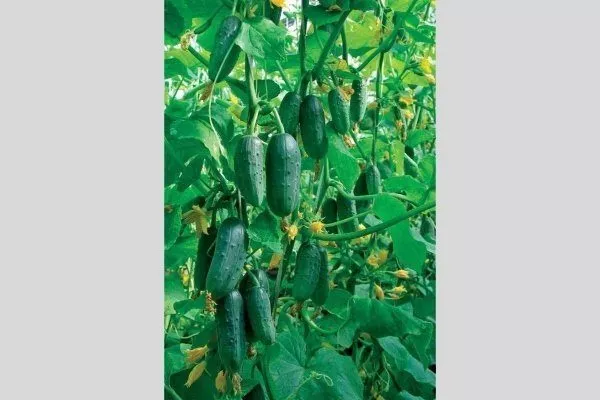
Cucumber bush Okhotny Ryad F1
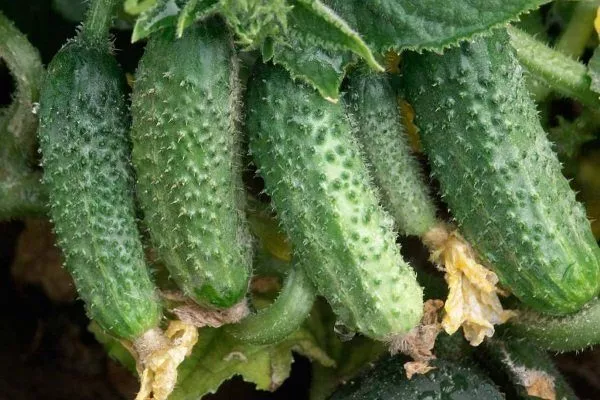
Cucumbers Prestige F1
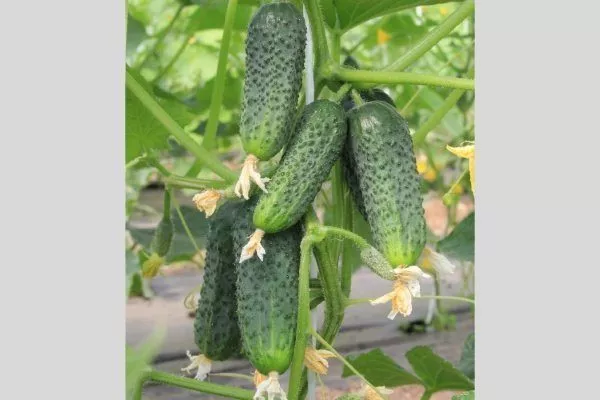
Cucumbers Teshcha F1
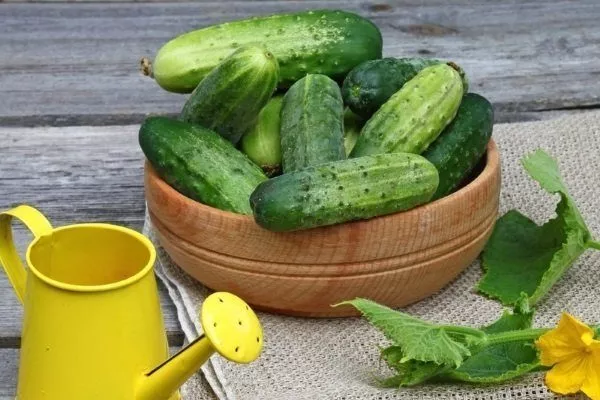
Cucumbers of the Parus F1 variety
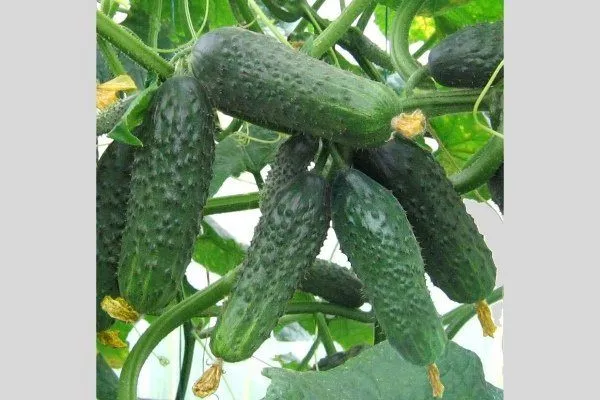
Cucumber variety Lavina F1
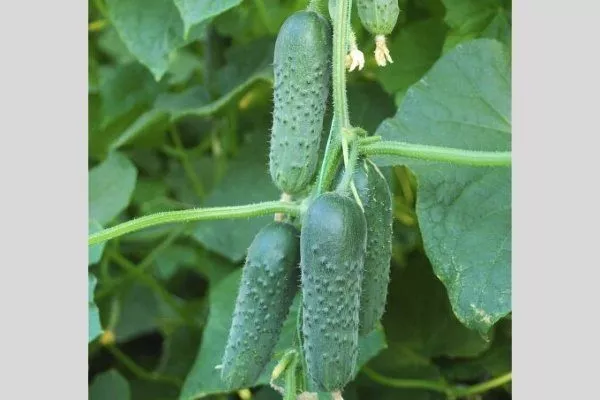
Cucumbers Nasha Masha F1
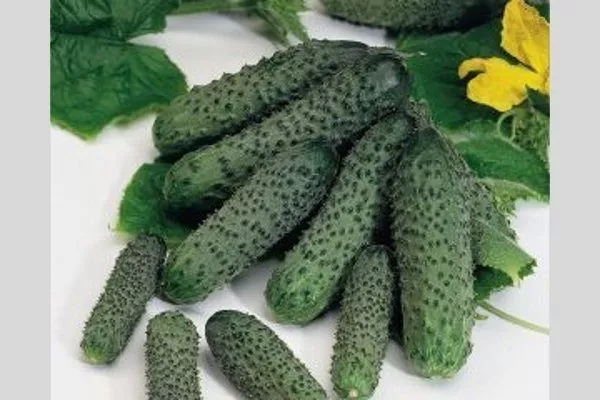
Piccolo F1 cucumbers
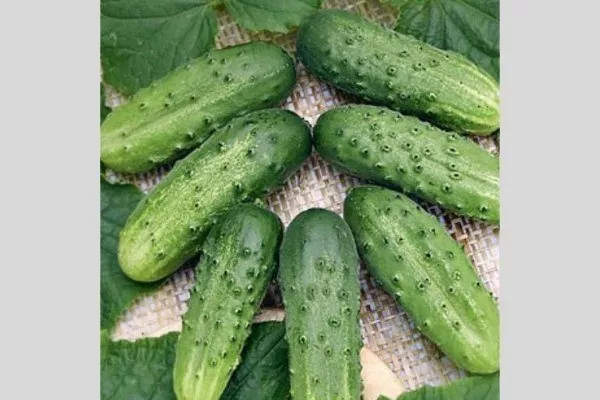
Cucumbers of the Lisette F1 variety
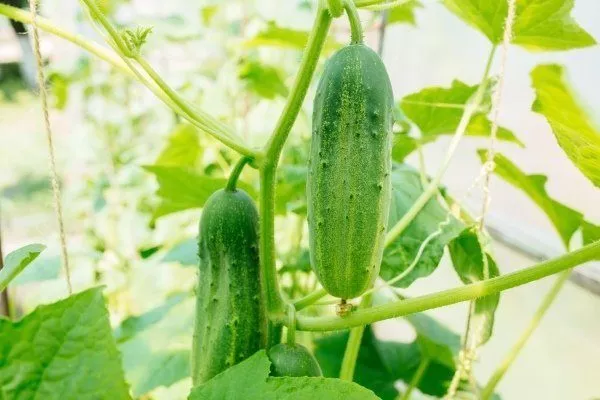
Cucumber variety Buyan F1
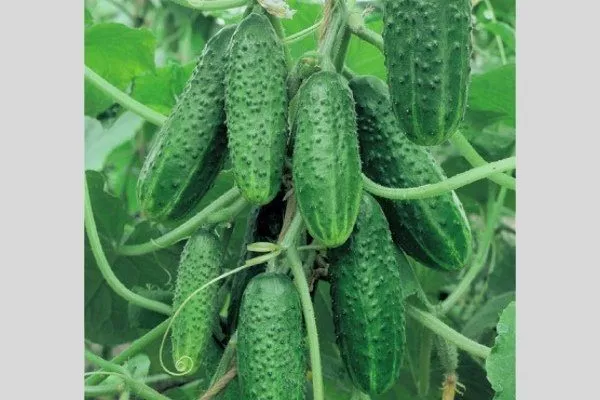
Cucumbers of the Dwarf F1 variety
Advantages and disadvantages of bunch cucumbers
Advantages of bouquet varieties:
- Consistently high yields. A single bush, depending on the variety, can produce 10-20 kg of cucumbers. A distinctive feature of cluster varieties is the sequential opening of flowers within the inflorescence. One to two flowers open per day. The plant maintains high yield potential and produces fruit reliably. The bush has "spare" ovaries in case some die due to unfavorable conditions. If some ovaries die, others will sprout, and the gardener will not be left without a harvest.
- Fruits are not prone to overgrowing. Due to intense competition for nutrients, fruits growing within a single node do not overgrow, unlike cucumbers growing individually.
- A large number of cucumbers ripen at one time. At peak yield, a single plant can produce up to 12-15 bunches of cucumbers ready for picking. Simply perfect for canning or selling.
- Small fruits. The maximum length of the fruit should not exceed 15 cm. Cucumbers that are too long, gathered in a single node, may become crooked. Small fruits are convenient for pickling and canning. Bunch cucumbers are suitable for those who enjoy pickled cucumbers.
- Resistance to temperature fluctuations. Seasonal.
- Early ripening. The first fruits appear approximately 35-40 days after germination.
- Good taste. Cucumbers have versatile uses.
The more cucumbers in one node, the slower their growth - this is very convenient for summer residents who only show up at their dacha on weekends.
Bouquet varieties have no obvious drawbacks. Only gardeners who only visit their plots occasionally might encounter difficulties – bunch cucumbers require careful care, and without it, one cannot expect to reap the benefits of these varieties.
Cultivation features: ovaries and fruiting
Cluster varieties are grown outdoors in much the same way as regular varieties. However, there are still some growing peculiarities. In weak plants, the ovaries dry up and fall off. Weakened bushes cannot provide nutrition to all the ovaries that have formed. To prevent this, take the following measures:
- About a week before planting, compost (10-15 kg per 1 sq. m) and mineral fertilizers (30-40 g per 1 sq. m) are added to the beds by digging.
- The beds are watered the day before planting. Planting occurs when the soil temperature reaches 10°C. Planting depth is 10 cm.
- The holes in which the seedlings are planted are disinfected with a weak solution of potassium permanganate.
- The seedlings are planted at intervals of 40-50 cm – bunch varieties do not tolerate crowding. The soil is mulchedThe most suitable mulch is humus.
- Install trellises, preferably stretched net for cucumbersThe bush is formed by pinching off side shoots. Trellising allows for a higher yield of bouquet cucumbers.
- Remove all flowers and side shoots from the axils of the four lower leaves. Two side shoots with ovaries can be left after pinching. The goal is to shape the bush so that the main stem produces the maximum yield.
- Use only warm water for watering. Do not allow the soil to dry out. Loosen the soil soon after watering to provide oxygen to the roots.
- The roots of bunch cucumbers do not tolerate high salt concentrations well, so fertilizers are applied in small amounts but frequently. For example, complex fertilizers are applied weekly at 15 g per square meter. Organic fertilizers are added every two weeks in the form of a manure or bird droppings solution.
- To ensure that plants bloom better and produce many ovaries, they are fed at the roots from time to time.
- To maximize yield, the fruit is harvested daily. Canes that have ceased bearing fruit are pruned.
The video below will tell you about the specifics of caring for bunch cucumbers when growing them:
Why is the number of ovaries decreasing and how can this be prevented?
Proper care is essential for vigorous fruit set. The following factors negatively impact fruit set:
- lots of nitrogen in the soil;
- irregular watering;
- overheating;
- lack or excess of sun.
The number of ovaries depends on growing conditions. The largest "bouquets" form on trellises and well-lit shoots.
"Resorption of bundles" is observed in:
- Intensive growth of the central stem. The nodes in the lower part of the plant often have more ovaries than those in the middle tier—this phenomenon is observed at high temperatures. Under favorable conditions, when the bush grows at a moderate pace, the number of ovaries gradually increases from the lower to the upper axils, and from the central shoot to the lateral shoots.
If fertilizers are not added to the soil for a long time, or if there is not enough fertilizer for normal fruiting, the largest bunches grow in the middle part of the plant. - Shading. Depending on the sun's rays, the number of ovaries in the bunches varies. Some nodes may contain 2-3 fruits, while others may contain 8-10 or more.
To prevent a decrease in the number of ovaries, it is necessary to follow the following rules:
- The temperature should be maintained at a level between +21 and +24°C.
- Do not allow the air to overheat, especially at night.
- You cannot overload the soil with nitrogen fertilizers.
- Maintain uniform lighting of plants.
The plant is unable to "nourish" all the buds that form—it simply lacks the strength, so some buds dry up and die even under the most favorable conditions. And yet, the principle remains: the more correct the agricultural practices, the higher the yield.
Secrets of growing bunch cucumbers
Growing bunch cucumbers has a number of secrets that help you get the most out of these high-yielding hybrids.
Lighting
Bouquet varieties love light, but there are also those that can bear fruit in partial shade. Lighting has a positive effect on the number of ovaries formed, so it is recommended to place cucumber beds in sunny areas, and growing cucumbers in greenhouses – use artificial lighting if necessary.
If the area is in partial shade when growing in open ground, it is necessary to choose shade-tolerant hybrids.
Soil
Bouquet cucumbers are susceptible to disease if the soil becomes waterlogged. To prevent this, ensure effective drainage in the beds.
- ✓ The pH level should be between 6.0-6.8 for optimal nutrient absorption.
- ✓ The soil should contain a high percentage of organic matter (at least 4%) to maintain moisture and structure.
The optimal soils for bouquet varieties are loose, nutritious soils with a structure that allows easy air flow to the root system.
Wind protection
Most garden plants react negatively to drafts. Bunch cucumbers are no exception. Cucumber beds are planted in areas protected from drafts and strong winds, which can cause plants to become diseased, weaken, and lose productivity.
Landing features
Cucumbers can be planted outdoors or indoors, using seeds or seedlings. In either case, the seeds are germinated.
Unlike conventional varieties, the seeds of bunch hybrids are not treated with stimulants and disinfectant solutions, but are only germinated.
Germination order:
- Immerse the seeds in warm water. Temperature: 30 to 35°C.
- Once the seeds have swollen, they are transferred to a damp cloth. Germinate at temperatures up to 20°C.
- Once the seeds sprout, they are planted in individual cups. This is done to avoid picking and to immediately plant the seedlings in the ground or a greenhouse. Picking them out can cause the plants to become ill and stunted.
Soil for growing seedlings can be purchased at agricultural stores or prepared from partially decomposed wood chips, peat, and humus. The mixture is poured into cups and filled with water. Then, the sprouted seeds are planted, planting them about 2 cm deep.
The soil, whether in a plot or a greenhouse, should be loose and light. When planting, follow the recommended planting spacing for the specific variety—too much space will negatively impact yield.
Features of planting bouquet cucumbers in open ground:
- The soil for planting is prepared in the fall.
- Holes are made in the beds, into which a solution of potassium permanganate is poured - for soil disinfection.
- Planting seedlings in open areas begins after the soil warms to 10°C. The optimal depth is 10 cm. The spacing between plants is 40 cm.
- Seeds are planted in open ground when the soil warms up to 10°C. The beds are 70 cm wide. Furrows are made in them, into which the seeds are sown at intervals of 40-50 cm. Three seeds are placed per hole. The depth is the same as for planting seedlings – 2 cm. The planted seeds are watered and covered with plastic film. When seedlings appear, the plastic film is removed and the plantings are thinned, leaving the strongest of the three sprouted seedlings.
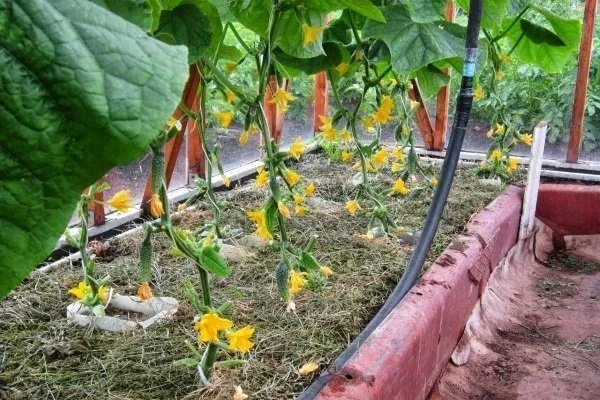
- The optimal growing method is vertical. A rope is attached from each plant to a string stretched 2 meters above the bed.
- During cultivation, bouquet varieties are sprayed with compounds that promote fruit set. "Zircon" or "Epin" are used for this purpose.
- Optimal timing sowing seeds for seedlings – the last days of April. Seedlings are planted in the ground at the end of May – the first two true leaves should appear on the seedlings.
- When planting seedlings in open ground, no more than 3-4 plants are planted per 1 square meter.
When grown in a greenhouse, the most favorable conditions for the crop are created: humidity 90-95%, temperature during planting - +23°C, during flowering and formation of ovaries - +27°C.
Caring for cucumbers
Caring for bunch cucumbers involves regular watering, spraying, top dressing, loosening the soil, and shaping the bushes. If growing in a greenhouse, temperature and humidity must be monitored and the room must be ventilated regularly.
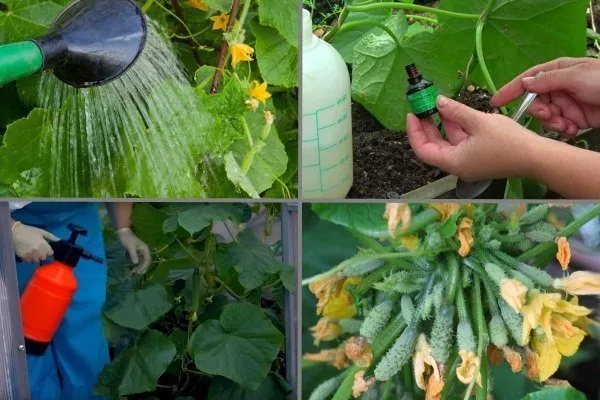
Top dressing
When fruiting begins, cucumbers require a lot of nutrition—they need minerals. The roots of this crop do not tolerate high salt concentrations in the soil, so they are fed sparingly.
- First week after planting: apply 15 g of complex fertilizer per 1 sq. m.
- Second week: Spray the leaves with a solution of microelements.
- Third week and beyond: Alternate organic and mineral fertilizers every 7 days.
Fertilize once a week or even more frequently. Apply complex fertilizers sparingly—10-20 g per square meter. If cucumbers are grown in a greenhouse, it's recommended to place a container with fermenting grass or slurry inside. The carbon dioxide released during fermentation helps cucumbers ripen faster.
Watering
Warm, settled water is used to irrigate cucumber beds. Until the fruit has formed, cucumbers are watered every six days. During harvest, the frequency of watering triples, with beds moistened every two days. Water the cucumbers only at the roots; drip irrigation is the optimal method.
To ensure a plant produces 15-20 kg of cucumbers, it needs to be prepared for this. A cucumber plant must have a strong root system, a sturdy stem, and healthy leaves—only such plants are capable of producing numerous ovaries that will develop into fruit.
Shelter
If there is no greenhouse on the site—after all, building one requires certain costs—a temporary film shelter can be sufficient. growing season Cucumbers are kept under plastic tunnels to prevent the plants from freezing during possible night frosts. Furthermore, plants will grow and develop faster under plastic, as there will be no significant drop in temperature that occurs at night in open ground.
Formation on a trellis
Hybrids with clustered ovaries are trained into a single stem to avoid wasting the plant's energy on side shoots. This approach increases yield. The best way to grow bouquet varieties is on trellises.
Principles of bush formation:
- Lateral shoots are removed almost to the trellis.
- You can leave a couple of shoots with ovaries near the trellis, pinching them above the 2nd leaf.
- All ovaries and shoots in the axils of the four lower leaves are removed. Ovaries with one leaf are left on the stem at each node.
We invite you to watch a video that clearly demonstrates how to properly form cucumber bushes with cluster and super-cluster ovaries:
Diseases and pests
One of the key advantages of bunch cucumbers is their resistance to diseases and pests. However, no variety is immune. Under unfavorable conditions, they may be susceptible to powdery mildew and other cucumber diseases.
Diseases and pests of bunch cucumbers and measures to control them:
| Diseases/pests | Signs of defeat | How to fight? |
| Powdery mildew | White spots cover the leaves, making the plants look like they've been dusted with flour. | Diseased leaves are trimmed and placed in a copper sulfate solution to kill the fungal spores. Plants are sprayed with colloidal sulfur (30 g per bucket). Repeat treatment after 10 days. |
| Downy mildew | Yellow spots first appear on older leaves, then on younger ones. The leaves turn brown and dry out. | Spray with Oxychom (40 g per bucket of water) or Bordeaux mixture (100 g per bucket). Apply 1 liter of solution per 10 square meters. Repeat the treatment after 10 days, but no later than 20 days before harvest. |
| White rot | Affected fruits are soft and slippery, covered with a white coating. | If growing in a greenhouse, ventilation and reduced humidity are recommended. Affected plant parts are cut off and the cut surfaces are sprinkled with sifted ash.
Plants are sprayed with a solution of copper sulfate and urea (2 teaspoons and 1 teaspoon per 10 liters of water, respectively). |
| Greenhouse whitefly | The butterfly lays its eggs on the undersides of leaves. The larvae suck the sap from the leaves and secrete a sugary substance that harbors a fungus that causes the foliage to turn black. | As soon as butterflies appear, spray the plants with verticillin (250 g per bucket of water). Apply the spray three times, at weekly intervals.
You can also set out sticky traps. Whiteflies love the smell of tobacco, so you can plant tobacco plants near cucumbers. When many butterflies gather on them, spray the plants with an insecticide, such as Intavir. |
Watch a video about biological diseases of cucumbers and how to prevent them:
Harvesting
It's recommended to harvest the cucumbers daily, or at least every two days. Frequent harvesting lightens the stems and creates favorable conditions for new fruit to form.
When it comes to harvesting, bunch cucumbers are versatile. Frequent harvesting promotes a higher yield, but harvesting once a week isn't detrimental—new fruits will simply develop more slowly. This is especially important for gardeners who only do their gardening on weekends.
Reviews from gardeners
Bunch cucumbers undoubtedly deserve the attention of gardeners. Their high yield and unique fruiting characteristics, backed by a strong immune system, attract both gardeners and commercial cucumber growers.