
Cucumbers grow bitter and dull when they don't get enough moisture. To prevent them from becoming bitter, water them regularly, especially during dry periods. Otherwise, you'll experience not only bitterness, but also withered fruits and leaves.
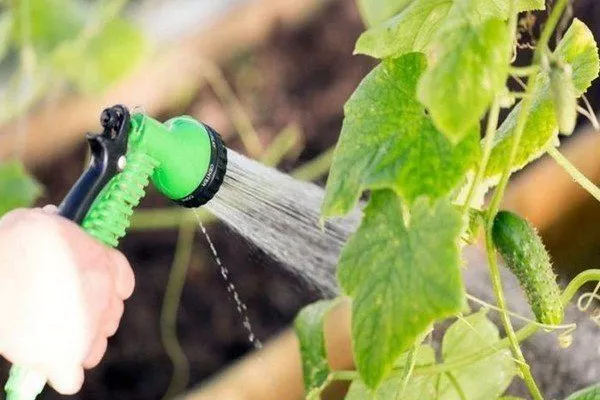
Watering rules
Proper watering of crops is based on 4 basic rules:
- RegularityThis applies not only to timing but also to water dosage. Plants are watered regularly, the amount depending on the age of the plant. Seedlings also require regular watering. Adjusting the water dosage is only permissible if the plant is growing too rapidly, which is unfavorable for you. This refers to a large amount of foliage but no fruit set. In this case, skipping a few waterings won't significantly affect the plant's development, but will prevent the development of excess leaves.
- Place for wateringAvoid directing water directly at the cucumber roots. This method exposes the plant's root system. This rule applies only to mature seedlings; seedlings are an exception. Explicitly exposing the root system increases the risk of root rot. If roots are accidentally exposed, cover the area with soil and hill up the plant. Use furrows located fairly close to the bed for this. This method prevents rot and saturates the plant with water.
- Temperature indicatorCold water damages plants, especially in cloudy and rainy weather. Such moisture contributes to excess dampness. cucumber diseasesUse only settled warm water.
- Observing plantsTo ensure proper growth, the plant requires constant monitoring. Even if you water it regularly and correctly, the leaves may still wilt. If this happens, don't worry; water the plant again.
- ✓ The pH level of the water should be between 6.0-7.0 for optimal absorption of nutrients.
- ✓ Water hardness should not exceed 4 mg-eq/l to avoid accumulation of salts in the soil.
When and how often should you water cucumbers?
The best time to water cucumbers is morning or evening. If you choose morning, make sure there's no water on the leaves before the sun begins to warm them, otherwise, burns will occur. If you water in the evening, time it so the water has time to soak into the leaves before the cold night sets in. Don't apply water too late, as this can cause root rot.
Find out how often and how much to water cucumbers from this video:
Temperature conditions
The water temperature shouldn't be colder than the ambient temperature. Ideally, it should be between 24 and 26 degrees Celsius. Fill the barrels with water and place them in the sun to warm up within 24 hours, along with the water inside.
The plant loves rain, so you can try collecting rainwater and watering the cucumbers with it. Use troughs or basins for this.
Applying water at a different temperature is only possible in dry, hot weather. During this period, the root system slows down in the hot soil and requires a cold "attack." However, water the plant only at the roots with lukewarm water, avoiding the leaves.
If the weather suddenly turns colder, the crop may experience water stress, even with regular watering. This is due to the application of water that isn't warm enough. At low water temperatures (around 10 degrees Celsius), cucumbers can't absorb it.
Even with ample watering, the plant can die due to dehydration. To save your plants, water the beds with water (40 to 50 degrees Celsius). Apply water only at the root system, but no closer than 50 mm from the stem.
Quality
The plant is also extremely sensitive to hard water. If your tap water or well has hard water, acidify it with citric acid or vinegar when watering.
Irrigation methods
In addition to watering manually from bottles or buckets, there are various methods: drip irrigation, systems, sprinklers, stations, etc. Let's look at some of them.
Drip irrigation of cucumbers
This method is modern and convenient, but it requires a small investment or a great deal of dedication to do the work yourself. It's not difficult to build. Simply purchase a large barrel (or bathtub, or something similar), place it on an elevated surface, and fill it with water. As it warms up in the sun, it becomes ideal for watering.
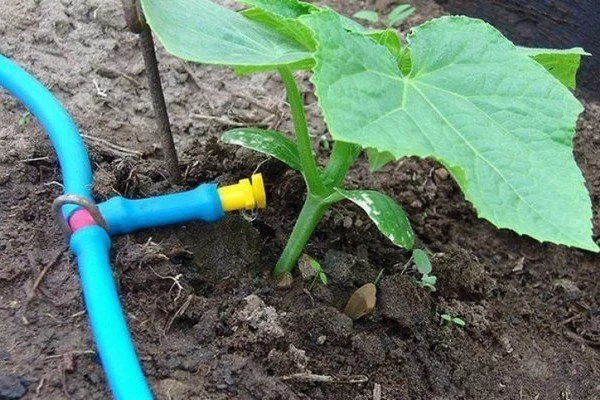
Attach a thick-walled hose to the tub and poke a series of holes in it. This is the easiest, standard option, but the liquid will leak out immediately. To prevent this, install a faucet near each hole and open it as needed. This technique helps improve and speed up watering.
Bottle irrigation
This method involves using plastic bottles filled with water. There are many variations of this method, but let's look at four main ones:
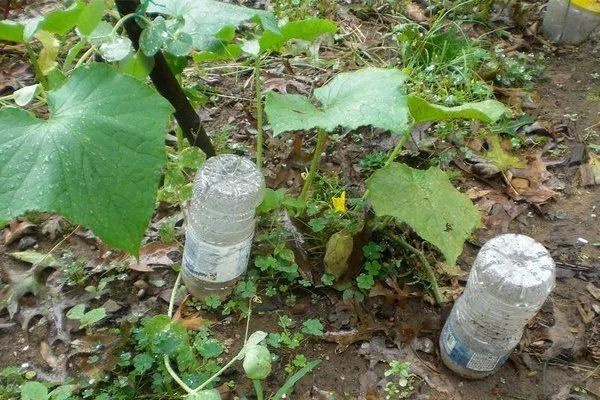
- Option No. 1Suitable for both open and closed soil. Mark a 30mm mark from the bottom of the bottle and make holes with a hot needle. Place them in several rows. The exact number of holes is up to you. It all depends on the density of the soil; the heavier it is, the more holes you need. The exact number of holes will depend on experience. If the soil is constantly wet, replace it with another one with fewer holes. Bury the bottles upside down between the plants. You can leave the lid on. If you want to leave it on, make a hole in it; otherwise, after the water evaporates, the bottle will completely shrink and lose its original shape.
- Option #2This method is almost identical to the first, but in this case, cut off the bottom. Make the holes close to the neck; you can do without them, but then insert foam rubber into the neck of the bottle. This method is suitable for heavy soils; in sandy soils, the water will evaporate in minutes. Screw on the lid and place it in the soil, neck down. To prevent the water from evaporating too quickly, don't throw away the cut-off bottom; instead, cover the bottle with it. Experienced gardeners recommend not cutting it off at all, but simply trimming it slightly to make it easier to add water.
- Option No. 3If you don't have time to visit your dacha often, use 5-liter plastic bottles. Poke holes in one end. Make one large hole in the other end to make it easy to pour water. Bury the bottles lying down, with the small holes facing down. This method will provide a supply of water for a couple of days.
- Option No. 4In this case, the containers aren't buried in the soil, but rather suspended above the cucumbers. This option is ideal for greenhouses. Make holes in or near the lid. If you don't want to make holes, you can simply open the lid. Fill the containers with water and suspend them above the beds. This method isn't particularly convenient, as water can get trapped on leaves. To avoid this, position the bottles as close to the soil surface as possible.
Sprinkling
When using sprinkler irrigation, it's best to use special sprayers made of plastic or other non-corrosive material. For effective irrigation, the water pressure should be 4 atm. However, greenhouses are often watered using a regular water supply, which operates at half the pressure, making this method less effective.
Pumping stations
When growing cucumbers commercially, gardeners use pumping stations. The choice of pumping station is based on the method of water extraction (from a water supply, a well, or a barrel). Pumping stations allow water to be quickly extracted from the reservoir and then transported to the plants.
Other methods
The main and most common method is manual. It's done with a watering can and a special attachment. This method has its own advantages: water can be heated at home or in a greenhouse, and the gardener can monitor and adjust the amount of water for each plant.
Another method is furrow irrigation. Ditches are dug near the cucumber plants, and water is then poured into them. The water flows throughout the garden, simultaneously irrigating the cucumbers. You can also use wastewater, which is rich in essential nutrients.
Features of watering
The amount of moisture required for normal plant development depends directly on the stage of its growth.
It would be nice in the spring after planting the plant in permanent soil mulch the soilso that the soil remains moist for a long time.
After landing
After planting the seedlings and until flowering begins, water at a rate of 4-5 liters per square meter. With this moderate watering, the cucumbers will not develop foliage and will quickly form ovaries. If the plant begins to grow vigorously and produce leaves, you can deprive it of watering for 1-2 times.
During flowering and fruiting
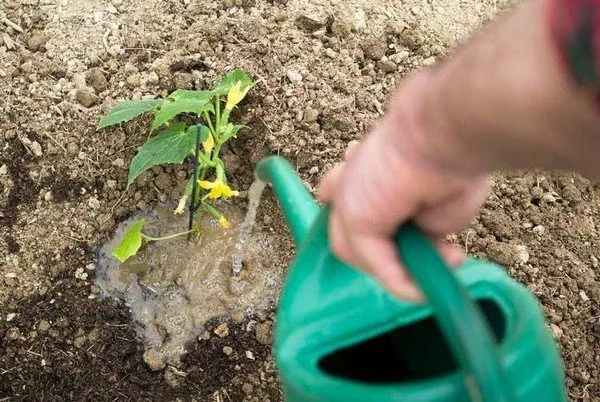
During fruiting, cucumbers are very demanding of water. This also applies to the other two stages: fruiting and harvesting. During these periods, water every three days, applying approximately 10 liters of water per square meter. Pay attention to precipitation, as it can have a significant impact.
Once the plant stops blooming, increase watering to once every two days. If the cucumbers are wilting, water them immediately.
In hot and rainy weather
On extremely dry and hot days, water cucumbers using a sprinkler system every morning and evening. Reduce watering during cooler weather or during cloudy periods. This is because cucumbers are tropical plants, and their roots are located close to the soil surface. Therefore, overwatering the soil and roots is not recommended.
When and how to water in a greenhouse?
There's no need to reduce watering in a greenhouse; it's the same as in open ground. At all stages of plant development, cucumbers require ample, but controlled, amounts of moisture. However, remember that greenhouses are slightly different from open ground, and the conditions vary. Monitor the crop's condition and increase or decrease water as needed.
This video explains how to water cucumbers in a greenhouse, how to make watering easier, and what water temperature requirements they require:
Important recommendations
Tips from experienced gardeners:
- Water cucumbers frequently, but do not exceed the recommended dosage.
- Do not apply water to the roots, otherwise it will be very difficult to cover them later, although possible.
- The water temperature should be close to the ground temperature.
- Pay attention to the foliage of plants; don’t miss the initial stage of “withering” of the greenery.
- During the growing season, the soil at the base of the plant should be dry.
- To prevent plants from overheating in the greenhouse, spray the windows from the outside of the greenhouse with a solution of water and chalk.
- ✓ Yellowing and wilting leaves can indicate either a lack or excess of water.
- ✓ The appearance of root rot indicates chronic waterlogging of the soil.
Watering cucumbers is the most important part of caring for them. Without adequate water, the vegetables grow tasteless and overly bitter.