
Both experienced and novice gardeners should always tie up cucumbers. This prevents unripe fruits from rotting. Staking makes caring for cucumbers and subsequent harvesting easier. However, this procedure, especially for inexperienced gardeners, must be performed very carefully to avoid damaging the plant's main stem.
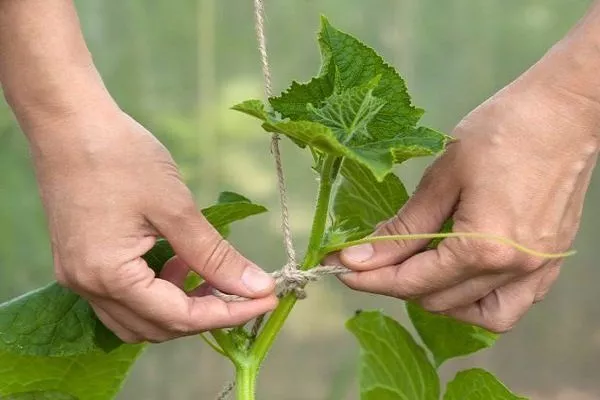
Why is garter necessary?
Staking cucumber plants is a challenging, labor-intensive, and time-consuming process, but it helps gardeners achieve positive results and avoid losing a portion of their harvest during flowering and ripening. So, let's take a closer look at why staking cucumbers is necessary:
- Correctly performed garter makes it easier to care for the bush during the growth period and harvesting without possible losses.
- Cucumbers tend to cling together with their tendrils, and proper garters prevent this.
- The garter is useful for the maturation of lateral shoots on which fruiting flowers appear.
- Open access (thanks to tying) to leaves, tendrils, and stems greatly simplifies care. Diseased leaves can be easily removed, desired shoots can be pinched, and cucumber tendrils can be trained in the desired direction. Furthermore, with proper tying, the number of male and female flowers on the plant can be controlled.
- Staking cucumbers helps prevent rotting and spoilage of the fruit and reduces the risk of parasitic insects appearing on the plantings.
Necessary materials
Before you begin tying up your cucumbers, first gather the necessary materials. Choose those that will securely hold the main stem in place. To tie up the cucumbers, you'll need:
- two-meter posts made of metal or wood;
- twine or wire;
- plastic mesh;
- hooks for securing twine and fixing the net;
- fixing pegs;
- cotton scraps of fabric, nails, hammer, pliers.
Thin wire and fishing line are not suitable, as they will dig into the bush, damaging it.
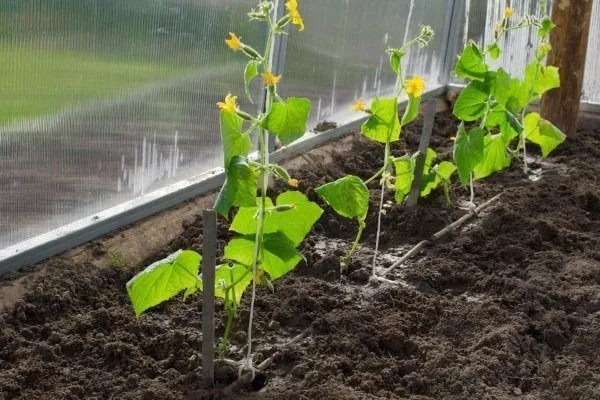
When should I start tying?
You should begin staking cucumbers 3-4 weeks after they begin growing, when the plant's height approaches 32-35 cm. It's best to do this promptly, rather than delaying it, as young cucumbers are much easier to work with due to the elasticity of their stems, while fully mature plants are more susceptible to damage when bent.
Gather all the necessary supplies for constructing supports, which should be erected before planting the seedlings. You can choose any staking method as you care for your bushes. The optimal method depends on the variety of plant being grown, the size of the area where the bush is located, and the availability of the necessary equipment for the upcoming gardening project.
Methods for tying cucumbers in a greenhouse
Currently, gardeners practice 3 main and 4 additional types of garter:
- horizontal;
- vertical;
- mixed method;
- using twine;
- application of fencing;
- arch garter;
- blindness.
Let's take a closer look at each method.
Horizontal garter
This is the most preferred method of bush staking. It's done horizontally in smaller greenhouses. The procedure for this type of staking is as follows:
- Place metal or wooden supports into the soil on the sides of the bed.
- Stretch a string or wire between them.
- Form the initial step, stepping back 25-30 cm from the ground surface (keep in mind that the distance between subsequent steps should increase by 5-10 cm).
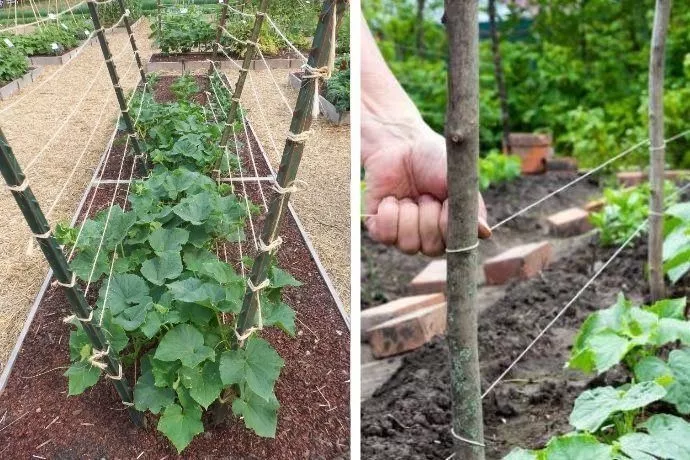
In this cucumber staking method, a mesh trellis can replace the steps. This is cost-effective, and the structure will be highly durable. If you choose to install a trellis, the distance from the ground will be the same as when installing a stepped arched structure.
After the structure is installed and the plant has grown to the desired size, the main stem is secured. It is wrapped around a wire and secured with ribbons. Lateral shoots can be secured to adjacent steps in the same manner.
When choosing a horizontal tying method, do not forget that in order to properly shape the bush, you need to pinch the upper part of the tied stem.
The downside of horizontal staking is that the cucumber plants don't grow tall. Once they grow tall, caring for them and then harvesting them becomes very difficult.
Vertical garter
Vertical garter is used when growing a plant in a greenhouseThe structure reaches a height of 2 meters. Thanks to the vertical tying, the plantings receive plenty of sunlight.
The slinging frame is made of metal or wood. One plank should be positioned near the ceiling, while the other remains below, connected to the first with a strong rope.
The number of guy ropes in such a structure depends on the volume of plants planted. Furthermore, each bush should have its own rope to wrap around.
To facilitate installation, you can stretch a rope along the greenhouse frame. Hooks should be installed on the inside of the greenhouse beforehand. A wooden block driven into the ground will serve as the bottom rail.
When staking cucumbers vertically, pinching out the top of the plant is essential when it begins to touch the top of the support during growth. This will slow the growth of the main stem and prevent the plant from growing up the greenhouse walls, thereby blocking sunlight from reaching other plantings.
Some gardeners cultivate cucumbers in the following way: they insert a wooden plank or metal rod into the soil, the length of which is equal to the height of the greenhouse, and then tie the cucumber stems to the resulting pegs using ribbons.
Three methods for growing cucumbers vertically in a greenhouse are discussed in this video:
Mixed garter
A mixed method is used for planting cucumbers in a circle. Instructions for the mixed method:
- Dig 10 metal rods into the soil and arrange them to form a cone.
- Stretch a mesh over the resulting structure.
- Place cucumber tendrils into the mesh holes so that the cucumber itself will eventually grow around the constructed pyramid.
- It's recommended to install the cone-shaped structure before sowing the seedlings. Installing it near young plants can damage the stems and leaves.
- It is advisable to use this method if the bush is not shorter than 25 cm and already has five leaves.
You can also use other available tools to create a so-called "hut" to which the cucumbers will be tied later. Watch the video to see how this type of tying is done:
Using twine
Gardeners often use twine installed vertically. In this case, the loops are loosely tied around the second or third leaf. Low stakes are also used to secure the twine and placed near the planted bushes.
To learn how to properly tie cucumbers with string or greenhouse twine, watch the following video:
Application of the fence
Using a hedge is a less popular method of tying cucumbers among gardeners than other methods, but it is very convenient and simple. A hedge is made using a sturdy net, placed on several tall stakes and stretched along the cucumber row.
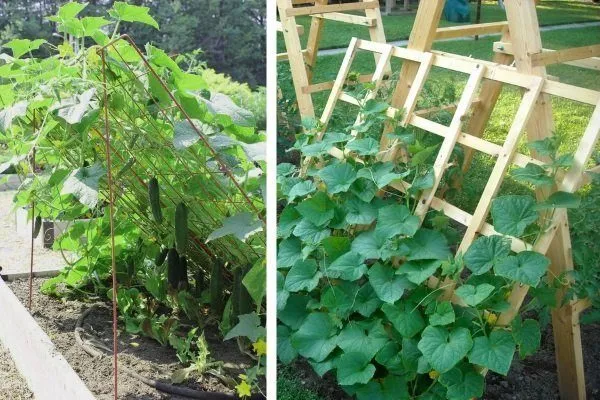
To secure the bushes, they are tied to the fence with rope. The advantage of this method is that the bush can be easily tied at different heights later.
Tying on arches and blinding
Sometimes, a large batch of cucumbers is placed under arches to which they are tied. To create these arched structures, bent rods are used, which are dug in next to each cucumber row.
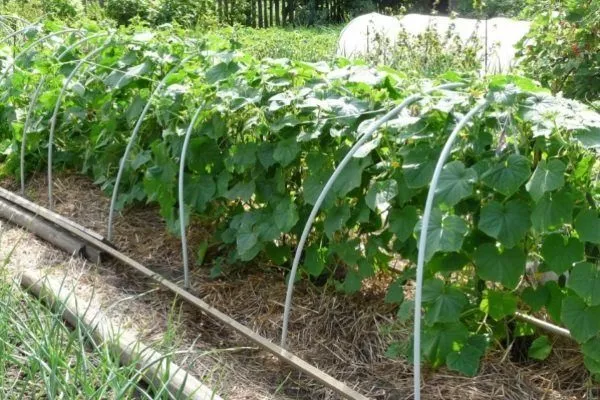
When blinding, the main stem of the plant is attached to a trellis. Then, excess shoots located at the top of the bush are cut off.
How to tie up cucumbers in a hotbed or greenhouse?
A two-meter trellis used to support the plant is installed on a profile located at the top side of the greenhouse. The trellis is typically made from materials such as:
- bast;
- thin branches;
- fabric scraps;
- jute twine.
Pieces of cotton fabric, 2-4 cm wide, are used to create a trellis of the required length. For this purpose, scraps of old textiles are used, sewn together. Unfortunately, such trellises are fragile and will not last long, so it is best to use branches from bushes or trees.
They are cleared of shoots and the bark is peeled off, and then a thin branch is attached to the top profile with wire. The bottom of the branch is buried in the ground to secure the trellis. The cucumber stems will grip this support structure quite firmly.
It's best to make a trellis from natural materials, as nylon will damage young shoots. Twine is attached to the top profile and then lowered down to the ground, securing it half a meter from the main stem. cucumber mesh, then there is no need to tie the vines, since the plant will cling to the net with the help of tendrils and will rise on its own without the use of supporting structures.
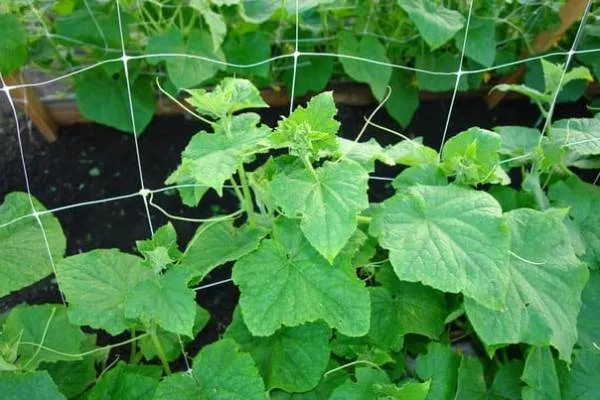
The mesh frame is constructed immediately before planting the cucumbers. To make it, you'll need eight stakes, each 8 cm in diameter and 2.5 m long. You'll also need four 0.8 cm long slats and four 4 x 4 cm slats, each 2.5 m long.
Next, drive in 4 pegs, each 1.8 m high, with a distance of 1.25 m between them. The tops of the pegs are wrapped with slats, and a net is installed on the frame.
Bush formation, pinching
When shaping the bush, the main stem is attached to a trellis so that the side shoots develop before the first buds appear. After this, the side shoots should be pulled toward the main stem. The tendril extending from the main shoot should be manually wrapped around the side shoot several times.
In the future, it will be necessary to periodically repeat this tying process. Unnecessary shoots should be promptly removed.
Side shoots are pinched before they grow 20 cm in length. The apical portion must be carefully trimmed away so as not to damage the plant. This method is also used for tendrils and axillary shoots. Here's the procedure for pinching cucumber shoots:
- the first 40-50 cm of the bush are completely “blinding”;
- after the next 40-50 cm, pinch off above the first leaf;
- After another 40-50 cm, pinch above the second, and then above the third.
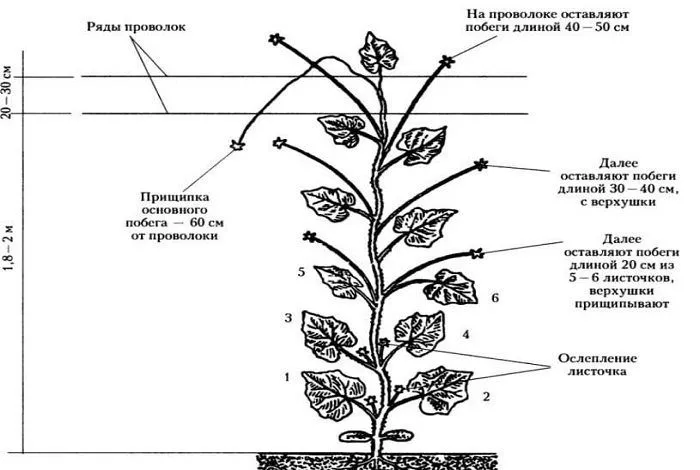
If the above plant care measures are not carried out, this will negatively affect the condition of the bushes and the quality of the future harvest.
Gardeners' Tips
When planting and tying cucumbers, gardeners advise adhering to the following rules:
- The bushes are tied up only when there are at least 8-9 leaves on the stem, the distance between the bushes is 1.5 m.
- If both tomatoes and cucumbers are grown in the same greenhouse, the room is divided into two parts, separated by a film curtain.
- Cucumbers are an easy-to-grow crop, but they do require a moist environment and frequent watering. Water the plants only with warm water to reduce the risk of disease.
- All damaged and dried fruits should be removed before the plant is fully ripe.
- There should be an angle of 60º between the stem and the shoots to avoid injury to the plant.
- When installing supports, it's best to have wooden stakes on hand, as iron ones oxidize during use and damage the plant. Reliable supports can also be made of plastic. However, for maximum reliability, plastic pipes will need to be driven very deep into the soil.
- Before driving the pegs into the ground, the ends are treated with a saline solution or using gasoline.
- ✓ The distance between plants when tying should be at least 1.5 m to ensure sufficient space for growth.
- ✓ The angle between the stem and shoots should be 60° to prevent injury to the plant.
Staking cucumbers, despite its labor-intensive nature, is a fundamental and essential gardening practice. This procedure helps improve the quality of the future harvest, prevent fruit decay, and facilitates care during the ripening period.