
The Nezhinsky cucumber is a cultivar. Its origins date back to the era of Catherine the Great (the second half of the 18th century). This variety was included in the State Register in 2009, but it gained popularity and demand much earlier. Breeders use it as a basis for creating hybrids.
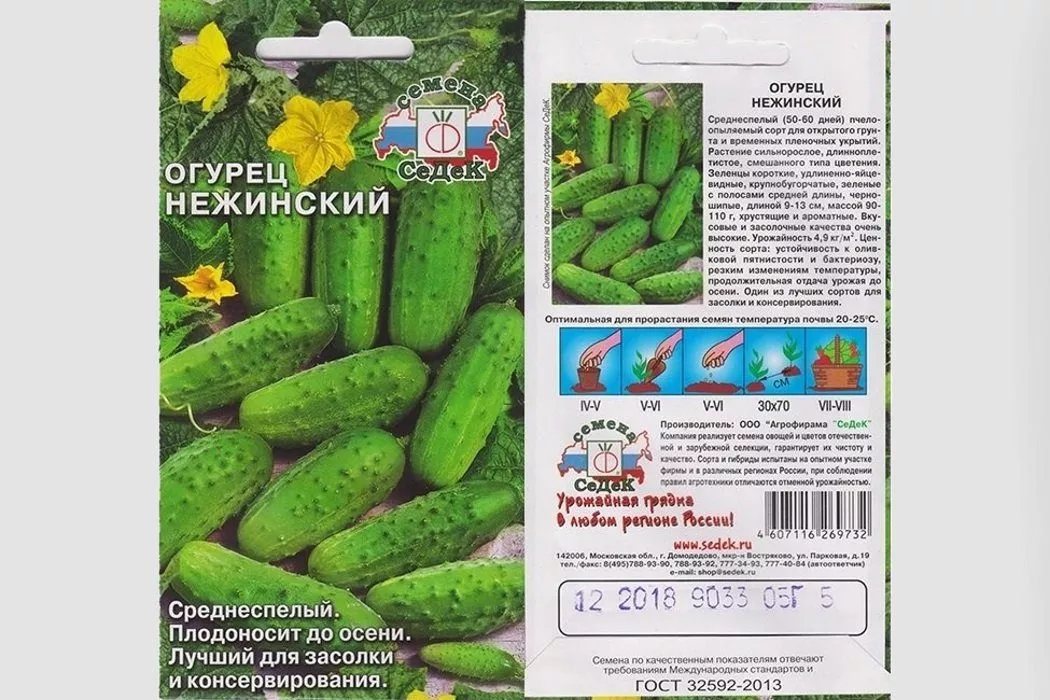
Cucumber seeds of the Nezhinsky variety
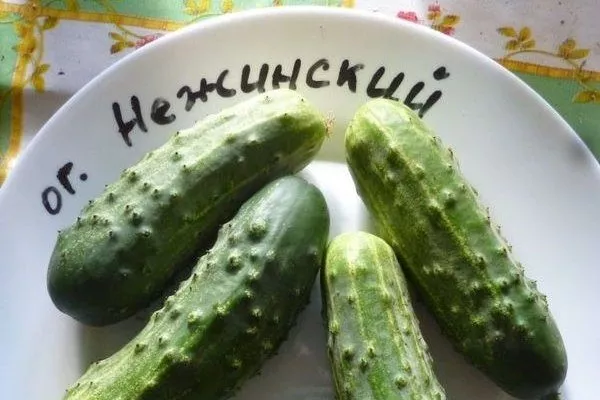
Cucumbers of the Nezhinsky variety
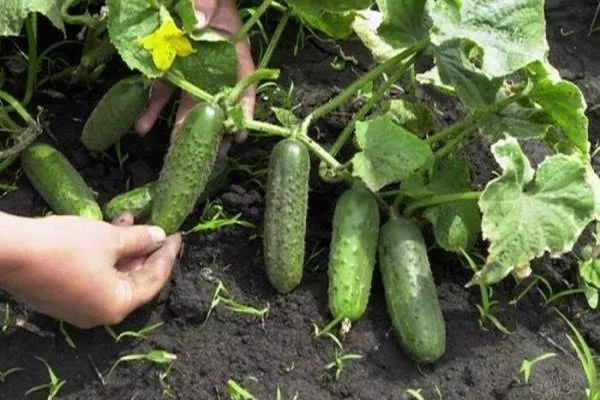
"Nezhinskie" cucumbers are ideal for canning. Pickled cucumbers turn out crispy.
Description of cucumber varieties
The Nezhinsky cucumber is a mid-season variety—the first harvest occurs around day 47. This variety is indeterminate, meaning stem growth is unlimited. It grows vigorously and can reach a height of up to 2 meters. Numerous lateral shoots also emerge quickly.
The Nezhinsky variety is bee-pollinated. It is grown primarily in open ground. Protected soil is also used for an early harvest. Coverings are temporary and removed once the desired outdoor temperature is reached.
The Nezhinsky cucumber is characterized by thin skin and small, black-tipped spines. The fruits of this variety are distinguished by a vibrant dark green color that blends with the foliage, and light longitudinal stripes. The cucumbers are ovoid in shape, reaching 10 cm in length and 4-4.5 cm in diameter. Each cucumber weighs an average of 100 g. The flesh is firm, juicy, and crisp, with a sweet flavor.
Due to its distinctive flavor and firm flesh, the Nezhin cucumber is commonly used for canning. Small black spines indicate that it is a pickling variety.
The Nezhin variety has a medium yield. Approximately 2-4 kg of cucumbers can be harvested per square meter.
Advantages and disadvantages
The popularity of the Nezhin variety is due to its numerous advantages:
- resistance to slight cold spells, temperature fluctuations, drought;
- open ground cultivation;
- long-term fruiting;
- good resistance to some diseases;
- the possibility of releasing seeds in the autumn;
- excellent taste;
- resistance to transportation;
- Versatility – cucumbers are delicious fresh and ideal for preserving in a variety of ways.
The Nezhinsky variety has few disadvantages. These include:
- bees are required for pollination;
- the need to form a bush.
Soil requirements
The soil for growing the Nezhinsky variety must be prepared in the fall. Manure should be added during this period; it must be fresh. In loamy soil, manure can be added in the year of planting, but no later than one month beforehand.
- ✓ Use only fresh manure for autumn application, avoiding rotted manure, to ensure maximum soil nutrition.
- ✓ For loamy soils, it is permissible to add manure in the spring, but no later than a month before planting, to avoid burning the root system.
Choosing the right planting location is also important. Melons are not recommended as a precursor to cucumbers. It's best to plant them after potatoes, tomatoes, and cabbage.
The soil must be light enough, otherwise the plant's root system will develop poorly. Heavy clay soil should be amended with compost. Before planting, be sure to dig the area and remove weeds. Mineral fertilizers are added during digging. These include potassium nitrate and superphosphate; application rates are indicated on the packaging.

Rules for sowing seeds and planting seedlings
The Nezhinsky variety can be grown in two ways: from seeds or from seedlings. The crop is usually planted outdoors.
If choosing seedlings, they should be planted in open or protected soil on the 30th day. They are grown as follows:
- Planting seeds for seedlings They should be grown in separate containers—peat pots (or peat pellets) or plastic containers. Boxes are not recommended, as this variety does not transplant well.
- Daytime temperatures should be between 18 and 22 degrees, with a drop at night being acceptable.
- Overcooling of the soil and drafts should be excluded.
- The soil should be moderately moist; the seedlings should not be overwatered.
- Natural light alone is not enough for growing seedlings. LED or fluorescent lamps are necessary.
- Plant seedlings when the soil warms up to at least 12 degrees – this temperature should not be on the surface, but at a depth of 25-30 cm, where the root system of the crop will develop.
When growing Nizhyn cucumber from seeds outdoors, temporarily cover the plants with plastic during frosts or in cold climates. Seeds should only be sown in warm soil. Planting is typically done in mid- to late May, when temperatures should be at least 15-20 degrees Celsius.
The seeds are planted after preliminary soaking. This should be done according to a specific pattern:
- depth of occurrence – no more than 3 cm;
- spacing between rows – 0.5 m;
- the distance between holes is 30 cm.
When planting the Nezhinsky cucumber variety, it's recommended to replace furrows with ridges. They're convenient for installing supports, which will be absolutely necessary.
To form ridges, first dig trenches—going 30 cm deep. Organic matter—rotted manure and compost—is placed into the prepared trenches. Then, the soil is ridged.
When planting seeds, plant them 2.5-3 cm deep. Place 3-4 seeds in each hole. Once they sprout, thinning will be necessary. Only one of the strongest seeds will remain.
After planting the seeds, apply mulch with peat, compost, or humus. Cover the bed with a covering material, then with PVC film. Remove this film immediately after the seedlings emerge.
Post-planting care
Caring for the Nezhin cucumber after planting involves the following steps:
- WateringThe soil should be moistened every two days. When temperatures rise and there is no precipitation, switch to daily watering. When watering, it's best to use a watering can, directing the stream at the soil above the root system. Avoid getting water on the plant leaves, as this can cause burns and rot.
- LooseningThis should be done after watering. Roots should not be exposed. Hilling is not required when mulching the top layer.
- ThinningThis is done to eliminate weak plants and ensure healthy ones have sufficient space. If all the seedlings are strong, the excess shoots can be transplanted; the harvest from these plants will be delayed.
- SupportsThis step is essential. The system is installed early, when no more than three true leaves have appeared. The stem must first be stretched along the support and then secured.
- Top dressingThis measure is necessary at any stage of growth, but especially during fruit set. Fertilization can be root or foliar, dry or liquid—alternating different types of fertilizer is effective. Urea, copper sulfate, potassium permanganate, boric acid, green manure, and stove ash can accelerate fruit ripening.
- A prerequisite for growing Nezhin cucumber is bush formationPinch the top of the plant after the fifth true leaf has formed. When first-order lateral shoots appear, wait until they grow and pinch them above the fourth or fifth leaf. Leave the second-order shoots alone—they are needed for the main fruiting. Male flowers, which contribute to pollination, should also be left.
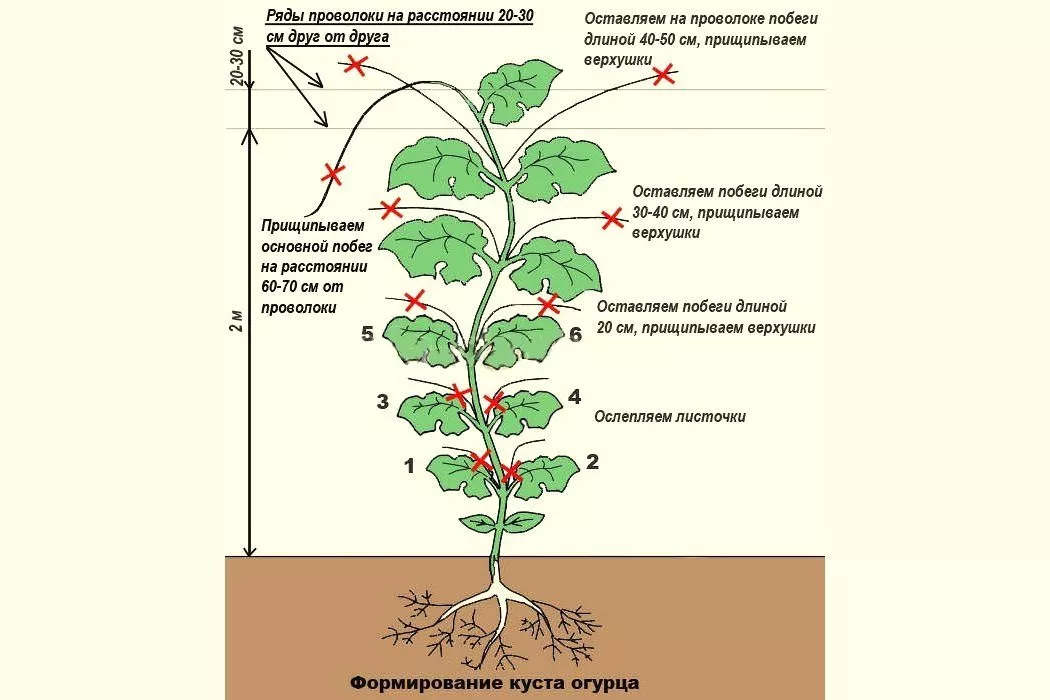
How to achieve a bountiful harvest?
To ensure good fruit production, the Nezhin cucumber is recommended to be planted outdoors. This is because the crop is pollinated by bees, which is difficult in greenhouses and hotbeds.
To ensure a good harvest, it's important to pick ripe fruit promptly. It's recommended to do this every other day. Timely harvesting stimulates the growth of new buds.
To prolong the fruiting period of the Nezhin cucumber, it is recommended to harvest small fruits without waiting for them to grow to record sizes for the variety.
Diseases and their prevention
The Nezhin cucumber is resistant to fungal diseases, but preventative measures are recommended to ensure the plant's health. This includes removing lower leaves and tying up the vines promptly. Fungicide sprays are recommended, and should be applied after prolonged rainfall.
The Nezhinsky variety is susceptible to powdery mildew. It can be prevented by spraying with a special solution: 20 grams of urea and 1 liter of mullein per 10-liter bucket.
| Method | Efficiency | Notes |
|---|---|---|
| Spraying with a solution of urea and mullein | High | Requires reapplication after rain. |
| Use of fungicides | Very high | Recommended for prevention after prolonged rains |
The plant can be infested by aphids. A soap solution and wood ash will help get rid of these small pests.
Harvesting and storage rules
Harvesting should be done immediately, as the Nezhin variety doesn't like to hang on the vine for long, as this will slow the growth of new ovaries and fruits. This variety is mid-season, so harvesting is done in July-August. It's best to do this in the morning or evening hours, when sunlight is at its lowest.
Don't wash the harvested cucumbers, as this will damage their natural protective layer. Cucumbers should be immediately placed in the shade, leaving the stems attached.
The successful and long-lasting storage of Nizhyn cucumbers depends on proper selection of the fruits. This is done immediately after the harvest. Only dry and undamaged specimens are suitable for storage.
Nizhyn cucumbers will keep in the refrigerator for 3 days. They can be stored in a plastic bag for 1.5 weeks if you place a damp cheesecloth over the untied bag. The shelf life can be extended to 2 weeks by placing the cucumbers in a bag, wrapping each one in a napkin first. The temperature should be above 32 degrees Fahrenheit (0 degrees Celsius).
Cucumbers of this variety are ideal for preserving, pickling, or marinating. Their flavor and crunch are preserved even when stored in brine for long periods.
The Nezhin cucumber has been prized for its flavor for centuries. This variety is excellent for pickling. To ensure a high-quality and abundant harvest, proper care and protection from various diseases are essential.