
Monolith cucumbers are a modern hybrid that has gained popularity among gardeners due to their excellent characteristics and versatility. They offer numerous advantages, making them ideal for a variety of growing conditions. They combine early fruiting with excellent productivity. Proper care is key.
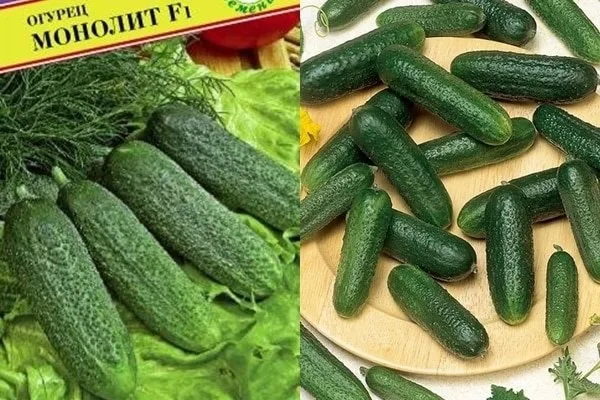
Description of the Monolith cucumber variety
Developed by Dutch breeders from NUNHEMS in 2009 and included in the State Register of Breeding Achievements of the Russian Federation in 2013, this indeterminate variety yields 2-3 harvests per season thanks to the ability to replant after harvesting ripe fruits or gherkins.
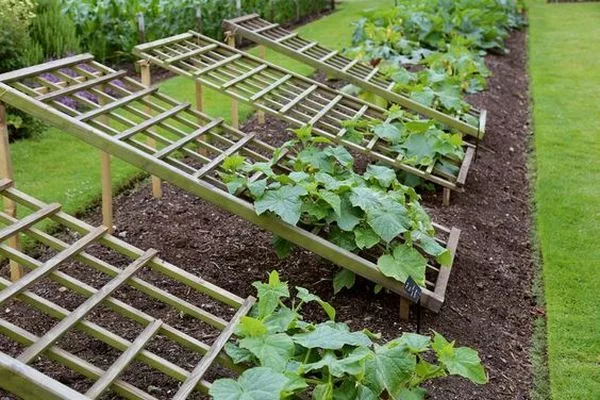
The crop is grown using trellises both in protected areas and in open ground. Monolith has high parthenocarpy, ensuring a consistently high yield without the need for pollinators or insect intervention.
Description of the plant and fruits
A plant of unlimited growth with a strong and flexible central stem of medium volume. The stem is fibrous, ribbed, and finely spined. The lateral shoots are few in number, thin, and light green.
Characteristic features of the variety:
- Leaves - medium-sized, heart-shaped with wavy edges and obvious veins, lighter than the main background, densely covered with stiff hairs.
- Root The system is superficial, overgrown, with a root circle of about 40 cm and a poorly developed central root.
- Flowering – Abundant, simple, bright yellow flowers are collected in threes in a pre-leaf node, with high formation of ovaries.
The distinctive features of the fruit are its uniform shape and even ripening. If the harvest is not collected on time, the cucumbers, once they reach biological maturity, retain their shape, color (they do not turn yellow), and flavor.
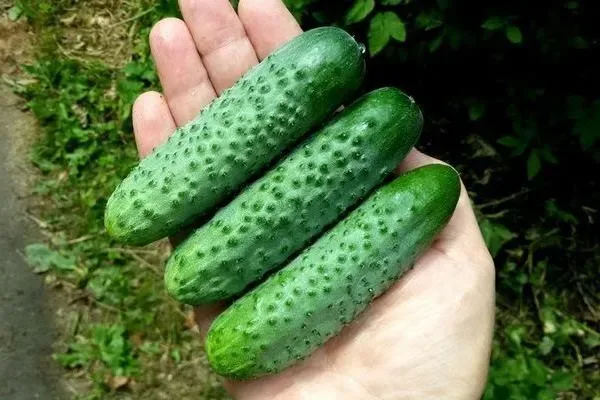
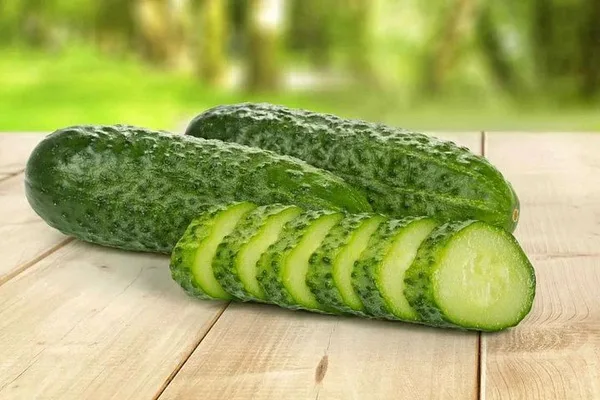
Cucumbers are oval-shaped, up to 13 cm long, and weigh approximately 105 g. The skin is dark green, with a glossy surface featuring beige stripes, small bumps, and soft spines. The skin is thin, dense, and tough, making it resistant to mechanical damage.
The flesh is tender, juicy, and dense, with no voids. The flavor is balanced, without acidity or bitterness, with a light aroma.
Main characteristics of the variety
It is highly stress-resistant. The hybrid is zoned for temperate climates and can withstand temperatures as low as +8°C. Young plants do not require overnight shelter, and recurrent spring frosts do not cause significant damage.
If damaged, the bush completely recovers the affected areas within five days, without affecting the timing or level of fruiting. It does not slow down photosynthesis in the absence of ultraviolet light. Fruiting remains stable even when grown in partially shaded areas.
Productivity
Monolith is characterized by ultra-early fruiting: just 35 days pass from the emergence of young shoots to harvest. The young fruits reach biological maturity in May. The average yield per bush is 10 kg. With proper planting timing, up to three harvests can be harvested per season.
Resistance to pests and diseases
During the process of adapting the crop to Russian weather conditions, work was simultaneously carried out to strengthen its immunity to infections and pests typical of this climate zone.
The plant is resistant to leaf mosaic virus and downy mildew, but anthracnose may develop with prolonged rainfall. To prevent fungal infections, treat the bushes with copper-containing products, and if the disease is detected, apply colloidal sulfur. Insects do not attack the crop.
Pros and cons of the variety
Monolith is a hybrid, so using your own seeds is not possible. Gardeners have reported no other drawbacks.
Growing rules
This early-ripening variety is grown using seedlings. This reduces the ripening period by at least two weeks. The seedlings grow quickly and are transplanted into the garden 21 days after sowing.
- ✓ Optimum soil temperature for planting seedlings: not lower than +12°C, despite resistance to +8°C.
- ✓ The need to use root formation biostimulants during transplantation to minimize stress.
Regionality and planting dates
This variety is adapted for cultivation in the Lower Volga region (Saratov, Astrakhan, and Volgograd regions). Sow the first batch of seeds at the end of March, then the next batch 10 days later, and then a week later.
Caring for cucumbers
The plant does not tolerate transplanting well, and if the roots are damaged, it will become ill for a long time. Grow seedlings in peat pellets or cups to be placed in the beds along with the containers. If the seedlings are growing in a container, transplant them carefully along with the root ball.
Planting pattern for open ground and greenhouse:
- Dig a hole to a depth corresponding to the peat cup.
- Place the planting material together with the container.
- Fill the soil up to the first leaves and water.
- Sprinkle the root circle with ash.
- The distance between plants should be 35 cm, the row spacing 45 cm, and three plants per square meter. Sow seeds in holes 4 cm deep, with 35 cm between each hole.
After cultivation, provide the plants with thorough care. Regular watering is the key to a bountiful harvest. The fruits will be juicy and sweet with regular moisture. Water them daily early in the morning before the heat sets in or in the evening after the heat subsides.
Water the bushes at the roots to prevent yellowing and leaf rot. Approximately 4 liters of water are needed per seedling. Use warm water, preheated in the sun.
The crop requires regular feeding to ensure good growth and high yields. A brief guide to feeding:
- After the first true leaf appears. Use a complex fertilizer containing nitrogen, phosphorus and potassium (15-20 g per 10 l of water) once every 10-14 days.
- In the budding phase. Use fertilizer with a high content of phosphorus and potassium (15-20 g per 10 l of water) – once every 10-14 days.
- During active fruiting. A complex fertilizer with an equal content of macroelements or specialized mixtures for cucumbers (15-20 g per 10 l of water) is effective – once every 7-10 days.
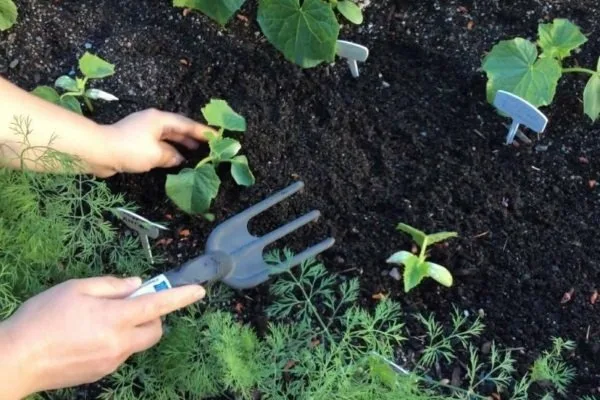
As weeds grow or a crust forms on the soil surface, loosen the soil.
Reviews
Monolith cucumbers are characterized by early maturity, disease resistance, and low maintenance. This hybrid is suitable for both professional farmers and amateur gardeners. Proper care is essential to ensure bountiful harvests and strengthen the plant's immune system.