
There are several ways to grow cucumbers, depending primarily on climate conditions and available growing space. Don't worry if you don't have land or live in a region that's too cold. Try growing cucumbers in buckets. We'll discuss how to do this in the article below.
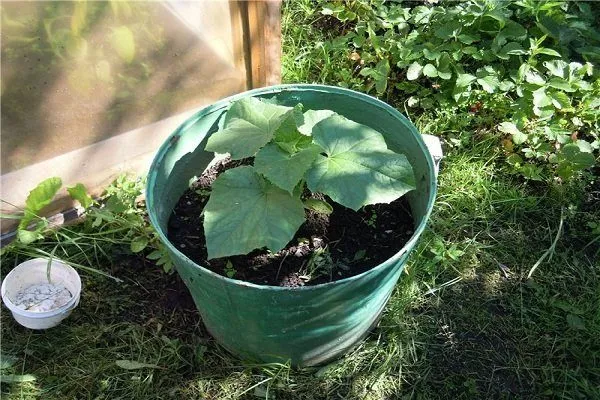
What varieties of cucumbers are suitable for growing in buckets?
| Name | Pollination type | Ripening period | Productivity |
|---|---|---|---|
| Bush Gift | Parthenocarpic | Early | High |
| Microsha | Self-pollinating | Average | Average |
| Bushy | Parthenocarpic | Early | High |
| Actor | Self-pollinating | Average | High |
| Hermes F1 | Parthenocarpic | Early | Very high |
| Abbot | Self-pollinating | Late | Average |
- ✓ Consider not only the type of pollination and ripening time, but also the variety's tolerance to stressful conditions, such as limited soil volume.
- ✓ Pay attention to varieties that have a compact root system and do not require a lot of space to grow.
When choosing cucumber varieties for growing in confined spaces, choose those with root systems that don't branch much and take up little space. Otherwise, the plants will lack nutrients due to root suppression and stunted growth. Therefore, consider bush and short-stemmed cucumber varieties (Kustovoy Dar, Mikrosha, and Kustovoy).
It's advisable to plant parthenocarpic or self-pollinating cucumbers (such as "Akter," "Hermes F1," and "Abbot") in buckets. This allows them to be independent of pollinating insects and weather conditions. Parthenocarpic varieties develop fruit without pollination, while self-pollinating varieties require no assistance in this process.
For cultivation using this method, choose seeds of varieties and hybrids sold in factory-sealed packaging. This ensures that the seeds are genuinely of the given variety and have undergone pre-planting preparation.
When planting your own seeds, please note that the most productive ones will be those that are stored for at least 2 years.
Advantages and disadvantages
Growing cucumbers in buckets has its pros and cons. The advantages of this method include:
- the possibility of cultivation in an apartment without a plot of land;
- independence of location and the possibility of moving containers with cucumbers;
- individual care for each plant of the crop;
- independence from predecessors, lack of importance of crop rotation;
- early fruiting;
- cucumbers are environmentally friendly due to the minimization of the need for the use of chemicals;
- convenience in agricultural technology and harvesting.
Features of cultivation
To use the method of growing cucumbers in buckets, it is worth knowing about its features in order to be able to avoid mistakes or correct them at an early stage.
Selecting and preparing a bucket
Any container with a capacity of over 5 liters is suitable for this cultivation method. Dogwood containers are preferred. Plastic buckets should be modified before planting: make several drainage holes in the sides and bottom. Planting container options include:
- old buckets;
- cut canisters;
- plastic containers;
- barrels;
- large cellophane bags;
- old car tires, etc.
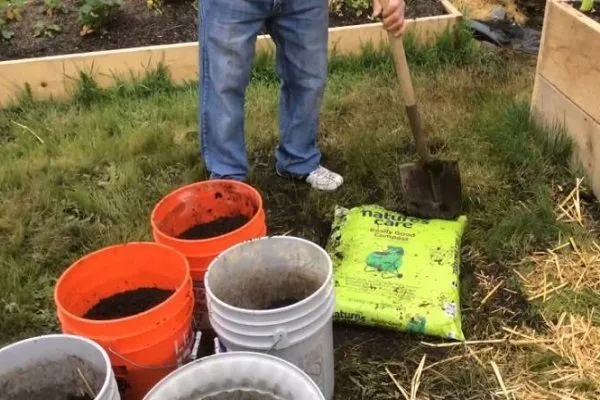
When planting cucumbers, choose buckets with a wide enough diameter to avoid accidentally damaging the plant during cultivation. Be sure to place a drainage layer of expanded clay or river rocks at the bottom of the container.
Soil preparation
You can purchase a cucumber planting mix from the store or prepare it yourself. The ideal soil for this vegetable crop is a mixture of the following ingredients in equal proportions:
- sand;
- humus;
- manure;
- turf.
Remember that homemade soil needs to be disinfected. To do this, bake it in the oven for 20 minutes at 200°C. This prevents fungal infections of cucumbers, which can be caused by any of the ingredients in the soil mixture.
To enrich purchased planting soil with microelements and nutrients, add any complex fertilizer. Dilute 10 g of fertilizer in 10 liters of water and water the soil at a rate of 1 liter of fertilizer per 10-liter container.
Sowing cucumbers
Once you've chosen a container, prepared the soil, and purchased cucumber seeds, you're ready to plant. If you're using personal seedlings, we recommend pre-treatment and disinfection.
Prepare a light pink solution of potassium permanganate and soak the seeds in it, wrapped in a layer of cheesecloth, for 15-20 minutes. Then rinse them with clean running water.
The action of manganese will destroy fungal spores, if any, which will prevent the occurrence of diseases during the growing season of cucumbers.
Before planting, it's recommended to calibrate and germinate the seeds. Select the largest seeds and place them in a saucer lined with cotton cloth or cheesecloth. Pour warm water over them until they're just covered. Cover with a layer of cloth, making sure it doesn't dry out. Leave them until sprouts appear. Then, rinse them carefully and let them dry slightly for easy use during planting.
Please follow the following landing algorithm:
- Plant 3-5 cucumber seeds in each bucket, placed on the east or south side, deepening them 3 cm into the soil.
- If they all sprout, they can be planted out by picking.
- After sowing, water moderately.
- To maintain the moisture level in the soil, you can place a plastic bottle filled with water in a bucket, making small holes in it.
Once the seedlings emerge, install supports for the vines. These can be wire arches or taut ropes attached to a central support. The choice of support structure depends entirely on the gardener's capabilities and imagination.
For more information on growing cucumbers in buckets, watch the following video:
Caring for cucumbers in buckets
The cultivation and care of cucumbers grown in buckets differ slightly from other growing methods. For example, the plants don't require shaping by pinching out side shoots, as the vines don't grow long with the right seeds. Weeding is eliminated because weed seeds are destroyed by proper soil preparation. All this makes it easier to care for the vegetable crop as it grows and the fruit ripens.
Caring for cucumbers in buckets involves ensuring the following conditions:
- Placing the buckets in a sunny position will ensure sufficient light for the crop. Use grow lights if necessary, especially during the seedling growth stage.
- Don't allow the soil in containers to dry out. Watering in small containers requires more frequent watering, as moisture evaporates and is used up faster than in normal growing conditions. Water should be warm.
- Sprinkle water. Cucumbers love this treatment and respond positively to it.
- Loosening the soil will increase aeration, preventing fungal diseases and providing oxygen to the plants. Add additional soil around the stem as needed or mound it with existing soil to prevent the roots from becoming exposed.
- When fruit set, feed the cucumbers with an ash infusion. To prepare it, dissolve 100 g of wood ash per liter of water. Let the mixture sit for 24 hours, then apply a root dressing.
- Water plants in the morning to avoid fungal diseases.
- Use warm water for watering to avoid shocking the roots.
- Feed the plants every 2 weeks with a complex fertilizer diluted in water.
For information on tying up cucumbers in buckets, watch the following video:
Harvesting cucumbers
Cucumbers are harvested as needed. The frequency of picking ripe cucumbers depends on the desired size and the yield of the variety. The harvest is carried out early in the morning or in the evening after sunset.
When harvesting, be careful, as leaving the fruit on the vines leads to over-ripening and yellowing of the cucumbers, which reduces the formation of new ovaries.
Check for cucumbers daily, and harvest at least once every 2-3 days. Avoid twisting the vines to avoid damaging them. Remove any deformed fruits immediately to prevent the plant from wasting energy and nutrients on the useless growth of such a crop. Harvest cucumbers, leaving the stems on the plant.
Reviews from gardeners
Growing cucumbers in buckets isn't particularly difficult; in fact, it offers advantages where harvesting is impossible by other means. The key is to consider the crop's needs and properly prepare and organize the growing process. Cucumbers grown "in a bucket" delight with their flavor and aroma.