
Most cucumber varieties require staking to properly shape the bush and fruit. In this article, we'll discuss favorable conditions for staking, as well as a variety of step-by-step methods for greenhouses and open ground.
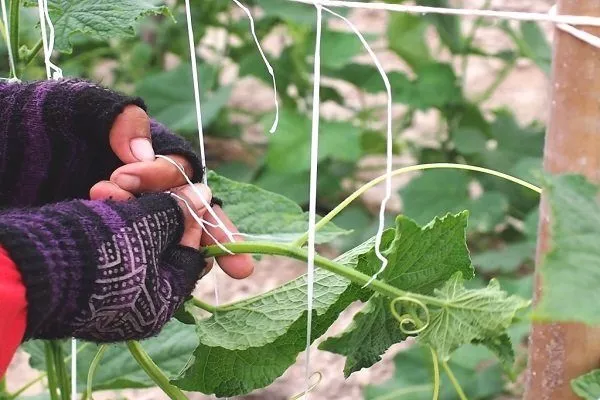
Reasons for tying up cucumbers
Proper staking of cucumbers plays a significant role in the subsequent development, health, and fruiting of the plant. When left on the ground, the long branches of the bushes are susceptible to rot and other diseases. Fruits in a humid environment lose shape, become diseased, and may not reach their full potential.
Staking vines offers numerous advantages and conveniences that will help you achieve good results from each plant. The main benefits include:
- Convenient organization of spaceA tied-up bush takes up 70% less space in the garden bed, allowing you to place more plants compactly.
- Easy to care for. A tied plant is easier to care for, fertilize, and water. Harvesting is easier because you don't have to search for them on the ground under the leaves. The cucumbers are clean and uniform.
- Abundance of harvest. After vertical fastening, the bush begins to grow many more shoots, on which new fruits are formed.
- Disease resistance. If the lower branches are diseased, the cucumber plant can send up new, healthy shoots. This also improves the flow of light and air to the leaves and stems, helping them grow without damage.
Put some effort into careful tying, you will see that it gives a good result and the efforts will pay off with a rich harvest.
It's time to tie up cucumbers
After planting the bushes, wait until they become established. The best time for the first staking is when the bush reaches 30 cm in height. The plant's trunk becomes stronger and enters the active growth phase. By this time, it will have formed 4-5 full-fledged leaves.
- ✓ Tie up the plants when they reach 30 cm in height and have 4-5 full leaves.
- ✓ Ensure the distance between horizontal garter levels is at least 25 cm to allow the shoots to grow freely.
Remember that allowing a bush to grow beyond 30 cm without support is dangerous for the stem. It becomes difficult for the plant to bear weight. This can lead to death if the stem breaks sufficiently.
Don't rush to tie up a plant that's too young. It's unnecessary when it's still small. Moreover, once the bush reaches the desired height, the staking and support will have to be redone.
Peculiarities of tying cucumbers in open ground
In open ground, bush shoots especially need tying up if there are no fences or trees nearby; the shoots spread along the ground, trying to cling to a support, and many of them die.
The design and type of tying can vary, but the main rule is to use a gentle approach. The supporting ropes should not be pulled too tightly, as they could cut the delicate stems of the bush under the weight of the fruit.
When choosing a planting and staking method for your garden, consider the total area and number of plants. The type of structure determines the compactness of the planting.
If space is tight but you need to accommodate as many plants as possible, choose linear structures. They can be planted very close together, leaving a clear path between rows.
Linear tying methods are also well suited for tomatoes, and standard beds for different crops can be arranged in the most compact manner at a short distance.
Don't use synthetic cords or jute ropes to secure branches, as they damage branches and leaves. Strips of old, soft fabric, 1.5-2 cm wide, work well.
- ✓ Use only soft, natural fabrics at least 2 cm wide to prevent damage to the stems.
- ✓ Avoid synthetic materials that may cause overheating or cuts on plants.
No special weather conditions are required for the first tying. The soil condition is crucial for the installation of the structures. Overly wet soil after rain will prevent the stakes from being firmly inserted and secured in place. Dry soil will make digging difficult.
Postpone the natural weave garter if there's a strong, gusty wind outside. It's more careful and easier to do this in calm weather.
Horizontal method
This simple and straightforward method is well suited for beginners; the design is straightforward and can be completed in a short period of time.
- Drive two pipes or thick metal rods into the ground at the ends of the bed. The rods must be securely fastened to withstand the tension from the bushes.
- Attach taut ropes between the pipes in several stages. Make sure the ropes aren't too tight and don't cut the stems. Place the ropes along the entire height of the pipes, spaced 25 cm apart.
- Start tying the stem from the bottom rope; the growing thin shoots can be directed downward. Try to position the bush vertically, but do not tie it too tightly to the support, as this may damage its surface.
The advantage of this method is its simplicity. The disadvantage is the horizontal position of the ropes; once secured to one level, the vine cannot independently reach the other. Therefore, cucumbers often begin to grow sideways or cling to adjacent stems when tied this way.
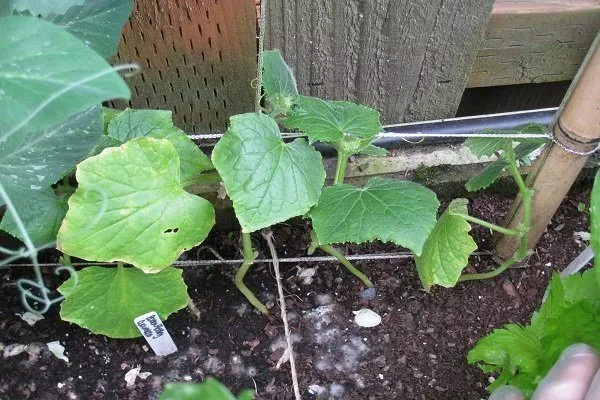
You can solve this problem by placing vertical ropes between the horizontal levels. This should create a grid-like structure that makes it easy to climb to the next level.
Vertical method
The second option is a simple design for securing plants. The support is formed into a "U" shape, requiring not only vertical side supports but also a sturdy top crossbar.
- Install the side supports. These can be metal pipes or long wooden stakes. Drive the supports deep into the soil so that they are stable and secure.
- To create the top support, you can use thick wire. Pull it taut and secure it to the side pipes as tightly as possible. If you're using a wooden base, you can use a wooden beam instead of wire. Secure it with nails on both sides.
- Tie a rope to the top support above the bush and pull it down.
- Secure the bottom end of the rope to the ground using a metal rod. Bend it in half and sink it into the ground, leaving a loop at the top for attaching the rope. Avoid placing the rod too close to the stem to avoid damaging it.
The advantage of this method is its compactness – the bushes are separated from each other, grow along one guide and do not grow horizontally.
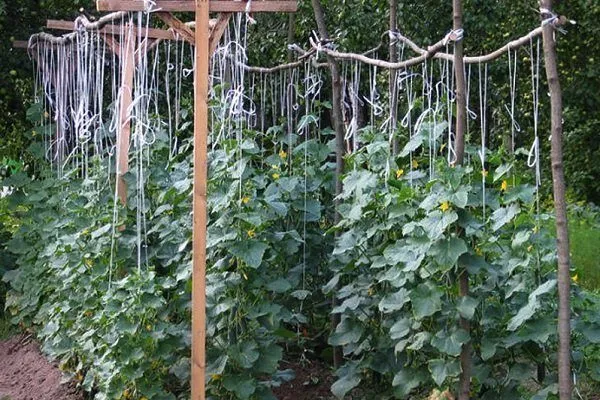
In many cases, the lower end of the rope is tied directly around the base of the plant stem. This method is also possible, but be careful with the rope tension. If the end is tied too tightly and the rope itself is under tension, the bush may be damaged. Breaks in the stem at the base will lead to drying out and death.
Using the grid
One of the most aesthetically pleasing and convenient methods of tying up plants is using trellis mesh. The mesh should be purchased at a gardening store in advance. Before purchasing, determine the length of the beds so you can purchase the correct length.
- To secure the mesh, you'll need two vertical supports, pipes, or beams. Drive them deep into the ground at the far ends of the row.
- Between the bases, stretch the net from the ground, slightly away from the stems of the bushes.
- Secure the mesh around the perimeter with wire.
The disadvantages of this method include the need to purchase the mesh itself and some difficulty in installation. However, the advantages far outweigh the disadvantages.
Read on to find out how to choose a net for cucumbers or make one yourself. this article.
The trellis is installed for several years and does not need to be removed for the winter. As they grow, the cucumber plants will climb naturally and arrange themselves on the trellis; staking is not necessary. Periodically, guide the vines in the desired direction and straighten them out.
The netting method makes harvesting, maintenance, and care of the bushes easy. The vines and leaves receive sufficient air and light.
To see how easy it is to install a net for cucumbers, watch the following video:
Modern methods of garter
As gardening advances, new methods of planting, maintenance, and placement emerge. Beyond the standard cucumber rows, try unusual staking and planting options.
Cucumber Tree
The method got its name from its unusual appearance: mature bushes in this type of garter resemble the crown of a tree strewn with cucumbers.
- Form a square bed to plant the cucumber tree. Support it with wide boards on all four sides.
- Plant the seedlings along the edges inside the square, placing the bushes at a distance of 30-35 cm from each other.
- Take four supports made of wood or metal and sink them into the ground at the corners of the square so that their upper ends connect in the center.
- Secure the top ends of the supports with wire to secure their position.
- Stretch rows of ropes around the entire perimeter of the resulting structure to support the bush. Space the ropes 30-35 cm apart.
This method is aesthetically pleasing, but it's time-consuming and requires a large area for a small number of shrubs. The advantage is that it can be used multiple times. Install a high-quality, sturdy structure, paying attention to detail and fastenings, and it will last for years.
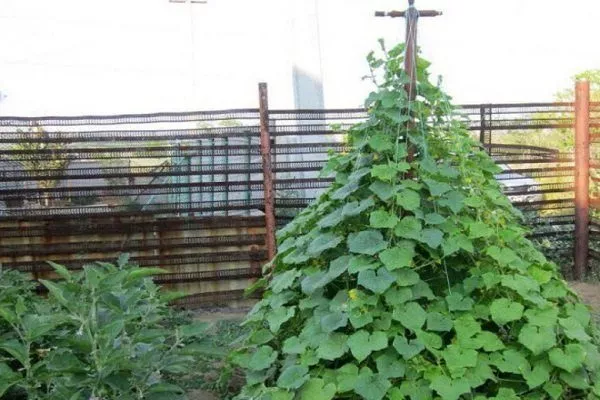
The ropes will need to be replaced every season. If desired, you can use a special net, which eliminates the need to remove it in the fall.
Barrel method
This method is well suited for limited space. The plant container can be placed anywhere on the property; it doesn't take up much space.
If you're using a tall, large barrel, it will serve both as a container and a support. Place the barrel, fill it with soil, and plant 3-4 bushes, depending on the barrel's diameter.
In this case, tying up is not necessary; the cucumber vines will descend down the barrel and bear fruit normally.
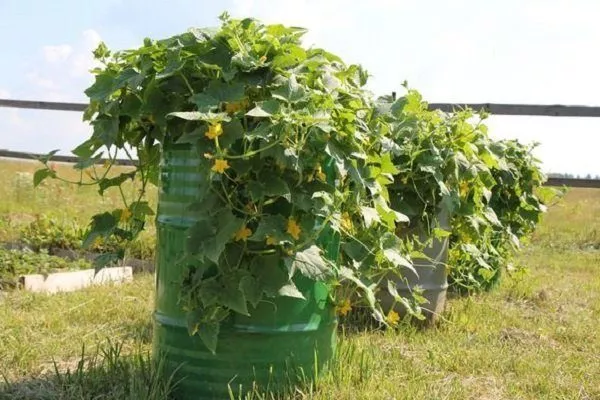
Read about how to plant and grow cucumbers in a barrel. next article.
A similar method can be used using buckets or small flasks.
- Place the container under the tree and plant 1-2 bushes in it.
- To assemble the weaving support, secure the end of a strong rope into the ground near the stem, then thread it through a tree branch.
- Secure the bottom end of the rope next to the stem of another bush so that the structure forms the letter "L".
This method does not require you to tie the vines yourself; they will stretch along the vertical rope and grow on their own.
Natural trellis
This method is inexpensive and labor-saving. It involves planting bushes along a property's boundary—a fence or mesh. The bushes are spaced 20-25 cm from the base of the fence, and diagonal ropes are stretched alongside them to the top of the fence.
The bush begins with a cord, and by the end of its growth, it covers almost the entire hedge, like grapes. The only drawback is the need to clear the hedge of dead vines in the fall.
Hybrid method
An interesting design variation involves driving trellises into the ground on three sides, forming a triangle. The upper ends of the supports are connected, resulting in a pyramid-like structure.
- Install supports on three sides at a convenient distance. You can use either metal or wooden supports for installation.
- Connect the upper parts of the supports with wire or secure with nails.
- Stretch ropes or mesh between the supports and secure the fabric with wire.
Since the vines are angled, the bushes can easily climb and reach new heights. This method is suitable for small beds of two or three plants, or for a new type of cucumber planting—a circular bed.
To learn how to make a cucumber trellis yourself, watch the following video:
Uses of plastic bottles
This method describes not the construction of the support, but rather a method for attaching the stem to a base or rope. A plastic bottle is cut into strips, then wrapped around the stem of the bush and the main rope. The plastic strip is stapled, forming a loose "clamp" around the stem.
The downside of this method is the plastic. It has thin, sharp edges, and this type of tying can cut the stem when bent. Plastic also contaminates the soil; if such a structure is lost, it will remain in the ground for many years.
Tying under the arches
The simplest method for low-growing cucumber varieties is to install metal arches above the bushes. Bent rods are driven into the ground so that the top of the arch is 35-40 cm above the ground.
The bushes are initially tied to arches, and then the vines grow horizontally on their own along the upper supports of the rods. This method is suitable for varieties with medium vine growth and height.
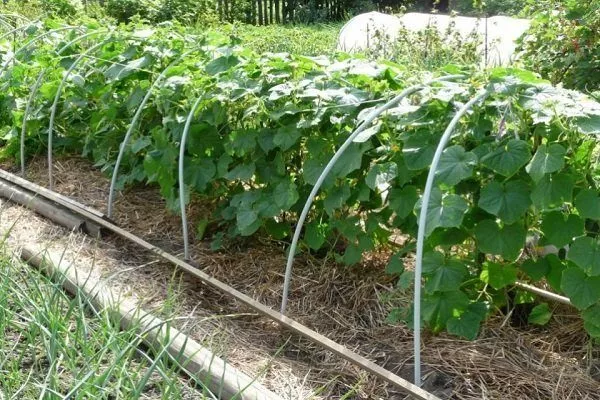
The disadvantage of this method is the dense weaving. The bushes can become intertwined, making it difficult not only to care for them and provide access to light, but also to harvest.
Tying to ladders and arches
This method got its name from its visual resemblance to a staircase or arch. The difficulty lies in the cost of purchase and the time required for assembly. This type of garter has a pleasing appearance and will last for many years.
- Choose and purchase a garden arch or a structure similar to a folding ladder at a garden supply store. These types of structures are typically used for decorative vines, but cucumber vines also work well for this purpose.
- Install the structure on the site and prepare the soil around it. Bushes can be planted on one side or both sides of the arch.
- After planting, periodically throw the bush shoots over the new level; it will secure itself on its own.
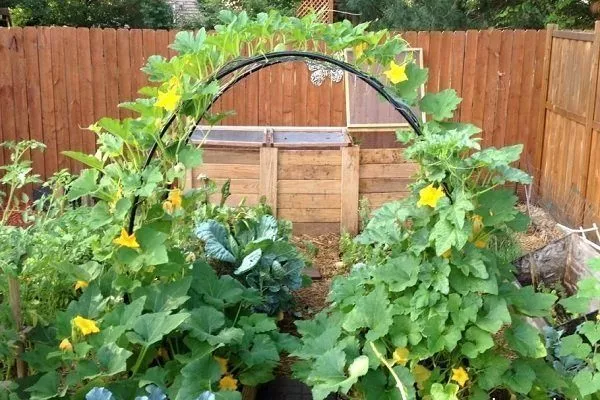
This method is more aesthetically pleasing, the structure is large, and few shrubs are used. Therefore, it's suitable for large areas where space is an issue.
Pyramid tying
This style is similar to the cucumber tree garter, but differs in the formation of the beds and the planting method. As they grow, the cucumber vines will climb the garter independently, forming a pretty "Christmas tree" of bushes.
- To create a pyramid, choose a planting site and place several wooden or metal sticks in the ground, arranging them in a circle.
- The upper ends must be connected with thick wire to form a conical pyramid.
- Stretch the ropes across the bars in several layers.
- Plant bushes around the pyramid from the outside; there is no need to reinforce the structure with boards.
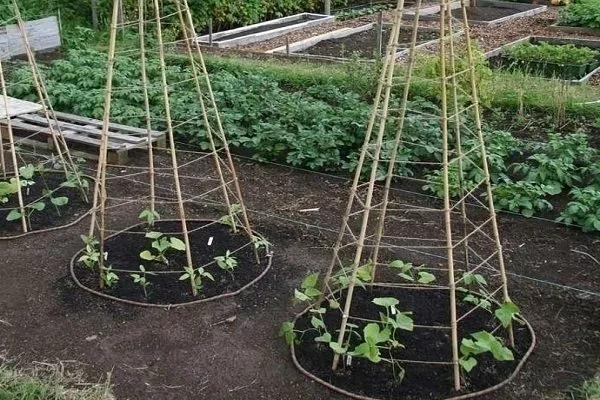
The only drawback of this method is the limited accessibility of the pyramid's interior. If a fruit-bearing vine begins to grow inward and becomes entrenched, it will be difficult to remove.
Tying cucumbers to stakes
For those choosing low-growing cucumber varieties, a simple staking method is quite suitable. Wooden stakes are installed next to each bush. The stake height should reach the maximum growth of the plant's vines.
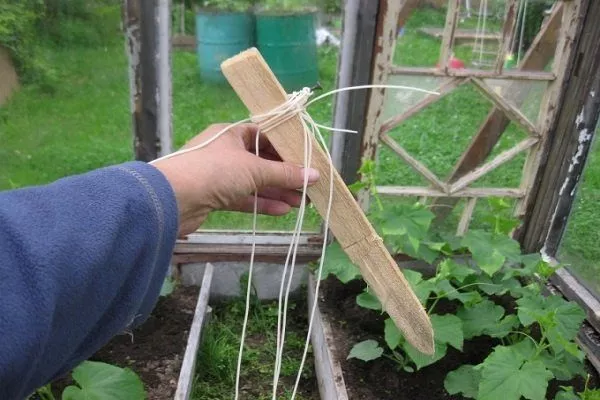
The garter is attached to the main trunk, securing it to a stake. The remaining shoots are also placed on the support, tied at a short distance with a strip of fabric.
Mistakes when gartering
Some difficulties and mistakes when tying have already been mentioned in the article, let's dwell on the main ones in more detail.
- Thin threads and artificial cords for attaching the stem to the ropes. Thin material or nylon threads can damage the delicate surface of the plant, leaving cuts. Such wounds can lead to death. Use soft fabric. 2 cm wide ribbons are ideal for tying.
- Too tightly pulled. Don't tie the stem to the main cord too tightly. A compressed bush will damage the stem as it grows. It's much easier to tie it so that you can fit a finger between the loop and the branch.
- Incorrect timing of garter. Don't delay tying up, as stems longer than 30 cm can break under the weight of the bush or from wind. However, don't tie up the plant too early either—it's pointless, and as the bush grows, the procedure will have to be repeated anyway.
- Too frequent ligation of new shoots. If a plant has become entangled in a net or structure, it can continue to grow on its own and only requires guidance. Don't secure the vines at each new level.
Staking cucumbers is a necessary process. Properly shaping the bushes provides the foundation for healthy growth and fruiting. Therefore, high-quality cucumber cultivation will only follow proper care and careful monitoring.