
Emerald Stream F1 is an early-ripening cucumber hybrid for salad use. This hybrid lives up to its name, producing abundant, long-bearing cucumbers with elongated, cylindrical fruits and delicate, thin skin, a sweet flavor, and a wonderful aroma.
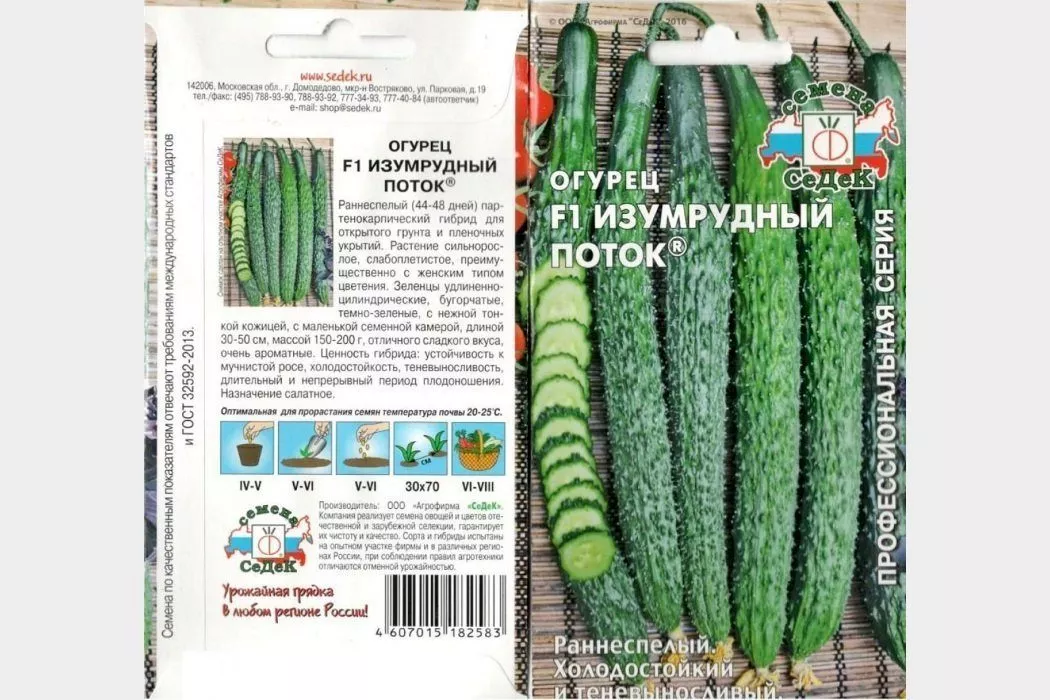
cucumber seeds "Emerald Stream"
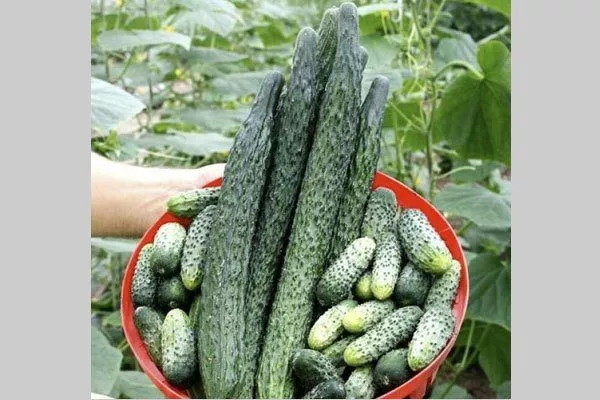
Ripe cucumbers "Emerald Stream"
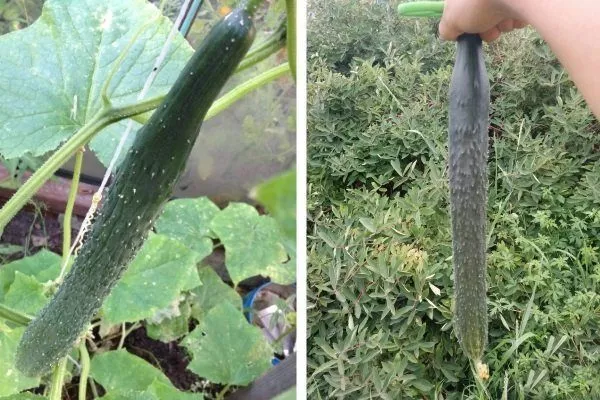
The Emerald Stream cucumber can grow up to 50 cm in length.
Description of the hybrid
In 2007, the Emerald Stream cucumber was added to the State Register of Plants of the Russian Federation for all regions. It fully lives up to its name with its abundant, long-lasting fruiting. Developed by breeders from the Moscow-based agrofirm Sedek, its authors are I.N. Dubinina, S.V. Dubinin, and A.N. Lukyanenko.
The hybrid is early maturing, so the first harvest can be collected 44-48 days after germination. Let's take a closer look at the characteristics of the plant's bushes and fruits.
Bushes
The plant is parthenocarpic (self-pollinating), making it a versatile hybrid, producing equally good yields under plastic covers and in open ground. Furthermore, it is suitable for both spring-summer and summer-fall rotations.
As for other characteristics of the plant, they are as follows:
- the bushes are powerful, medium-sized and medium-climbing;
- stems are strong;
- the leaves are dark green and relatively large;
- ovaries are abundant and cluster-shaped;
- lateral shoots with good regrowth;
- flowering type – predominantly female (only female flowers appear in the axils).
It's important to remember that vigorous plants require sturdy support. Therefore, the bushes should be tied up using netting or a trellis. Pinching off side shoots will also stimulate the formation of new buds.
With proper care, each bush can produce 4-5 vegetables at a time.
Fruit
This cucumber crop is often called "giant," as it can reach up to half a meter in length and weigh up to 250-300 g. It takes about 1.5 months from planting until the first cucumbers, ready for fresh consumption, appear. Their precise characteristics are as follows:
- Form. Elongated-cylindrical, often curved, with slight ribbing, medium tuberosity and a long handle (neck).
- DimensionsOn average, the length of the fruits is 30-50 cm, and the weight is 150-200 g.
- Skin. Soft, thin and dark green with small whitish stripes, medium-density pubescence, prickly and white spines.
- PulpCrispy, with a small seed chamber and small seeds, a distinct cucumber aroma and an excellent sweet taste, without bitterness.
The most delicious cucumbers are those no more than 25 cm long. These specimens are the most tender, sweet, and crunchy. It's best not to let them grow beyond 45-50 cm, as this will cause them to lose their flavor and may thicken, crack, and turn yellow.
You can see what ripe fruits look like in the video below:
Table of characteristics
More details on the main qualities of the hybrid can be found below:
| Parameter | Description |
| General description | An early maturing hybrid that produces its first harvest 44-48 days after sowing the seeds. |
| Growing conditions | It can be cultivated throughout the country, grown in open beds, protected ground, and under temporary plastic shelter. The hybrid is cold-hardy, shade-tolerant, and drought-resistant, so it can withstand adverse weather conditions and adapt to temperature fluctuations. However, it's important to keep in mind that the plant is tall and vigorous, requiring ample space to grow. |
| Productivity | With proper cultivation practices, you can harvest an average of 5-7 kg of cucumbers per square meter of garden bed. Remarkably, this hybrid bears fruit throughout the season, right up until the first frost and snow, forming new fruits after ripe cucumbers are removed from the vines. |
| Resistance to diseases and pests | Hydride has strong immunity to many diseases that pose a threat to cucumbers. For example, it rarely suffers from powdery mildew, cladosporiosis, and other diseases. Furthermore, the plant is rarely attacked by spider mites and aphids. However, it can be susceptible to root rot. |
| Purpose | Emerald Stream is a salad-grade hybrid, so it's best used fresh and in salads. Less commonly, the slender fruits are used lightly salted, pickled, and marinated. Due to their large size, they need to be cut into several pieces to fit into jars. |
- ✓ The hybrid has high resistance to powdery mildew and cladosporiosis, but is vulnerable to root rot.
- ✓ The fruits of the hybrid can reach a length of up to 50 cm, but the optimal size for harvesting is 25-30 cm.
The characteristics of Emerald Stream and how to grow it are described in the following video:
Agricultural technology
To get a good harvest of Emerald Stream, you need to know the following basic agricultural practices:
- In northern regions, the crop should be grown from seedlings, which can be transplanted to a permanent location when they have 3-4 true leaves. In southern regions, seed planting, which involves sowing the seeds directly into open ground, is also an option.
- Seedlings should be sown in April-May, with the seedlings ready to be transplanted to their permanent location in May-June. Seeds can be sown outdoors in May-June. The ideal soil temperature for seed germination is 20 to 25°C, and the air temperature should be at least 18°C. Under these conditions, the first harvest can be collected as early as June-August. Critical parameters for successful cultivation
- ✓ The optimal soil temperature for seed germination should be no lower than +20°C, and the air temperature no lower than +18°C.
- ✓ The distance between plants when planting should be at least 30-35 cm, and between rows - 50 cm to ensure sufficient space for growth.
Cucumbers are very demanding of air temperature, and if it drops below +10°C, they may stop growing altogether.
- Plants should not be overly dense to ensure full development and fruiting. In greenhouses, the recommended planting rate is up to 3 plants per square meter, while outdoors, the recommended planting rate is 4-6 plants per square meter.
- Cucumbers should be grown in sunny, wind-protected areas with fertile, light, and loose soils. Acidic, heavy, and waterlogged soils are not recommended. The best predecessors for this hybrid are:
- early and cauliflower;
- tomatoes;
- onions and garlic (ideal predecessors, as they disinfect and saturate the soil with their phytoncides);
- beet;
- potato;
- peppers;
- green;
- legumes (except beans).
- As for bad predecessors, they include:
- late varieties of cabbage;
- carrot;
- cucumbers.
Cucumbers should not be planted next to beds where potatoes are grown, as this experiment will lead to crop diseases and slow down its development.
- To obtain a bountiful harvest, it's essential to provide proper care, including watering, tying the bushes to a sturdy support, and applying complex fertilizers. The hybrid is resistant to powdery mildew and insect attacks, so it doesn't require chemical treatment. For preventative purposes, you can spray the plant with a pale pink solution of potassium permanganate.
In the following video, a gardener shares his experience growing a hybrid salad variety:
Site preparation
The hybrid should be grown in light, well-drained soils with a loose structure and a neutral or slightly alkaline pH. If the soil is not fertile enough, nitrogen, phosphorus, and potassium fertilizers should be added. This preparation should be carried out in the fall. To do this, follow these steps:
- Clear the garden bed of weeds and last year's crops.
- While digging, add 5 kg of manure and 5 g of phosphorus-potassium fertilizer per square meter of soil to a shovel's depth to improve the soil's fertility. If the soil is highly acidic, add 250 g of lime, and if it is slightly acidic, add 100-150 g.
If the soil is “problematic”, it can be improved with a few tricks:
- Clay will help "weight down" sandy soil. It will retain moisture, which is essential for a good harvest. It should be applied at a rate of 1 to 3 buckets per square meter of sandstone.
- Clay soil becomes dense and airtight when wet. Add 1 to 4 buckets of sand and compost per square meter to loosen the soil and allow it to circulate more freely, preventing water stagnation.
If weather conditions prevent preparing the plot in the fall, it can be done in the spring. To do this, dig the bed, adding 3 kg of humus or compost and 50 g of complex fertilizer per square meter.
Emerald Stream thrives in shade but prefers sunny locations. In any case, it should be grown in areas protected from northerly winds. Various structures or north-facing crops, such as climbing beans or corn, can serve as shelter.
Planting through seedlings
This method of cultivating the crop is more labor-intensive, but it yields a good harvest even in northern climates. The seedlings themselves can be purchased or grown at home. In either case, special attention must be paid to this, otherwise the sprouts may not take root in their new location.
Buying seedlings
To purchase strong seedlings for planting in a permanent location, it is worth following these recommendations:
- Pay attention to the external characteristics of the specimens. At 30 days old, they should have a strong stem and a uniformly dark green color with 4-5 true leaves measuring 15-18 cm in diameter. The optimal height for the seedlings is 20-25 cm. These specimens are ideal for planting in a greenhouse as early as mid-April.
- For planting in open ground or a greenhouse, you can purchase younger seedlings—20 days old. They should be up to 16-18 cm tall and have 2-3 true leaves up to 15 cm in diameter. In this case, planting should begin in mid-May.
- For planting in the ground, you can also choose very small seedlings—10-12 days old. They should have one true leaf. If transplanted to their permanent location at the end of May, they will take root well and produce an early harvest.
- Discard seedlings with elongated, thin, small, and pale leaves, as they were grown in violation of cultivation technology.
- Inspect the leaves from all sides for signs of aphids and other pests. If any are found, the seedlings are unsuitable for cultivation.

- Determine the condition of the root system. It should be well developed, but not protruding through the holes in the containers. This will indicate that the seedlings are much older than they appear, making it difficult for them to establish themselves in their new location. Additionally, sniff the container containing the roots. If there's an unpleasant odor, the shoots may be rotted, so discard these seedlings.
- Preference should be given to seedlings sold in peat pots, since they can be transplanted directly into the ground, without subjecting the sprouts with immature root systems to additional stress.
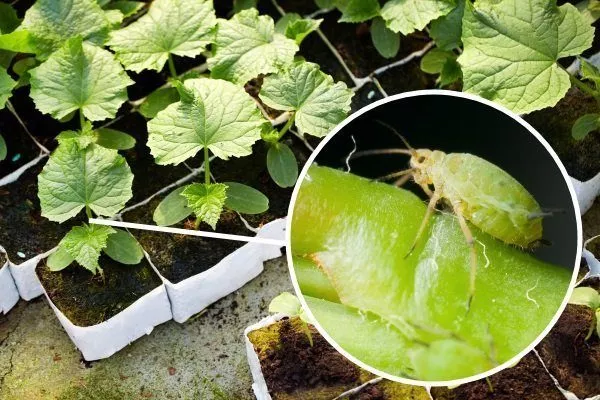
By purchasing seedlings of different ages, you can organize their planting in stages to provide yourself with fresh cucumbers from the end of May until the autumn frosts.
Preparing seedlings yourself
Independent growing cucumber seedlings can be divided into several stages, each of which determines the strength of future sprouts:
- Substrate preparationYou can buy it at a gardening store or make it yourself, but in any case, it should be light, crumbly, and nutritious. To prepare this mixture, you can mix:
- turf soil, sand, wood ash and rotted manure at a ratio of 3:1:1:1;
- peat, humus and rotted sawdust at a ratio of 2:2:1, and for 10 liters of this composition add 1 glass of wood ash and 1 teaspoon of urea, superphosphate and potassium sulfate.
Regardless of the chosen composition, environmentally friendly materials such as agroperlite, vermiculite, expanded clay, or crushed polystyrene foam can be added to improve its drainage and air permeability. The finished composition should be watered with a weak solution of potassium permanganate or hydrogen peroxide (3 tablespoons per 10 liters of water) to disinfect it. pests and diseases.
- Seed treatmentYou can buy hybrid seeds labeled F1 at the store, which don't require pre-treatment. Otherwise, the seeds need to be prepared for planting. First, inspect them. If there's a film on the surface of the seeds, they don't need soaking. If they're uncoated, soak them in a hydrogen peroxide solution (1 teaspoon per 100 ml of water) for 3 hours. They can be sown for seedlings without pre-drying.
- Selecting a containerTo avoid damaging young cucumber seedlings during transplantation, use peat pots or tablets. They can be transplanted directly into the ground, which will also provide additional nutrition with moist, decomposing peat. For planting seeds, you can also use individual plastic cups or, in a pinch, a spacious box.
- SowingPlant 2-3 seeds at a depth of 1.5-2 cm in pots with moist soil, then cover them with soil. The optimal soil temperature is 8 to 10°C, and the air temperature is 10°C. If all the seeds germinate, thinning will be necessary.
- CareUntil the first sprouts appear, maintain the room temperature at 25°C. To create a greenhouse effect, cover the seedling containers with glass or a plastic bag. When the first sprouts appear, remove the cover and reduce the temperature to 19°C. Keep the containers close to a window or use supplemental lighting. Water the soil moderately, as a crust forms on the surface. Ten days before transplanting, harden off the seedlings by placing them outdoors for several hours. The weather should be warm and windless.
Seedlings should not be kept in pots for longer than 30 days, as after this period they will be less able to withstand various manipulations and will not be able to adapt to new living conditions.
Transplanting seedlings into the ground
When planting in a greenhouse, atmospheric conditions don't need to be taken into account, so seedling maturity is the only criterion. If cucumbers are grown outdoors, planting should be done after the last frost has passed. This typically occurs in the second ten days of May, when the air warms up to 15–18°C and the soil reaches 12°C.
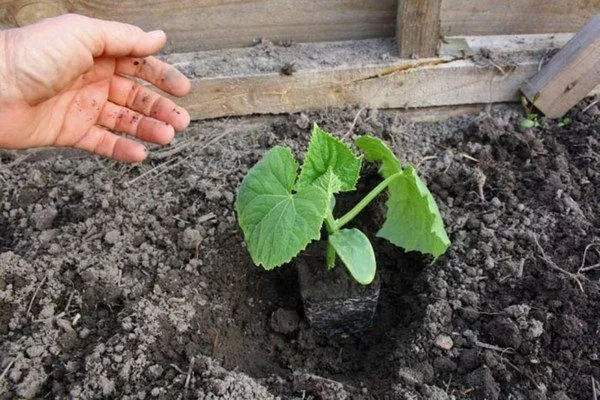
Transplanting seedlings is carried out in the following order:
- Level the beds by forming rows using a taut cord.
- Prepare holes as deep as the peat cups or soil around the plant. Since Emerald Stream is a medium-sized, large-leaved climber, space the holes 30-35 cm apart, and space the rows at least 50 cm apart. Therefore, the planting pattern is 50 x 30 cm.
- Moisten the prepared holes and add hydrogen peroxide, if this has not been done in advance, at a rate of 0.8 l for each hole.
- Plant the pots or sprouts with a lump of earth in the soil so that their upper edges coincide with the edges of the holes, and then sprinkle them with soil.
- Water the crops generously with room temperature water at a rate of 2 liters per plant. To prevent the soil from drying out and protect it from weeds, mulch the bed, using pine needles, sawdust or black agrofibre.
During the first 3-4 days after planting, seedlings need to be watered generously, preferably in the evening, avoiding water getting on the leaves, as this can delay the plant's development.
Direct sowing of seeds into the ground
When growing from seed, work begins in the second ten days of April or early May, when the threat of spring frosts has completely passed. Ideally, the temperature should not drop below 12°C at night for 2-3 days, and should not drop below 20°C during the day. When sowing cucumbers in a heated greenhouse, this requirement is rather arbitrary.
At optimal times, sowing operations are carried out in the following order:
- Dry the processed seeds until they become free-flowing.
- In moist, but not waterlogged, soil, make furrows 15-20 cm apart. The optimal distance between rows is 70 cm.
- Plant the seeds 2-4 cm deep and carefully cover with nutrient mixture so as not to damage the sprouted shoots.
- To prevent the soil in the area from drying out, it's a good idea to cover it with plastic film. This will also protect the crops from sudden temperature changes or spring frosts.
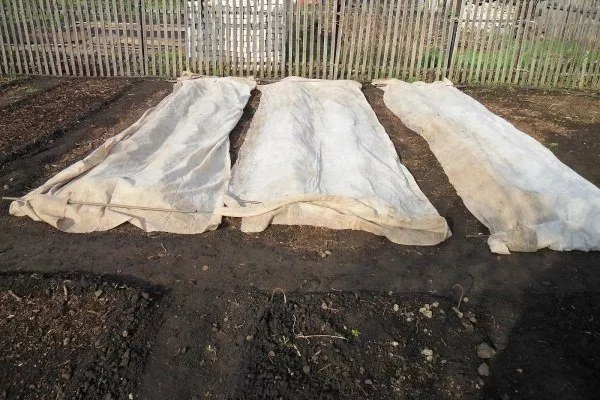
Sawdust or pine needles can be scattered around the planting site to repel the mole cricket.
Caring for seedlings
Emerald Stream is a high-yielding salad cucumber, so growing 2-3 plants is enough to provide the whole family with fresh fruit. However, to ensure abundant fruiting, proper care is required. We'll discuss which cultivation techniques require special attention.
Watering
Cucumbers are 90% water, so they require regular and generous watering. The plant should be watered with settled, room-temperature water in the evening, as most of its growth occurs at night. On hot days, this can be done daily, and on rainy days, as the soil dries out. Keep the following tips in mind:
- When watering, be careful not to allow excessive moisture to stagnate under the bushes, as this can lead to root rot and the death of lateral hairs, which will weaken the plant, lag behind in development, and may be susceptible to various diseases.
- The optimal depth of soil wetting is at least 10 cm.
- Pour water directly under the bushes to prevent it from splashing on the foliage and creating a favorable environment for pathogenic microflora. Furthermore, droplets of moisture on the leaves can form lenses and cause burns to the foliage.
- If the soil is dry, avoid immediately overwatering it, as fluctuations in humidity will cause root and stem rot, which can lead to plant death. In hot, dry weather, it's best to water cucumbers with a sprinkler to prevent the soil beneath the bushes from eroding.
- To water the bushes, you can use a watering can or a hose with a sprayer, but don't use a strong pressure. If possible, it's worth setting up a drip irrigation system for the bushes. You can use not only a commercial one, but also a homemade one made from plastic bottles.
You can make grooves between the rows to allow water to flow through them without endangering either the leaves or the roots of the plant.
Loosening and weeding
Such activities should be carried out as necessary, but always after the soil has been moistened.
In warm or hot weather, a dry crust quickly forms on the soil, preventing adequate air exchange. This results in plant roots receiving insufficient oxygen and stunted development. Therefore, it's crucial to perform shallow loosening of the soil bed. When doing this, apply gentle, scraping movements only to avoid damaging the roots located close to the soil surface.
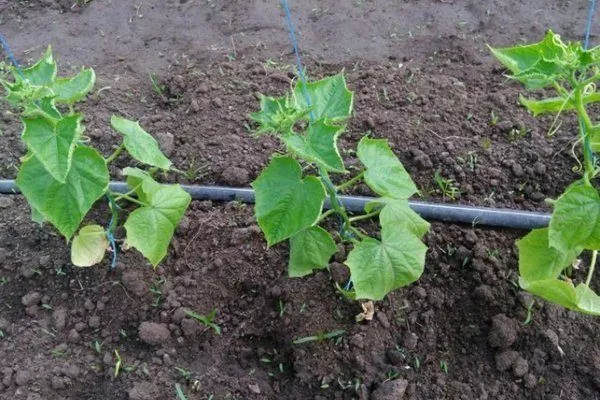
Cucumbers thrive in clean conditions, so the area should not only be regularly loosened but also cleared of weeds. Weeding on damp soil is not recommended, as this can cause lumps and expose the roots.
After loosening and weeding, the bed can be sprinkled with dry soil or a nutrient mixture so that it dries out more slowly.
If culture grown in a greenhouse, the room needs to be regularly ventilated to create comfortable conditions for the cucumber giant to thrive. The greenhouse effect can cause various diseases due to the activity of pathogenic bacteria.
Top dressing
The plant needs to be fed throughout the growing season. For active growth and fruiting, it's advisable to add natural fertilizers such as:
- humus;
- infusion of onion feathers or peel;
- solution based on chicken manure infusion.
They should be applied 3 times per season according to the following scheme:
- After the formation of the first leaf.
- 21 days after the first feeding.
- Before the whips close.
Fertilizer should be applied in the evening, using warm, settled water. Avoid allowing the solution to come into contact with the greenery.
In addition to adding organic fertilizers such as slurry and composted manure, nitrogen and phosphorus fertilizers should also be applied. However, chlorine-containing mixtures are strictly prohibited. The plant's appearance will also help you choose the right fertilizer:
- If the stems and leaves are pale, thin and die quickly, and the size of the fruits does not meet expectations, use nitrogen complexes;
- If hook-shaped fruits are formed and the lower leaves acquire a reddish tint and dry out, fertilizers containing potassium will be required.
All these deficiencies can be eliminated by introducing appropriate preparations.
Pinching out side shoots and garter
To extend the fruiting period and increase the hybrid's yield, it is necessary to properly shape the bush, although lateral shoots are formed in small quantities.
Like other long-fruited cucumbers, this hybrid needs to be side-sonned in the following manner:
- Form bushes into one main stem with lateral shoots.
- After the formation of the 6th true leaf, remove all ovaries and shoots growing in the leaf axils.
- Next, leave one ovary at a time, forming stepsons.
- After 2-3 leaves, leave an ovary and a stepson, which needs to be pinched above the first leaf, leaving the ovaries on it.
Emerald Stream is a parthenocarpic hybrid, so the ovaries form in clusters, and the plant often lacks the energy to nourish them. Therefore, it is necessary to regularly remove some of the ovaries, otherwise yellowing and ovary shedding will occur.
The hybrid is medium-sized and therefore requires tying to a sturdy support. For this, you can use chain-link fencing, either by guiding the vines through the mesh at the right time or simply tying them to it. Sturdy trellises can also be used in a garden bed or greenhouse. To prevent injury to the plant, such support should be installed early, after 2-3 true leaves have emerged. The bushes should be tied so that they can support the weight of the ripening fruit.
In open ground, cucumbers can be grown spread out and without forming a bush, but in this case there is a high risk of curling of the fruits.
You can see what a greenhouse-grown cucumber looks like in the following video:
Protection from diseases and pests
The hybrid is highly resistant to cladosporiosis, downy mildew, and other diseases, but preventative measures should not be neglected. These include the following:
- maintain a comfortable temperature;
- water the bushes on time;
- loosen the soil and remove weeds as necessary;
- add soil to the exposed roots.
The hybrid is most susceptible to root rot, so it is extremely important to strictly follow all watering recommendations and prevent stagnant moisture under the bushes.
To prevent fungal diseases, spray the leaves with a solution of 1 tablespoon of hydrogen peroxide and 40 drops of iodine per 1 liter of water. This solution saturates the plant with oxygen and inhibits pathogenic microflora.
As for pests, garden beds should be protected from mole crickets and ants. To do this, grow marigolds, calendula, and savory near vegetables. Also, regularly inspect the leaves from all sides to spot aphids and spider mites early. These should be controlled with specialized insecticides.
Harvesting and storage
Cucumbers should be harvested as they ripen. This is often done daily or every other day. The fruits must be carefully cut without damaging the ovaries. The optimal length for cucumbers is 25-30 cm, although they can grow up to half a meter.
The harvested cucumber should be stored in a cool, ventilated area. If the cucumbers were cut before they reached 50 cm, they are not suitable for long-term storage, as they quickly become soft. To keep these cucumbers for 2-3 days, keep them in a bag in the refrigerator and wash them immediately before eating.
The following video explains how to harvest in a greenhouse:
Pros and cons
Emerald Stream F1 is a cucumber hybrid that has the following advantages:
- is a weakly climbing plant of the female type with strong growth force;
- is characterized by continuous fruiting and high yield (5-7 kg of fruit per 1 sq. m);
- tolerates poor lighting, unfavorable climatic and seasonal conditions when the work of pollinating insects is difficult;
- It does not require time for the seeds to ripen, so the fruits do not turn yellow, and throughout the entire growing season they retain an attractive appearance and excellent taste.
As for the disadvantages of this hybrid, it's susceptible to root rot. Gardeners also note that the cucumbers' appearance can be affected by their physiology. The problem is that the fruits sometimes become excessively long, causing them to curl and twist into arcs.
The Emerald Stream cucumber is a hardy salad-type hybrid that produces abundant fruit even in conditions where other varieties are either stricken by cold and disease, or even stop producing. It's also easy to grow, though it does require careful attention to agricultural practices.