
German is a popular cucumber variety. It was developed by Seminis, a subsidiary of Monsanto's agricultural company. It has been listed in the Russian Federation State Register since 2001 and can be grown in any Russian region. It has many advantages, but also some disadvantages. A number of nuances must be taken into account when growing it.

Cucumber seeds of the "German" variety
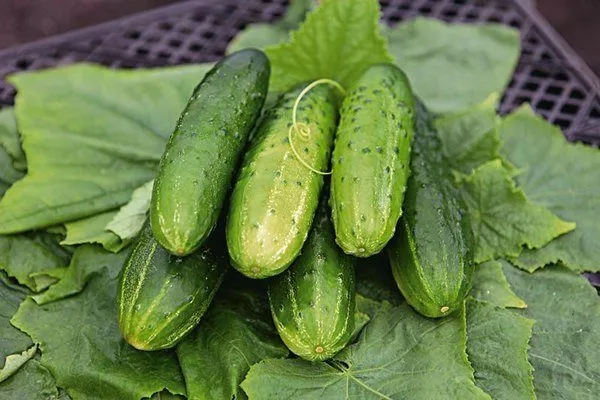
Cucumbers of the "German" variety, fresh from the garden
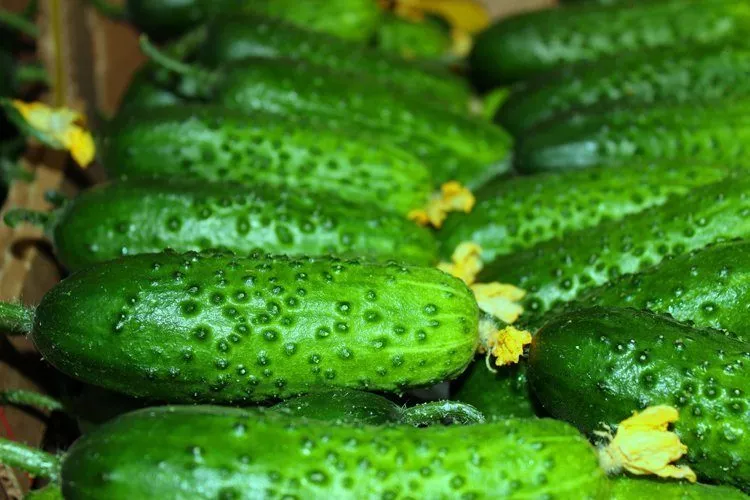
Cucumbers Herman produce a good harvest
Description of cucumber varieties
German is a hybrid variety characterized by early maturity and high yield. It is primarily grown in garden plots and small farms.
- ✓ Parthenocarpic type of pollination, which does not require the participation of bees.
- ✓ Formation of ovaries in the leaf axils in bunches of 6-7 pieces.
Herman is suitable for growing in both protected and open ground. The plant is medium-sized and determinate, meaning the main stem grows only in limited quantities. This variety has female flowering and parthenocarpic pollination, meaning bee pollination is not required for ovary formation. The ovaries form in clusters in the leaf axils, each containing 6-7 ovaries. The leaves are medium-sized and dark green.
Fruiting begins 40-45 days after germination. The fruits are gherkin-shaped, reaching 8-10 cm in length. They are cylindrical, have a coarsely tuberculated surface, and are typically dark green in color, but can be lighter depending on the lighting. They are characterized by faint spotting, short white stripes on the skin, and a slight waxy coating. The fruits are densely pubescent and have white spines.
Each cucumber weighs approximately 70-100 g and averages 2.5-3 cm in diameter. Herman cucumbers are characterized by delicious, crisp flesh and a lack of bitterness, even when not hydrated. The flavor is sweet, the density is medium, and the seeds are small.
Herman's cucumber yields up to 20-25 kg per square meter, with a 95% marketable yield. The cucumbers are not only eaten fresh but also used for canning.
Advantages and disadvantages
Herman is a popular cucumber variety in various regions. This is due to its many advantages:
- the ability to grow not only in a greenhouse, but also in open ground;
- the variety is unpretentious and easy to grow;
- high resistance to diseases;
- parthenocarpic pollination – no bees required;
- after germination, the harvest is formed in an ultra-short time;
- the harvest is stable and high, the product indicators are at a decent level;
- the fruits have excellent taste, no bitterness;
- universal use - fresh, for canning;
- storage without yellowing.
Against the background of such positive characteristics, the German variety has few disadvantages.
This includes poor transplant tolerance, sensitivity to temperature drops (both air and soil), and instability to rust.
This video review will tell you about the most productive cucumber variety, Herman:
Soil requirements
Considering one of the variety's main drawbacks, soil temperature is an important requirement. It shouldn't be below 12 degrees Celsius; otherwise, even high soil fertility won't help – seeds will germinate poorly, seedlings will adapt poorly, and yields will suffer.
- ✓ The soil temperature should be at least 12°C to ensure good seed germination and seedling adaptation.
- ✓ Soil pH should be between 6.0-7.0 for optimal nutrient absorption.
Another important soil requirement is its fertility. It is improved by adding humus, peat, sand, and fertilizers. The specific types and proportions depend on the soil characteristics of a particular site and region. The following combination is a classic example:
- humus - bucket;
- peat and sand - half a bucket each;
- ammonium nitrate, potassium nitrate and superphosphate - a tablespoon each.
Fertilizers in this quantity are applied per 1 square meter.
Rules for sowing seeds and planting seedlings
To ensure a high and early harvest, it's important to prepare the seeds for sowing. This process is carried out according to the following algorithm:
- Sorting the material. A salt solution works well for this step. Most of the seeds that fall to the bottom should be left for planting. The remaining material is not of full-bodied quality, so it is recommended to discard it.
- Drying of selected seeds.
- Pre-sowing warming. This stage takes 2 hours. The temperature should not exceed 60 degrees Celsius.
- Disinfection. This can be accomplished in various ways. A popular option is a 1% potassium permanganate solution. For dry disinfection, use TMTD or NIUIF-2.
Planting in open ground occurs in late May or early June, when the soil has warmed up completely and temperatures above zero have become stable. The soil should be not only organically fertilized but also loose.
For planting, you can use different schemes:
- row method – 65 cm between rows, 10-15 cm between plants;
- The pattern is 90x30 cm, the seeds are planted 1.5 cm deep.
Prepared seeds can be planted in open ground immediately or first grow seedlingsThis is done in separate planting containers, each with a minimum capacity of 0.5 liters. To fill the containers, use a nutritious soil mixture, which should be suitable for vegetable crops.
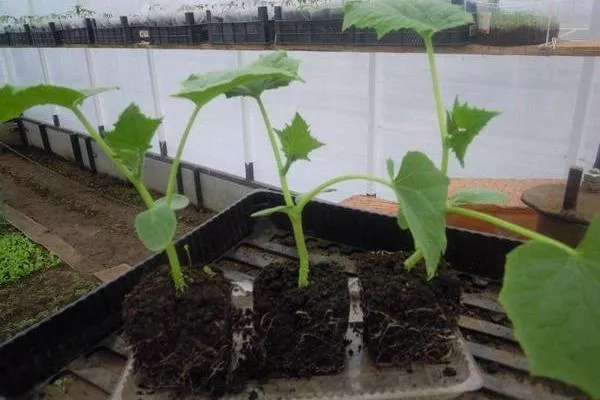
Seedlings are usually planted in early to mid-June, when no more night frosts are expected. When transplanting, the seedlings are planted deep down to the cotyledons. Row cultivation is recommended.
Cucumbers can be planted in protected soil as early as mid-May.
Post-planting care
Growing cucumbers of the hybrid variety Herman is not difficult, but to obtain a high yield, you must follow certain rules.
When planting in open ground, it is necessary to remember the temperature regime. For watering Use only warm water. Water cucumbers every 2-5 days, depending on rainfall. Increase watering frequency during dry periods, when fruit set, and at the peak of harvest.
When growing cucumbers in protected soil, water them every 2-3 days. Approximately 10-15 liters of water are required per square meter of planting.
In open ground, it is better to water cucumbers in the evening. growing in greenhouses Watering can be moved to early morning.
An important condition for growing cucumbers is loosening the soilThis must be done carefully and after each watering. Only the spaces between rows should be loosened.
Necessarily hillingThis should be done when the third leaves appear.
As a base fertilizers Slurry and bird droppings are used. Foliar feeding is also used, using mineral fertilizers. The use of chloride-containing potassium salts is prohibited. Foliar and root feeding should be done at least three times per season, preferably five to six times.
The important point is bush formationIt is recommended to do this on a single stem. First, pinch off the ovaries and shoots when the first four leaves appear in the axils. This technique ensures the formation of strong roots.
The shoots are again pinched in the axils of the 5th and 6th leaves, but leaving one ovary. The next shoot removal is in the axils of the 7th-10th leaves, but leaving two ovaries. After this, the formation of the bush can be completed.
Once the top of the bush reaches the trellis, the plant can be grown along it or directed downwards – pinching is necessary at a height of one meter.
Getting rid of weeds is held regularly throughout the season.
Watch a video about growing this cucumber hybrid in a greenhouse and how to shape it:
How to achieve a bountiful harvest?
A bountiful harvest can be achieved by taking all necessary steps in a timely manner. This includes planting practices, proper watering, bush training, and fertilizing. Regular inspection of plants, disease and pest prevention, and appropriate treatment when necessary are essential.
After the initial wave, yields taper off by August. Hilling and foliar feeding are used to stimulate growth:
- 35 drops of iodine per liter of whey or milk;
- 10 g of boric acid per liter of hot water (almost immediately after boiling).
These solutions are used for spraying. Both solutions can be used, with a 10-day interval between applications.
Diseases and their prevention
The Herman cucumber variety is not very susceptible to diseases, but they are still possible. The main problem is rust – the appearance of orange spots on leaves and shoots. Fundazol and other fungicides are used for prevention. Treatment begins early and ends 10 days before harvest. A Fundazol solution (1 g per liter of water) is applied twice a season at a rate of 1.5 liters per 10 square meters.
Another possible problem is – downy mildew, which manifests itself as white spots on the leaves. This disease is also controlled with fungicides.
Dangerous and pests – aphids, root-knot nematodes, spider mites. Various infusions help against aphids:
- tobacco;
- laundry soap and wood ash;
- onion or garlic.
Steam treatment helps against root-knot nematodes, and replacing the topsoil if necessary. Spider mites can be controlled with a soap solution or herbs such as celandine, horse sorrel, and yarrow. These can be used as an infusion.
Harvesting and storage rules
Harvesting time depends on planting time. This period begins in mid- to late June and lasts until August-September. It's recommended to begin harvesting immediately after flowering and before the fruits reach their peak size—small cucumbers are tastier. It's best to harvest them every other day, in the evening or early morning. The fruits should be trimmed, not broken off.
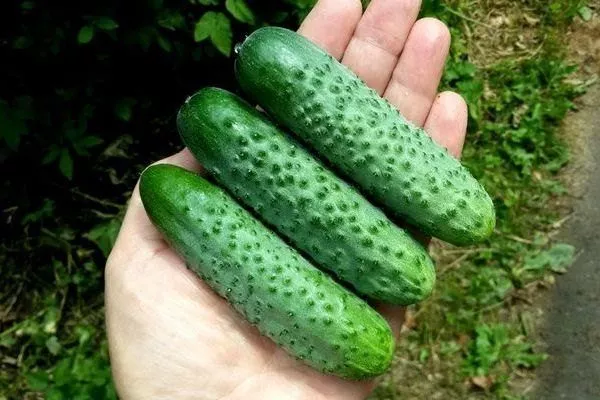
Fresh cucumbers of this variety don't keep for long—only a few days. They can be refrigerated for up to a month, but their flavor and firmness will be significantly reduced. These cucumbers are excellent pickled or salted.
Herman cucumbers boast many advantages, including their low maintenance and excellent flavor. These qualities have made this variety a favorite in many regions and are highly popular. Following all growing guidelines will yield an excellent harvest.