
Gerasim is a hybrid variety that quickly gained popularity. It boasts relatively good productivity and disease resistance, but that's not all it has to offer. It's suitable for cultivation in almost all regions of the country, except the northern ones. Even there, gardeners manage to grow it in heated greenhouses.
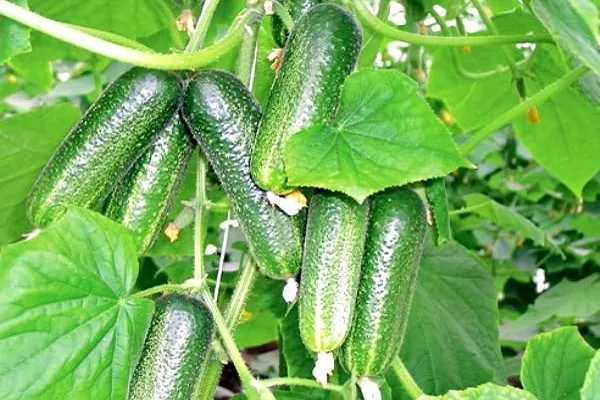
Introduction to the variety
This hybrid is parthenocarpic and ideal for growing in greenhouses under plastic. To achieve impressive harvest results, proper care is essential. It's essential not only to understand its basic characteristics but also to master key aspects of agronomic practices.
Information about origin
Gerasim was created by a team of Russian breeders, which included such specialists as Gavrish S. F., Portyankin A. E., Shamshina A. V., Shevkunov V. N., Khomchenko N. N., Surovova T. Ya. In 2010, the variety received official recognition and was included in the State Register, after which it began to be actively used not only in Russia, but also abroad.
Features of bushes, fruits, taste
The plant is characterized by moderate branching, with lateral shoots not developing intensively. Other characteristics of the hybridized variety:
- bushes can reach impressive parameters of up to 220-250 cm;
- the root system is distinguished by its special strength and power;
- flowering occurs with the formation of female inflorescences of a bright yellow color;
- the leaves of the bushes are small, but bright green;
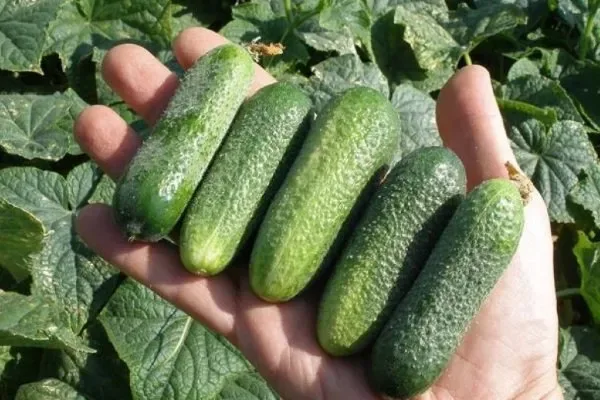
- the fruits are cylindrical in shape and can grow up to 14 cm in length, but in the gherkin form – about 8 cm;
- the skin is thin, decorated with white linear strokes or spots, covered with large tubercles and light spines, colored in a dark green tone;
- the pulp has a crisp texture, is juicy and free of voids;
- The taste of this variety is sweetish, with a slight freshness, without bitterness.
Fruiting period and productivity
Hybrid Gerasim is an early-ripening variety. Seedlings emerge, and the first fruits can be expected within 39-40 days. Some specimens begin to yield as early as 33-35 days after sprouting.
The yield of this variety is considered average. Up to 10 kg of cucumbers can be harvested from 1 square meter of cucumber planting, but in greenhouse conditions, productivity is higher – around 12-13 kg.
Landing features
The Gerasim f1 variety can be cultivated using various methods: sowing in open ground, growing seedlings at home and then replanting.
For regions with cool climates, the seedling method is preferable, after which the plants are transplanted into beds covered with thick plastic. In southern regions, seeds can be sown directly into the soil.
Planting dates
It is recommended to sow seeds for seedlings after April 20-25. Transplanting into open ground occurs when the soil temperature reaches 10-14 degrees Celsius and the air temperature reaches 15-17 degrees Celsius.
If cucumbers are planned to be grown directly in the field, then the seeds are sown in late May, when the soil warms up to +16-18 degrees.
Site preparation
For successful growth of Gerasim cucumbers, it's important to choose a sunny, wind-protected location. Carry out preparatory work in the fall:
- loosen the area using a shovel or pitchfork;
- remove all weeds;
- enrich the soil with humus, wood ash or compost.
Planting seeds
Before you begin sowing, be sure to pre-treat and harden the soil. To do this, follow these steps:
- Soak the seeds in a manganese solution with a concentration of 2-3% for half an hour.
- Then harden them by immersing them in hot water (no higher than +45-50 degrees) for a couple of minutes, and then in cold water for the same amount of time.
- Use germination technology: wrap the planting material in a well-moistened cloth.
- ✓ Optimum soil temperature for seed germination: +20-22°C.
- ✓ Concentration of manganese solution for seed soaking: 2-3%.
After all the preparatory work, you can begin sowing. Here's how experienced gardeners do it:
- Place the planting material into prepared holes about 2 cm deep. Typically, two seeds are placed in each hole.
- Cover with soil.
- Water generously with warm water from a spray bottle and place it in a warm, well-lit place.
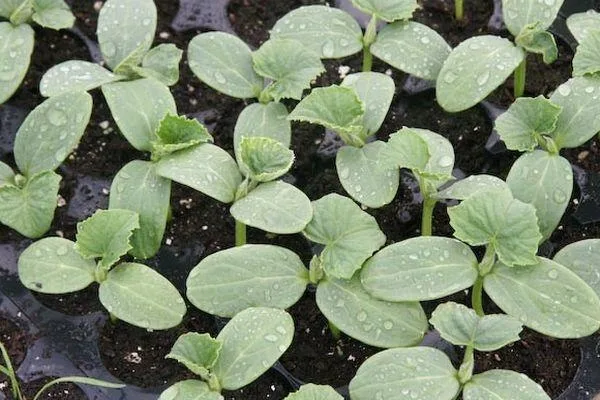
When caring for seedlings, remember:
- cucumbers prefer a nutrient-rich soil mixture;
- avoid over-watering the beds;
- maintain optimal temperature in the greenhouse structure;
- Feed your plants regularly;
- do not allow seedlings to overgrow;
- Before planting in open ground, acclimatize the plants.
Planting seedlings
When the Gerasim f1 cucumber seedlings have approximately five true leaves, it is time to move them to their permanent growing location, which usually occurs a month after planting the seeds.
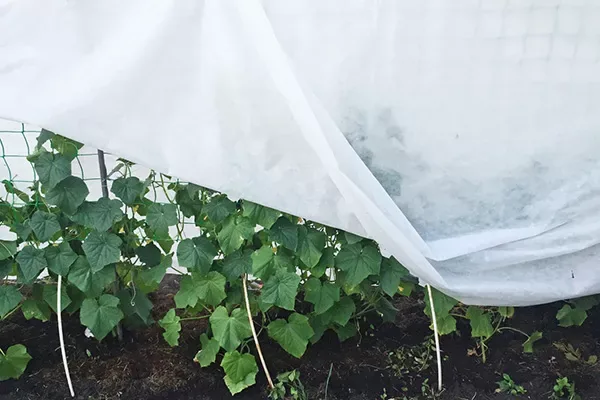
Once the plants are in the ground, they will need regular watering and protection in the form of film to help them better adapt to the new conditions.
Planting diagram
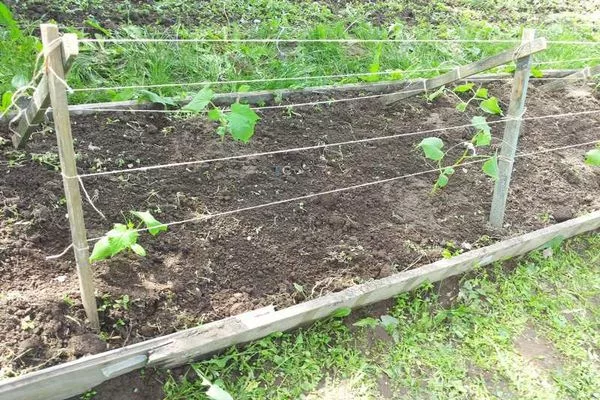
For Gerasim f1 cucumbers, it is important to maintain a distance of 30-35 cm between plants and 70-75 cm between rows, which will ensure ease of harvesting and agricultural practices.
How to care for it properly?
To ensure a bountiful harvest of Gerasim cucumbers, adhere to certain agricultural practices, including regular watering, fertilizing, loosening the trunk area, and tying up the vines.
Watering
Regular watering is key to caring for cucumbers – it should be done approximately every three days. During periods of extreme heat, watering frequency can be increased to daily or every other day.
Cucumbers are typically watered with warm water directly at the roots, preferably after sunset. It's important to avoid overwatering, as this can lead to root rot.
Here are some recommendations for organizing the watering procedure for cucumbers Gerasim:
- Use settled water, especially if it comes from a centralized water supply (such liquid contains a lot of chlorine and other harmful compounds that easily evaporate within a few hours).
- Make sure that there is no excess moisture not only in the beds, but also in the aisles.
- On hot summer days, when temperatures rise, cucumbers require more frequent watering. Reduce the intervals between treatments or provide watering both morning and evening, but maintain a consistent amount of water per week.
- When watering cucumbers, try to avoid dripping onto the leaves and stems to prevent burns.
- During the germination phase, it is important to maintain the temperature at least at +20-22°C.
- If the temperature drops sharply, protect the seedlings with a temporary film cover and reduce the frequency of watering.
Garter and shaping of bushes
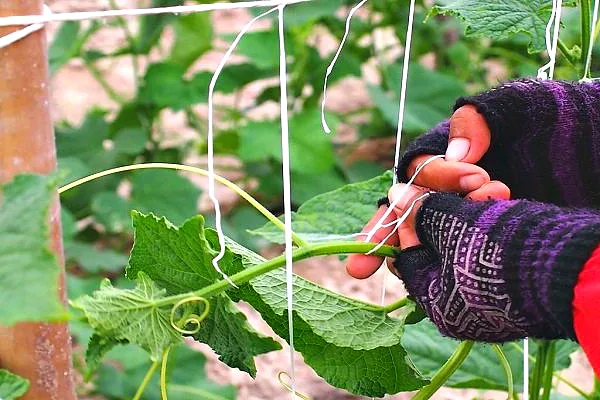
To support cucumber growth, trellises are necessary. Hybrid varieties tend to form clusters of flowers, resulting in multiple buds blooming simultaneously. However, not all of these buds will survive the competition, leading to wilting and fruit drop.
To avoid losses, it's important to properly shape the bushes as they grow. Key rules:
- Do not allow multiple stems to appear on the sides.
- Remove the bottom three nodes and all side shoots, leaving only the two main shoots.
- Don't forget to trim them after the second leaf appears to encourage further growth of the bush.
Top dressing
Throughout the growing season, cucumbers need to be regularly fertilized. Here's a rough guide:
- Apply fertilizer for the first time when the seedlings have developed a pair of leaves. Ideally, use organic matter such as manure or chicken manure.
- Then fertilize every two weeks using mineral complex mixtures with a high content of phosphorus and potassium.
To properly organize the fertilization process, follow these recommendations:
- When applying fertilizer to cucumber beds, combine it with watering.
- Use foliar technologies by spraying solutions on plants in the evening or on a cloudy day.
- Combine mineral preparations with organic products.
- Avoid over-fertilizing.
- Continue to fertilize the plants even during the fruiting period.
Hilling
Instead of traditional hilling, experienced gardeners recommend loosening the soil with a pitchfork. This helps remove the compacted surface layer, which prevents moisture and oxygen from reaching the plant roots.
Resistance to diseases and pests
Gerasim F1 varieties are resistant to diseases such as root rot, various types of spotting, and powdery mildew. However, they are susceptible to the following diseases:
- Ascochytosis - This disease manifests itself as light gray spots with black blotches on leaf blades. Small white-brown marks appear on stems and shoots.
To combat this disease, purchase chemical products such as Topsin-M, Rovral, as well as biological products Fundazol or Topaz. - Mosaic – A viral infection that causes wrinkling of leaves, cracks in the stems, small spots on the fruit, and stunted growth. To treat mosaic, buy Actellic, Aktara, or Farmayod.
- Fusarium - This is a disease that causes the plant to wilt, the foliage to turn yellow, and the shoots to dry out. To combat fusarium wilt, use the chemical Previcur.
Harvesting and storage
Gerasim f1 cucumbers are known for their generous harvest, so daily harvesting is recommended. To preserve freshness, they are best grown in cool locations with temperatures no higher than 4-5 degrees Celsius. A cellar or basement is usually suitable.
Positive and negative qualities
Before growing Gerasim f1 cucumbers, it's important to familiarize yourself with their advantages and disadvantages. Experienced gardeners note the many benefits of this hybrid, but there are also some disadvantages associated with its cultivation:
Despite the abundant harvest, the fruiting period is short. This is the only drawback of the crop.
Reviews
Growing Gerasim F1 cucumbers is easy, even for a novice gardener. With optimal conditions throughout the growing season, you can expect a bountiful harvest that will be a source of pride for you and the envy of your neighbors.