
Cucumber plantings require special care. Forming a single-stemmed bush is very popular among gardeners growing the crop in both greenhouses and open ground. This technique guarantees increased yields and improved immunity to various diseases.
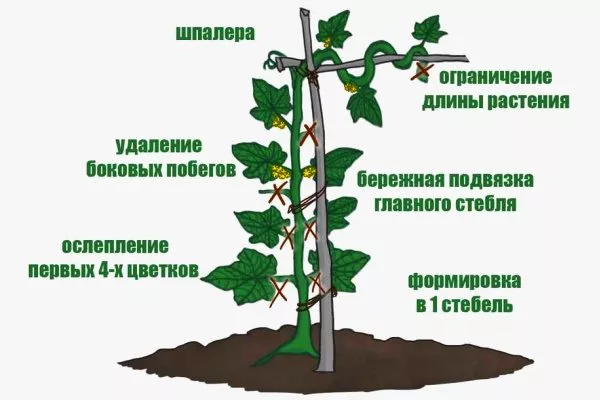
What does shaping a cucumber bush provide?
Learning to properly train cucumbers increases your chances of a bountiful harvest. Don't let them grow and twist as they please. This agricultural technique brings only undeniable benefits:
- Thickened plants not only reduce yields, but also slow down their growth.
- Forming cucumbers helps to obtain a large number of fruits and also prolongs the fruiting period.
- The plant will stop wasting energy and nutrients on green mass and will completely devote its energy to the fruits.
- This method is very popular when training cucumbers in a greenhouse. It allows you to save space by planting plants close together.
- Forming cucumbers into a single stem will allow for additional light. The plant will be better ventilated and therefore less susceptible to disease.
- The main trunk is a must tie it upRemove shoots that don't produce flowers. This will help you get a larger harvest by shaping the bush, making it easier to care for the plants, and creating comfortable conditions for harvesting.
- ✓ The optimal height of the trellis for forming a single stem should be at least 2 meters to provide sufficient space for growth.
- ✓ The distance between plants when planting should be 30-40 cm in a row and 60-70 cm between rows to ensure good ventilation and lighting.
Simple tasks like weeding and loosening the soil can be problematic. Growing cucumbers in a greenhouse creates conditions conducive to the development of pathogens and pests. These pests will be very difficult to control, negatively impacting the yield.
The pros and cons of forming a bush into a single stem
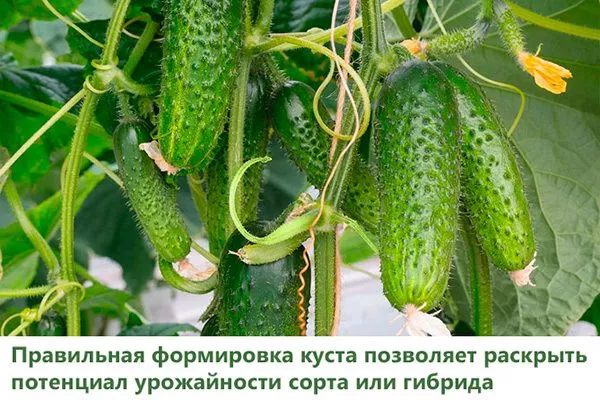
Forming cucumbers into single stems is a simple procedure. Your efforts will pay off during harvest. This agricultural technique has many advantages:
- the possibility of denser planting of seedlings;
- the yield becomes higher and the fruiting period becomes longer;
- obtaining larger fruits with excellent taste;
- Treated plants are less susceptible to various diseases.
There are also some disadvantages of this method:
- not suitable for low trellises;
- Plants with a minimum amount of green mass may be susceptible to diseases that affect the leaves;
- In case of improper fertilizing, lack or excess of moisture, plants can become very sick.
If you train your cucumbers correctly, you can harvest around 15 kg of fruit per square meter.
Nuances of varieties and hybrids
To get a good harvest, experienced gardeners plant cucumber varieties that are best suited to growing conditions.
Typically, varietal cucumbers are grown in open ground. If desired, seeds can be collected from the fruits of such bushes and planted the following year. This way, the plant will fully inherit the characteristics of its parent.
In greenhouses, it's preferable to plant first-generation hybrid varieties—you'll find the F1 designation on the packaging of these seeds. They produce a good harvest, but you won't be able to collect the seeds yourself. overripe fruits, because they do not retain the acquired properties.
In addition to varietal cucumbers and hybrids, the vegetable is divided by pollination type:
- Self-pollinating. Both male and female flowers grow on the same bush at the same time, so such plants do not need pollination.
- Bee-pollinated. The varieties are pollinated by insects.
- Parthenocarpic hybrids. There is no need for pollination, since the ovaries are formed without the participation of pollen.
It is preferable to choose for greenhouses and open ground self-pollinating varieties and parthenocarpic plants. These plants produce fruit primarily on the central stem, so they don't need lateral shoots.
Formation deadlines
Begin shaping cucumbers as soon as the plants begin active growth. Once the stem has five full leaves, secure it to a support, as it will soon begin branching.
Don't delay the procedure. For example, if side shoots are not removed promptly, there's a risk of reduced yields.
The first removal of side shoots occurs when the plant reaches 20 cm in height. Subsequently, remove side shoots as they grow, until the end of July.
What tools are needed?
First, you need to build a good support, so gather some wooden blocks about 2 meters long, copper wire, jute twine, and wooden slats. You'll also need strips cut from long, scrap rags.
Tie up the main stem Use soft twine to prevent damage during further growth. Avoid using wire or thin thread, as they can cut the trunk. You'll need the following tools:
- scissors;
- nails;
- pliers;
- hammer;
- a small sledgehammer.
Once the support is ready and the plant has grown sufficiently, begin shaping it into a single stem. To do this, use a well-sharpened knife or hand pruning shears to quickly remove unwanted leaves and side shoots. Removing side shoots is fairly easy; no tools are required—they snap off easily.
Step-by-step formation technology
Cucumbers can be trained into a single stem if the plants are tied vertically to a tall horizontal trellis. As they grow, simply wrap the stem around the twine clockwise and simultaneously train the stem.
The first method
Parthenocarpic hybrids bunch type of fruiting form several ovaries at each node, so remove all lateral shoots, starting from the fifth leaf.
Follow these steps:
- At the bottom, remove all vegetative organs: 4 leaves, all ovaries and shoots.
- Leave the remaining ovaries and remove the side shoots.
- Continue this way until you reach the trellis.
- Then wrap the stem around the trellis and lower it down.
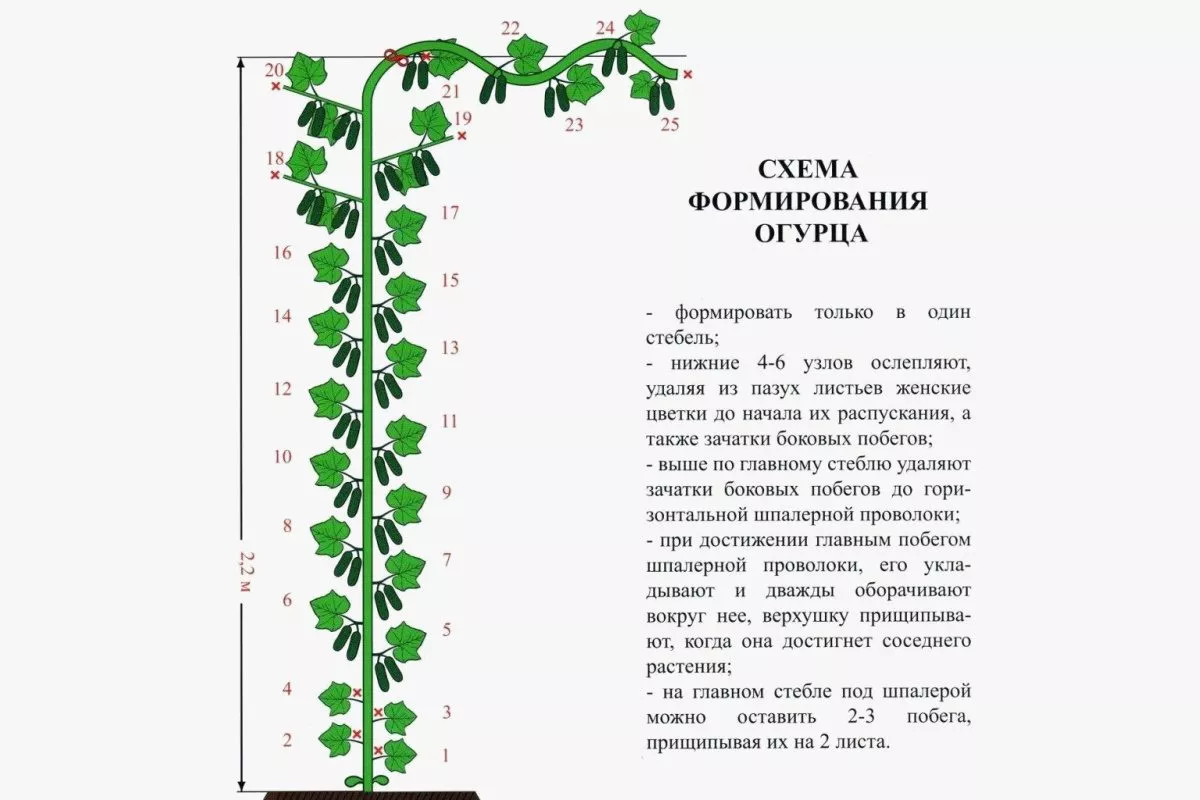
You can grow several side shoots with a few leaves near the trellis, then pinch off the tops. There's also another method for prolonging fruiting:
- Carefully lower the stem when the plant reaches the horizontal trellis and the lower part of the vine has already produced fruit.
- Twist the exposed part and place it on the ground. This will allow the upper part of the stem to continue growing.
Choose the option that is most convenient for you to ensure ease of care and large harvests.
The second method
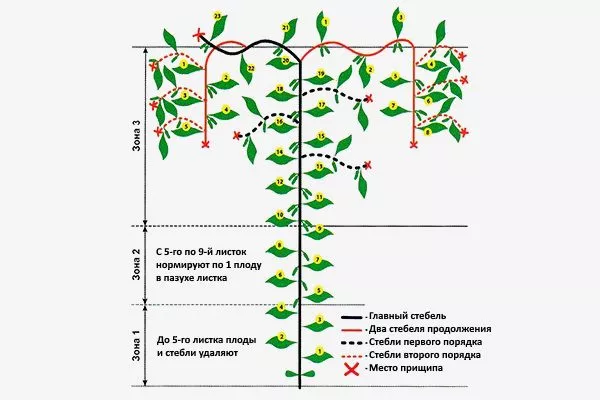
Cucumber varieties that produce multiple ovaries in the axils of the main stem should be trained into a single stem, forming an umbrella-shaped plant. Follow these recommendations:
- In the area of the first 3-5 leaves, remove all flowers, side shoots and the leaves themselves, thereby creating a blinding zone.
- At the level of 5-7 leaves, leave the ovaries and get rid of all lateral shoots.
- Above the 7th leaf, up to a height of 1-1.5 m, leave one shoot in the axil, which you pinch after the first ovary appears.
- In the next zone, leave a shoot with two ovaries in the axil.
- The trellis should have 3-4 leaves and 3 ovaries left on the lateral shoot.
The last step is to either pull the stem down over the wire or pinch it off.
Care before and after shaping
It is best to shape cucumbers in the morning so that any damage caused during the procedure has time to heal by evening, thereby minimizing the risk of infection.
When working in the greenhouse, do not turn the vines over to prevent the plants from dying. Removing dead parts of the bushes will provide more light for the fruit. If you didn't pinch the plant in time, leave it as is to avoid damaging it.
- After 3-5 days of formation, apply a complex fertilizer with a high potassium content to maintain fruiting.
- Two weeks after the first feeding, use an organic fertilizer, such as grass infusion, to restore the soil microflora.
After you remove the shoots that have stopped bearing fruit, the plant will become weaker, so it won’t hurt top dressing, allowing you to gain strength. Use ready-made complex fertilizers and herbal infusions prepared at home.
What mistakes can be made?
Growing single-stem cucumbers isn't suitable for all varieties. Even experienced gardeners often make common mistakes when choosing the right method and technology:
- Bee-pollinated varieties produce fruit on side shoots, as the main stem produces male flowers—sterile flowers. Removing side shoots will result in a loss of fruit. These varieties are suitable for training into multiple stems, and in grown in open ground even without pinching out the stepsons.
- If you delay removing side shoots, they will grow, and further removal will weaken the plant and waste nutrients. If you missed the pinching, choose a different shaping method and correct the mistake at the next nodes.
- Excessive bending of the whip to the side can lead to injury of the stem and rejection of the ovaries.
The biggest mistake gardeners make is completely ignoring crop formation, especially in greenhouses. If crop formation isn't carried out in a timely manner, yields will be significantly lower, and in some cases, the plant may die altogether.
Tips for shaping cucumbers
To properly shape cucumbers, you need to follow certain rules; otherwise, you can make a mistake that will negatively affect the crop.
Helpful tips from experienced gardeners:
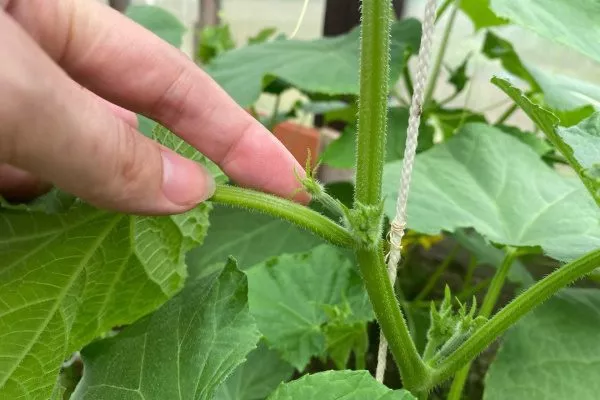
- Work on your cucumbers at least once or twice a week. Cucumbers grow very quickly, so if you leave things to chance, it will be more difficult to manage. If you prune them extensively in one go, the plant will be hurt.
- Get rid of unnecessary parts: empty flowers, lower old leaves, beginning to turn yellowIt is not necessary to remove damaged or torn leaves entirely; simply trimming them with scissors is sufficient.
Also remove any crooked fruits and diseased ovaries. Remove any shoots that are no longer bearing fruit. Remember to always leave the lower part of the stem bare. - Cucumbers need light to produce consistent fruit, otherwise the ovaries will turn yellow and wilt. Maintain planting density and remove any leaves that block sunlight. If you notice rot on a cucumber vine, trim it off immediately.
- If in doubt, don't prune; pinching the top of the shoot is better. Incorrect pruning will reduce the yield.
- If you missed a side shoot on which a cucumber has already formed, leave the fruit to ripen, then remove the shoot.
Reviews
Forming cucumbers into a single stem is a popular agricultural technique that is extremely important for gardeners. It helps the plants grow in the desired direction, resulting in significantly higher yields. This method prevents the plant from wasting energy and nutrients on developing unnecessary foliage.