
An unusual plant, the Antillean cucumber, or Anguria, grows naturally in tropical and subtropical climates. Read this article to find out why it's so beloved in many countries and whether it can be grown in temperate climates.
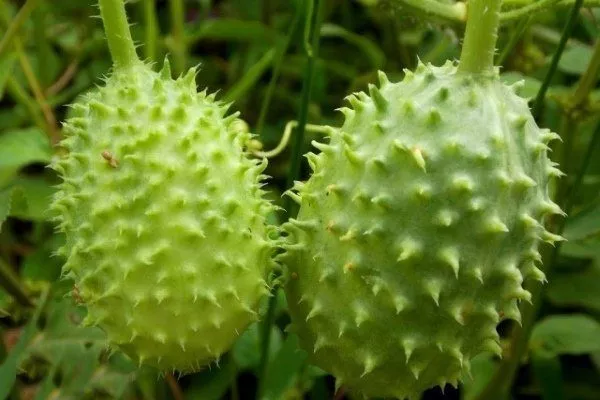
Anguria (Watermelon Cucumber)
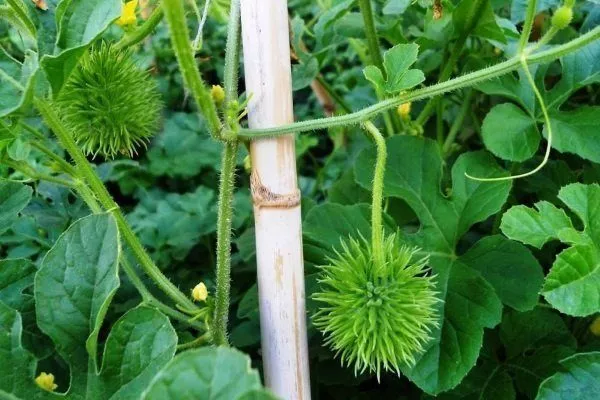
Ripening of Anguria fruits
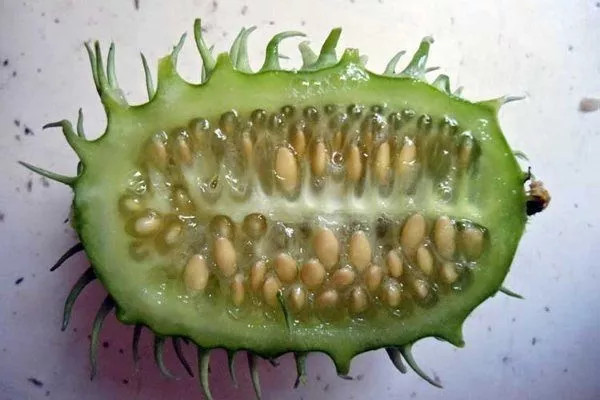
Cross-section of the Anguria fruit
Botanical description
Cucumis anguria (Anguria) is an annual vine belonging to the Cucurbitaceae family, Cucumber genus. The stems are long, thin, and fragile, green, with tendrils covering their surface. The leaves are serrated, reminiscent of watermelon. The flowers are yellow, and the sexes are small and dioecious.
The fruits are small, elongated, oval, completely covered in soft spines or hairs, and taste like cucumber. By the time they reach seed maturity, they turn yellow-orange.
A single variety can produce different fruit colors when grown in different climates. Fruiting begins in July and ends with the first frost. Anguria produces a consistently high yield.
The crop ripens 60-70 days after germination, later the fruits become inedible.
Historical information
The plant is native to the Antilles and was domesticated by Native Americans. It spreads by seeds carried by birds and animals. After the colonization of the Americas, it was virtually replaced by the common cucumber.
Why does the variety have different names?
According to some sources, the name "Anguria" in Sanskrit is a homonym for one of the rulers of India who fathered tens of thousands of children, alluding to the plant's large number of seeds. The Slavs pronounced this word as "ogurok," which is where the name "cucumber" comes from.
Today you can find the following names for the plant:
- Antillean cucumber - comes from the name of the plant's homeland;
- Horned cucumber or hedgehog cucumber - because of its appearance;
- Maxixe is what this plant is called in Brazil.
You'll often hear the Anguria called a watermelon cucumber, alluding to the similarity of the leaves of these plants. However, this is actually the correct name for a different species of plant—Melotria shcabra (or Cucamelon, also known as the Mexican cucumber/Mexican watermelon). The fruits of the Melotria shcabra resemble small cucumbers with a watermelon coloring (unlike the Anguria, the fruits of the Melotria shcabra lack spines). Their flavor is also similar to cucumber.
Spreading
Today, Anguria is grown in many countries in South and Central America, Europe, India, the Far East, and New Zealand. It is found in tropical and subtropical regions. However, in Russia, it is a rare species.
The Antillean cucumber is grown as a vegetable crop and an ornamental plant.
Characteristics
Table of the main characteristics of the Antillean cucumber:
| Length of liana, m | Fruit length, cm | Fruit width, cm | Fruit weight, g | Yield, fruits/plant | Growing season, days | Temperature for growing, °C |
| 4-6 | 8-10 | 4-6 | 30-50 | up to 200 | 60-70 | 20-27 |
The fruits have good shelf life, while retaining their beneficial elements.
Anguria is used:
- fresh;
- salted;
- pickled.
Advantages and disadvantages
The advantages of Antillean cucumbers include:
- decorative value of the plant;
- excellent taste;
- rich vitamin composition;
- care is no different from care for other melon crops;
- low susceptibility to diseases and pests.
The disadvantages include:
- thermophilic;
- demanding of soil moisture;
- requires constant fertilization;
- It is rarely used as food by residents of the CIS countries.
Anguria varieties
| Name | Length of liana, m | Fruit length, cm | Fruit width, cm | Fruit weight, g | Yield, fruits/plant | Growing season, days | Temperature for growing, °C |
|---|---|---|---|---|---|---|---|
| Anguria dietetica | 4-6 | 8-10 | 4-6 | 30-50 | up to 200 | 60-70 | 20-27 |
| Anguria Gourmet | 3 | 6 | 4 | 30 | up to 150 | 47-52 | 20-25 |
| Anguria syriaca | 4 | 7-8 | 5 | 50 | up to 180 | 50-60 | 20-27 |
Only one variety is registered in the state register – Anguria dieteticaRecommended for growing in greenhouses and hotbeds. Early maturing, it matures in 47-52 days. The plant has a high rate of shoot formation and climbs well. The stems are thin and fragile. The fruits are light green, with white stripes and soft spines, oval in shape, up to 6 cm long. The flesh is yellow-green, medium-firm, juicy, and has excellent flavor.
Fans of this plant mainly cultivate foreign varieties.
Also often grown:
- Variety Anguria "Gourmet". It is grown as a vegetable and ornamental crop. The vines grow to about 3 meters in length. The fruits are oval, light green, with large, juicy spines. Young fruits are edible, while overripe ones, when they change color, can be dried and used in floral arrangements.
- Anguria syriaca varietyThis variety is distinguished by its early ripening, vines up to 4 m in size, and numerous shoots. Fruits are up to 7-8 cm in size, weighing up to 50 g, and covered with small spines. Young fruits are highly decorative, beautiful on the plant and as a garnish for dishes. They are sweet in taste and light green in color. Fruiting lasts from July until frost. They are grown on trellises.
Kiwano(Cucumis metulifer, or horned melon, or African cucumber) is considered a relative of the anguria, very similar to it. Its fruits are dark green and have large, fleshy spines. They weigh up to 300 g. The flavor is cucumber-like, with hints of banana or something else.
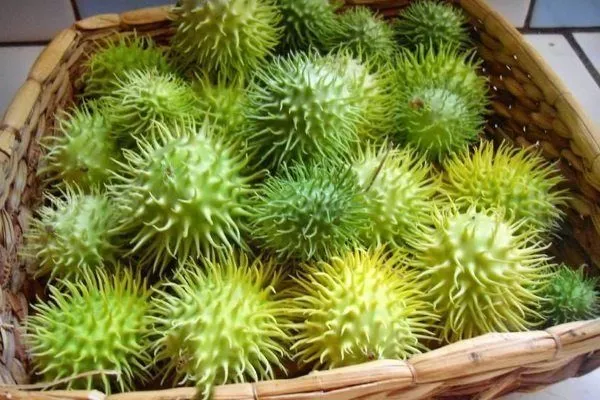
Anguria “Gourmet”
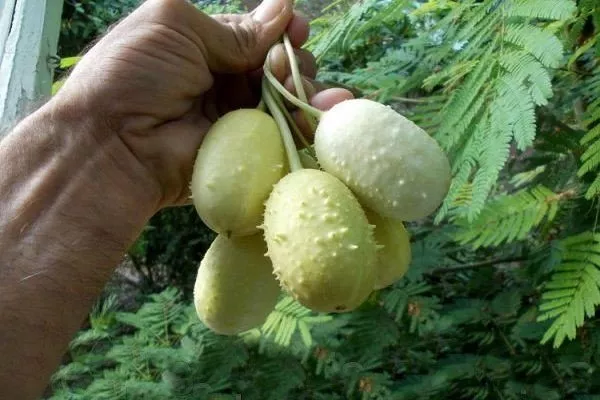
Anguria syriaca
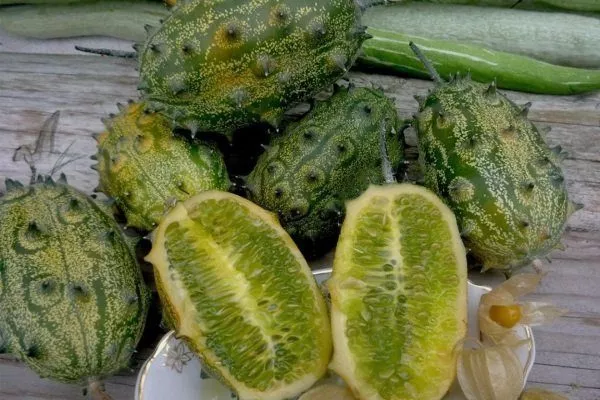
Kiwano
Agrotechnical features
Anguria is a heat-loving plant. When temperatures drop to 10°C, it stops growing. When temperatures rise, growth resumes; when temperatures drop below 5-6°C, the vine dies.
The Antillean cucumber's growing location should be well-drained and protected from the wind. The plant dislikes shade and dense plantings. Ideally, the bed should be elevated, away from stagnant rainwater.
The soil should be fertile and well-drained. Black soil or sandy loam with a neutral pH is suitable.
Acidic soils and close groundwater levels can kill the plant.
If the required soil is not available in your region, it can be amended by adding a sand-peat soil mixture to the site. To reduce acidity, lime should be added.
Legumes, root crops, greens, and early cabbage can be grown in the selected area before Anguria.
Horned cucumber will not grow well in a garden bed where any pumpkin crops were the predecessors.
Planting Anguria seedlings
The best time for sowing seeds for seedlings is considered to be the beginning of April.
Procedure:
- Selection of seeds. Sort out the seeds and select only the large ones.
- Disinfection. Disinfect the planting material in a solution of potassium permanganate.
- Using a root former. A day before germination, soak the seeds in a rooting solution, such as Epine.
- Germination. Place the seeds on several layers of cheesecloth and cover with more cheesecloth on top. Place in a warm place and keep the cloth from drying out. Once the seeds sprout, they're ready to transplant.
- Transfer. Use peat pellets to preserve the root system when replanting in the ground. Rules:
- soak the peat tablet in water for 5 minutes;
- After it has risen in height, drain off excess water;
- increase the depression in the middle to 1 cm;
- Place a seed in it and seal it.
- Mini greenhouse. Create greenhouse conditions by covering the tablet with a plastic cup.
You can use peat or paper cups 8-10 cm deep, filled with soil mixture for seedlings.
- First shoots. Expect it in a week.
- Bedding. When 2-4 true leaves appear on the stems, the seedlings can be transferred to the garden bed.
To prevent the stems of the Anguria from stretching too much due to a lack of light, additionally install fluorescent lamps above the seedlings.
Planting in the ground or in a greenhouse
The seedlings are planted in the ground approximately 20-25 days after sowing the seeds.
- ✓ The soil temperature for planting seedlings should be at least 10 °C.
- ✓ It is essential to have a trellis to support the vines, as the stems are fragile and require support.
In our latitudes, a good harvest can be obtained by growing Anguria only in a greenhouse.
Rules for planting:
- Scheme. Plant Antillean cucumbers using a 50x40 cm pattern. If you need to plant along a fence, space the seedlings 80 cm apart.
- Neighbors in the garden bed. Keep a distance of about 50 cm from neighboring plants so that they do not shade the cucumbers.
Corn can be planted on the windward side as a living windbreak.
Umbelliferous plants such as coriander, dill, and parsley, planted nearby, will promote cross-pollination and increase yields. - Holes. Dig holes deep enough for the seedling to fit completely into them.
- Fertilizer. Add 2 liters of compost to each hole. You can add a handful of ash to the compost.
- Disinfection. You can prevent the development of diseases by watering the hole with a weak solution of potassium permanganate.
- Watering. Moisten the soil by pouring a sufficient amount of water into each hole. This step can be skipped if the soil was disinfected with potassium permanganate.
- Landing. Cover the plants with soil up to the cotyledons.
- Supports. Install trellises along the rows. When the seedlings reach 20 cm and develop runners, train them onto the trellis.
You can plant seedlings in open ground after it has warmed up well, to at least 10 °C.
Anguria can be grown in tubs to enhance balcony landscaping. Planting and care are the same as for open ground. Make sure to provide vertical supports, and by stretching netting over the top, you can create a canopy.
Further care
Caring for the plant is not much different from caring for regular cucumbers.
After the first ovary appears, the Antillean cucumber vines are pinched so that the second-order shoots begin to develop quickly.
Watering
Although Anguria tolerates drought better than common cucumbers, it should be watered regularly, especially during the fruiting period. However, avoid overwatering the soil, as this can lead to fungal diseases.
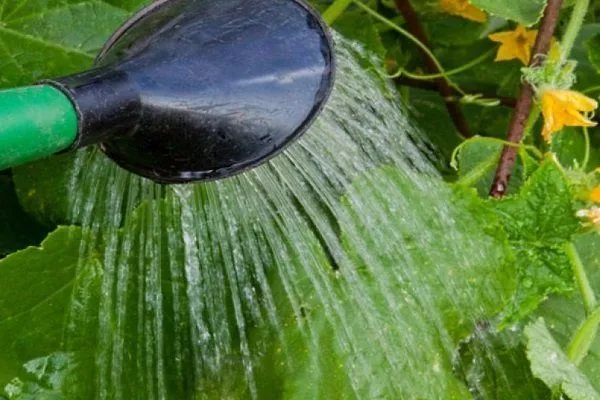
Watering features:
- water when the soil is dry, but not so dry that cracks form;
- prepare the water in advance, it should be settled and warm;
- the soil around the trunk should not become waterlogged;
- water the plants under the bush;
- in dry and hot weather, water Anguria every day in the evening;
- During the rainy season, avoid watering.
Top dressing
To ensure the plant develops well and bears fruit, it needs to be fed every 10 days.
For this, one of the solutions is prepared:
- Mullein. Mix 1/4 of a bucket of compost with a bucket of water. Leave the solution in a warm place for several days to ferment. Dilute 1 bucket of the solution in 3-4 buckets of water and water the plants at a rate of 10 liters per square meter.
- Chicken droppings. To prepare, fill half a bucket with manure and top it up with water. Leave the solution to ferment in a warm place. Before applying, dissolve 1 liter of manure in 10 liters of water. It's best to apply the fertilizer after rain; in dry weather, thoroughly water the bed 2 hours before applying.
The concentrated solution can be stored all summer and used as needed.
- Nitrophoska. For top dressing, use a complex mineral fertilizer by dissolving 3 tablespoons in 10 liters of water. Add 0.3-0.5 liters of water to each bush.
- "Mortar". To provide the plant with phosphorus, sodium, and potassium, apply after 5-6 leaves appear. Prepare a solution of 10-15 g of fertilizer per 10 liters of water.
- The first feeding should be carried out 10 days after planting the seedlings, using a mullein solution.
- The second feeding should be carried out at the beginning of flowering, using complex mineral fertilizer.
- The third feeding should be carried out during the period of active fruiting, using a solution of chicken manure.
Experienced gardeners advise alternating the application of mineral and organic fertilizers.
Diseases and pests
Antillean cucumber is rarely affected by common fungal diseases or pests.
Table of possible diseases:
| Types of diseases | Names of diseases | Reasons for the defeat | Solution to the problem |
| Fungal | powdery mildew | Most often they develop with:
| Treatment involves:
|
| anthracnose | |||
| root rot | |||
| white rot | |||
| Pests | spider mite | Violation of humidity, both in the direction of increase and decrease | Insecticides are used:
|
| melon aphid |
When using chemicals, take into account their breakdown periods. Harvesting during this time is prohibited.
Propagation of Antillean cucumber
As an annual plant, Antillean cucumbers cannot be grown from cuttings or shoots; they are grown only from seed. In Russia's climate, it is preferable to grow Anguria using potted seedlings.
Sometimes, if the seed germination rate is low, some gardeners advise:
- pinch off a shoot up to 15 cm in size;
- remove 2 leaves from the bottom;
- put it in a growth stimulator for 24 hours;
- plant in a garden bed, covering it with a jar on top.
After 2 weeks, the live bait should take root and start growing.
Beneficial properties
Anguria contains many useful substances:
- vitamins: P, C, B1, B2, B6, B9;
- microelements: potassium, iron, sodium, manganese, zinc, copper.
This contributes to a beneficial effect on the body:
- relieves insomnia, has a sedative effect;
- eliminates gastrointestinal problems;
- useful for heart diseases;
- as a preventative measure against tuberculosis, gout, and bronchitis;
- when losing weight it cleanses you of toxins and has a low calorie content (44 kcal per 100 g);
- cleanses the kidneys and liver;
- promotes cleansing and relief of inflammation of the skin.
The fruits of Antillean cucumbers do not accumulate nitrates and are not bitter.
There are also precautions:
- Consuming Antillean cucumbers can be dangerous for health in case of urolithiasis, they can provoke severe pain;
- People prone to allergies should use them with caution;
- Not recommended for use by pregnant or nursing mothers and children under 18 years of age.
Watch the video to learn about the Antillean cucumber, its cultivation, its use in folk medicine, and what can be made from its fruits:
Is it profitable to grow in Russia? Is there demand?
These "cucumbers" are rarely seen in Russia as table decorations or ornamental plants. Therefore, growing them on an industrial scale would be unprofitable.
Exotic lovers should decide for themselves whether it makes sense to grow Anguria in their garden, weighing all the pros and cons.
Reviews
Anguria is an exotic plant, highly prized worldwide, but virtually unknown in Russia and the CIS. It boasts excellent ornamental and flavor properties, requires less maintenance than other members of the cucurbitaceae family, and is resistant to diseases and pests. However, it thrives in warm conditions, so for a good harvest, it should be grown in a greenhouse.