
Carrot watering follows specific guidelines. For example, when the root system is developing, it's important to provide sufficient water, ensuring the water doesn't stagnate. Otherwise, the young sprouts will rot and die. Therefore, it's important to adhere to generally accepted standards for carrots throughout all stages of plant development.
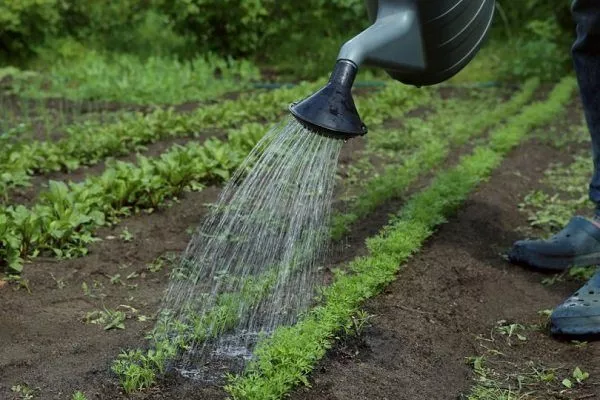
When and what to water carrots with?
The average frequency for watering carrots is once every 3-5 days, depending on weather and climate conditions. Watering is done with room-temperature water, which completely eliminates the possibility of using cold water from a well/borehole/water main.
- ✓ The water temperature should be at least 18°C to prevent stress on plants.
- ✓ The pH of the water should be in the range of 6.0-7.0 for optimal absorption of nutrients.
It's much easier to connect a hose to a pipe, install a sprinkler, and water the vegetables without supervision. However, you'll first have to pump the water into a separate reservoir and then transfer it to the beds. This is because cold water has a detrimental effect on root vegetables—the plant dehydrates because the root system can't absorb water at lower temperatures. Furthermore, root rot and various diseases develop, and the roots simply die, leading to the death of the crop.
Since carrot roots are quite weak, especially at the sprouting stage, watering them with a hose is strictly prohibited. A watering can (with a low-pressure nozzle and a diffuser) is used for watering.
It's best to water the plant late in the evening to prevent moisture evaporation. Watering should be stopped 15-20 days before long-term storage.
Irrigation rates
Adherence to watering standards affects vegetable yield and root crop quality (roots tend to crack during drought). There are general guidelines:
- increased moisture is necessary during the period from sowing the seed material until fruit formation;
- the water consumption rate per 1 hectare is from 4,000 to 4,500 cubic meters, but if the summer is rainy, the figures increase by another 1,000;
- precipitation level – maximum 500 mm;
- from sowing to the formation of root crops, 25-32 cubic meters per hectare are required;
- from fruit formation to maturity – from 35 to 43 cubic meters/ha;
- during the growing season – from 22 to 27 days.
Before sowing
Carrot seeds will never germinate in dry soil, so ample watering is essential in the pre-planting period. If the soil is very dry, apply the fertilizer a few days before planting. It's important to use a rain nozzle rather than a high-pressure watering system.
It is also recommended to use potassium permanganate, which will kill pathogens in the soil. Therefore, if seeds are planted in early spring after rain or snow, there is no need to water the soil. If planting occurs during warmer periods, after the meltwater has subsided, watering is necessary.
After sowing
Watering the seeds after planting is not necessary, as this can wash away the seeds. The only exception is if the soil isn't moist enough before planting. In this case, use a watering can with a sprayer (applying water as carefully as possible).
If germination (the period depends on climate and other factors) is excessively delayed (the sprouts fail to emerge for a long time), and the weather is hot (there is no rain), then drip irrigation is necessary at a rate of up to 30 cubic meters per hectare. Ensure that the soil is free of dry crusts and cracks.
To retain moisture, immediately after sowing, cover the seed with a mixture of peat and sand, then cover this thin layer with soil.
Carrot seedlings
Immediately after germination, the amount of water applied increases significantly. This is necessary for root and foliage development. Water daily or every other day, but in small amounts. Continue this process until three full stems emerge.
- ✓ The first leaves should be bright green, without yellowing.
- ✓ The stems should be strong, not elongated.
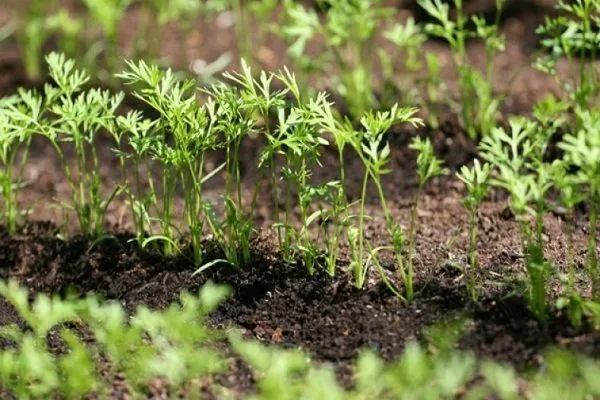
Then, the amount of water is reduced by almost half. The soil type is important to consider: on heavy soil, water more frequently, while on light soil (with peat and sand), water less frequently.
In the phase of root crop formation
As the fruit begins to form, the amount of water added increases, but the frequency, conversely, decreases. For example, if you previously watered the vegetable frequently and sparingly, now you should water it less frequently and in large amounts.
This is due to the fact that the root vegetable grows in size, and accordingly, so does the watering depth. Thus, the volume of moisture should reach up to 20 liters per square meter, and the frequency is once a week. The liquid penetration depth is up to 15 cm.
Mature plants
As carrots mature, they need less watering. This affects the quality of the vegetable—with too much water, they become covered with hairs and lateral roots.
However, you shouldn't leave the root crop in over-dried soil, as it will become hard and cracked. It's easy to tell if you're watering the crop correctly—the soil shouldn't be too dry or too wet.
About three weeks before digging up the root vegetables, watering should be stopped completely. However, just before harvesting, it's recommended to lightly water the soil, which will facilitate the process of removing the vegetables from the ground.
Common mistakes when watering and their consequences
The soil needs to be moistened at all stages of root and seed development, but this must be done in accordance with the rules, otherwise the yield may decrease.
What mistakes do gardeners make when watering carrots, and what are the consequences?
- If the crop is grown in dry soil, the fruits will be rough and their cores will be too light. Furthermore, the taste will change, with the carrots becoming bitter. Conversely, if the humidity level is too high, the fruits will stop growing as the above-ground foliage develops excessively.
The plant is also susceptible to rot, mold, and other diseases, and the roots become gnarled. To avoid these two mistakes, always water the plants evenly, at regular intervals. The amount of water depends on the vegetable's stage of development. - Few people think about what kind of water to use for carrots. But this factor plays a crucial role. As mentioned earlier, cold water should not be used, as it kills the plant's roots.
Watering from tap water is prohibited, as it often contains chlorine and other impurities. Therefore, the water should be poured into containers and allowed to settle (24-48 hours is sufficient). However, a better option is natural rainwater, which can be collected during heavy rainfalls. - Another mistake novice vegetable growers make is planting their beds at elevated levels. While this method is certainly viable, it's not suitable for carrots. This is because the vegetables don't receive sufficient oxygen, and moisture isn't retained (it quickly drains into the lower soil layers). However, there is an exception: carrots can be planted at elevated levels where groundwater is close and in marshy areas.
How to combine watering and fertilizing?
To reduce the need for fertilizer, fertilize the soil in the fall. If you haven't done this, you'll need to add organic matter and minerals during the growing season and development stage.
The first time, this is done 20-30 days after germination (a small amount of manure or chicken manure is added). The second time, another month later, is fertilized with the universal fertilizer Nitrophoska (1 tablespoon per bucket of water). The third time, potassium-based minerals are added.

To avoid fertilizing (if you're short on time), you can combine fertilizing with watering. Here's what you need:
- Once a week, mix water with crushed wood ash (for 10 liters of warm water you need 1 liter of wood tincture);
- twice (during active growth of the fruit and during ripening) 1 teaspoon of boric acid is added to a bucket of water;
- make decoctions from plants such as nettle, then water once a month;
- Manure or compost is added along with irrigation.
Try not to overfeed carrots, especially with nitrogen-based fertilizers. Otherwise, the taste, appearance, and quality of the roots will deteriorate.
Watering carrots on mulched soil
Mulching refers to covering the soil with organic or inorganic material. What can be used for carrots?
- nettles and weeds;
- compost and manure;
- straw, hay and leaves;
- pine needles and green manure;
- bark and wood chips;
- peat;
- cardboard and woven materials;
- film and agrofibre.
What does mulching provide:
- overheating of plants is prevented;
- moisture does not evaporate;
- weed growth slows down;
- nutrients are supplied;
- the optimal temperature and humidity level are maintained;
- crop yield increases;
- protection from strong winds is provided.
If you mulch your beds, you'll need to water them much less frequently, and you won't need to loosen the soil as often. However, the key rule here is to water them infrequently but thoroughly.
The relationship between watering and hilling
Carrots need to be hilled, especially if the top of the root is above ground level. This helps retain moisture, prevent sunburn, and provide oxygen to the root system.
Hilling is done four times during the vegetable's growth period. Watering is done simultaneously. This helps maintain humidity and an optimal temperature.
Watering carrots with salt water
Even in the days of our ancestors, before fertilizers were invented, carrots and other crops were watered with a saline solution. Salt isn't considered a fertilizer, but sodium chloride activates other fertilizers by quickly dissolving nutrients, allowing the plant to absorb them several times faster and better.
Furthermore, a saline solution helps combat carrots' main enemies—pests and diseases. In this case, the tops are sprayed. If the soil is watered, the roots acquire a characteristic sweetness and their carotene content increases.
Salt application is most effective on infertile and heavy soils. Watering with the solution should begin in late July or early August, when root formation begins. Depending on the desired outcome, you can prepare the following solution:
- To prevent rot and accelerate fruit growth, take a bucket with 10 liters of warm water. Add 1 tablespoon of table salt and stir thoroughly until the sodium chloride is completely dissolved. Water the carrots, not at the roots, but in the furrows created around the roots.
- To improve the soil quality, you will need 2 tablespoons of salt per bucket of water.
Immediately before applying the salt solution, it is recommended to water the plants with plain water, which will speed up the salt's action. The solution can be applied up to three times per season.
Watering Carrots (Video Tips)
In this video, you'll find helpful tips from an experienced gardener on watering carrots:
Knowing how to properly water carrots at different stages of growth and ripening can help increase yields. Before planting seeds, be sure to familiarize yourself with the watering requirements for your particular variety and strictly adhere to these recommendations. Ensure the soil doesn't crack or form a dry crust on the surface.