
The ancestor of the modern carrot was purple, and remained so until the 16th century. Growing this unusual carrot is no different from cultivating the familiar orange variety. Furthermore, modern varieties and hybrids are highly resistant to various diseases.
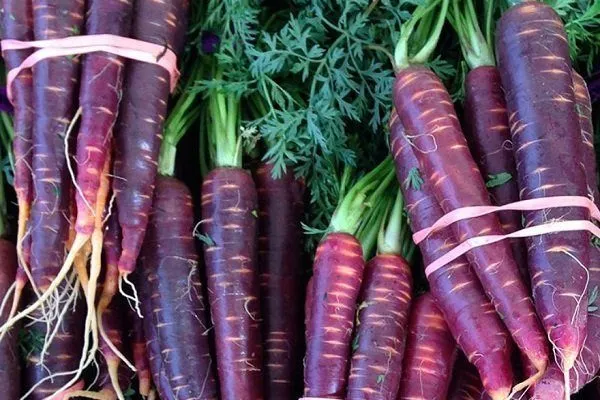
General characteristics of purple carrots
Purple carrots belong to the Apiaceae family, subspecies Daucus carota ubsp. sativus. They are biennial herbaceous plants. The first year sees the growth of green foliage.
This vegetable is characterized by low yields, good germination, and resistance to diseases and pests. Since the 19th century, purple carrots have been considered an excellent remedy for a number of ailments.
Appearance of the bush and fruits
In appearance, the plants are indistinguishable from classic orange carrots. The plant also shares a similar appearance with other members of the Apiaceae family.
This purple vegetable has a sturdy root and feathery leaves. The fruit comes in varying shades of purple depending on the variety. They are 20-30 cm long.
Short fruits ripen faster than long ones. The depth of the soil also influences root development.
Compound
The vegetable is rich in minerals. 100 g contains:
- magnesium – 38 mg;
- chlorine – 63 mg;
- calcium – 27 mg;
- sodium – 21 mg;
- sulfur – 6 mg;
- potassium – 200 mg;
- phosphorus – 55 mg;
- vanadium – 99 mcg;
- molybdenum – 20 mcg;
- nickel – 6 mcg;
- copper – 80 mcg;
- fluorine – 55 mcg;
- lithium – 6 mcg.
Properties
Recent studies have shown that the chemical composition of this unusual vegetable is significantly richer than that of the common carrot, as it possesses an ideal balance of vitamins and minerals. As a result, purple carrots, when consumed regularly, strengthen the immune system and the cardiovascular system. They are also beneficial for the eyes due to their high concentration of anthocyanins.
The root vegetable contains easily digestible calcium and other substances beneficial for hair, nails, and skin, so it is best to combine eating purple carrots with using them in home beauty treatments.
Pros and cons
Advantages purple carrots:
- Easy to grow.
- Long shelf life.
- Demand and benefits of vegetables.
Flaws:
- When it is peeled, it stains everything it comes into contact with purple tones - hands, clothes, dishes, other vegetables.
- When cooked, it discolors the water, turning brown and unappealing. Therefore, it is mainly eaten raw.
Popular purple carrot varieties
| Name | Ripening period | Disease resistance | Length of root crop |
|---|---|---|---|
| Purple Elixir | Average | High | 20-30 cm |
| Dragon | Early | High | 20-30 cm |
| Cosmic Purple | Average | High | 20 cm |
| Purple haze | Early | High | 30 cm |
| Purple Dragon | Average | High | 25 cm |
| Rainbow mix | Early | High | 18 cm |
There are several popular varieties of carrots:
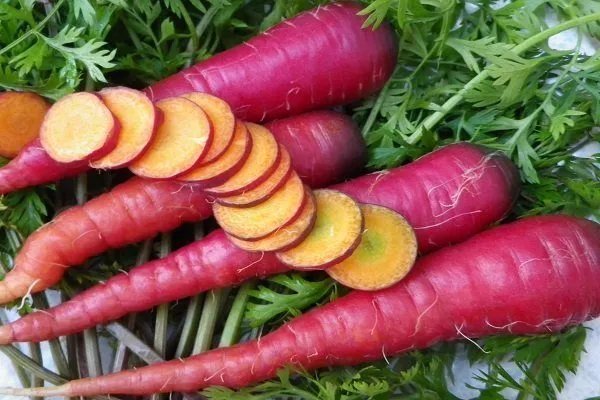
- Purple Elixir. The roots of this variety are easily distinguished from all others by their characteristic purple-violet coloring on the outside. Inside, purple carrots have a yellowish-orange core. Like most members of this species, this purple carrot is extremely rich in vitamins and minerals.

- Dragon. This variety has a bright purple exterior and an orange center. It's sweet and contains a large amount of vitamin A and beta-carotene.
- Cosmic Purple. The inside of the carrot is completely orange. A raspberry-purple hue is present only on the outside in small amounts. The carrot's flavor is rich and sweet. The fruits reach a length of 20 cm.
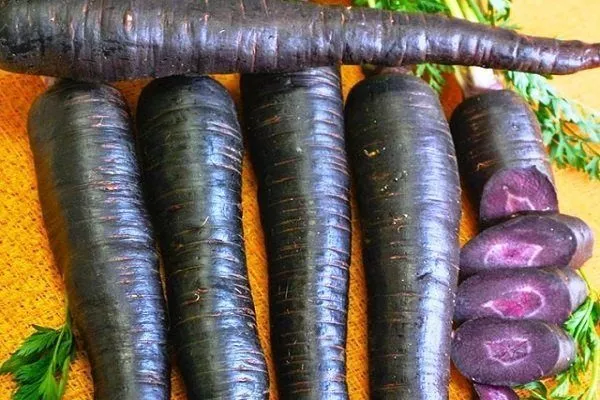
- Purple haze. The hybrid is distinguished by its dark purple color. The interior of the root is orange. This variety is considered early maturing, reaching maturity 70 days after planting. The roots grow up to 30 cm in length. Purple Haze is resistant to many diseases.
- Purple dragon. This variety is considered exquisite. It has a pleasant sweet flavor with spicy notes. The outer part of the root is purple-red, while the inner part is orange-yellow. The carrots reach 25 cm in length.
- Rainbow mix. This variety belongs to the colored carrot category. Its fruits range in hue from orange to deep purple. The roots are cylindrical in shape and reach a length of 18 cm.




How to grow purple carrots?
To obtain a good harvest, it is important to pay attention to planting, care, and treatment of carrots against diseases and pests.
- ✓ The optimal soil pH should be in the range of 6.0-6.8.
- ✓ The soil should be well drained, without stagnant water.
Preparing for landing
To help seeds germinate faster, you can use the following methods:
- Soak. Place the seeds in cloth bags, fill them with warm water, and soak them for 24 hours, changing the water regularly. You can also soak them in water mixed with wood ash. Sometimes, heating is used in parallel with soaking.
- Heat treatment. Take the bags, fill them with seeds and dip them alternately in hot water for 20 minutes, then in cold water for 2 minutes.
- Bubbling. The method involves soaking the seeds in oxygenated or air-saturated water. This should be done in a container made of a non-oxidizing material.
- Burying seeds. Bury the seeds in bags at a shallow depth for 10-12 days. This method ensures germination as early as 4-5 days after sowing.
The seeds can also be mixed with damp peat and stored in a warm place for 7 days. There, they will begin to germinate, after which they can be used for sowing. Sow the seeds outdoors in early spring, immediately after the snow melts.
Landing features
If the soil is light, the seeds should be planted 20-30 mm deep; if the soil is heavy, the planting depth should be reduced to 15-20 mm. The row spacing should be approximately 20 centimeters. The distance between seeds in a row should be 30 to 40 mm.
To prevent seeding from becoming too dense, gardeners often resort to the following trick: cut toilet paper into thin strips, apply drops of paste (flour or starch) to them at intervals of 30-40 mm, and then scatter the seeds among them. Once the paste has dried, fold the paper in half lengthwise and roll it into a roll.
When sowing, the paper with the seeds is unfolded and placed into furrows, which must be thoroughly moistened beforehand. Once the seeds are embedded in the soil, the surface of the bed should be covered with a three-centimeter layer of mulch. This will prevent a crust from forming on the surface, which would hinder the germination of the seedlings.
There's another method for sowing this crop. Toilet paper or a paper napkin is cut into small squares, with a drop of paste added to each. Place one or two seeds and one granule of complex mineral fertilizer on top of the squares. Roll the squares into balls. Once dry, store them until ready to sow. During sowing, place the balls in a furrow, keeping a distance of 30-40 mm.
Care instructions
The essence of caring for purple carrots consists of loosening the soil, adding fertilizer, and thinning the seedlings.
The first thinning is done when one or two leaves appear on the bush. Large plants are left 2 cm apart. When two pairs of leaves appear, the procedure is repeated, doubling the distance between adjacent plants.
In summer, water the seedlings, loosen the soil, and thin out any densely growing plants. Fertilize with mineral fertilizer if necessary. To ensure sweet and beautiful carrots, regularly cultivate the soil. The first weeding may be necessary before the seeds germinate.
The presence of weeds has a detrimental effect on the development of carrots, so they must be eliminated immediately after they appear.
For 3-4 months after planting, water the plant 3-4 times a week (4 liters of water per square meter). Then, increase the amount of water at a time and reduce the frequency of waterings. Now, once every 7 days is sufficient.
Gardeners recommend not overusing fertilizers. Only two applications are sufficient (Kristalon, Rastvorin, and Ammophos have proven effective). Liquid fertilizers made from nettles, manure, or compost can be applied monthly.
Most purple carrot varieties require frequent soil loosening, starting when the first shoots emerge. This should be done immediately after rain and with great care. This can be combined with regular weeding, which is essential for this vegetable (especially in the first few months). Weeding should be done manually to avoid accidentally damaging the plants.
When the carrots reach 10-15 cm in height, you can begin mulching. It's easiest to do this after weeding and thinning, using finely chopped grass as mulch. Repeat mulching after 2-3 weeks.
Mulching is not a mandatory measure, but it can significantly reduce weed problems and improve the quality of root crops.
Ripe carrots should be harvested as quickly as possible. This will have a beneficial effect on the development of the remaining root vegetables.
Diseases and pests
The following diseases pose the greatest danger to this crop:
- Bacteriosis. It spreads with plant debris and seed material.
- Fomoz Damages the stems of seed plants, as well as their inflorescences. Brown spots appear at the top of the root crop, and over time, the entire root crop is affected. Before sowing, the seed should be treated with a Tigam solution.
- Septoria. Small chlorotic spots appear on the foliage of the affected bush. As the disease progresses, they turn brown. As a preventative measure, sow seeds in hot water and then immediately cool.
- Black rot. Coal-black, rotten patches appear on the affected root. Treat with a Tigam solution.
- Red rot. Initially, purple or brown spots appear on the roots, which then disappear, and black fungal sclerotia form in their place. This disease is caused by the addition of manure to the soil.
- Gray rot. Its symptoms appear on almost all vegetable crops. This occurs during vegetable storage.
- Before planting, treat the seeds with a Tigam solution to prevent phomosis and black rot.
- Regularly inspect plants for signs of disease and pests.
- Conduct preventive spraying with biological preparations every 2 weeks.
Purple carrots can also be damaged by:
- Slugs. They can be collected by hand, but it is better to control pests using traps.
- Winter cutworms They injure the above-ground parts of the bush and also damage shoots and roots by gnawing at them.
- Carrot flies. They are active at night. As soon as the carrot plant produces a few new leaves, they begin laying eggs.
- Wireworms – click beetle larvae. These are beetles that lay eggs on crops.
Possible errors and difficulties
Mistakes and problems when growing:
- poorly leveled and cleared planting surface;
- careless watering leads to rot and fungal diseases;
- lack of space for feeding (planting too densely);
- lack of regular hilling – as a result, carrots become bitter, quickly burn out in the sun and acquire a green tint;
- Applying fertilizer before planting results in the appearance of small, crooked root crops (it is better to plant carrots in the same place as cucumbers, tomatoes, and onions, which were well fertilized last year);
- abuse of nitrogen fertilizers.
The difficulty lies in the fact that purple carrot seeds are not available in stores or markets—they can only be found and ordered online. Furthermore, purple carrots require comfortable conditions and proper care, with strict adherence to harvesting and storage guidelines.
Harvesting and storage
Harvesting purple carrots involves several stages. Early-ripening varieties are harvested in July. Mid-season varieties are dug up in August. Late-ripening varieties, which can be stored for a long time, are harvested in the second half of September.
Harvesting takes place on a sunny, dry, and warm day. The fruits are dug up, dried, and cleaned of clods of soil.
The harvest can be stored. A cellar or basement is ideal for storing this vegetable. Carrots are placed in plastic or wooden boxes, sprinkled with dry sand so that the roots do not touch each other. Moss can be substituted for the sand if desired.
Another method for storing carrots involves glazing them with clay. The clay is mixed with water until it reaches a creamy consistency, after which the carrots are dipped one by one into the mixture and laid out on a wire rack to dry. The dried vegetables are placed on winter storagePurple carrots retain their unique properties until next season.
Culinary uses
Purple carrots can be used in cooking, just like their orange counterparts. They can be stewed, fried, boiled, baked, or steamed. They can also be used to make marinades.
Purple carrot dishes are not only tasty and healthy, they're also easy to digest. They pair well with almost any food, especially grains, other vegetables, and meat. Eating raw carrots, without cooking, is also beneficial.
Due to its unusual color, this root vegetable is often used to decorate various dishes.
Purple carrots for weight loss
They're low in calories and can be eaten raw or steamed. Carrots are very filling and high in fiber. This vegetable aids digestion. Not only does it lower blood sugar levels, but it also helps the body better absorb nutrients.
Including purple carrots in your diet reduces bad cholesterol and improves metabolism, which promotes weight loss.
Video footage of purple carrots
This video explains what purple carrots are, how to plant them properly, harvest them, and more.
Reviews
Purple carrots are a vitamin- and mineral-rich vegetable. Their consumption has a positive effect on the human body. Therefore, purple carrots are not a genetically modified product, but a truly natural one, possessing many beneficial and essential qualities for humans.