
Onion Zolotisty Semko is a domestic hybrid. This variety has excellent characteristics and a number of advantages. It can be planted from onion sets or seedlings grown from seeds. In either case, the crop requires optimal conditions, including specific care.
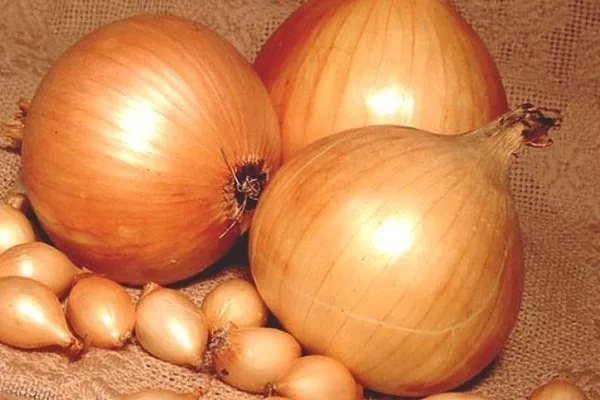
Onion Golden Semko
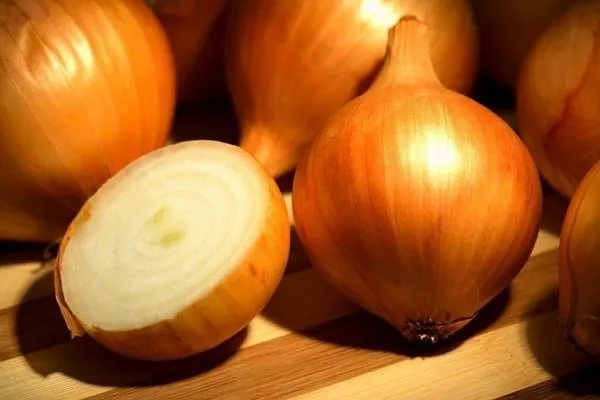
The Golden Semko onion has a high yield
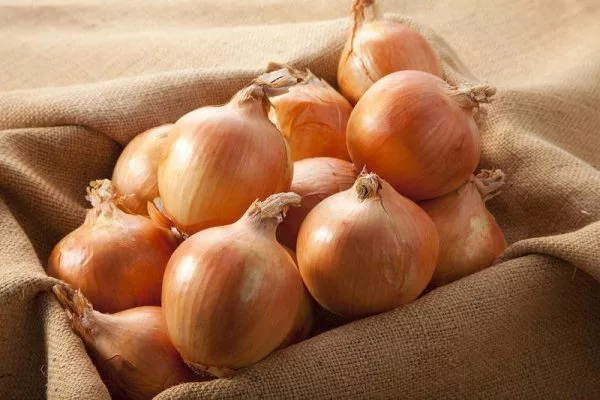
Onion Golden Semko can be stored for a long time
Characteristics of the variety, its advantages and disadvantages
Zolotisty Semko is an early-ripening crop. From germination to the first harvest, it takes 75-80 days, or 2.5 months. This is an average time, as the crop ripens faster in southern regions than in northern latitudes.
The onion has the following characteristics:
- round shape of bulbs;
- weight of one fruit – 70-100 g;
- thin neck;
- golden dry scales and white flesh;
- small-nested nature of branching;
- semi-sharp taste.
Golden Semko has many advantages:
- the possibility of cultivation in different climatic conditions, but with differences in growing seasons: in the south the variety is annual, and in the northern regions it is biennial;
- undemanding to soil characteristics;
- the possibility of growing both seedlings and sets;
- the variety is little susceptible to diseases;
- high yield – up to 5 kg per square meter, and in different climatic conditions;
- long-term storage with minimal losses – under proper conditions, 90-95% of the harvested crop is preserved;
- Thanks to its semi-sharp taste, this variety is widely used in cooking, both raw and for cooking, and when cooked, it causes fewer tears.
Optimal conditions for growing
Golden Semko is an unpretentious crop, but to obtain a good harvest, several conditions must be met:
- The site is on an elevated site. Cold lowlands adversely affect crop development, resulting in a poor harvest.
- Sufficient illumination of the area.
- Wind protection. The plant does not like drafts.
- Follow crop rotation rules. It's best to plant onions after pumpkins, nightshades, cabbage or kohlrabi, celery, spinach, and lettuce. Bad crop neighbors include garlic, legumes, dill, parsley, and broccoli. Onions should not be replanted in the same area for three years.
- Avoid prolonged exposure to low temperatures. If not winter sowing, it is recommended to sow at temperatures starting at 4°C (4°F). Onions begin to develop at temperatures starting at 12°C (55°F). The crop tolerates short-term frosts well.
- The right neighborhood. Onions thrive next to beets, carrots, tomatoes, any type of cabbage, lettuce, and chicory.
- Selecting planting material. This step is crucial, as discarding seeds or sets for planting will yield a much greater harvest than ignoring such steps.
- ✓ The optimal soil temperature for planting should be at least 12°C to begin the formation of bulbs.
- ✓ The distance between plants should be at least 10 cm to ensure sufficient space for growth.
Soil requirements
Golden Semko is undemanding to soil, but for better growth and development of the crop, it is worth providing the following conditions:
- neutral acidity, slightly alkaline substrate is also suitable;
- the soil must be light, loose and fertile; heavy clay substrate does not ensure the full development of the crop;
- sufficient removal of groundwater – distance to the ground surface of at least 1 meter;
- Before planting, add organic fertilizers - fresh manure is not recommended, it is better to use sand and humus; 2-3 kg of such fertilizer is needed per square meter;
- Further fertilizing is not mandatory, but can be carried out as needed, depending on the soil characteristics.
The soil for planting Golden Semko should be prepared in the fall. When digging, it's helpful to add the following mineral fertilizers per square meter:
- ammonium nitrate – 10 g;
- wood ash – 15 g;
- potassium salt – 15 g;
- superphosphate – 30 g.
It is recommended to apply superphosphate in the fall, two weeks after loosening the soil. Apply to a depth of 5 cm. When applying the fertilizer, dig the area to a depth of a bayonet. Efficient drainage of meltwater should be ensured by digging ditches around the perimeter.
Growing seedlings from seeds
Zolotisty Semko can be planted from seeds or sets. The former is recommended for this variety, as it ensures an earlier and more abundant harvest.
- ✓ Seeds should be uniformly colored, without spots or damage.
- ✓ When soaked in water, high-quality seeds sink to the bottom, while low-quality ones float.
Seedlings emerge in spring, and the harvest can be reaped as early as midsummer. A disadvantage of winter sowing is the need to sow more seeds, as harsh winter conditions can lead to losses. It is recommended to increase the amount of planting material by a tenth.
The process begins with growing seedlings in late February or early March. Follow these steps:
- Checking planting material for germinationWrap several seeds in a damp cloth and leave for several days. If 70% of the seedlings sprout, they are considered ready for sowing. Less than 50% sprouting means the seeds are unsuitable for planting.
- DisinfectionThis step is necessary to prevent possible diseases. For disinfection, you can use a weak solution of potassium permanganate, after soaking the seeds in plain water for 18 hours.
Another option is to place the seedlings in a cloth bag, soak them in hot water for 15 minutes, and then soak them in cold water for a minute. Then, leave the seeds in the bag at room temperature for at least 24 hours, occasionally moistening them. - Growth stimulationThis step is optional, but it helps speed up and improve crop germination. Kornevin, Ecosil, Biostim, and Emistim are commonly used. Use the chosen product according to its instructions.
- Preparing a landing siteYou can grow seedlings indoors in wooden boxes or in hotbeds or greenhouses. Regardless of the method chosen, ensure adequate light, proper temperature, and proper care. Make furrows in the prepared soil, deepening them to a maximum of 2 cm. Leave 10 cm of space to the edges of the container or bed, and 5 cm between rows.
- Planting seedsIt is recommended to leave 1.5 cm between them. This variety should not be planted too densely.
- Soil compaction and wateringIt's best to water the plant with settled water. It should be at room temperature.
- InsulationCover the bed or box with the planted seeds with plastic wrap. Remove it once the seedlings emerge. If using a separate container, place it in a warm place—onions require a temperature of 25 degrees Celsius (77 degrees Fahrenheit) for the first few days.
- HardeningThis process is carried out before the seedlings appear. Place the onion containers in a location with a temperature of 12 degrees Celsius (55 degrees Fahrenheit) for three days. If possible, use additional fluorescent lamps to increase the amount of daylight. The seedlings should be taken outdoors. Indoors, this can be a balcony or an open window. Increase the hardening time gradually, starting with a quarter of an hour. Hardening off the onions should begin at least two weeks before planting outdoors.
- ThinningThis stage is carried out when seedlings emerge. There should be 1.5-2 cm between adjacent seedlings.
- WateringThis should be done regularly, at least once a week. The amount of watering should be adjusted based on the soil condition. It shouldn't dry out, but too much moisture is also harmful.
- LooseningThe procedure is carried out to get rid of weeds and improve air and moisture penetration.
- FertilizerThis step is optional, but necessary if the crop is not growing well. Weeds are often the cause. A urea solution should be used: dissolve 3 grams of fertilizer in a liter of water.
It's important to monitor the quality of the seedlings. Small loops should appear on the soil. If roots are visible on the surface, these plants should be discarded.
In total, seedlings take approximately 50 days to grow from sowing. They are planted outdoors in the second half of April, after 3-4 leaves have formed.
Planting seedlings in open ground
Seedlings should be planted in consistently warm weather, but not too hot. It's important that the soil is well-warmed.
You need to act according to the following algorithm:
- Level the selected area and make furrows or holes. Dig to a maximum depth of 5 cm. Leave 25-30 cm between furrows.
- Water the prepared area and the seedlings themselves generously.
- Carefully transfer the seedlings to the garden bed, treating the roots of each seedling with a mixture of clay and mullein—just dip the roots in the mixture. Inspect the seedlings during transplanting, removing any damaged or weak ones. Leave approximately 10 cm between seedlings.
- Fill the furrows, lightly compacting the soil.
- Water the plantings. From now on, water the beds every 2 weeks.
- The next day, prepare a humate solution and water the plantings with it. This treatment promotes rooting of the seedlings.
Planting onion sets in open ground
Using onion sets allows for an earlier harvest. This planting method is also attractive for northern regions, as the crop's growing season lasts two years, while sets allow for a harvest within the same year.
One of the most important rules for planting onion sets is careful selection of the raw materials. The bulbs must meet the following requirements:
- diameter 1-3 cm;
- dense structure;
- dryness – the husk should rustle;
- smooth surface and no damage or rot spots;
- absence of foreign odor – the onion set’s own smell is specific.
It's recommended to sort the onion sets by size. It's best to plant each group separately.
Onion sets can be purchased or prepared at home. The latter option requires thoroughly drying the material and storing it at a specific temperature. Avoid handling the sets unnecessarily, as this will cause them to sprout.
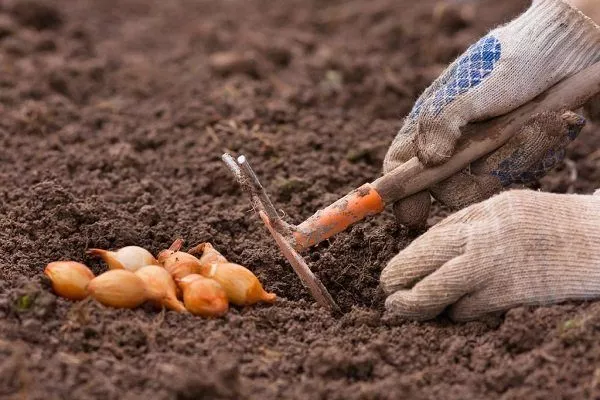
Planting of Golden Semko onion sets in open ground is carried out according to the following algorithm:
- Dry the planting material. Maintain a temperature of 35-40 degrees Celsius and keep the sets in these conditions for a week.
- Treat the onion with copper sulfate.
- Loosen the soil, remove weeds and level the area.
- Make holes. Dig them 5 cm deep, leaving 10-15 cm between bulbs in rows and 20 cm between rows.
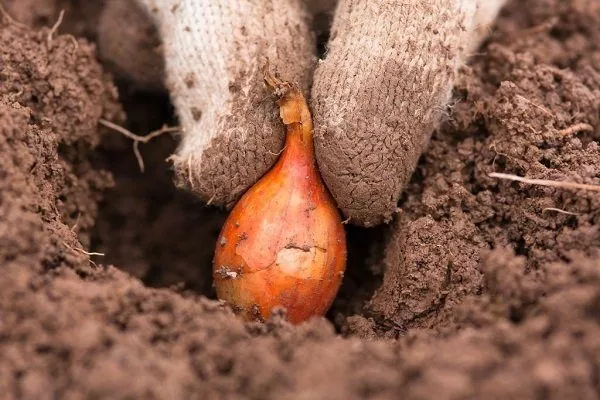
- Place one bulb in each hole, cover with soil, and compact it lightly. The stems and a third of the bulbs should be visible above the surface. If you plant them too deep, the bulbs will stretch too much, and if you don't plant them deep enough, they will become deformed.
For planting onion sets, it's best to choose cloudy, dry weather, scheduling the work for the afternoon. Zolotisty Semko can be planted not only in spring but also in autumn. In the first case, planting occurs in the first ten days of May, and in the second, in early October.
Caring for a plant in open ground
Much depends on the correct planting of onions, but for proper development the crop requires certain care.
Watering
The frequency of watering Zolotisty Semko should be adjusted to the soil condition. Overwatering should be avoided. Moisture deficits, which are especially dangerous during the growing season, should also be avoided. The optimal watering frequency is once a week. The water should be warm and settled.
During dry periods, watering should be increased, and during rainy periods, watering should be stopped completely. If the soil dries out, water more frequently.
If greenhouses are used to grow Golden Semko, a drip irrigation system can be used.
Watering should be stopped completely 3-4 weeks before harvesting.
Top dressing
The need for fertilizing is determined by the condition of the crop. Organic fertilizers are recommended. This can be an infusion of mullein or chicken manure. Use it for watering, adding a glass per bucket of water. Use one bucket per 3 square meters. Fertilizing is recommended two weeks after planting.
If your onions are growing slowly and looking lifeless, emergency measures are needed. A urea solution can be used. Add 30 grams of the solution to a bucket of water and water the plants generously.
Weeding and loosening
Periodically, it's necessary to loosen the spaces between rows to ensure proper soil aeration. This is most convenient and effective after watering.
Regular weeding is also important. If weeds are not removed promptly, the onion's growth and development will be slowed. Adjust weeding frequency to the specific needs of your site. If fresh manure was applied in the fall, weed activity will increase.
Pest and disease control
The Golden Semko has excellent disease resistance, but this doesn't eliminate pests. If pests have already appeared, insecticides such as Actellic, Aktara, Bitoxibacillin, and Gomelin should be used. Copper sulfate is also effective as a preventative: add a teaspoon of the product to a 10-liter bucket of water and spray it on the green feathers.
An unfavorable environment can trigger fungal diseases such as rust, fusarium wilt, smut, and powdery mildew, including downy mildew. Fungicides such as Previcur, Infinito, Teldora, and Consento are required for treatment.
Harvesting and storage
It's important to choose the right day for harvesting. It should be dry and sunny. Avoid harvesting immediately after rainfall—the onions need to be dry. The optimal time for harvesting is also determined by the condition of the onions—wilted greens and dried necks.
Culling should be done immediately during harvest. Only undamaged specimens are suitable for long-term storage. The rest can be used for food or preserves. Specimens showing signs of rot should be discarded.
After harvesting, the onions need to be thoroughly dried. To do this, choose a well-lit area and leave them for two weeks. Be sure to protect the crop from rain.
Zolotisty Semko is well suited for long-term storage. It will keep for up to six months with minimal loss. Storage should be dry and cool. It's best to store onions in nets or boxes. Ideally, arrange the onions in a single layer.
An experienced gardener will talk about the benefits of onions in the following video:
Proper cultivation of the Zolotisty Semko onion variety will provide gardeners with a bountiful harvest that lasts a long time. It's important to follow all planting and growing guidelines to ensure good results.