
Harvesting onions isn't as difficult as it seems at first glance. In reality, it's important to know the exact ripening time, the harvesting technique, and the preparatory steps, especially in unfavorable weather conditions. This determines the shelf life of the bulbous crop.
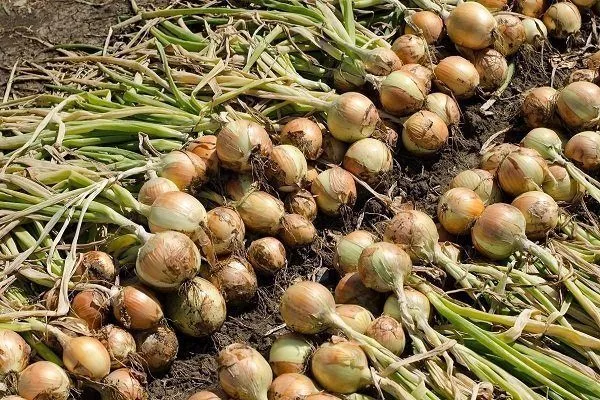
How to determine the timing of harvesting onions?
Onion harvesting begins after the onions have fully matured. The timing largely depends on the variety—early, mid-season, or late. Factors such as weather conditions, climate, proper care, and so on also influence this.
This video explains how to determine when your onion harvest is ready, and also provides practical tips for harvesting onions:
By external signs
If you're unsure what variety of onion you've planted, or for some reason can't determine the harvest time, carefully inspect the plant, as its external signs will speak for themselves:
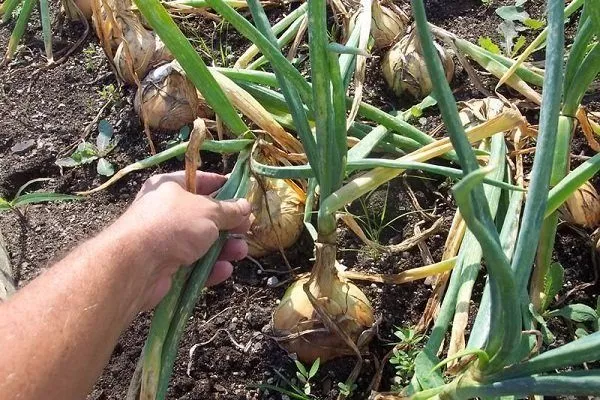
- The color of the onion feathers changes, turning yellow. However, this isn't always the case; some onion varieties remain green.
- The above-ground part falls to the ground. In some species, it is too strong and may not lay flat.
- The root system becomes weakened – the roots become shortened, thinned, and dry out.
- The neck of the head becomes thin, soft and dry.
- The husk acquires a golden hue or a color corresponding to the varietal characteristics.
- The integumentary scales peel off.
According to the lunar calendar
Many gardeners use the lunar calendar to increase the shelf life of their bulbs. The calculation is simple: root vegetables are harvested during the waning moon. Harvesting during the full moon and new moon is strictly avoided.
According to the lunar calendar for 2019, onions are dug up on the following dates:
- August – 19-26, 29-31;
- September – 16-22, 25-27.
Mathematically
If you can't determine the exact ripening date of root vegetables, perform mathematical calculations. This requires knowing the exact planting date and variety (and, therefore, the ripening period). Early varieties need 3 months to ripen, mid-season varieties 120 days, mid-late varieties 140 days, and late varieties 150 days. Add the ripening period to the planting date, and you'll get the harvest date.
Example:
- onions were planted on April 15;
- vegetation period – 120 days;
- 15+120=135;
- Starting from April 15, count 135 days on the calendar – you get August 13.
Please note that the ripening period may vary depending on weather conditions. If the summer is rainy, the ripening time will increase.
Depending on the region
Russia is divided into regions, each with its own climatic conditions that influence the ripening time of vegetable crops. Depending on the region, onions are harvested at the following times:
- southern strip – end of July;
- middle zone – beginning of August;
- Northern regions – mid-to-late August.
How to prepare onions for harvesting?
Preparing bulbous plants is necessary if there is a need to speed up the ripening of the bulbs (for example, due to impending adverse weather conditions). What can be done:
- If the stems are located below the top layer of soil, pull back the soil, which will cause the foliage to turn yellow. Shorten the roots slightly (by 5 cm), which will promote faster ripening of the bulbs.
- About a month before harvest, artificially bend the stems toward the ground. This will ensure that nutrients are directed exclusively to the heads, which will begin to rapidly grow in size.
- Stop moistening the soil 15 days before harvesting.
Harvesting technology
There are two ways to harvest onions from the garden:
- Manual method It's used for harvesting in small areas (like a summer cottage or home garden). In loose soil, simply pulling the stem by hand is enough to remove the turnips. If the soil is dense, a tool (a pitchfork or shovel) is used. The bulbs are dug up and then pulled out.
- Mechanized technology Involves harvesting onions using specialized onion harvesting equipment. It is used in fields where large volumes are being collected.
Rules for harvesting onions
By following the proper onion harvesting guidelines, you can extend the shelf life of your onions and preserve their nutritional value and flavor. Key requirements:
- The stems should not fall completely to the ground, but only 70-80%—this determines the flavor and spiciness of the crop. This percentage is determined 7-10 days before the exact harvest time.
- Weather conditions must be favorable.
- Harvesting time is morning. Immediately after removing the onions from the soil, they should be spread out in the garden to dry. If the tops haven't dried by evening, cover the vegetables with plastic wrap to prevent moisture from getting in.
- Do not pull out 2-3 bulbs at a time, even if the soil is very loose.
- Try not to damage the husk, act carefully.
- It is unacceptable to knock off the remaining soil from the heads (on any objects, hands, the surface of the ground, etc.) - wait until the soil dries out naturally and crumbles.
Do not cut the stems immediately after harvesting - this leads to rapid infection of the bulbs with pathogens.
Rules for collecting onion sets
Onion sets are bulbs grown from seed obtained in the first year. These are the ones that are best planted the following year to produce full-sized bulbs. Onion sets are usually no larger than 2.5 cm, so pay special attention to this.
The harvesting guidelines are the same as for onions, but in this case, it's absolutely not recommended to dig up the planting material during rainy weather. This is because the root system can re-root, making the bulbs unsuitable for planting until spring. For this reason, it's acceptable to dig up the sets earlier.
How to harvest in adverse weather conditions?
If the summer is rainy, you don't have to be too particular about the harvest day (wait for sunny, warm weather), although digging up the bulbs in such conditions is not recommended. The same applies to climates with high humidity.
What could be the consequences for culture:
- Onions do not like excessive moisture, as the root system begins to die off due to rotting.
- During prolonged rainfall, the ripening period is extended, and the heads remain underdeveloped. This is because the water promotes the growth of green mass, not root growth.
- Overwatering weakens the plant's immunity, making it susceptible to fungal diseases. Most commonly, these include powdery mildew, downy mildew, and root rot.
- The shelf life is reduced.
You can minimize risks and preserve your harvest for long-term storage ahead of time (if you know the summer will be rainy) by following the recommendations of experts and gardeners:
- Choose the right variety (there are species that are resistant to rot diseases and dampness).
- Plant the crop in the right place - well ventilated, with a slope to drain rainwater.
- Treat with antifungal agents more often.
- ✓ Resistance to fungal diseases: Choose varieties with high resistance to powdery mildew and root rot.
- ✓ Ripening period: early ripening varieties are preferred to minimize the risk of under-ripening due to rain.
How to act correctly in adverse weather conditions:
- Stop fertilizing approximately 20-30 days before harvest. If rain is expected during harvest time, stop watering completely.
- A few days before harvesting, cover the beds with plastic film. To do this, install wooden stakes around the perimeter, and stretch non-woven fabric over them. This will prevent raindrops from directly splashing on the onions and will also allow the beds to ventilate.
- During rain, the heads should be dug up without shaking off the clumps of dirt.
- After harvesting, ensure proper drying by placing the vegetables in a well-ventilated area (install fans if necessary). Drying time depends on how wet the bulbs are.
- When drying, turn the heads over several times a day.
- As the dirt dries, clean the roots, but do not use sharp objects to avoid damaging the scales.
Storage
The shelf life of onions depends on various factors, including weather conditions, cultivation techniques, care, and proper harvesting. But equally important is the careful preparation of the bulbs for storage and adherence to the proper conditions. During storage, be sure to inspect the bulbs once a month for any damaged parts, as they are susceptible to mold and rot.
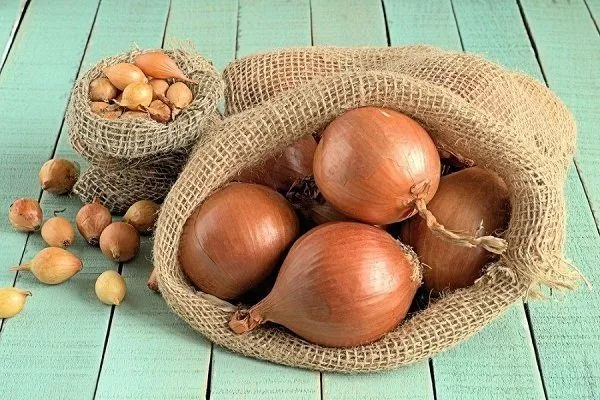
How to prepare onions for storage?
Preparatory activities include the following main steps:
- Drying root crops immediately after harvesting the bulbs from the beds.
- Cleaning the heads from residual soil.
- Cutting off feathers and neck (its height should be 4-6 cm).
- Subsequent drying of the bulbs at a temperature of +25 degrees (if it is sunny, the vegetables are laid out outside).
- Trimming roots by 2 cm.
- Removing a layer of scales.
- Inspection of each head for damage – rejection.
Today, an intensive root drying method is used to extend the shelf life of root vegetables. To achieve this, the bulbs are dried for 12 hours at a temperature of 38-40 degrees Celsius. This method simultaneously destroys pathogenic microorganisms that cause diseases.
Requirements for the drying procedure:
- Immediately after harvesting, it's best to dry the bulbs outdoors in direct sunlight. To do this, lay the bulbs flat on the ground (or place them on a cloth to allow them to breathe). If this isn't possible, move the bulbs to a warm, ventilated area. Drying time ranges from a few hours to two days.
- The second drying process is longer – 15-20 days. For this, the onions can be placed in the attic or any room with access to fresh air.
- Be sure to bend the neck so that the greens do not draw the juices from the heads.
- Root vegetables are laid out on wooden surfaces or hung with the tops facing upwards.
- If the bulbs are collected during rain, remove 1-2 layers of husk, which will allow the heads to dry faster.
- How to determine complete drying: the feathers become yellow and thin, the neck, tops and roots are completely dry.
How to store vegetables?
To store onion crops, it is necessary to select an appropriate room that must meet the following requirements:
- This can be a cellar that meets the following standards: air temperature from 0 to +4°C, humidity level of 75-85%. A ventilation system is required. The heads are hung or placed in containers. The vegetables can be sprinkled with dry sawdust, sand, chalk, dried grass, or onion skins.
- A room in a house/apartment: air temperature up to 20-22°C, humidity up to 70%. In a warm room, keep the bulbs in a dark place. Avoid direct sunlight.
Methods for storing onions:
- Wooden boxes with holes in the walls, that is, structures made from individual boards. If the container is solid, holes can be made using tools or filled with sawdust or sand.
- Plastic boxes They usually don't have holes, so they can be drilled (3 cm in diameter). Special models designed for vegetables are now available. Their advantage is that they save space, as the containers can be stacked on top of each other.
- Cardboard boxes (Banana crates, containers from household appliances, food products, etc.). The material is considered natural and breathable, but since onions require ample ventilation, you'll need to make some small holes.
- Baskets made of natural wicker – the best option, as flexible wood and wicker provide maximum ventilation. Keep in mind that baskets should be small, as the center of the bulbs will not be able to breathe. The optimal volume is 3-5 liters.
- Fabric bags (cotton, linen, burlap). They should be small in size – a maximum of 5 kg of vegetables. If you don't have such a large container, place the bulbs in large bags, but don't overfill them, and lay the bags on their sides. This will allow the bulbs to breathe.
- Old nylon tights Every woman has one. The bulbs are piled high and the structure is suspended. For better preservation, you can use another method: place one bulb in a stocking, tie a knot, place the next one, and tie it again. Continue this process until the net is full.
- Paper bags, bought in a supermarket, are well ventilated, eliminating the risk of putrefactive diseases.
- Polypropylene mesh – is another of the best options, as it provides maximum air access.
- Braiding Using feathers that don't need to be cut, and rope. There are several universal methods that not only preserve the bulbs, but also save space and create a special touch in your interior design. The simplest method braiding The technique is based on a three-strand braid of bulbs, similar to a regular braid. Take a long piece of twine, fold it in half, and make a loop into which you insert the first bulb, feather-like. Then, alternately weave in the remaining bulbs from one side to the other. The bottom row is secured with twine (by tying a knot).
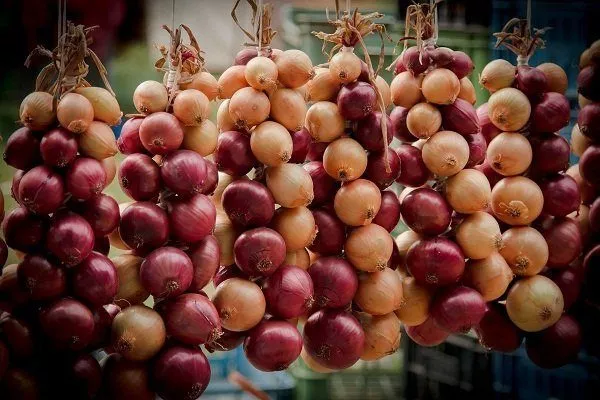
Regardless of the method you choose, you can store onions anywhere in your room, in a pantry, under your bed, on shelves, or even in the refrigerator, whole or sliced into rings:
- Place a small amount of onions on the bottom vegetable shelf of the refrigerator for use throughout the month.
- Vegetables can be stored in the freezer for a long time. Peel and chop the onions using your preferred method. Place them in plastic bags in portions and freeze.
- Powder: Cut the peeled and washed caps into rings up to 4 mm thick. Next, cut the rings into quarters and place them in a salt solution (50 g of table salt per 1 liter of water). Let sit for 5 minutes, then dry completely, then grind into a powder. Use as a seasoning and store in a glass jar.
- Rings – cut into thin rings, dry.
How to dry onions for powder and rings:
- Under direct sunlight.
- On the heating device.
- In an electric or gas oven, preheat the oven to 50 degrees Celsius, add the chopped onion, and let it dry for 6 hours.
- In the oven. First, drop the onion rings into boiling water for 2-3 minutes. Turn the oven to 70 degrees Celsius (158 degrees Fahrenheit) and dry for 2 hours. Then reduce the temperature to 40 degrees Celsius (104 degrees Fahrenheit) and continue drying until completely dry.
How to store onion sets?
The sets to be planted in the spring are prepared in advance using the standard method, but with the wild oats (small root vegetables up to 10 mm) sorted out. These elements are not fully preserved until spring planting, so they are planted for the winter or on a windowsill for greenery.
You should store the sets in the same way as regular onions, but strictly adhere to the following rules:
- For warm storage, onions are placed in a room at a temperature of up to +25°C.
- With the cold method – in a cellar, temperature – from 0 to +3°C.
- The onions are best preserved in the dark.
- Before planting, the onions are kept in a warm room for 10-12 days.
What happens if you don’t harvest on time?
Onions, like other crops, require strict adherence to harvesting timing. This is due to the following potential risks:
- The taste quality deteriorates.
- The content of useful substances decreases.
- If harvested too early, the husks don't have time to fully develop, leaving the bulbs susceptible to disease. Furthermore, the necks don't have time to dry, so they remain thick and juicy, leading to a shorter shelf life.
- Leaving the heads in the ground for too long increases the risk of rot and disease due to damp autumn weather. Excessive root growth (also due to high humidity) also reduces storage time.
Possible errors and useful recommendations
Sometimes, harvests spoil during storage due to certain mistakes. Here are some helpful tips to prevent this:
- The conditions of temperature and humidity, collection and drying of bulbs are not met.
- Onions do not tolerate sudden temperature changes, so when moving them from one environment to another, lower or raise the temperature gradually.
- The heads don't store well if there are any unripe ones among the total harvest (these should be used first). These can be identified by the thickness and juiciness of the neck.
- You cannot cut off the neck before storing under the shoulders of the bulbs - you need to leave at least 4 cm.
- When the heads are overdried, the husks crack, exposing the heads. This leads to a reduced shelf life and the development of diseases.
- Many beginners, in order to speed up the ripening of the bulbs, trim the tops completely instead of breaking them off. This is prohibited, as the bulbs also get their nutrition from the stems.
- The bulbs must not be damaged mechanically - by throwing them, tapping them to remove dirt, or using sharp objects.
- If the drying time is reduced, the vegetable is affected by fungi.
- It is not advisable to dry the heads in several layers - their inner layers of scales will not dry out.
- Onion plants should be stored separately from other vegetables.
You can also learn about the rules for storing onions in the following video:
If you've strictly followed the rules for harvesting and storing onions but haven't been able to keep the harvest for long, don't worry, as experience comes with years and practice. Be sure to consider regional climate conditions, the conditions for a particular variety, and remember the planting dates.