
Leeks – a healthy vegetable cultivated worldwide. It's prized for its pleasant, delicate flavor and appealing aroma, which can add zest to many dishes. It's best eaten fresh, but retains its qualities when frozen or canned. Therefore, it can be stored in a variety of ways.
How and when to properly harvest onions from the garden?
Leeks can only be harvested once they reach technical maturity. At this stage, the white stems contain the maximum amount of vitamins, and their flavor becomes more pronounced. Ripe specimens are best suited for long-term storage.
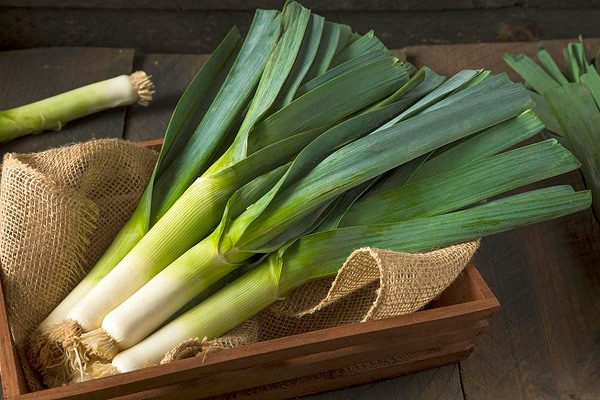
The ripening time depends on several factors:
- Varietal affiliationEarly varieties can be dug up 90-130 days after planting. Mid-season varieties – 130-150 days, late varieties – 180-200 days.
- Cultivation regionIn the central part of the country, the vegetable is harvested in mid- to late October. In the Urals and Siberia, harvesting begins in the third ten days of September. In the south, leeks can be prepared for storage in November.
- Weather. In a warm summer with little rainfall, the vegetable ripens 1-2 weeks ahead of schedule. Many cold days with prolonged rain are a reason to delay harvesting for 2-3 weeks.
Peculiarities:
- You can tell onion ripeness by its external appearance. When ripe, the leaves lose their elasticity, and the tips of the tops turn yellow. Dry scales, which are easy to remove, appear on the lower part of the stem.
- If the foliage is still green, it's too early to begin harvesting. It's best to wait, as the crop tolerates light frosts down to -3 degrees Celsius.
- If you have any doubts about the readiness of the vegetable, dig up one specimen and carefully examine the bulb and stem.
- Wateriness and the release of a large amount of juice at the cut indicate that the ripening stage is not yet complete. Don't delay harvesting too long. This root vegetable doesn't store well. A second root growth may begin.
Rules for preparing vegetables
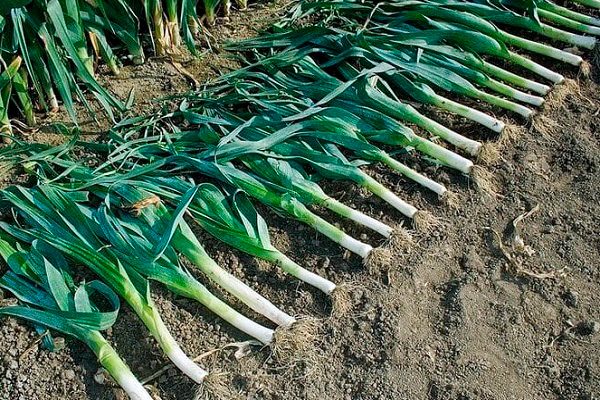
Dry, sunny weather is best for harvesting leeks. This allows for the following procedure:
- Dig up the vegetable and leave it in the garden bed to dry out.
- Spread burlap or a piece of tarpaulin on the ground and arrange the vegetables in a single layer. This will allow you to inspect the bulbs and disinfect them in the sun.
- Bring the harvest indoors in the evening. Otherwise, drying will be ineffective, as dew will form condensation that will settle on any surface.
- If the region is known for high humidity and limited sunshine, the roots are dried for 10-14 days in a well-ventilated area. This could be a shed, attic, or balcony. It's important to turn the onions daily.
Once the pre-drying stage is complete, prepare the crop for further storage. What to do:
- Trim the roots, leaving 1-1.5 cm. Work carefully so as not to damage the base.
- Cut the greens to 2/3 of their length.
- Sort: root vegetables with a stem diameter of less than 3 cm are processed. Discard any that show mechanical damage, signs of mold or rot, cracks at the base, or damaged scales.
- Remove any remaining soil with a rag or paper kitchen towels.
How to keep it fresh?
Fresh leeks offer the most nutritional benefits. If properly prepared for storage and all storage guidelines followed, they will remain edible for up to six months.
In the refrigerator
| Name | Ripening period (days) | Disease resistance | Cultivation region |
|---|---|---|---|
| Calambus | 90-130 | High | Middle zone |
| Vesta | 130-150 | Average | South |
| Bastion | 180-200 | High | Urals and Siberia |
| Tango | 130-150 | High | Middle zone |
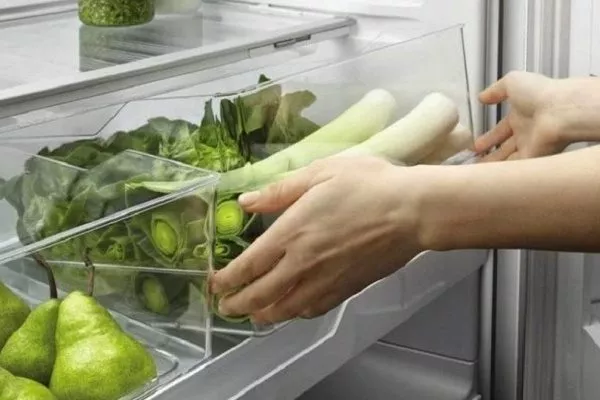
Onions store well in the refrigerator if wrapped in plastic film. Each roll should contain no more than 5 onions. Before packaging, keep the onions in the refrigerator for 3 hours. This will prevent condensation.
Before placing the vegetables in the refrigerator compartment, wash and clean them of any dirt. Store them in the dedicated vegetable compartment in the refrigerator compartment. The temperature should be between 0 and 3 degrees Celsius. Under these conditions, the shelf life will be 3-5 months.
The advantages of this storage method:
- the structure remains juicy, the meatiness does not disappear;
- reduced vapor permeability prevents the growth of microbes;
- preserving beneficial properties for a long time.
The disadvantage is that the root vegetable is large and takes up a lot of space.
On the balcony
Leeks can only be stored on the balcony if the room temperature is stable. If the temperature fluctuates significantly, the vegetable will quickly spoil, losing its flavor. A temperature range of -1 to +5 degrees Celsius is acceptable.
What you need to do:
- Pour sand into a clean container to a depth of about 5 cm.
- Place the onions next to each other.
- Cover the vegetables with thick paper.
- Cover with a blanket. This will protect the crop from freezing and help maintain humidity at the desired level.
Advantages of the method:
- long shelf life – from 3 to 5 months;
- no need to buy additional materials;
- If you don't need the whole onion, but just a part, then the trimmings can be returned to the box.
Disadvantages of the method:
- more suitable for southern regions, where even in winter the temperature remains above zero;
- On a small loggia the container will take up a lot of space.
In the basement
The ideal temperature is between -1 and +1 degrees Celsius. Store vegetables upright. This will help them maintain their shape and prevent them from rotting or becoming damaged.
Advantages of the method:
- It is convenient to get the root vegetable, just pull on the top of the trunk;
- During such storage, signs of spoilage can be immediately noticed;
- all properties are preserved for 6 months;
- many indoor placement options;
- You can arrange the entire harvest.
The disadvantages include the need to purchase containers (if you don’t have any) and the labor intensity; it takes a lot of time to pack.
- ✓ The temperature should be stable, without sudden fluctuations.
- ✓ Air humidity should not exceed 70% to avoid mold development.
There are several ways to store onions in a basement or cellar:
- In the sand. Take a shallow box or tray. Fill it with coarse river sand to a depth of about 6 cm. It should be thoroughly washed and pre-heated in the oven. Place the vegetables upright, slightly tilted, with the bottoms facing down.
The distance between the specimens is 5 cm. Add more sand on top, but this time to a thickness of 15-20 cm.

- In buckets. Add 7 cm of soil to the bottom of the washed container. Place the root vegetables vertically, 4 cm apart. Cover with 5 cm of soil. It should not dry out or be excessively wet to prevent secondary root growth. In this case, do not trim the onion tops or root parts.
- On the shelves. Place a small container with holes on top. This could be a box, cardboard, or plastic container. Lay the vegetables out in a single layer. Cover the layer with thick paper. Repeat this process until the container is full. This storage option isn't the best. The shelf life is significantly reduced, and the leeks wilt quickly.
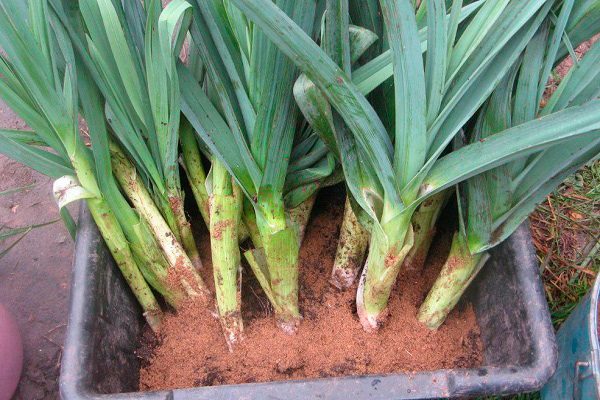
Leeks can be stored in sand in a greenhouse. To do this, dig a trench about 7 cm deep. Fill it with sand and insert the leeks, covering it with 10 cm of sand. The optimal temperature for this type of storage is 0 to 1°C (32 to 35°F). Freezing temperatures will ruin the harvest.
Alternative methods
If you grow a large amount of leeks in your garden, you won't be able to preserve the entire harvest fresh. The remaining vegetables can be dried, frozen, or preserved for the winter.
Freezing
This option allows you to enjoy this valuable vegetable for 10-12 months. Vitamin loss is 30%. Suitable temperatures range from -10 to -17 degrees Celsius.
Advantages:
- compact placement;
- long-term storage;
- You can cook in portions so you don't have to defrost large quantities to prepare meals.
Flaws:
- onions must be heat treated before consumption;
- If there are a lot of specimens, even when crushed, they take up a lot of space.
What you need to do:
- Trim the greens and the base with any remaining roots. Rinse the leeks with warm water.
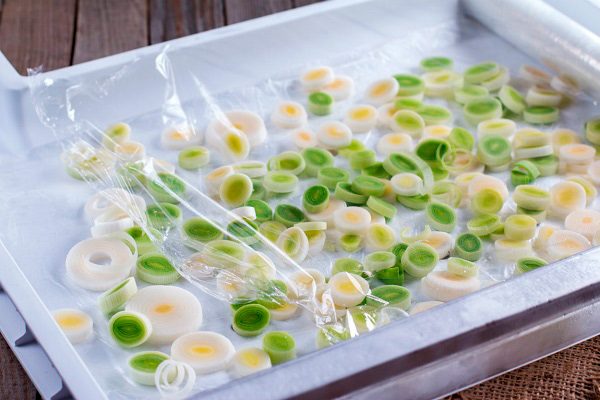
- Dry and cut the leg into rings no more than 5 mm thick.
- Place the vegetables on a cutting board and place them in the freezer.
- After 3 hours, remove and transfer to a container or food bags.
- Return to the freezer.
Choose small containers, as re-freezing significantly reduces the taste and vitamin content.
Drying
A great way to preserve leeks. Dried, they can be used as a seasoning for a variety of dishes. Benefits:
- processing at low temperatures guarantees the preservation of a large number of useful substances;
- household appliances to choose from;
- storage temperature from +21 to +25 degrees, i.e. the one established in the living area (but only on condition that the container is breathable);
- shelf life – 12 months.
The disadvantage is that it takes a lot of time to prepare.
There are several ways:
- In an electric dryer. The temperature is around 60 degrees Celsius. Allow 4 hours for the moisture to completely evaporate. Swap the trays periodically.
- In the oven. You'll need a baking sheet lined with parchment paper. The temperature shouldn't exceed 50 degrees Celsius. The baking time is 5 hours.
- Using an air grill. The fastest preparation option. It only takes 30 minutes.
You can dry onions in the open air, but it will take a long time. They can only be stored after two weeks.
It doesn’t matter which method is chosen, the algorithm of actions is the same:
- Wash the stems and let them dry.
- Chop the onion.
- Place the pieces on a tray or other surface intended for drying.
- After the drying process is complete, put the root vegetable away for storage.
The vegetable slices can be placed in a regular glass jar and sealed with a lid. Cloth or paper bags are also suitable for this purpose.
Pickling
Pickled leeks are less nutritious than fresh ones, but they have an excellent flavor. Pickled leeks are perfect for salads and cold appetizers. They have a shelf life of about 12 months.
The only drawback is the need to sterilize the jars. If you skip this procedure, the onions can only be stored at temperatures between 0 and 3 degrees Celsius. After sterilization, normal room temperature is sufficient.
Method of preparation:
- Cut 200 g of vegetables into large rings.
- Prepare the marinade. Add 10 g of salt, 20 g of sugar, and 40 g of 9% vinegar to 0.5 liters of water. Add 2 bay leaves and 5 black allspice berries to the solution.
- Place the mixture on the stove. Bring to a boil, add the onion, and simmer for 1 minute.
- Place the chopped root vegetable in a jar and pour in the marinade, then roll up the container.
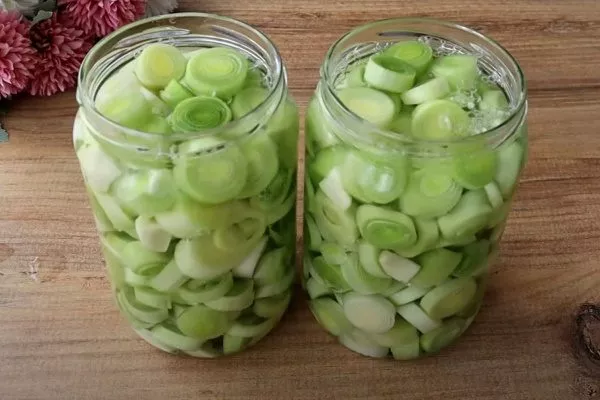
You can store the preparation in a pantry or cellar.
Pickling
The main advantage of this storage method is its simplicity; even a beginner can handle it. Other benefits:
- You can enhance the flavor with various additives: red pepper, sesame seeds, soy sauce, etc.
- can be used for cooking;
- suitable for consumption in prepared form;
- easy to store, shelf life is about 12 months.
Flaws:
- some of the beneficial properties are lost;
- the process is time-consuming.
Recipe:
- Take 1 kg of leeks and 50 g of table salt.
- Cut the vegetable into rings and place in an enamel bowl, pressing lightly with your hands.
- Season the mixture with salt and mix well. You can add your favorite spices if desired.
- Cover the slices with a lid and place a weight on them.
- Place the product in a dark place for 10 days.
- After the time has passed, place the chopped stems in clean jars and store in the refrigerator.
Helpful tips
The shelf life of leeks can be extended. To do this, follow these tips:
- Before placing the root crop in the sand, first clear the basement of debris and plant remains.
- Treat the area where the onions will be stored against fungus. Lime or copper sulfate work well.
- Wipe the storage container with a damp cloth soaked in a strong solution of potassium permanganate. Then air dry.
- Avoid placing this vegetable near potatoes and apples. The former evaporates a lot of moisture, which can lead to stem rot. Apples emit a specific gas that accelerates the rotting process.
- Only specimens of one variety can be placed in one container.
- Every two weeks, provide forced ventilation in the basement or cellar. This is necessary to avoid stagnant air and prevent the development of unpleasant odors.
- Inspect leeks regularly for wilting, darkening of scales, etc.
- Not all varieties are suitable for long-term storage. Calambus, Vesta, Bastion, and Tango have been noted to have satisfactory shelf life.
- ✓ Disease resistance must be high, as the risk of infection increases under storage conditions.
- ✓ The ripening period must allow harvesting before the onset of stable frosts.
Leeks are a vegetable with a mild, moderately pungent flavor. This valuable root vegetable is beneficial for obesity, gout, and rheumatism. These properties make it worthwhile to plant them in your garden. However, to avoid limiting its consumption to the season, it can be stored fresh, dried, or canned for several months.