
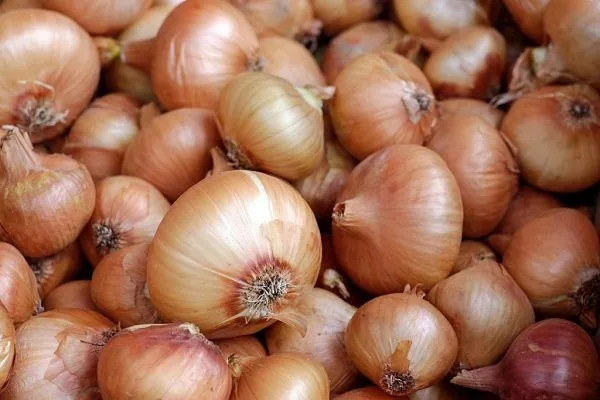
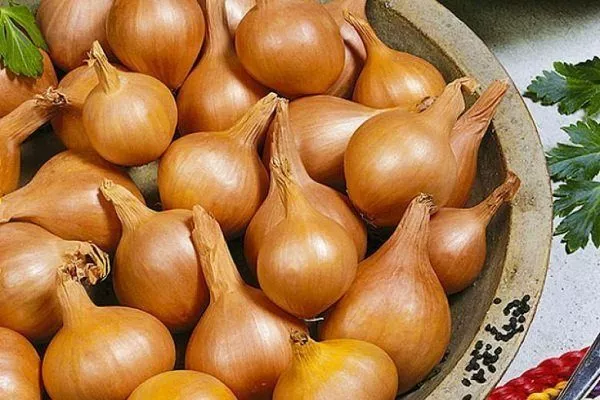
Family onions include numerous varieties, distinguished by their multi-bud type—a single bulb contains several small bulblets (up to 10). A bulb's weight ranges from 150 g to 300 g. These varieties are distinguished by their disease resistance, juiciness, mild flavor, and excellent aroma.
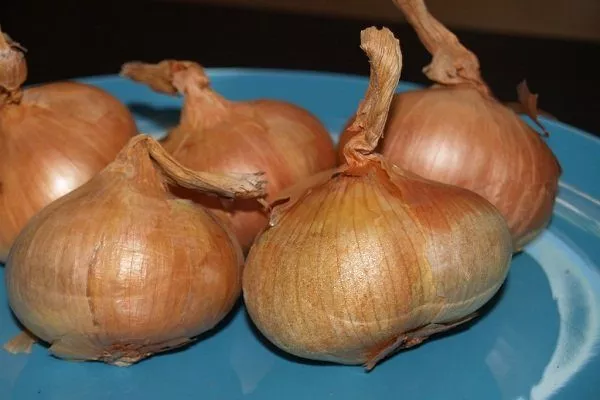
Distinctive characteristics of family onions
This family variety of onion is considered a common crop, first bred in Russia's northern regions. Breeders sought to cultivate an onion plant that could survive in harsh climates. Over many decades, scientists refined the varieties, achieving higher yields, early maturity, and long-lasting shelf life.
Characteristic features of family onions:
- the average ripening period from planting the seed to harvesting is 60-70 days;
- shelf life – 11-12 months;
- increased resistance to cold;
- preservation of taste and nutrients throughout the entire shelf life;
- possibility of planting in winter and spring;
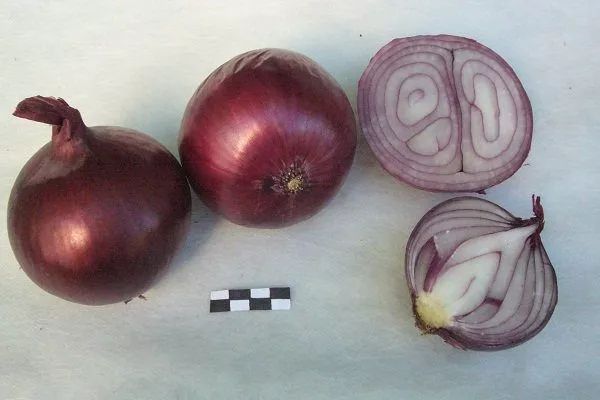
- the color of the husk is golden, brown, purple, bronze, depending on the specific variety;
- the shade of the core is usually white or pink, less often purple;
- high yield;
- lack of shooting ability;
- disease resistance;
- unpretentiousness;
- Possibility of growing for head and feather.
Family onions are used for canning, marinades, preparing first and second courses, cold appetizers, and salads.
Varieties of family onions
| Name | Ripening period | Color of the husk | Number of bulbs in a head |
|---|---|---|---|
| Ryzhik | mid-late | bright golden | up to 10 |
| Monastic | early | pinkish | 8 |
| Old Believer | average | copper-yellow | 10 |
| Prince | average | brownish pink | up to 10 |
| Veliky Ustyug | average | brownish-red | up to 10 |
| Prometheus | average | red-brown | 8 |
| Albik | early ripening | yellow | some |
| Grant | average | not specified | 12 |
| Pesandor | average | not specified | 15-20 |
- ✓ Resistance to specific diseases typical for your region.
- ✓ Requirements for soil composition and pH.
- ✓ Adaptation to daylight hours.
There are many varieties of family onions, each with its own characteristics:
- Ryzhik This is a mid-late variety. The bulbs are oblong, with snow-white flesh and bright golden scales. They have a pungent flavor, and a single bulb contains a maximum of 10 bulbs, each weighing 50-70 g.

- Monastic – an early onion, considered native to the Kostroma region. The bulbs are round-elongated, weighing up to 65-70 g, with pinkish skin and white-pink flesh. The bulbs contain eight and have a mildly pungent flavor.
- Old Believer – spicy in flavor, bred in the Vologda region. The bulb is round-oblong, copper-yellow in color, and contains 10 bulbs weighing 70-80 g each.
- Prince – a large variety with bulbs weighing 80 grams each, with up to 10 bulbs per bulb. The skin is a brownish-pink color, and the flesh is juicy and pleasantly flavored.
- Veliky Ustyug has a brown-red shirt, the number of bulbs reaches 10 units weighing 50-80 g. The taste is quite spicy.
- Prometheus It has a mild flavor and exceptional juiciness. The flesh is snow-white, the skin is reddish-brown, and the shape is round. Each bulb contains 8 bulbs weighing 70-75 g.
- Albik – an early-ripening variety with round, flat bulbs and yellow scales. This is a small onion, containing several bulbs weighing 30-50 g. A distinctive feature is that it is grown primarily for its greens.
- Grant – the largest onion with 12 bulbs. Each bulb weighs up to 200 g, has a pungent flavor, and juicy flesh.
- Pesandor – has a mild flavor and an extremely high number of heads per nest – 15-20. The flesh has a purple hue.
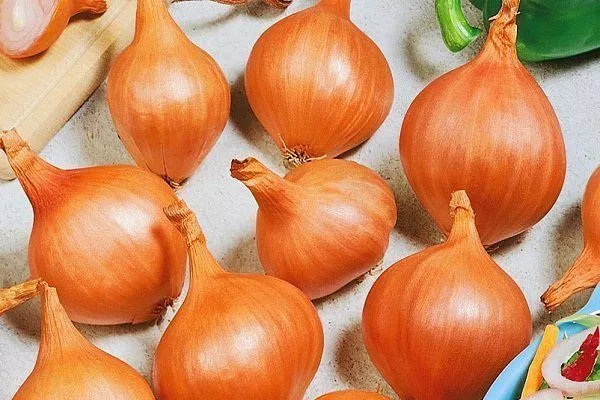
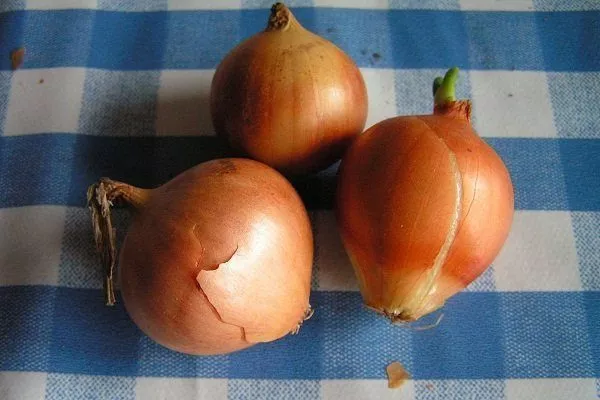
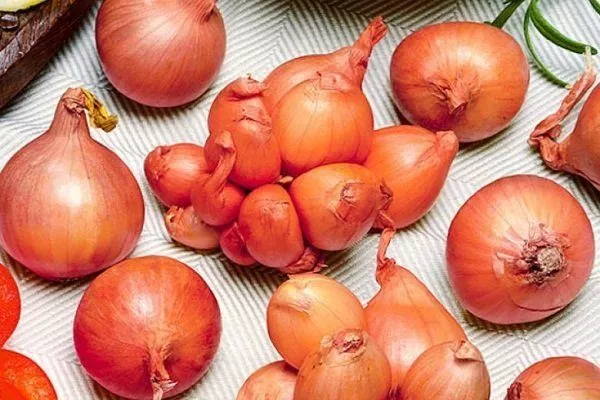
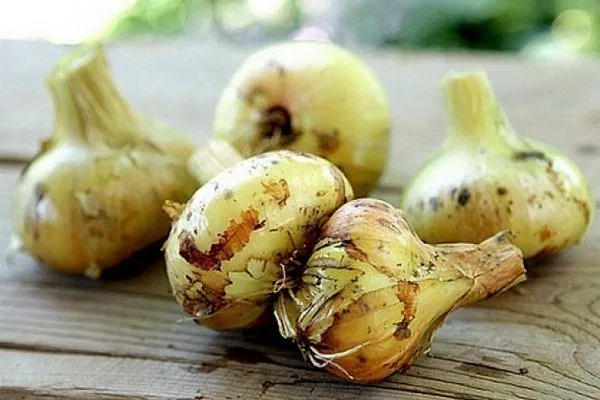
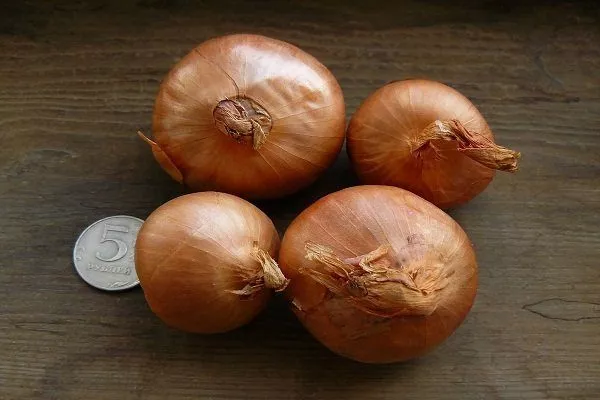
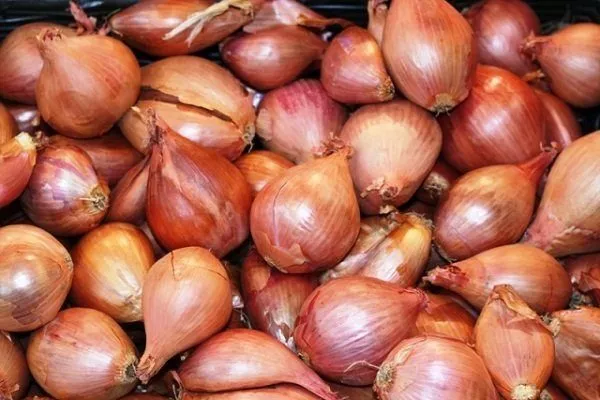
There are also other varieties that are intended for northern latitudes - Siberian yellow, Kuznechik, Krepysh, Sprint, and for southern regions - Rostov, Russian violet, Kuban yellow.
Propagation of family onions
Family onions are propagated exclusively vegetatively, as a single bulb contains several bulbs. For planting, use medium-sized bulbs, from which the smaller components are removed. This must be done carefully to avoid damaging the root system.
The variety is planted directly into open ground or a greenhouse for growing using the seedling method.
Preparing family onions for planting
Bulbous crops, like other vegetables, need to be prepared before planting, which increases yield, accelerates the process of sprouting and seedling growth.
Preparatory activities include three steps: processing the planting material, choosing a location based on crop rotation, and preparing the beds.
Preparation of seed material
Before planting the bulbs, carry out the following manipulations:
- Remove the outer layers of the husk, which can harbor pathogenic microorganisms. These microorganisms can contribute to the development of diseases, especially fungal ones.
- Treat the bulbs with a disinfectant. You can use a solution of potassium permanganate or copper sulfate. Soak them in the solution for 2-3 hours. Special disinfectants (such as Maxim) are available at the store.
- Rinse the bulbs with clean water.
- Soak the planting material in humic fertilizer, organic matter, minerals, or growth stimulants. Leave it in the solution for 10 hours.
- Place the bulbs in a large container and place it in an unheated area. Roots will grow within a few days.
- Before planting, cut off the tops of the heads to encourage seedling growth.
To learn how to prepare your family onions for planting, as well as how to protect against onion flies, watch the following video:
Preparing the beds
First, choose a sunny location away from strong winds. This should be done in the fall, as the beds are prepared immediately after the previous harvest. Since loose soil is required, the garden is dug to the depth of a spade. At the same time, apply fertilizer (at the rate per square meter):
- 15 g of potassium salt and 25 g of superphosphate.
- Humus or compost – 5 kg.
Crop rotation rules
Crop rotation is an important agricultural practice that optimizes soil utilization by replenishing missing resources naturally.
Each crop has a unique impact on the composition and structure of the soil, so different vegetables should be alternated when planting. Otherwise (if only one crop is grown in a bed), the soil will be depleted of a particular nutrient or complex of nutrients. Furthermore, pest larvae that only feed on nightshade crops, for example, can accumulate.
Onions should never be grown in the same plot every year. They can only be returned to previous plots after three years.
The best predecessors for onion family crops:
- tomatoes;
- celery;
- white cabbage, kohlrabi;
- squash, zucchini;
- potato;
- spinach, lettuce;
- pumpkin;
- eggplants.
Worst predecessors:
- garlic and onion;
- radish and horseradish;
- beans and peas;
- cucumber and dill;
- sunflower and corn;
- parsnip and parsley.
Vegetable crops are typically planted next to each other based on their beneficial effects. Heirloom onions grow well alongside cucumbers, beets, tomatoes, carrots, strawberries, spinach, and lettuce.
It is not advisable to plant onions next to kohlrabi and broccoli, turnips and dill, radishes, peas, beans, parsley, cabbage, and lettuce.
Onions can be planted directly next to desired crops or in a specific pattern. For example, plant 2-4 rows of onions, 1 row of carrots, 2-4 more rows of onions, 1 row of tomatoes, and so on.
Planting family onions
Family onions are planted according to a specific pattern depending on the type of variety, but the distance between bulbs, unlike small-bud varieties, is much greater.
This is because a single bulb contains several bulblets, which grow laterally. If this rule is not followed, the bulbs will grow small.
Planting dates
A biological characteristic of heirloom onions is that their root system develops better in cool temperatures. For example, the optimal temperature for roots is between 2 and 20 degrees Celsius, while for the green part, 15-25 degrees Celsius. During the root and bulb formation stage, onions are resistant to frosts down to -6-7 degrees Celsius, and excessive heat is also not harmful.
These parameters allow you to plant the crop at any time of year—early fall, spring, or before winter. You can sow onions at any time, but it's important to pay attention to the growing requirements for a specific variety.
Schemes
The planting depth of family onions varies from 2 to 3 cm, the distance between rows should be no less than 30 cm, and no more than 40 cm. The distance between seedlings depends on the size of the bulbs when grown:
- small varieties require 10 cm;
- medium-large – 15 cm;
- large – up to 30 cm.
The process of planting family onions in open ground
Planting family onions in open ground:
- loosen the beds by adding saltpeter (7 g of substance per 1 sq. m);
- level the surface of the ground;
- make grooves or holes according to the chosen pattern;
- water generously;
- sprinkle with wood ash;
- install bulbs;
- sprinkle with soil and compact.
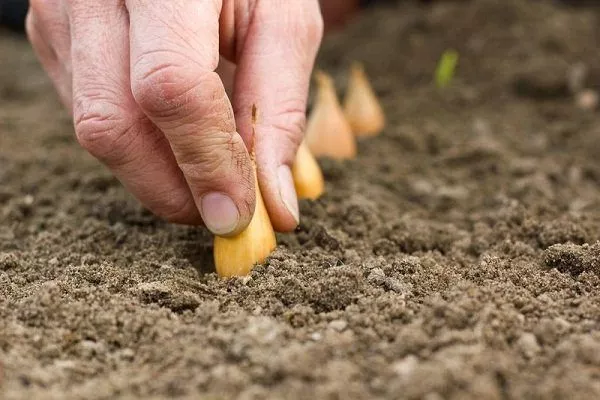
It is not recommended to water the beds after planting, but to maintain optimal moisture levels, it is advisable to mulch.
How to grow family onions using seedlings?
When planting onions outdoors, they need to be thinned out; not all the bulbs may sprout, and young shoots need to be protected from heavy rain. These problems don't arise with the seedling method.
How to sow onions for seedlings:
- process the seed material in the standard manner;
- plant the bulbs in wooden boxes, watering them generously;
- Cover with plastic film until the first shoots appear.
During the growing season, moisten the soil periodically and maintain a temperature between 14 and 25 degrees Celsius. You can fertilize once with chicken manure diluted with water at a ratio of 10:1.
Planting can be done after weather conditions have stabilized. The timing depends on the climate – seedlings are ready for transplanting in 30-50 days, depending on the variety.
The transplant process:
- water the seedlings in the box generously;
- dig up the bulbs with a tool and pull out the heads;
- trim the roots slightly - 4 cm should remain;
- pour a solution of liquid manure into the prepared hole;
- plant seedlings;
- cover with earth;
- water generously;
- lay down mulch.
After planting, loosen the soil 3 days later.
Features of winter planting
Almost all varieties of multi-germ onions are suitable for winter planting, as they tolerate frost. However, there is one requirement: a strong root system, so planting timing must be considered. Therefore, heirloom onions are planted 1.5-2 months before frost, in late September or early October.
The preparation and planting process are identical to those for spring planting. Before the onion frosts, mulch the soil. The mulch should be at least 6-8 cm deep.
How to care for family onions?
To grow a decent harvest, you need to properly care for your family onions.
Watering
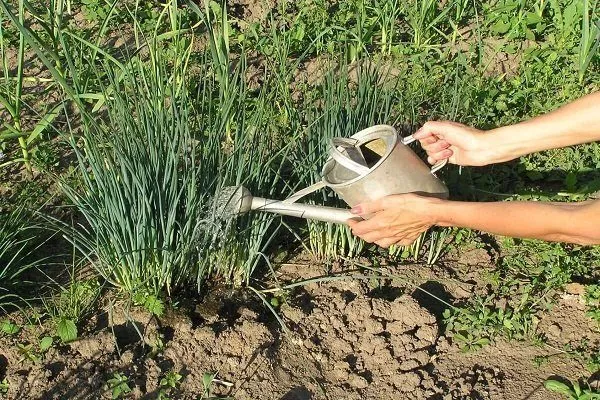
When growing onions, gardeners want to get not only the bulbs but also the green foliage. The heirloom variety, with its multiple bulbs per bulb, produces a profuse foliage. To achieve this, watering is essential. Watering begins after the seedlings have emerged and reached a height of 8 cm.
Watering rules:
- Watering once every 6-7 days is sufficient. 16-20 liters of water are required per square meter.
- Rainwater is used to moisten the soil. If this is not available, tap water can be used, but be sure to let it sit for 3-4 days.
- The water should be warm (cold water makes the plant sick and dies), so leave the liquid collected in the container in direct sunlight.
Sometimes, even with sufficient watering, the green mass turns yellow, so inexperienced gardeners increase the amount and frequency of watering. This shouldn't be done, as the cause is a mineral deficiency. To solve the problem, apply an ammonium nitrate solution or sprinkle the plants with wood ash.
Mulching
Mulching saves time, water, and effort, and prevents weed growth. The mulch retains moisture for a long time, reducing the frequency of watering. Mulch forms a dense, porous layer that is difficult for weeds to penetrate.
The procedure is carried out immediately after rain or moisture. Only natural materials are used: grass, tops of other crops, hay, straw, sawdust, and pine leaves.
Top dressing
Family onions don't require fertilization, as they are fertilized before planting. However, if you notice wilting or yellowing of the leaves, or if bulb growth has stalled, use the following:
- For 10 liters of water, take 15 g of potassium salt and 10 g of ammonium nitrate.
- Dilute chicken manure in a ratio of 1:15/20.
Loosening
Loosen the soil between rows the day after watering. Four times a season, under normal weather conditions, is sufficient.
If the summer is very dry and cracked crusts form on the soil surface, the soil will need to be loosened more frequently. Along with loosening, weeding is also necessary.
Pest and disease control
Family onions are considered disease-resistant, but under unfavorable conditions, fungal diseases most often occur. Pests also occasionally attack the plants.
How to combat the most common diseases and insects:
- If fusarium wilt occurs, which causes rot on the bulb, stop watering completely. Treat the plants with a 1% copper sulfate solution or copper oxychloride.
- For prevention, use a solution of copper sulfate - 5 g, water - 10 l, crushed laundry soap - 50 g.
- To protect against pests, the beds are sprinkled with tobacco dust and ground black pepper.
- It is useful to water the spaces between rows with a saline solution - 200 g per 10 liters.
- The onion fly, which attacks heirloom varieties, poses a particular threat. The following products are used to control it: Iskra, Inta-Vir, Mukhoed, and Zemlin.
- It is advisable to plant marigolds and carrots near the beds.
- You can boil mint and pine needles and water the beds.
Forming a bow nest
Family onion nests are formed to produce larger bulbs. This should be done starting in late June. The optimal number of bulbs for growth is 4-5.
How is the procedure performed:
- inspect the head by slightly moving the soil away from it;
- carefully separate the excess bulbs without pulling the head out of the hole and without damaging the root system;
- bury the bulbs.
Harvesting
The time to harvest heirloom onions depends on the variety, but you can also determine it yourself by observing external signs—the bulbs dry out and fall off. Harvesting should be done in favorable weather conditions. This should be done in the morning, as after harvesting, the bulbs are laid out in beds exposed to direct sunlight to dry.
- ✓ The appearance of cracks in the top layer of soil around the bulb.
- ✓ Change in the color and structure of the bulb neck – it becomes soft and thin.
During rainy weather, move the onions to a warm, ventilated area and place them on a cloth to allow air to circulate. In this case, turn the bulbs 2-3 times a day.
How to properly harvest family onions?
To ensure onions are stored for a long time, it is necessary to follow the basic rules of harvesting:
- It is prohibited to remove the heads by pulling them out by the tops;
- First you need to dig up the vegetables;
- then gently pull, holding the base (neck) with your hand;
- lightly shake off dirt without hitting each other or other objects;
- lay out to dry;
- cut off the green mass, leaving a neck of 3-4 cm;
- Dry again until completely dry indoors for several days or weeks depending on the humidity level;
- trim the roots by 1-2 cm;
- discard damaged bulbs.
Storage rules
Once you've collected and prepared your family bulbs, they're stored for long-term storage. This storage space can be an apartment (kitchen, pantry, drawers, balcony) or a cellar. The requirements for the storage location are as follows:
- At room temperature, the acceptable temperature range is 18 to 22°C, with humidity of 60-70%. Storage options include:
- in a cardboard box;
- in old nylon stockings;
- in bags made of natural fabric;
- in wicker baskets;
- in paper bags;
- in polypropylene nets;
- in the form of braids, which are woven from bulbs with untrimmed tops.
- In the basement, the temperature should be between 0 and 4 degrees Celsius, with a maximum humidity of 85%. The heads can be stored in wooden or plastic boxes filled with sand or sawdust. It's essential to drill holes to eliminate excess moisture and allow air to escape.
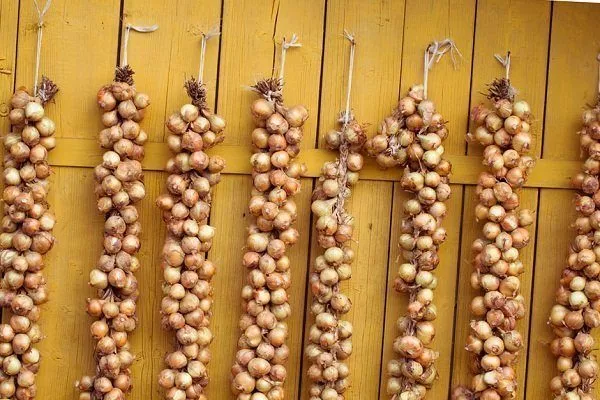
Drying family onions
If family onions are not dried thoroughly, they will be susceptible to rotting diseases, making it impossible to store them for a year.
The first time the crop is dried in the beds, and the second drying requires the following conditions to be met:
- Drying period: minimum 10 days, maximum 20 days.
- Place: attic, ventilated room, street (under a canopy).
- Method: spread on woven material and hang in a bunch.
Helpful Tips
Novice gardeners often make mistakes that prevent them from getting a good harvest of heirloom onions. To avoid this, follow these tips from experienced gardeners:
- Don't be afraid to plant multi-germ varieties in early spring - they are not afraid of frost.
- When choosing seed, keep in mind that small bulbs produce more feathers, medium bulbs produce more bulbs, and large bulbs will produce neither. This is because there will be little greenery, and the bulbs will grow small.
- If the rules for harvesting and storing crops are not followed, the planting material for the following year will be of poor quality.
- If feathers suddenly turn yellow, they're deficient in nitrogen or potassium. To resolve the issue, apply the appropriate fertilizer.
- But before applying fertilizer, inspect the plants carefully. Yellowing leaves may be due to pests such as onion flies and their larvae.
- Oddly enough, yellowing of greenery can occur when the soil is over-watered.
- If growth occurs only in the feather, it means that the onion was planted too late, when the air and soil temperature were not conducive to the growth of the root system.
- The heads do not ripen if there is an excess of nitrogen fertilizers.
- To ensure the heads grow immediately after planting, try not to water the soil at all for about 6-7 days.
Reviews
The yield and flavor of heirloom onions depend on how well they are cared for. With care and diligence, you'll harvest tasty, juicy, and nutritious vegetables. And if you harvest and store them properly, you'll have enough to last until next spring.